Description
1. Overview
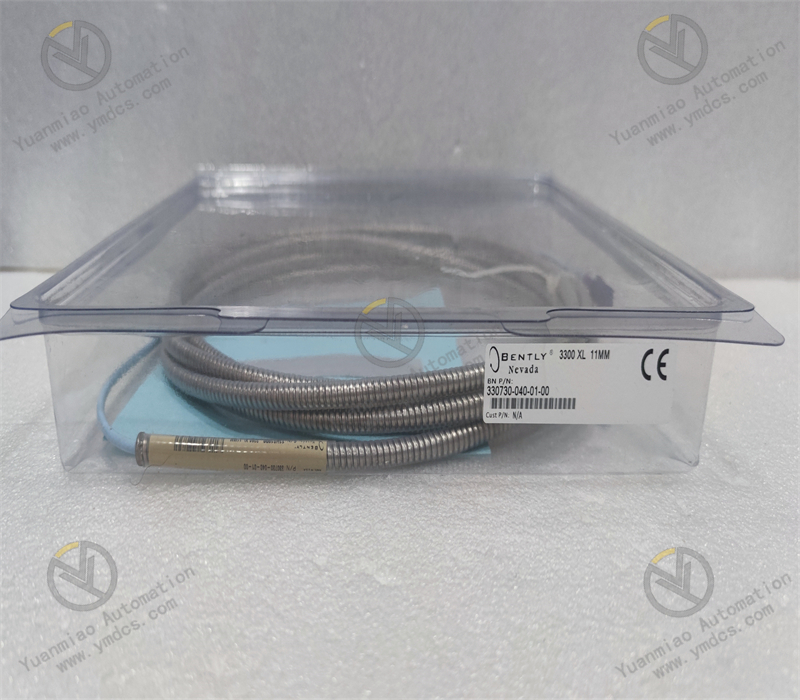
Bently Nevada 330730‑040‑01‑00 is a dedicated extension cable for the 3300 XL 11 mm eddy‑current sensor manufactured by Baker Hughes Bently Nevada. As a core accessory of the 3300 XL eddy‑current monitoring system, it is designed for 11 mm‑probe‑based eddy‑current displacement and vibration monitoring, and serves as a critical transmission unit for shaft‑vibration, shaft‑displacement and eccentricity measurement chains of large‑scale rotating machinery. This is a standard industrial long‑length cable variant, fully compatible with Bently Nevada 3500, 1900 and 1701 monitoring systems. It perfectly matches 330700‑series 11 mm probes and 330180‑series proximitors to realize long‑distance, low‑loss and highly‑stable sensor‑signal transmission.
The 330730‑040‑01‑00 extension cable adopts factory‑customized double‑shielded twisted‑pair construction with patented CableLoc cable‑locking and TipLoc connector‑forming technologies. It features low signal attenuation, strong anti‑interference performance, high tensile strength and excellent temperature‑drift stability. It addresses field‑wiring challenges including insufficient probe installation distance, long wiring spans and dispersed equipment layout. It preserves purity of high‑frequency analog eddy‑current signals and prevents monitoring distortion caused by signal attenuation, phase shift and noise interference. Widely deployed in shaft‑condition‑monitoring systems for steam turbines, centrifugal compressors, large‑sized fans, pumps and motors in thermal‑power, chemical, oil‑gas and metallurgical industries. Typical use cases include new‑unit matching, legacy‑point retrofits, replacement of aged cables and monitoring‑system capacity expansion.
2. Functions and Features
2.1 Core Functions
Low‑loss Long‑distance Signal Transmission: Standard industrial length of 12.2 m (40 ft), specifically engineered for 11 mm eddy‑current monitoring systems. Impedance parameters are fully matched between probe and proximitor to deliver stable shaft‑vibration and shaft‑displacement measurement without signal attenuation or phase distortion over long distances.
Full‑chain Signal Shielding against Interference: Double‑shielded twisted‑pair structure effectively suppresses electromagnetic crosstalk and power‑frequency interference from on‑site variable‑frequency drives, high‑voltage power cables and electrical equipment. It guarantees clean transmission of weak high‑frequency eddy‑current signals and eliminates data jitter, drift and spurious fluctuation.
Precise Native System Compatibility: Natively compatible with the 3300 XL 11 mm probe system and all Bently Nevada proximitors and rack‑mount monitor modules. Capacitance, impedance and electrical parameters strictly follow factory specifications for plug‑and‑play deployment without extra calibration, preserving linear accuracy of the complete monitoring chain.
High‑strength Mechanical Protection and Locking: Patented cable‑locking construction offers high tensile resistance against sustained vibrational pulling, repeated bending and minor on‑site mechanical shocks. It mitigates common faults such as loose connectors, broken inner conductors and shielding failure.
Stable Wide‑temperature Transmission: Designed for cyclic industrial temperature variation with ultra‑low temperature drift. Electrical parameters and transmission performance remain consistent across the full operating‑temperature range to support 7×24‑hour continuous online machinery monitoring.
Support for Standardized System Expansion & Retrofit: Uniform factory‑defined electrical and interface specifications support legacy‑cable replacement, measuring‑point relocation and new‑point capacity expansion. Measurement accuracy and system parameters stay consistent before and after modification with no compatibility deviation.
2.2 Product Characteristics
Accurate Electrical‑parameter Matching: Complies strictly with factory capacitance, impedance and line‑loss specifications of the 3300 XL 11 mm system. Electrical characteristics are perfectly matched between probe and proximitor to maintain original linear range, sensitivity and measurement accuracy of the eddy‑current monitoring chain.
Superior Electromagnetic‑interference Rejection: Double‑shield plus twisted‑pair noise‑rejection architecture suppresses heavy on‑site EMI, ground‑loop currents and power‑frequency noise. High‑SNR high‑frequency signal transmission is maintained without long‑term signal distortion.
High Mechanical Reliability: Patented CableLoc forming technology enhances tensile, bending and fatigue resistance at cable‑to‑connector junctions. Rated tensile strength reaches 330 N to withstand pulling and abrasion under continuous vibration for extended service life.
Broad Industrial‑environment Compatibility: Industrial‑grade temperature‑resistant materials tolerate high/low temperature, dust, humidity and oil contamination. Suitable for harsh on‑machine installation without additional thermal protection.
Minimal Transmission Loss and Temperature Drift: Premium low‑loss insulation and shielding materials reduce signal loss. No parameter shift occurs under varying temperature conditions; frequent recalibration is unnecessary and maintenance overhead is low.
Standardized Interfaces for Easy Maintenance: Standard waterproof locking BNC connectors ensure smooth insertion‑extraction and firm connection for fast field replacement. Uniform construction facilitates large‑scale point retrofits and standardized system maintenance.
3. Specifications
| Item | Specifications |
|---|---|
| Model | 330730‑040‑01‑00 |
| Product Type | 3300 XL 11 mm Eddy‑current Sensor Extension Cable |
| Brand & Manufacturer | Bently Nevada (Baker Hughes) |
| Compatible System | 3300 XL 11 mm Eddy‑current Monitoring System |
| Matching Probe | 330700‑series 11 mm eddy‑current probes |
| Matching Proximitor | 330180‑series dedicated proximitors |
| Total Cable Length | 12.2 m (40 ft) |
| Cable Construction | Double‑shielded twisted‑pair |
| Connector Type | Standard waterproof locking BNC |
| Rated Voltage | 300 VAC |
| Rated Current | 1 A |
| Tensile Strength | 330 N (75 lbf) |
| Operating Temperature | ‑40 ℃ ~ +121 ℃ |
| Storage Temperature | ‑40 ℃ ~ +85 ℃ |
| Ambient Humidity | 5%‑95% RH, non‑condensing |
| Process Features | CableLoc locking, TipLoc connector sealing, low loss, low temperature drift, high shielding & anti‑interference performance |
4. Operating Principle
The Bently Nevada 330730‑040‑01‑00 extension cable operates on the principle of low‑loss distortion‑free high‑frequency analog‑signal transmission. Serving as the intermediate transmission link of the 11 mm eddy‑current monitoring system, it faithfully delivers weak high‑frequency induction signals from the probe to the proximitor and guarantees measurement accuracy and stability of the overall shaft‑monitoring chain.
During equipment operation, 330700‑series 11 mm eddy‑current probes capture dynamic physical quantities such as shaft vibration, displacement and eccentricity via electromagnetic induction and convert them into weak high‑frequency analog electrical signals fed into the extension cable. Its double‑shielded twisted‑pair design cancels loop‑coupled interference through twisted‑pair balancing and blocks external electromagnetic radiation via outer shielding. Signal attenuation, phase shift and noise superposition over long‑distance runs are minimized, while amplitude, frequency and phase signatures of raw vibration and displacement signals are fully preserved.
Clean conditioned signals travel through the cable to Bently Nevada proximitors, which perform signal amplification, waveform shaping and conversion. Standard linear voltage outputs are sent to downstream 3500 / 1900 monitor modules for precise measurement, trend logging and over‑limit alarming of shaft‑vibration, shaft‑displacement, differential expansion and eccentricity.
Factory‑matched capacitance‑impedance properties together with patented locking‑sealing technology maintain electrical consistency across the transmission path. They avoid system‑level linear distortion, range offset and accuracy errors caused by mismatched generic cables. Environment‑adaptive stability sustains consistent transmission performance under fluctuating temperature, vibration and humidity for reliable long‑term shaft‑monitoring operation.
5. Application Scenarios
Shaft‑monitoring System Matching for Large‑scale Units: For 11 mm eddy‑current monitoring systems of critical primary equipment including steam turbines, centrifugal compressors and large expanders in thermal‑power, chemical and oil‑gas plants. It carries signals from measuring points for shaft‑vibration, shaft‑displacement, main‑shaft eccentricity and casing differential expansion over long distances.
Long‑distance Wiring for Dispersed‑layout Equipment: Suited for sites with distributed on‑machine measuring points, remotely‑located cabinets and long routing spans. Its 12.2‑meter length satisfies loss‑free long‑haul signal transmission and removes constraints imposed by short cables.
Legacy‑point Cable Retrofit: Replace aged, abraded and shielding‑degraded legacy extension cables to resolve symptoms such as data drift, jitter and out‑of‑tolerance readings and restore original factory measurement performance.
System Expansion and Measuring‑point Relocation: Adapt to unit technical retrofits, point relocation and new shaft‑monitoring‑point addition. Standard factory parameters ensure compatibility between old and new links with reduced commissioning work and no requirement for full system recalibration.
Harsh‑environment On‑site Cabling: Wide‑temperature tolerance, oil resistance, tensile strength and strong anti‑interference capability enable stable deployment under high‑temperature, dusty, EMI‑rich and continuously‑vibrating on‑machine conditions.
Data Transmission for High‑precision Fault Diagnosis: Preserve fidelity of high‑frequency shaft‑vibration and fine‑displacement signals. Supply clean authentic raw data for spectrum‑based diagnosis of rotor unbalance, misalignment, shaft bending, oil‑film oscillation and rub‑impact faults.
6. Common Faults and Troubleshooting
6.1 Data jitter, drift and poor stability
Root Causes: Damaged cable shielding; improper shield‑grounding; partial conductor breakage or insulation ageing induced by sustained vibration; EMI from routing alongside power / variable‑frequency cables; poor contact from loose connectors.
Solutions: Inspect cable for cuts, ageing and crush damage. Implement single‑end shield grounding and reroute cables away from heavy‑interference zones. Re‑seat and lock BNC connectors firmly. Replace extension cable if anomalies persist after corrective measures.
6.2 No measuring‑point signal; channel fault / sensor‑fault alarm
Root Causes: Complete inner‑conductor breakage; oxidized, damp or shorted BNC connectors; open‑circuit failure from repeated pulling‑bending; ground short‑circuit due to insulation breach.
Solutions: Power off and test cable continuity, insulation resistance and resistance‑to‑ground to evaluate circuit and insulation health. Clean connector oxidation and apply moisture‑proof sealing. Install brand‑new 330730‑040‑01‑00 extension cable if repair is not feasible.
6.3 Out‑of‑tolerance measurement accuracy, degraded linearity and range offset
Root Causes: Electrical‑parameter drift from long‑term high‑temperature exposure; increased signal loss from shielding degradation; high connector contact resistance; parameter mismatch caused by cable ageing.
Solutions: Cross‑check system range and sensitivity against factory specifications. Clean connectors to reduce contact resistance and re‑verify system linearity. Replace genuine factory cable if accuracy cannot be recovered and parameter offset persists.
6.4 Intermittent signal dropout and sporadic data loss
Root Causes: BNC connector loosening under equipment vibration; intermittent internal contact from bending‑fatigue cable; unstable insulation due to moisture ingress via failed connector sealing.
Solutions: Retighten connectors and apply anti‑loosening measures. Optimize cable routing to eliminate sharp bends and tensile stress. Seal connectors against dust and moisture. Replace cable when intermittent faults recur.
6.5 Frequent system alarms and false triggering
Root Causes: Noise ingress from shielding failure; ground‑loop currents caused by chaotic cabling; signal crosstalk from degraded insulation; low signal‑to‑noise ratio.
Solutions: Optimize cabling and grounding to eliminate multi‑point‑ground‑induced ground loops. Separate signal cables from power‑related interference sources. Verify shielding integrity and insulation performance. Replace cable if interference cannot be mitigated.