Description
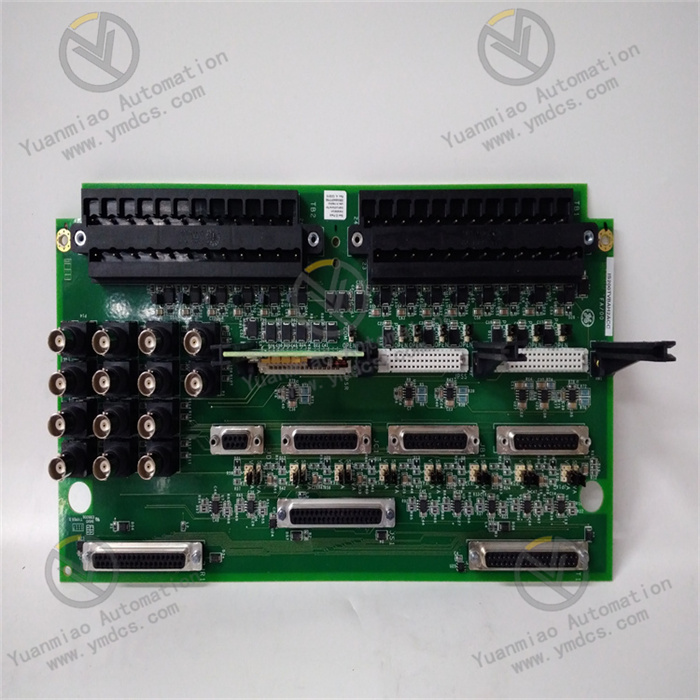
GE IS230TNSVH3A
I. Overview
The GE IS230TNSVH3A is a high-performance temperature input module, which serves as a core temperature acquisition component of the Mark VIe steam turbine control system. Specifically designed for key temperature monitoring scenarios of large rotating machinery (such as steam turbines, gas turbines, and generators) and industrial process equipment, it undertakes core tasks including accurate acquisition of Thermocouple (TC) and Resistance Temperature Detector (RTD) signals, signal conditioning, digital conversion, and fault diagnosis. As the "sensing front-end" of the temperature monitoring system, this module converts on-site temperature changes into stable digital signals through a dedicated multi-type signal processing circuit, and uploads the signals to the control system to realize real-time monitoring, abnormal early warning, and closed-loop regulation, thereby providing reliable data support for safe equipment operation, process optimization, and fault prediction.
II. Technical Parameters
| Parameter Category | Specific Specifications | Detailed Description |
|---|---|---|
| Power Supply Parameters | Operating Power Input | DC 5V DC ±5% (logic power supply, from the system backplane bus), DC 24V DC ±10% (analog power supply, independent power supply); Logic power supply fluctuation range: 4.75V~5.25V, Analog power supply fluctuation range: 21.6V~26.4V; Equipped with reverse power connection protection, overvoltage protection, and overcurrent protection functions |
| Power Consumption Indicator | Logic power consumption ≤ 3.5W; Analog power consumption ≤ 7.5W; Total power consumption under full-load operation ≤ 11W; Standby power consumption ≤ 1.8W | |
| Temperature Acquisition Parameters | Number of Input Channels | 12 differential temperature input channels, adopting single-channel independent isolation and conditioning design; each channel can be independently configured as TC or RTD input |
| Supported Sensor Types | Thermocouples: Type J/K/T/E/R/S/B/N; Resistance Temperature Detectors (RTDs): Pt100 (385Ω/℃), Pt1000 (385Ω/℃), Cu50 (42.8Ω/℃), Cu100 (42.8Ω/℃); Supports 2-wire, 3-wire, and 4-wire (for RTD) connection modes | |
| Measurement Range and Accuracy | Thermocouples: -200℃~1800℃ (depending on the type), accuracy ±0.1% FS; RTDs: -200℃~600℃, accuracy ±0.05% FS; Equipped with a 24-bit high-precision ADC chip, minimum resolution 0.01℃ | |
| Sampling Rate | Maximum sampling rate per channel: 200Hz; Total sampling rate ≥1200Hz during multi-channel polling sampling; Channel switching time ≤ 4μs | |
| Cold-Junction Compensation (for TC) | Built-in high-precision cold-junction compensation circuit, compensation range: 0℃~60℃, compensation accuracy: ±0.15℃; Supports external cold-junction compensation input | |
| Lead Resistance Compensation (for RTD) | Supports automatic lead resistance compensation for 3-wire/4-wire systems, compensation range: 0~15Ω per wire; Manual compensation setting supported for 2-wire systems | |
| Signal Processing Parameters | Filter Function | Built-in hardware RC filter (switchable cutoff frequency: 50Hz/60Hz) + programmable digital filter (adjustable filter time constant: 1ms~2000ms); Supports spike pulse suppression and signal smoothing processing |
| Isolation Level | Isolation voltage between channels ≥ 2000V AC (rms), Isolation voltage between channels and power supply/ground ≥ 3000V AC (rms), compliant with IEC 61131-2 standard and IEEE 1613 industrial standard | |
| Communication and Redundancy Parameters | Communication Interface | Communicates with the controller via the Mark VIe system backplane bus (EtherNet/IP), bus rate: 1Gbps, data transmission delay ≤ 5μs; Supports 1 RS485 debugging interface (for on-site configuration and diagnosis) |
| Redundancy Design | Supports 1+1 hot redundancy configuration; master and backup modules synchronize acquisition data, configuration parameters, and diagnostic information in real time; Redundancy switching time ≤ 30ms, no data loss during switching | |
| Environmental Parameters | Temperature and Humidity Range | Operating temperature: -10℃ ~ 70℃; Storage temperature: -40℃ ~ 85℃; Relative humidity: 5% ~ 95% (no condensation), supports humidity adaptive adjustment |
| Anti-interference and Protection | Complies with IEC 61000-4 anti-interference standard, ESD contact discharge ±10kV, air discharge ±15kV, surge immunity ±4kV, burst immunity ±2kV; Protection class IP20, suitable for installation in control cabinets, optional dust cover available | |
| Physical Parameters | Dimensions and Installation | 210mm × 170mm × 95mm (length × width × height); Installed via DIN 35mm standard guide rail or fixed with screws; Recommended module spacing ≥ 25mm to ensure heat dissipation; Weight ≤ 1.2kg |
III. Functional Features
1. Dual-Signal Type Compatibility, High Adaptability to Acquisition Scenarios
2. Ultra-High Precision Acquisition and Intelligent Compensation, High Data Reliability
3. Enhanced Anti-Interference and Redundancy Design, Adaptation to Severe Industrial Working Conditions
4. Full-Dimensional Fault Diagnosis and Intelligent Alarm, Improved Operation and Maintenance Efficiency
5. Flexible Configuration and Intelligent Operation and Maintenance, Reduced Management Costs
6. High Compatibility and Data Traceability, Facilitating Intelligent Upgrading
IV. Common Faults and Solutions
| Common Faults | Possible Causes | Solutions |
|---|---|---|
| Module fails to power on, power indicator is off | 1. System backplane bus fault (logic power supply not provided); 2. Loose connection or poor contact between the module and the backplane bus; 3. Loose wiring, short circuit, or abnormal voltage of the analog power supply; 4. Module power circuit fault (such as burned fuse) | 1. Check the output of the Mark VIe system power module to ensure normal 5V logic power supply on the backplane bus; 2. Power off, reinsert the module to ensure the bus connector is tightly plugged, and clean the oxide layer on the connector contacts; 3. Check the wiring of the 24V analog power supply, measure whether the voltage is within the range of 21.6V~26.4V, and eliminate short-circuit faults; 4. Open the module cover to check the built-in fuse; replace it with a fuse of the same specification if burned; return the module for repair if the fault persists |
| Significant deviation in acquired data (exceeding the allowable range) | 1. Incorrect sensor wiring (such as reversed positive and negative poles of TC, poor contact of 3-wire RTD wiring); 2. Incorrect configuration of channel signal type or connection mode; 3. Compensation function not enabled or incorrect compensation parameter settings; 4. Module not calibrated or expired calibration; 5. Aging, damage, or improper selection of sensors | 1. Recheck the wiring diagram and rewire; fasten the 3-wire RTD terminals and ensure correct positive and negative poles of the TC; 2. Verify the channel configuration via the configuration software to ensure consistency with the sensor type and connection mode; 3. Enable the corresponding compensation functions (TC cold-junction compensation, RTD lead compensation) and check the compensation parameters; 4. Recalibrate the channel with a standard temperature source/resistance box; 5. Replace with a qualified sensor of the same model and confirm that the sensor range matches the measurement range |
| "Sensor fault" alarm for a specific channel (no data display) | 1. Sensor open circuit, loose wiring, or poor contact; 2. Sensor short circuit (such as Adhesion of TC poles, burned RTD wire); 3. Lead resistance exceeding the compensation range (>15Ω per wire); 4. Fault in the channel signal conditioning circuit | 1. Check the sensor wiring, fasten the terminals, and use a multimeter to test the line continuity; 2. Use a multimeter to measure the sensor resistance/voltage, eliminate short-circuit faults, and replace the damaged sensor; 3. Replace with thicker shielded twisted-pair wires or shorten the transmission distance to ensure the lead resistance ≤15Ω per wire; 4. Connect the sensor to a spare channel for testing; return the module for repair if the channel fault is confirmed |
| Frequent fluctuations in acquired data (poor stability) | 1. Severe on-site electromagnetic interference (such as interference from excitation systems and frequency converters); 2. Sensor not grounded or poorly grounded (circulating current caused by multi-point grounding); 3. Excessively small filter parameter settings (insufficient anti-interference capability); 4. Poor wiring contact caused by sensor vibration or poor sensor stability | 1. Use shielded twisted-pair wires for sensor cables; ground the shield layer at one end and keep it away from high-voltage cables and interference sources; 2. Ensure single-point grounding of the sensor and module, with a grounding resistance ≤4Ω, to eliminate circulating current from multi-point grounding; 3. Increase the digital filter time constant (100~500ms recommended) or switch the hardware filter frequency to match the power grid; 4. Reinforce the wiring terminals, use anti-vibration terminals, and replace the sensor with qualified stability |
| Redundant module switching failure (master and backup data asynchrony) | 1. Loose wiring or damaged cables in the master-backup module synchronization link; 2. Inconsistent configuration parameters and firmware versions between master and backup modules; 3. Fault in the redundant communication interface; 4. Module hardware fault causing loss of synchronization signals | 1. Check the wiring of the synchronization link, fasten the terminals, and replace damaged cables; 2. Synchronize the parameters of the master and backup modules via the configuration software and upgrade the firmware to the same version (refer to the GE official compatibility list); 3. Switch the communication interfaces of the master and backup modules to test interface availability; 4. Test with a spare module; return the module for repair if the hardware fault is confirmed |