Description
Bently Nevada1900/65A-01-00-01-00-00
1. Basic Information
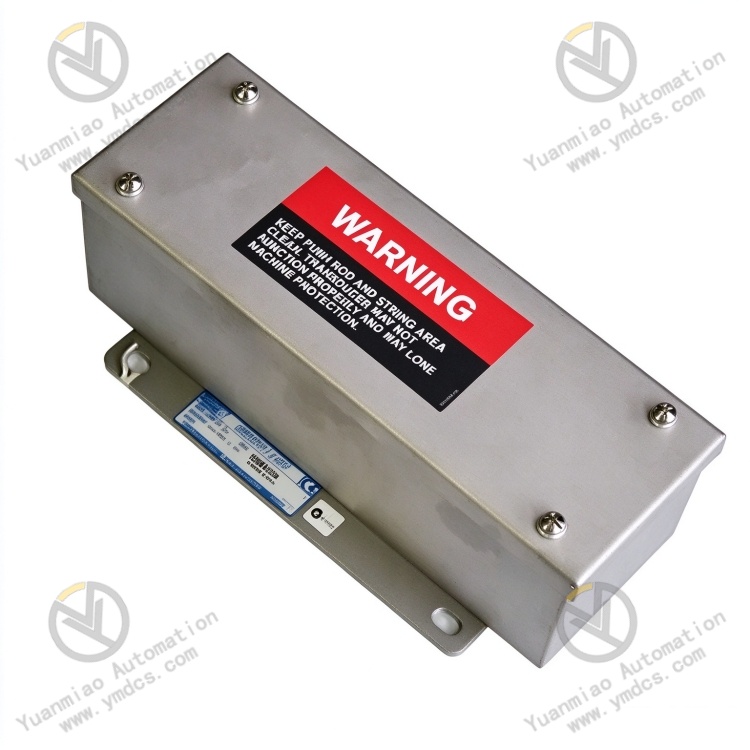
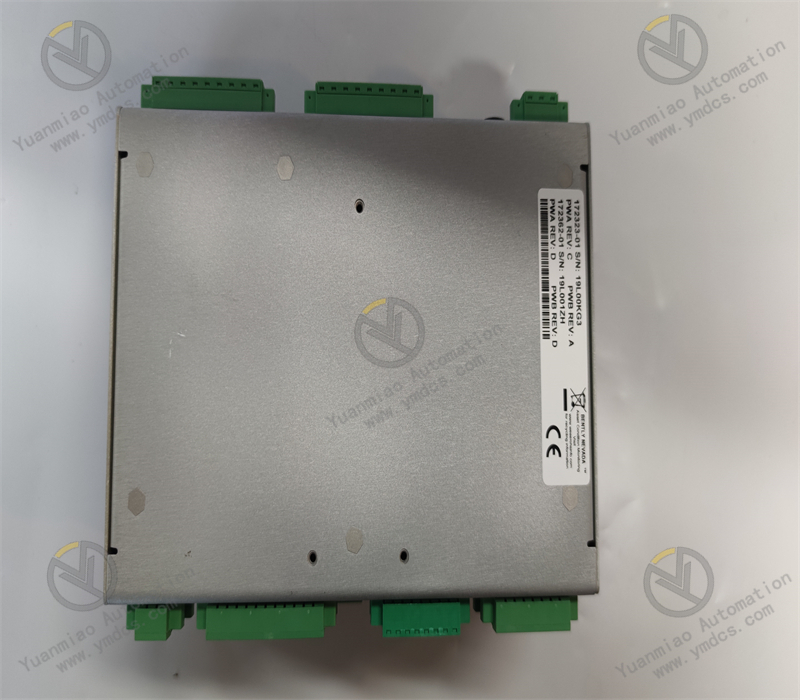
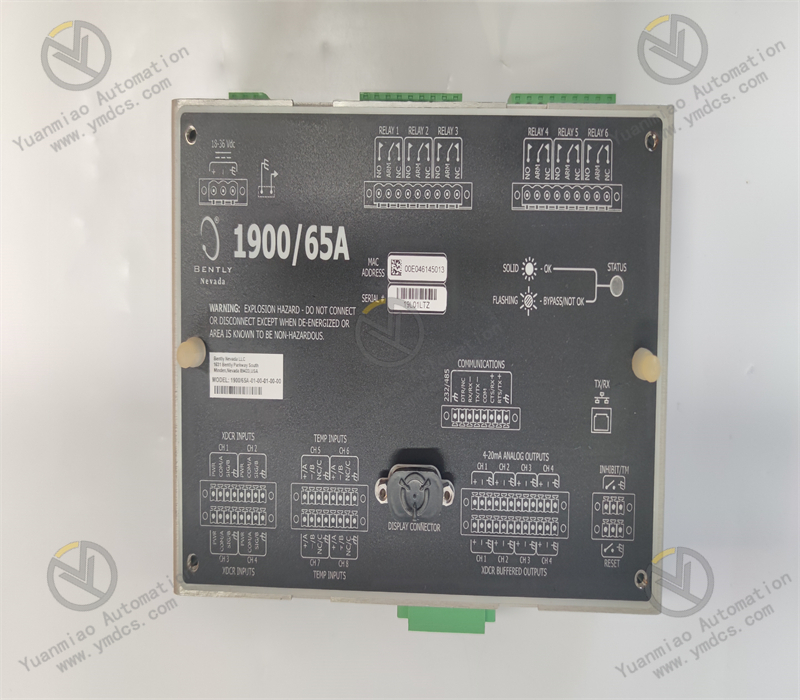
Bently Nevada 1900/65A-01-00-01-00-00 is an industrial vibration monitoring device for rotating machinery. It belongs to the general-purpose monitoring product line of the 1900 series, serving as a high-precision monitor dedicated to vibration and bearing condition monitoring of rotating equipment. It is mainly applied to real-time condition monitoring, fault early warning and equipment protection of medium and small-sized rotating machinery, providing accurate data support and reliable protection functions for safe and stable equipment operation.
Core Positioning: A general-purpose high-precision vibration monitor for rotating machinery. It independently completes vibration signal acquisition, processing, analysis and alarm output. Suitable for medium and small rotating equipment, it balances practicality and economy, delivering an integrated solution of independent monitoring plus alarm protection to effectively prevent equipment failures and cut maintenance costs.
2. Technical Specifications
2.1 General Specifications
- Brand: Bently Nevada (Affiliated to GE Group)
- Model: 1900/65A-01-00-01-00-00
- Device Type: Industrial rotating machinery vibration monitor / accelerometer, general-purpose condition monitoring unit
- Core Technology: Eddy current induction technology (compliant with API 670), enabling accurate measurement of vibration and displacement parameters
- Overall Dimensions: 140mm×100mm×60mm (L×W×H); compact design suitable for narrow installation spaces
- Weight: Approx. 450g; lightweight structure for easy installation and maintenance
- Mounting Method: DIN rail mounting or panel mounting, flexible selection with simple installation without complicated adaptation
Protection Class: IP67 (NEMA 4X); excellent dustproof, waterproof and anti-corrosion performance for harsh industrial environments
2.2 Measurement Specifications
- Monitored Parameters: Vibration (acceleration, velocity, displacement) and bearing condition; real-time detection of vibration deviation, bearing wear and other fault symptoms
- Probe Compatibility: Matches 65A series 8mm proximity probes (corresponding to "-01" configuration in model code). The probe coil generates high-frequency magnetic field to perform measurement by sensing eddy current changes on metal shaft surfaces
- Measurement Accuracy: Vibration measurement ±1.0% full scale; displacement sensitivity 7.87mV/μm, featuring low error and high data reliability
- Frequency Range: 10Hz~10kHz, covering common vibration frequency bands of medium and small rotating machinery, applicable to pumps, fans, motors and other equipment
- Measurement Formula: Output voltage (K = sensitivity 7.87mV/μm, d = gap between probe and target surface, = zero-gap voltage -10V DC)
Channel Configuration: 1 monitoring channel (corresponding to "-01" setup), supporting independent vibration and bearing condition measurement at a single measuring point and separate channel parameter configuration
2.3 Electrical Specifications
- Power Supply: Standard DC 24VDC±10%, power consumption ≤5W; "-00" in code means standard power configuration compatible with mainstream industrial power systems
- Signal Output: Supports 1~5V analog voltage output and 4~20mA analog current output, directly connectable to PLC, DCS and other host systems for data transmission
- Alarm Output: 2-channel relay alarm output (NO/NC configurable) corresponding to warning and trip levels with freely adjustable alarm thresholds
- Communication Interface: Standard RS485 interface supporting Modbus RTU protocol; "-00" stands for standard communication setup to realize remote parameter configuration and data interaction
Pre-amplifier Matching: Separately equipped pre-amplifier (e.g. 3300 XL 8mm) is required to work with probes and extension cables for signal conversion and transmission
2.4 Environmental Specifications
- Operating Temperature: -40℃ ~ +70℃, adaptable to high and low temperature industrial sites for long-term stable operation
- Storage Temperature: -40℃ ~ +85℃, convenient for equipment transportation and long-term storage
- Humidity Range: 0%~95% non-condensing, suitable for high-humidity environments without condensation damage risks
- Anti-interference Performance: Excellent electromagnetic compatibility, CMRR>60dB @50Hz, effectively suppressing on-site electromagnetic interference and avoiding signal distortion
- Environmental Resistance: Wear-resistant, oil-resistant and slightly corrosion-resistant, applicable to complex working conditions in petrochemical, metallurgical and other industries
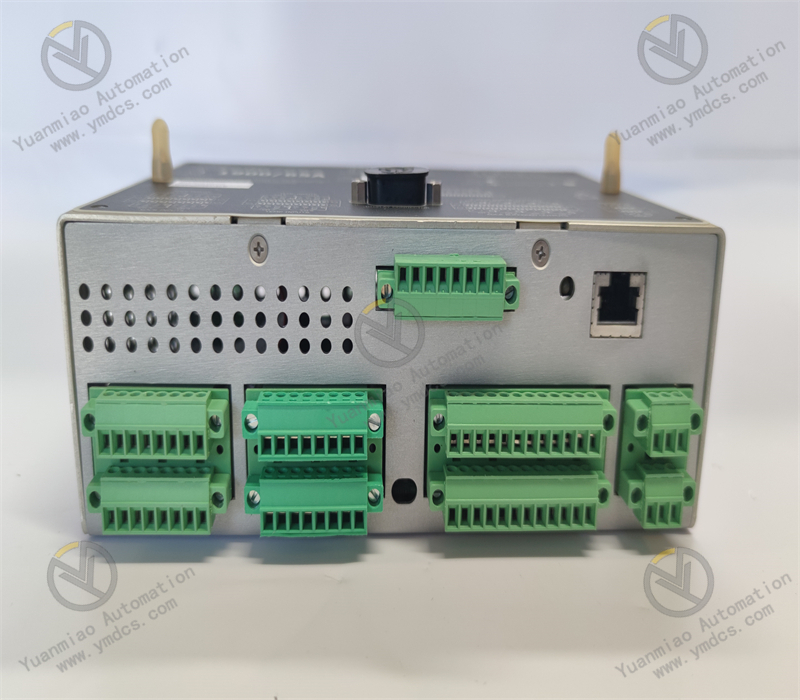
3. Hardware Structure & Design Details
3.1 Overall Structural Design
Core Structural Logic: Centered on the eddy current measurement unit, it cooperates with the signal processing unit for data acquisition and analysis. The power supply unit provides stable power input, and the interface unit realizes signal output, communication and alarm functions, while the outer shell offers full protection. All units work coordinately to guarantee accurate and reliable monitoring results. In addition, it can be matched with 65A proximity probes, extension cables and pre-amplifiers to form a complete monitoring chain covering the whole process from signal collection to data output.
3.2 Key Component Design
3.2.1 Housing & Protection Design
The housing is made of high-strength anti-corrosion engineering plastics with special surface treatment, featuring dustproof, waterproof, anti-corrosion and shockproof properties up to IP67 (NEMA 4X). It effectively resists dust, moisture, oil contamination and minor impacts on site to extend service life. The housing complies with DIN rail and panel mounting standards with reserved mounting holes for easy installation, and built-in heat dissipation holes ensure proper heat dissipation and prevent overheating failure under high temperature conditions.
3.2.2 Core Measurement Unit
Designed based on eddy current induction principle, this unit is embedded with high-precision sensing elements to accurately capture gap variations between probes and metal shafts of rotating machinery and convert them into vibration and displacement signals. Built-in signal conditioning circuits perform preliminary filtering and amplification on raw signals to eliminate interference and ensure measurement accuracy. When matched with 65A series 8mm proximity probes, the coil generates high-frequency magnetic field to induce eddy current on metal shaft surfaces. Changes in eddy current intensity alter magnetic field strength, which is then converted into DC voltage signals by the pre-amplifier and transmitted to the signal processing unit.
3.2.3 Signal Processing Unit
Equipped with advanced DSP digital signal processing technology, this unit further filters, integrates, differentiates and analyzes amplitudes of incoming signals to extract valid vibration and bearing condition data. It compares processed real-time data with preset alarm thresholds to judge equipment operating status and trigger corresponding alarms. It supports parameter configuration, allowing users to adjust alarm limits, filter parameters and output modes via communication ports or local buttons to satisfy diverse monitoring requirements of different devices.
3.2.4 Power & Interface Unit
4. Working Principle
4.1 Signal Acquisition
Install 65A proximity probes at key positions of rotating machinery such as near bearings and rotors and keep a proper gap between probes and metal shaft surfaces. Driven by the pre-amplifier, the probe coil generates high-frequency magnetic field. During equipment operation, eddy current is induced on the metal shaft surface. Eddy current intensity varies directly with the gap (vibration and displacement changes), which leads to magnetic field fluctuation and completes preliminary collection of vibration and displacement signals.
4.2 Signal Conversion & Transmission
4.3 Signal Processing & Analysis
The built-in signal processing unit receives DC voltage signals and applies DSP technology for filtering, calculus operation and amplitude analysis to eliminate industrial interference and extract valid vibration data including acceleration, velocity, displacement and bearing status. Real-time data is compared with user-defined alarm thresholds to judge equipment working conditions and accurately identify faults such as vibration unbalance, misalignment, bearing wear and mechanical looseness.
4.4 Alarm & Data Interaction
5. Application Scenarios
5.1 Petrochemical Industry
Widely used in oil refining and chemical production lines for vibration and bearing condition monitoring of centrifugal pumps, vacuum pumps, compressors and auxiliary motors of reactors. Featured with IP67 protection grade and excellent environmental adaptability, it runs stably under high temperature, high pressure, dusty and oily harsh conditions. Accurate vibration monitoring gives early warning of bearing wear, impeller unbalance and mechanical looseness, preventing medium leakage and equipment damage and ensuring production safety and efficiency.
5.2 Power Industry
Suitable for thermal power plants, hydropower stations, substations and other sites to monitor vibration conditions of auxiliary equipment including medium and small motors, fans and water pumps. As essential supporting facilities for stable power grid operation, these auxiliary devices can be supervised in real time for abnormal vibration and potential faults to avoid main system shutdown caused by auxiliary equipment failure and guarantee steady power supply. Its easy installation and remote monitoring functions also reduce routine inspection workload.
5.3 Metallurgy & Mining Industry
Applied in steel plants and mining enterprises for monitoring auxiliary mill motors, crushers, conveyor drive motors, fans and other heavy-load equipment. Such devices operate under heavy loads with fierce vibration and demand high reliability of monitoring systems. This monitor delivers high-precision measurement and strong anti-interference performance to capture subtle vibration abnormalities, pre-warn bearing failure and mechanical looseness, cut down maintenance expenses and downtime, and maintain continuous production.
5.4 General Manufacturing Industry
Applicable to automobile manufacturing, mechanical processing, papermaking, cement, food processing and other fields for condition monitoring of motors, reducers, machine tools, fans and water pumps on production lines. It operates independently without complicated system integration and perfectly meets monitoring demands of small and medium-sized enterprises. Real-time monitoring and fault early warning facilitate predictive maintenance, avoid production line halt, boost operational efficiency and reduce overall maintenance costs.
5.5 Light-duty Machinery Protection