Description
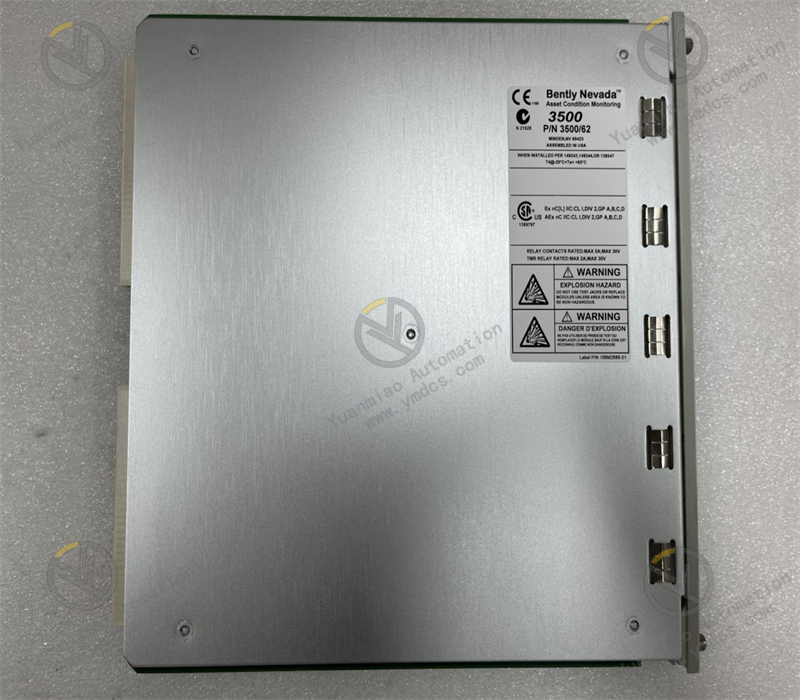
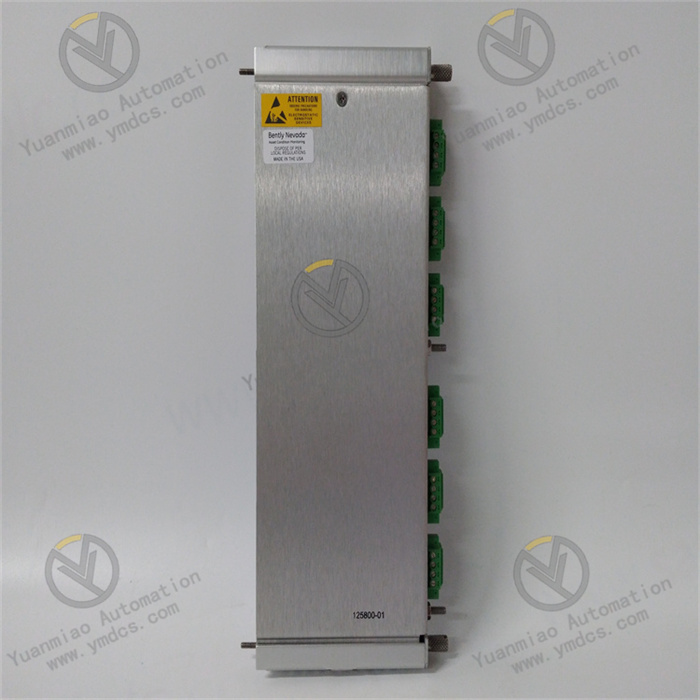
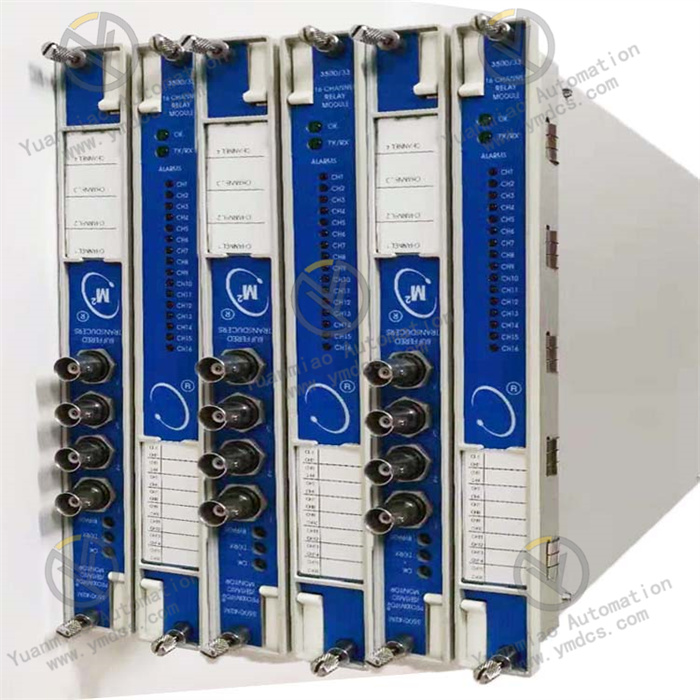
Bently Nevada 3500
The Bently Nevada 3500 Series is a modular online machinery protection and condition monitoring system, designed to provide comprehensive monitoring and protection solutions for the safe and stable operation of rotating machinery. Fully compliant with API 670 standards from the American Petroleum Institute, it features a highly modular rack‑mounted design that supports flexible configuration of various functional modules. It enables continuous online monitoring of key parameters of rotating machinery such as steam turbines, compressors, generators, and fans, including vibration, displacement, speed, and temperature. Equipped with alarm interlocking, data uploading, and remote diagnostics, it is suitable for harsh industrial environments including power generation, petrochemical, and metallurgical applications. As a core system for condition monitoring and fault prevention of rotating machinery in industry, it is manufactured in the USA and renowned for high reliability, flexibility, and compatibility.
1 System Overview and Value
1.1 System Positioning
The Bently Nevada 3500 Series is a full‑featured online monitoring and protection system for industrial rotating machinery. Unlike standalone monitoring modules, it uses a standardized rack as a carrier and integrates components such as sensor systems, monitoring modules, power supply modules, and communication modules to form a complete monitoring and protection closed loop. It not only monitors equipment operating status in real time but also triggers timely alarms and interlock protection when abnormalities occur, preventing equipment damage or production interruptions, while providing accurate data support for predictive maintenance of equipment.
1.2 Core Values
- Equipment safety assurance: Monitors key parameters of rotating machinery in real time, identifies abnormal conditions promptly, triggers hierarchical alarms and interlocks, and prevents serious equipment failures.
- Improved O&M efficiency: Modular design simplifies installation, commissioning, and maintenance; supports remote diagnostics and configuration, reducing on-site operation and maintenance workload.
- Lower operating costs: Identifies potential equipment issues in advance through predictive maintenance, reduces unplanned downtime, and extends service life.
- Industry standard compliance: Fully meets API 670 requirements and satisfies strict monitoring specifications in power, petrochemical, and other industries.
2 System Composition and Architecture
The 3500 Series features a highly modular design. Its core components include sensor systems, racks, functional modules, and supporting software, which work together to form a complete monitoring chain as detailed below.
2.1 Core Components
- Sensor system: Consists of eddy current sensor probes, extension cables, and proximitors, serving as the data acquisition source of the system. Probes are installed on field equipment to measure bearing vibration, displacement, speed, and other parameters; extension cables connect probes and proximitors to transmit raw signals; proximitors convert probe signals into voltage signals acceptable to monitoring modules for preliminary signal conditioning and conversion.
- Rack: The physical mounting platform of the system, available in full‑size and mini‑rack versions. The full‑size rack conforms to the 19‑inch EIA standard with 14 monitoring module slots and reserved positions on the left for power supply and rack interface modules. The mini‑rack is 12 inches wide with 7 monitoring module slots, suitable for space‑limited installations. Both racks support cabinet embedded installation and integrate a backplane bus for data transmission between modules.
- Required functional modules:
- Power supply module (e.g., 3500/15): Provides stable power for the entire system, supports AC or DC input, and can be configured with 1–2 units for redundant power supply to ensure uninterrupted operation.
- Rack Interface Module (e.g., 3500/20, 3500/22M): The core data integration module of the system that receives measurement data and status information from all monitoring modules for aggregation and forwarding. The 3500/22M is a transient data interface module supporting transient data acquisition and analysis.
- Monitoring module (e.g., 3500/40M vibration module, 3500/50 speed module): Receives signals from the sensor system, performs real‑time processing, analysis, and monitoring of parameters such as vibration, displacement, and speed, and triggers local alarms; serves as the core monitoring unit of the system.
- Optional functional modules:
- Keyphasor module (e.g., 3500/25): Acquires keyphasor signals of rotating machinery, assists in analyzing vibration phase, and enables accurate fault location; 1–2 units can be configured.
- Communication module (e.g., 3500/92): Enables data interoperability between the system and upper‑level control systems (DCS, PLC, SCADA), supports standard protocols such as Modbus, and provides dual Ethernet redundancy for stable data transmission.
- Display module (e.g., 3500/94): Connects to an external monitor via a VGA interface to synchronously display all monitoring data and alarm statuses of the system for quick on‑site viewing.
- Diagnostic access panel (e.g., 3500/08): Integrates buffered output signals from monitoring modules and provides a centralized diagnostic interface for on‑site engineers to perform signal testing and troubleshooting.
- Relay module (e.g., 3500/32, 3500/34 TMR): Receives system alarm signals and triggers external interlock actions for emergency shutdown protection, ensuring personnel and equipment safety.
- Supporting software: Includes 3500 Rack Configuration Software and condition monitoring software (e.g., System 1). The former is used for system parameter configuration, module setup, and commissioning; the latter for data storage, trend analysis, fault diagnosis, and remote access, serving as core tools for system operation and data analysis.
- Optional accessories: Include intrinsic safety barriers, galvanic isolators (for hazardous area installation), signal transition cables, identification labels, etc., configured flexibly according to on‑site installation environments and requirements.
2.2 System Architecture
The 3500 Series features a clear architecture forming a complete “acquisition‑processing‑transmission‑display‑protection” closed loop, with the following signal chain:
Sensor system (probe + extension cable + proximator) acquires key parameters of rotating machinery → Monitoring module receives and processes signals, completes parameter analysis and alarm judgment → Rack Interface Module aggregates data from all modules → Data is uploaded to upper‑level control systems via the communication module, while local visualization is realized through the display module. When parameters exceed alarm thresholds, the relay module triggers interlock protection. Engineers can perform fault diagnosis and commissioning via the diagnostic access panel or remote software. The rack backplane bus runs through the entire system, enabling high‑speed data interaction between components.
3 Functions and Technical Features
3.1 Comprehensive Monitoring Capabilities
Supports continuous online monitoring of core operating parameters of rotating machinery, including radial and axial vibration, shaft displacement and differential expansion, speed, temperature, keyphasor phase, etc. It adapts to various types of rotating machinery with high monitoring accuracy and timely data refresh, accurately capturing equipment operating anomalies and providing reliable evidence for fault diagnosis.
3.2 High Modularity and Flexibility
The system adopts a modular design. All functional modules support front‑installation and hot‑swapping (in accordance with standard procedures). Module types and quantities can be flexibly configured based to on‑site monitoring needs, allowing system upgrade and expansion without rack replacement. The combination of full‑size and mini‑racks adapts to different installation space requirements, enhancing system applicability.
3.3 High Reliability and Redundant Design
Core components are industrial‑grade designed for harsh environments, featuring wide temperature operation, strong anti‑interference, and corrosion resistance. The system supports power redundancy and network redundancy (dual Ethernet ports on communication modules); it automatically switches upon single component failure to ensure uninterrupted monitoring. With a long MTBF (Mean Time Between Failures), it meets 7×24 continuous operation requirements. Racks are available with NEMA 4 and 4X waterproof enclosures for harsh environments. When internal safety barriers are used, rack depth increases by 74 mm (3 inches).
3.4 Complete Alarm and Interlock Protection
Supports multi‑level alarm settings (warning, danger) with flexible alarm logic based on parameter thresholds. Equipped with relay modules, it can quickly trigger interlock shutdown during severe equipment abnormalities to prevent fault escalation. It also records alarm events and parameter trends to support fault traceability.
3.5 Convenient Diagnostics and Maintenance
Supports local and remote diagnostics. Engineers can quickly obtain buffered output signals via the diagnostic access panel for on‑site testing and troubleshooting. System configuration, parameter adjustment, data download, and trend analysis can be completed remotely using configuration and condition monitoring software, reducing on‑site workload. Clear module status indicators facilitate rapid identification of abnormal operation.
3.6 Strong Compatibility and Standardization
Fully compliant with the 19‑inch EIA industrial standard, with standardized rack and module interfaces compatible with universal industrial cabinets worldwide. Communication modules support Modbus TCP/IP, Modbus RTU, and other standard protocols, enabling direct connection to mainstream DCS/PLC systems such as Honeywell, Siemens, and ABB. Exclusively compatible with Bently Nevada 3500 Series components to ensure stable operation and compatibility; not compatible with other Bently Nevada series (e.g., 1300, 2300 Series) or third‑party components.
4 Technical Specifications (Series General)
| Category | Specification Details |
|---|---|
| System Identification | Series: Bently Nevada 3500; Manufacturer: Bently Nevada (USA); Country of Origin: USA; Compliant Standard: API 670; Application: Online monitoring and protection of rotating machinery; Warranty: New original components typically include 12‑month warranty |
| Rack Specifications | • Full‑size rack: 19‑inch EIA standard, 14 monitoring module slots, depth 349 mm (13.75 in), supports cabinet embedded, panel cutout, and wall‑mount installation• Mini‑rack: 12 inches wide, 7 monitoring module slots, supports panel cutout installation, adaptable to 19‑inch cabinets via adapter plate, not wall‑mountable• Note: Rack depth increases by 74 mm (3 in) with internal safety barriers; wall‑mount rack depth is 267 mm (10.5 in) |
| Environmental Rating | • Operating temperature: 0°C ~ 60°C (industrial grade)• Humidity: 5% ~ 95% (non‑condensing)• Immunity: Complies with industrial EMC standards, resists on‑site interference such as electromagnetic interference, dust, and humidity• Protection: Optional NEMA 4, 4X waterproof enclosures for harsh environments |
| Power Parameters | • Power module: 3500/15 series, supports AC or DC input• Power supply mode: Configurable with 1–2 power modules for redundant supply• Module power consumption: Varies by module (e.g., communication module approx. 5.0–5.6 W, diagnostic access panel has no independent power consumption) |
| Communication Parameters | • Communication module: 3500/92 series, dual 10/100M RJ45 Ethernet ports, supports Modbus TCP/IP and Bently proprietary protocol; RS‑232/422/485 serial port supporting Modbus RTU• Data transmission: High‑speed backplane bus with millisecond‑level data refresh• Remote access: Supports remote configuration, diagnostics, and data download via Ethernet |
| Compatibility | • Component compatibility: All 3500 Series functional modules, sensor systems, and supporting software• Rack compatibility: Full‑size and mini‑racks combinable as needed• Upper system compatibility: Mainstream DCS, PLC, SCADA systems• Incompatibility: Other Bently Nevada series modules, third‑party components and racks |
5 Application Scenarios
- Power industry: Steam turbines, generators, hydraulic turbines, etc., in thermal and nuclear power plants. Monitors shaft vibration, shaft displacement, speed, differential expansion, and other parameters to ensure safe and stable unit operation, avoid unplanned downtime, and maintain continuous power supply.
- Petrochemical industry: Compressors, pumps, fans, etc., in refineries and natural gas processing plants. Monitors vibration, pressure, temperature, and other parameters, supports installation in hazardous areas, ensures continuous and stable production, and prevents interruptions caused by equipment failures.
- Metallurgy and manufacturing: Large fans, rolling mills, turbines, hydraulic systems, etc. Enables predictive maintenance through comprehensive equipment condition monitoring, reduces equipment wear, and improves production efficiency.
- Other industrial scenarios: Rotating machinery in paper, mining, cement, and other fields. Adapts to various harsh environments, provides accurate data support for equipment maintenance, and ensures long‑term stable operation.