Description
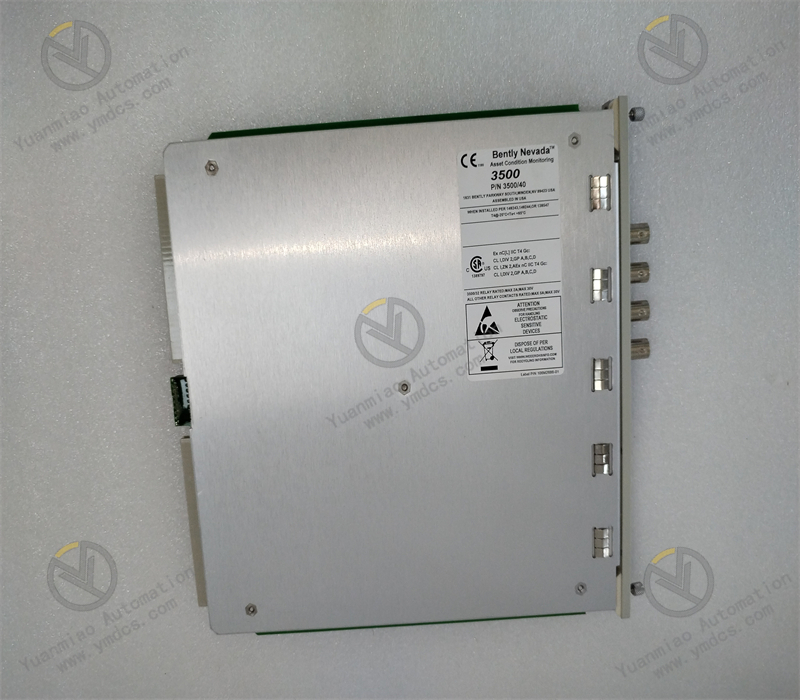
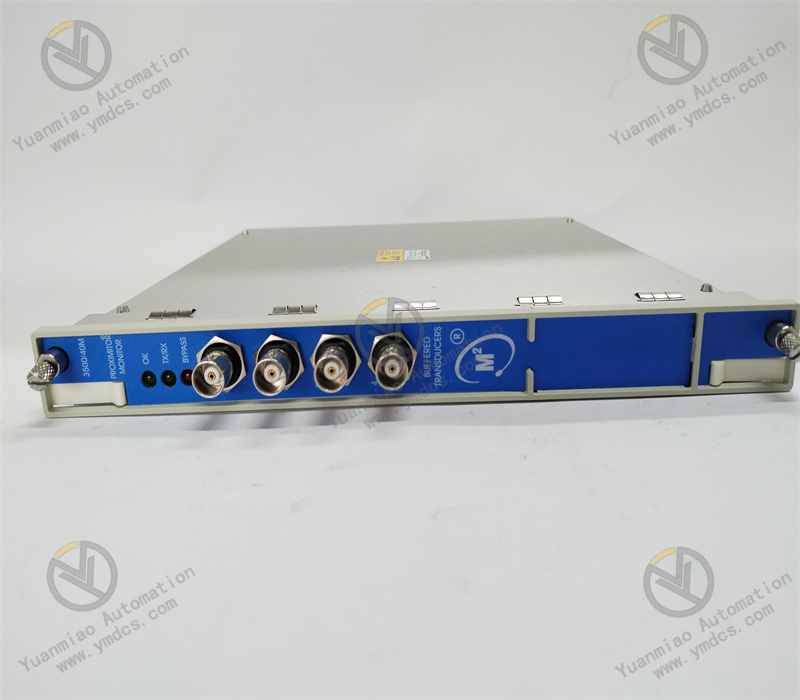
Bently Nevada 3500/40M 140734-01
I. Basic Information
Bently Nevada 3500/40M 140734-01 is a high-performance four-channel displacement monitor, positioned as a critical protection and condition monitoring solution for large rotating machinery. It is specially designed for vibration and displacement monitoring of industrial equipment, primarily used to receive input signals from Bently Nevada proximity sensors. After signal conditioning, it provides various vibration and position measurement data, and compares them with user-programmable alarm thresholds to implement equipment protection and status early warning, providing core technical support for the safe and stable operation of large rotating machinery such as gas turbines and steam turbines.
As a core monitoring module of the 3500 Series, the Bently Nevada 3500/40M 140734-01 features independent four-channel configuration, enabling flexible implementation of multiple monitoring functions including radial vibration, eccentricity, REBAM, axial displacement, and differential expansion. It is compact and highly integrated, allowing direct installation into 3500 Series system chassis without excessive additional space. It is highly compatible with 3500 Series chassis, software, and other monitoring modules, and is widely used in oil & gas, power generation, metallurgy, and other industries, serving as a key component of critical protection systems for large rotating machinery.
II. Technical Specifications
- Signal Acquisition Specifications: Four-channel monitoring module capable of accepting 1 to 4 channels of input signals from Bently Nevada proximity sensors, supporting multiple monitoring functions such as radial vibration, eccentricity, REBAM, axial displacement, and differential expansion. Standard I/O input impedance is 10kΩ (for proximity sensor and acceleration inputs), and the effective impedance of TMR I/O three-channel parallel connection is 50kΩ. Sensor power supply is -24VDC. Each channel is equipped with a coaxial connector with short-circuit protection, and output impedance is 550Ω.
- Signal Conditioning Parameters: Provides high-precision signal conditioning, including filtering, amplification, and calibration of proximity sensor input signals. Sensitivity is configurable: 3.94mV/μm (100mV/mil) or 7.87mV/μm (200mV/mil) for radial vibration, axial displacement, and eccentricity; 0.394mV/μm (10mV/mil) or 0.787mV/μm (20mV/mil) for differential expansion; 40mV/μm (1000mV/mil) or 80mV/μm (2000mV/mil) for REBAM. Frequency response is user-programmable. Direct filter is single-pole 4Hz to 4000Hz or 1Hz to 600Hz. Gap filter -3dB point is 0.09Hz, with 60Hz notch filtering (Not 1X filter) to ensure signal quality and monitoring accuracy. All parameters are calibrated at +25℃ (+77℉).
- Communication Characteristics: Enables seamless communication with other modules in the 3500 Series chassis, with the TX/RX indicator on the panel visually displaying communication status. Supports parameter programming and configuration via 3500 Rack Configuration Software without additional external modules or wiring. Data exchange with System 1 software can be achieved via a single Ethernet cable through the Ethernet port of the 3500/22M Transient Data Interface module. It can also connect to plant control and automation systems by adding communication gateway modules, supporting multiple communication protocols. Multiple gateways can be configured for communication redundancy or to meet system requirements of different protocols.
- Power Supply: Typical power consumption is 7.7 watts, compatible with the unified power supply of the 3500 Series system chassis. It features stable power input and good voltage adaptability, tolerating common voltage fluctuations in industrial sites to ensure continuous and stable operation of the monitor. No complicated independent power supply configuration is required, reducing system integration difficulty and cost.
- Environmental Parameters: Industrial-grade protective design delivers excellent anti-electromagnetic interference and anti-vibration performance, complying with relevant industrial EMC standards. The operating temperature range adapts to harsh industrial environments, enabling stable operation under extreme high and low temperature conditions. Humidity range is 5%~95% (non-condensing). It is suitable for complex scenarios such as marine, offshore platforms, and hazardous areas, meeting monitoring requirements of various industrial environments.
- Compatibility: Highly compatible with Bently Nevada proximity sensors and can flexibly connect to various applicable proximity sensors. Fully compatible with all 3500 Series system chassis, power modules, other monitoring modules, and 3500 Rack Configuration Software, allowing seamless integration into the 3500 Series monitoring system. Supports connection with System 1 condition monitoring and diagnostic software, and is adaptable to various plant control and automation systems with high integration flexibility.
- Physical Specifications: Compact size, approximately 4cm × 4cm × 9.2cm, weighing about 0.3kg. Constructed with industrial-grade high-quality components and a rugged structure. The panel is equipped with LED indicators for intuitive operation status display. Designed for installation in 3500 Series system chassis, it requires no extra maintenance under normal operation, has a long service life, and supports rapid on-site maintenance and module replacement for convenient operation by maintenance personnel.
III. Functional Features
- Flexible Four-Channel Monitoring and Signal Conditioning: Features independent four-channel configuration, accepting 1 to 4 channels of proximity sensor input signals and supporting radial vibration, eccentricity, REBAM, axial displacement, differential expansion, and other functions. Channel functions can be flexibly programmed according to actual monitoring requirements. Channels can be programmed in pairs: Channels 1–2 can perform one function, while Channels 3–4 can perform the same or different functions, fully covering key parameter monitoring needs of large rotating machinery.
- High-Precision Measurement and Reliable Alarm: Adopts high-precision signal conditioning technology with configurable sensitivity and user-programmable frequency response, accurately capturing subtle changes in equipment vibration, displacement, and other parameters to ensure measurement accuracy. Supports user-programmable alarm functions, allowing alarm thresholds for each valid static measurement and danger thresholds for any two valid static measurements. Real-time comparison with monitoring data triggers timely alarm signals for equipment protection and fault early warning, preventing equipment damage and production interruptions.
- High Compatibility and Easy System Integration: Highly compatible with Bently Nevada proximity sensors, 3500 Series system chassis, and related modules, enabling seamless integration into 3500 Series monitoring systems without additional modification or adaptation. Supports connection with System 1 diagnostic software and plant control automation systems without bulky external modules or extra wiring. Data exchange is realized via Ethernet ports or communication gateways, reducing integration difficulty and improving efficiency.
- Industrial-Grade High Reliability and Fault Tolerance: Built with industrial-grade high-quality components and a rugged structure, providing excellent anti-EMI and anti-vibration performance for long-term stable operation in complex industrial environments. Comprehensive self-test and fault-tolerant design ensure extremely high reliability even in simplex mode, reducing protection failure caused by monitor faults and meeting the 24/7 continuous monitoring demands of large rotating machinery.
- Convenient Operation and Maintenance: The panel is equipped with OK, TX/RX, Bypass, and other LED indicators to intuitively display operating status, communication status, and bypass mode for real-time equipment condition checking. Compact and lightweight, it supports rapid on-site maintenance and module replacement. Parameter programming and configuration can be performed remotely via 3500 Rack Configuration Software without complicated on-site debugging, lowering operation and maintenance costs.
- Flexible Configuration and Adaptability: Supports user software programming of channel functions, sensitivity, frequency response, alarm thresholds, and other parameters, which can be flexibly adjusted according to different equipment and monitoring scenarios. It adapts to the monitoring requirements of various large rotating machinery such as gas turbines, steam turbines, and reciprocating compressors, offering strong application flexibility.
IV. Application Areas
- Oil and Gas Industry: Used in key rotating equipment such as gas turbines, compressors, and pumps on offshore drilling platforms and in petroleum refineries. Adapts to complex working conditions including offshore and hazardous areas. By monitoring radial vibration, axial displacement, and other parameters, it detects potential faults in a timely manner for equipment protection and early warning, ensuring continuous operation of oil and gas extraction, transmission, and refining processes while complying with stringent safety and compliance requirements in the industry.
- Power Industry: Widely applied to large rotating machinery such as steam turbines and generator sets in thermal power, hydropower, new energy, and other power plants. Through high-precision displacement and vibration monitoring, it tracks equipment operating status in real time and provides early fault warning, avoiding power supply interruptions caused by equipment failures and ensuring safe and continuous power generation, meeting the high reliability requirements of the power industry.
- Heavy Industry: Deployed in large rotating equipment in heavy industrial scenarios such as metallurgy, mining, and cement production, including centrifugal fans, crushers, rolling mills, etc. Adapting to complex industrial conditions, it continuously monitors vibration and displacement parameters to identify potential faults such as equipment wear, unbalance, and looseness in a timely manner, reducing downtime and improving production efficiency and operational safety.
- Marine Engineering: Suitable for ship propulsion systems and key rotating equipment on offshore platforms. Certified by DNV and NK classification societies, it operates stably in complex marine environments. By monitoring equipment displacement and vibration status, it safeguards the safe operation of marine engineering equipment and prevents offshore operation interruptions caused by equipment failures.