Description
1. Overview
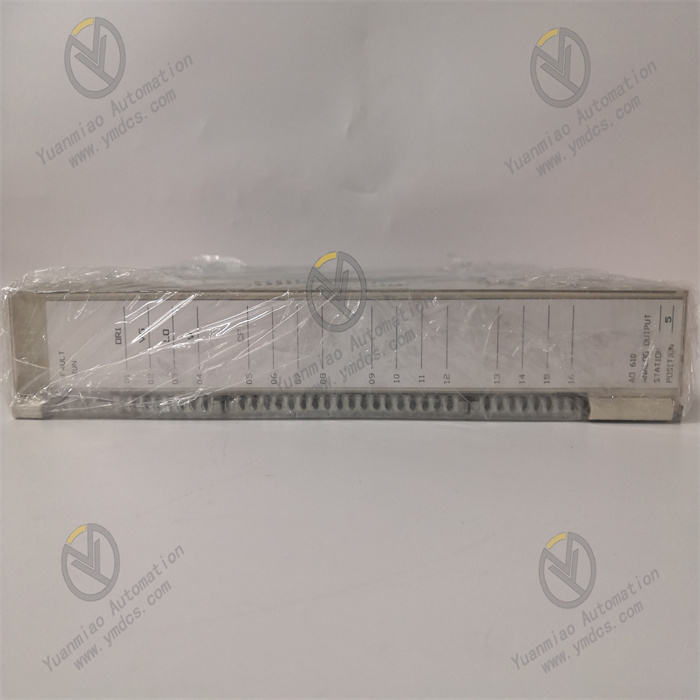
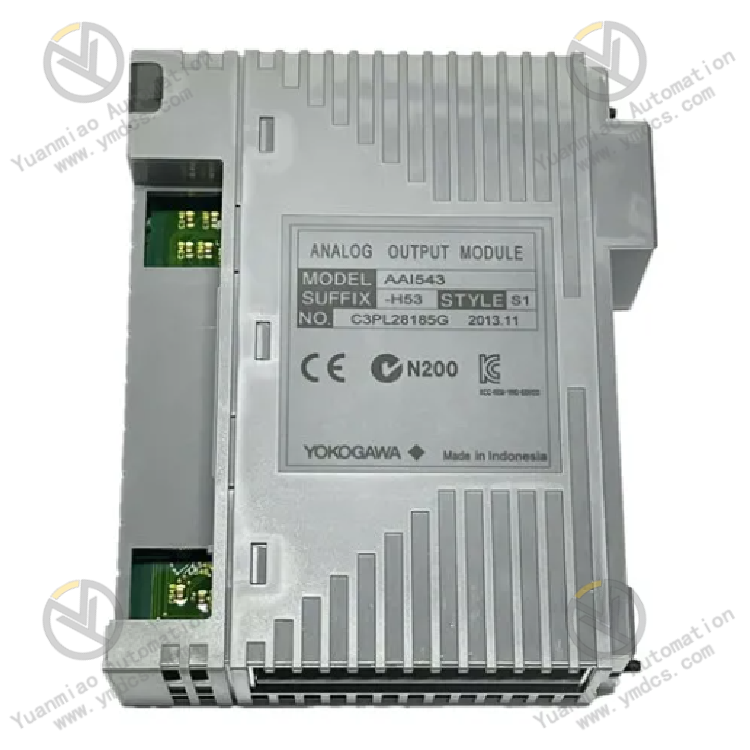
Yokogawa AAI543‑H50 S1 is a 16‑channel isolated analog output module designed for Yokogawa CENTUM VP, CS3000 and FCS field‑bus control systems. It belongs to Yokogawa high‑end industrial analog‑output I/O hardware family, engineered for precise closed‑loop regulation of field control valves, actuators and variable‑frequency devices. This is a standard non‑explosion‑proof module equipped with 16 high‑density isolated analog output channels supporting standard 4‑20 mA industrial current signals. It natively complies with the HART smart instrument protocol and can drive multiple field intelligent actuators simultaneously. It serves as the core output hardware for process regulation, valve‑position control and load adjustment in process industries.
AAI543‑H50 S1 features inter‑channel galvanic isolation, superior output accuracy, low temperature drift, fast response, redundancy compatibility and HART transparent data transmission & diagnosis. It is suitable for 24‑hour non‑stop production in chemical, oil‑gas, power and metallurgical industries. As an original Yokogawa dedicated spare part with no universal substitute, it is widely used for analog‑output point expansion, legacy module replacement and control‑system upgrade for DCS/FCS. Its back‑plane bus, communication protocol and electrical parameters are fully compatible with mainstream Yokogawa control systems. It can be put into service directly without rewiring or re‑configuration after replacement.
2. Functions and Features
2.1 Core Functions
16‑Channel High‑precision Analog Output: 16 independent analog output channels providing standard 4‑20 mA current signals. It can simultaneously drive field control valves, electric actuators, variable‑frequency drives and positioners to satisfy large‑scale multi‑point continuous regulation requirements of process plants.
Native HART‑compliant Communication: Supports transparent HART data transmission, remote parameter read/write and device condition diagnosis. It retrieves auxiliary process parameters, fault codes and range information from smart valves and transmitters to realise remote instrument maintenance and refined management.
Full Galvanic Isolation Protection: Bidirectional isolation between channels and between channels and back‑plane bus. Short‑circuit, signal anomaly or device failure on one channel will not crosstalk to other channels or system back‑plane, eliminating whole‑board output abnormality and system disturbance triggered by external faults.
Fast Dynamic Response Output: Millisecond‑level command response with short data update cycle. It accurately follows regulatory commands from the controller, adapting to variable‑load operation, fine parameter tuning and dynamic closed‑loop control to keep process parameters stable.
Comprehensive Fault Self‑diagnosis & Alarm: Continuously monitors channel output anomaly, load open‑circuit, short‑circuit, over‑current, module power failure and bus communication error. Faulty channel and fault type are precisely located with real‑time system alarms to reduce maintenance workload.
Redundancy‑Tolerant Control Support: Natively supports system redundant architecture with bumpless output switching. Continuous field‑device regulation is maintained during module abnormality or maintenance to guarantee non‑stop operation of critical process loops.
High‑speed Bus Data Exchange: High‑speed communication with controller via dedicated ESB back‑plane bus. It receives regulatory commands and uploads module status, HART instrument data and fault alarms to ensure real‑time and consistent command delivery and data interaction.
2.2 Product Features
Industrial‑grade High Accuracy & Stability: High‑precision DAC chip delivers output accuracy of ±0.1 % and low temperature drift of ±16 μA / 10 ℃. Output performance remains stable under wide‑temperature conditions with excellent long‑term running reliability for precision process control.
Robust Anti‑interference Isolation Design: Combined opto‑electronic and galvanic isolation withstands field electromagnetic interference, ground‑potential difference and load surges, preventing signal distortion, output jitter and unintended device actuation under harsh industrial conditions.
High‑density Compact Integration: Sixteen output channels on single module save cabinet footprint, simplify hardware layout and lower system procurement and maintenance costs.
Original Plug‑and‑play without Commissioning: Standard Yokogawa slot‑mount form‑factor. Electrical parameters, bus protocol and HART logic are fully compatible with CENTUM VP, CS3000 and FCS. No configuration modification or on‑site calibration is required upon replacement.
Long‑term Adaptability for Harsh Conditions: Industrial reinforced components and anti‑ageing PCB tolerate dust, humidity, vibration and temperature swing. Low failure rate for non‑stop long‑term service in process industries.
3. Specifications
| Parameter Item | Technical Specification |
|---|---|
| Model | AAI543‑H50 S1 |
| Device Type | 16‑Channel Isolated HART Analog Output Module |
| Output Channels | 16 independent isolated analog output channels |
| Output Signal | Standard 4‑20 mA DC current |
| Communication Protocol | Native HART smart instrument protocol support |
| Output Accuracy | ±0.1 % high‑precision output |
| Temperature Drift | ±16 μA / 10 ℃ low‑drift performance |
| Data Update Cycle | 100 ms fast response |
| Isolation Withstand Voltage | 500 V AC inter‑channel isolation (1‑minute withstand) |
| Power Supply | DCS back‑plane bus powered |
| Operating Temperature | 0 ℃ ~ +60 ℃ (industrial wide‑temperature range) |
| Ambient Humidity | 5%‑95%RH, non‑condensing |
| Explosion‑proof Rating | Standard version, no explosion‑proof certification |
| Installation | Standard slot‑mount in DCS/FCS cabinet |
| Applicable Systems | Yokogawa CENTUM VP / CS3000 / FCS control systems |
4. Working Principle
Yokogawa AAI543‑H50 S1 implements closed‑loop regulation workflow: Bus Command Reception → Digital Calculation → DAC Digital‑to‑Analog Conversion → Isolated Output → HART Transparent Communication → Real‑time Self‑diagnosis.
The controller sends digital regulatory commands such as valve opening and equipment load via ESB back‑plane bus. Internal DSP chip performs precise computation and algorithm correction after command reception.
Processed digital signals are fed into high‑precision DAC unit and converted into standard 4‑20 mA analog current. After galvanic isolation, signal amplification and waveform shaping, analog signals are transmitted to field actuators to control valve opening and equipment load for closed‑loop process regulation. For HART‑enabled smart devices, the module modulates and demodulates HART signals for bidirectional transmission of instrument parameters, device status and fault information to support remote diagnosis and parameter configuration.
The module continuously monitors output current, load condition, loop status and self‑health. Once short‑circuit, over‑current, open‑circuit or communication failure is detected, the faulty channel is latched and system alarm is triggered to isolate fault and protect other healthy channels. Under redundant configuration, bumpless output switching is achieved to maintain continuous, stable and accurate process regulation.
5. Application Scenarios
Chemical Process Control Systems: Control of control valves and actuators for reactors, heat exchangers and distillation columns in refineries, coal‑chemical and fine‑chemical plants. Realises precise regulation of temperature, pressure, flow and level for continuous and refined chemical production.
Oil & Gas Automation Systems: Regulation of pressure‑regulating valves, throttle valves and variable‑frequency equipment for oilfields, gas fields, LNG plants and long‑distance pipelines. HART diagnostic function enables remote maintenance of field smart instruments to ensure safe and stable oil‑gas production & transportation.
Power‑plant Control Systems: Drive and control of regulating valves and actuators for boiler, steam turbine and auxiliary‑control systems. Meets dynamic regulation demands for unit load variation, frequency modulation and peak‑shaving, guaranteeing stable unit parameters and accurate load response.
General Process‑industry Automation Systems: Control of process actuators in metallurgy, pharmaceutical, water‑treatment and building‑material industries. High accuracy, low drift and strong anti‑interference capability satisfy various precision closed‑loop control requirements.
Legacy‑system Maintenance & Expansion: Fully compatible with legacy Yokogawa DCS/FCS series. Direct replacement of faulty or aged analog output modules without rewiring, loop modification or configuration change enables fast I/O expansion and hardware upgrade.
6. Common Faults and Troubleshooting
6.1 No channel output, no field‑device action
Fault Causes: Abnormal module bus communication; damaged output circuit; field load open‑circuit; loose or disconnected wiring; module power supply anomaly.
Solutions: Inspect back‑plane communication and power supply; power‑cycle and reset module. Check field output loops, terminals and actuators point‑by‑point to eliminate open‑circuit and device faults. Clean edge connectors and slot contacts then re‑seat and fasten module. If no output persists after excluding external causes, the channel hardware is defective; replace with original AAI543‑H50 S1 module.
6.2 Large output deviation, inaccurate process regulation
Fault Causes: DAC circuit drift; degraded output accuracy; excessive temperature drift; mismatched field load; parameter offset caused by signal interference.
Solutions: Calibrate channel output accuracy and 4‑20 mA linearity using precision current source. Rectify field shielding and earthing to suppress electromagnetic interference. Verify field load‑resistance matching. Replace original module if drift cannot be calibrated and accuracy is severely degraded.
6.3 Output jitter, frequent process‑parameter fluctuation
Fault Causes: Severe field electromagnetic interference; improper cable shielding & earthing; ageing module filter circuit; poor contact in output loop.
Solutions: Optimise signal shielding and earthing to isolate interference from variable‑frequency and high‑voltage equipment. Tighten and clean terminals to eliminate loose connection and oxidation. Improve cabinet cooling to avoid module overheating. Replace module if signal jitter cannot be eliminated.
6.4 HART communication failure, no return data from smart instruments
Fault Causes: Incorrect HART configuration; defective module communication circuit; faulty field smart instrument; mismatched output‑loop impedance.
Solutions: Verify system HART configuration parameters and restart communication stack. Inspect field instrument health and loop impedance to meet HART load requirements. Replace module if communication still fails after ruling out external instrument and loop faults, indicating defective HART hardware.
6.5 Whole‑board communication loss, no output for all channels
Fault Causes: Poor back‑plane‑bus contact; abnormal module firmware; cabinet power‑supply fluctuation; overall module hardware ageing failure.
Solutions: Inspect cabinet back‑plane interface and power‑supply voltage to eliminate power and bus faults. Power‑cycle module to reset firmware. Clean slot and bus contacts and re‑install module. Replace original module if communication failures recur.