Description
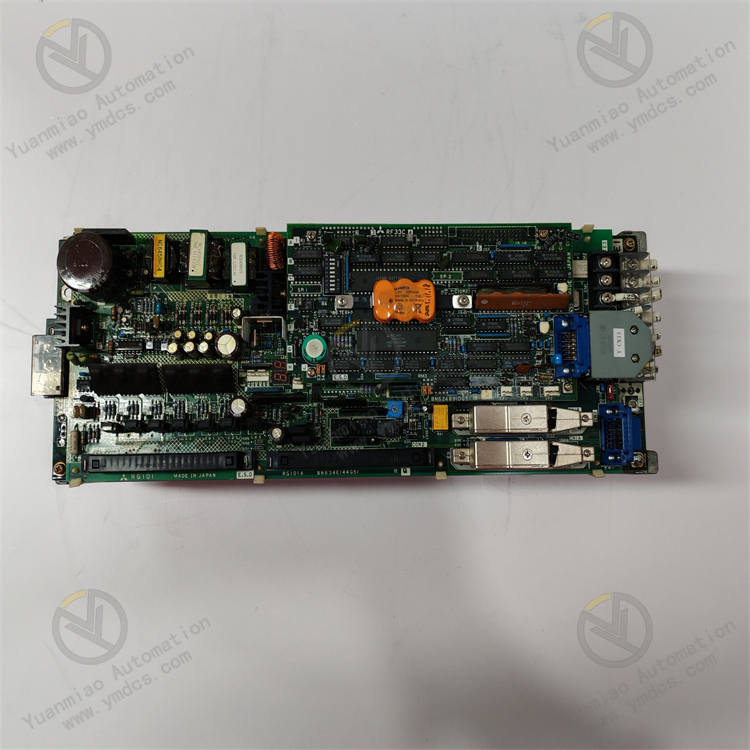
MITSUBISHI A1SJ61QBT11
1. Basic Information
MITSUBISHI A1SJ61QBT11 is a CC-Link master/local station communication module for PLC. It is specially developed for fieldbus communication in industrial automation, acting as a core component to realize high-speed data exchange between PLC and remote I/O modules, sensors, actuators, servo drives and third-party devices. Adopting Mitsubishi open CC-Link fieldbus technology, it features high-speed transmission, large-capacity I/O mapping and dual master-local mode compatibility. Its core function is to build real-time and deterministic distributed control networks and complete two-way transmission of cyclic data and transient data. It meets multi-device cooperative communication demands of production lines, process control, intelligent manufacturing and other scenarios while balancing communication efficiency and system reliability.
2. Technical Specifications
2.1 Core Communication & Electrical Specifications
- Communication Protocol: Mitsubishi CC-Link Ver.1.10, supports cyclic communication (batch I/O and register data) and transient communication (on-demand message transmission).
- Transmission Speed: Optional multiple speeds: 156 kbps, 625 kbps, 2.5 Mbps, 5 Mbps, 10 Mbps, dynamically matched with transmission distance.
- Max Transmission Distance: 900m@156 kbps, 400m@625 kbps, 160m@2.5 Mbps, 100m@5/10 Mbps (CC-Link dedicated cable).
- Station Mode: Switchable between Master and Local mode; local station occupies 1~4 station addresses (set via DIP switch).
- Connection Capacity: Up to 64 slave stations in master mode; 2048 points for remote I/O (RX/RY), 256 points each for remote read/write registers (RWw/RWr).
- Electrical Parameters: Operating voltage 24V DC (powered by PLC backplane), low power consumption, supports RS-485 differential transmission with strong common-mode interference resistance.
Temperature Range: Operating temperature: 0°C ~ 55°C; storage temperature: -20°C ~ 75°C, suitable for conventional industrial working environments.
2.2 Physical & Structural Specifications
- Mounting Type: Standard PLC backplane/rack mounting, compatible with MELSEC-A/QnAS series racks, single-slot design.
- Dimensions: Standard industrial module size (approx. 130×40×120 mm), compact structure saves cabinet space.
- Weight: Approx. 300g, lightweight without increasing rack load, easy for installation and maintenance.
- Interface Design: 1 set of CC-Link communication terminal block, built-in switchable terminating resistor; equipped with RUN, ERR, TX/RX LED indicators on panel to display real-time communication status.
Product Features: Industrial flame-retardant housing with outstanding vibration and impact resistance, certified by CE and UL, suitable for long-term operation in harsh industrial sites.
2.3 Core Function & Compatibility Specifications
- Core Functions: Realizes master station control or local station data interaction on CC-Link network; supports remote I/O monitoring, remote register read-write and transient message transceiving; integrated network diagnosis, fault detection and alarm functions to monitor communication status and slave station connection status in real time.
- Integration Performance: Highly integrated design with built-in communication control chip, signal processing unit and isolation circuit. It can work directly after connecting to PLC backplane without extra auxiliary components, simplifying system wiring and configuration.
- Compatibility: Matches MELSEC-A/QnAS series CPUs, fully compatible with all Mitsubishi CC-Link slave modules including remote I/O, analog and servo interface modules; allows access of third-party CC-Link compliant devices for higher system scalability.
- Reliability: Adopts NRZI encoding and CRC-16 checksum to ensure low bit error rate; supports network redundancy and automatic fault recovery with stable communication performance, effectively reducing industrial production downtime risks.
3. Working Principle
According to preset cycles, the master station sends output data (RY, RWw) to all slave stations via RS-485 bus, and simultaneously receives feedback input data (RX, RWr) from slaves to realize real-time synchronization of batch I/O and register data, ensuring high-speed interaction of control signals and status data.
4. Application Scenarios
4.1 Industrial Automated Production Lines
Applied to distributed control of automobile, electronics, food packaging and other production lines. Used as CC-Link master station to connect remote I/O, sensors, cylinders and servo drives, realizing coordinated operation of multi-station equipment, synchronous production rhythm and real-time data collection, so as to improve automation level and operational efficiency of production lines.
4.2 Process Control Industry
Widely used in metallurgy, chemical industry, water treatment and other process industries. It connects analog slave modules for temperature, pressure, flow measurement and actuators such as valves and pumps to realize remote monitoring and closed-loop control of process parameters. It adapts to harsh environments with high temperature, high pressure and high humidity to ensure stable and controllable production processes.
4.3 Intelligent Manufacturing & Logistics Warehousing
Applied in equipment networking of smart factories and sorting systems of logistics warehousing. It connects AGVs, sorting robots, barcode scanners and other equipment to realize data interaction and scheduling control, support flexible production and intelligent warehouse management, and improve overall system intelligence and collaborative efficiency.
4.4 Equipment Networking & System Integration