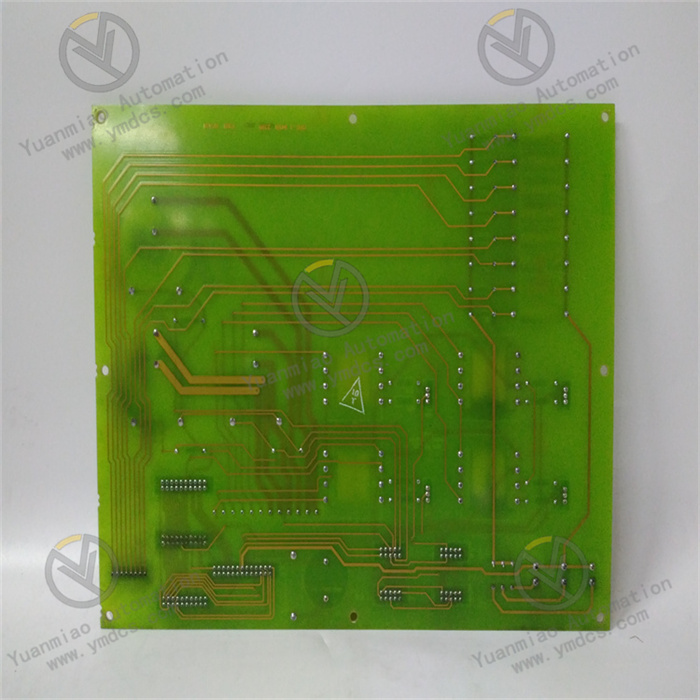
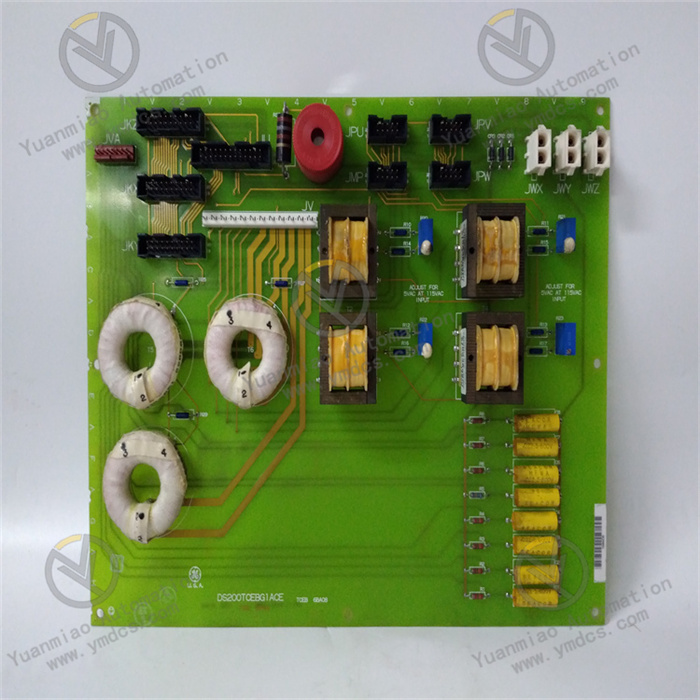
GE DS200FGPAG1AFC | Gate Pulse Amplifier Board

GE DS200FGPAG1AFC | Gate Pulse Amplifier Board

Brand: General Electric

Product ID: DS200FGPAG1AFC

Condition: New / used

Terms of payment: Paypal、T/T 、Western Union

Category:

Description

GE DS200FGPAG1AFC

I. Overview


GE DS200FGPAG1AFC is a fuel control module, specifically positioned as a "Precision Control and Safety Interlock Unit for Heavy-Duty Gas Turbine Fuel Flow". It focuses on addressing issues such as precise control of fuel supply, guarantee of combustion stability, and safety protection against over-temperature and over-pressure for gas turbines in scenarios like combined cycle power plants and industrial drives. It provides critical fuel control hardware support and safety barriers for the full-operating-condition operation of gas turbines, including start-up and speed-up, load adjustment, and shutdown cooling.


Deeply integrated into the Mark VIe control system architecture, this module adopts high-precision fuel flow closed-loop control technology, dedicated fuel valve drive circuits, and multiple safety interlock logics. It undertakes core tasks such as parsing fuel demand commands, collecting fuel flow signals, precisely adjusting fuel valve opening, monitoring combustion status, and executing emergency shutdown signals. This ensures the stability, accuracy, and safety of fuel control under harsh operating environments such as high load fluctuations, changes in fuel composition, and high temperature and pressure.


As a core execution unit of the Mark VIe fuel control system, the DS200FGPAG1AFC features core advantages including high-precision fuel flow control, adaptability to multiple types of fuel valves, millisecond-level safety response, and in-depth collaboration with the combustion system. Without the need for additional drive modules, it can directly connect to key gas turbine equipment such as fuel control valves, shut-off valves, and fuel nozzle actuators, realizing full-link closed-loop management of fuel control covering "demand-collection-adjustment-feedback".


It is widely used in various heavy-duty gas turbine systems, such as GE 9F and 7F series gas turbines for combined cycle power plants, PG6500 series gas turbines for industrial drives, and fuel control scenarios of gas turbines for waste incineration power generation. The module possesses core characteristics including seamless collaboration with the Mark VIe system, precise and stable fuel valve drive, multiple combustion safety interlocks, wide-range fuel adaptability, and intelligent diagnosis. It can adapt to an operating environment of -20℃ to 65℃, meet strict electromagnetic compatibility requirements and long-term reliability standards under high-temperature environments, fully satisfying the rigorous demands of the gas turbine industry for fuel control accuracy, response speed, and safety redundancy.


II. Technical Parameters


Parameter CategorySpecific SpecificationsDetailed Description
Core Control & Adaptation ParametersAdaptation PlatformSpecifically designed for the GE Speedtronic Mark VIe control system; compatible with Mark VIe main controllers (e.g., IC697CPU772) and fuel system expansion modules; supports collaboration with the Mark VIe system’s ToolboxST configuration software, HMI operation interface, and combustion optimization system.

Core Function ConfigurationIncludes 6 analog inputs (AI), 8 digital inputs (DI), 4 analog outputs (AO), 4 pulse-width modulation (PWM) outputs, and 3 fault alarm outputs; built-in dedicated PID chip for fuel control, supporting cascade PID regulation algorithm; equipped with dedicated power amplifier circuit for fuel valve drive.

Signal Adaptation RangeAnalog Input: 4-20mA (fuel flow, fuel pressure, valve position feedback), 0-10V (gas temperature, flame detection signal); Digital Input: 24V DC dry/wet contacts (fuel valve status, flame detection, emergency shutdown signal); Analog Output: 4-20mA (fuel control valve opening command, pressure regulation command); PWM Output: 0-24V DC, adjustable frequency of 100-1000Hz, adjustable duty cycle of 0-100%, driving capacity ≤2A per channel.

Control Accuracy IndicatorsAnalog Input Accuracy: ±0.02% FS; Analog Output Accuracy: ±0.05% FS; PWM Output Accuracy: duty cycle ±0.1%, frequency ±1Hz; Fuel Flow Regulation Accuracy: ±0.5% rated flow; PID Regulation Response Time: ≤5ms; Sampling Rate: 100Hz (analog), 200Hz (digital); Valve Position Control Accuracy: ±0.1% full stroke.
Interface & Isolation ParametersField InterfaceAdopts 4 sets of 40-pin pluggable terminal blocks (signal input, valve drive output, power supply, interlock signal); Rated Voltage of Power Output Interface: DC 24V/AC 220V; Rated Voltage of Signal Interface: DC 30V; Rated Terminal Current: 5A (power interface), 1A (signal interface); Wiring Specification: 0.5-6mm² (single/multi-strand wires); supports shielded cable connection, with independent shielded grounding terminal for each set of terminals.

System InterfaceConnects to the main controller via the Mark VIe system’s dedicated Ethernet/IP bus; Bus Communication Rate: 100Mbps (real-time synchronous transmission); Supports hot-swap function (compliant with Mark VIe system hot-swap specifications); Equipped with module ID identification and IP address configuration functions, supporting module-level redundant backup.

Isolation ParametersIsolation between Power Output and Signal Circuit: 2500V AC (1 minute); Isolation Between Analog Input Channels: 1000V AC; Isolation Between Digital Input and Output: 1000V AC; Power Supply Isolation: 2500V AC; Common Mode Rejection Ratio ≥140dB, Differential Mode Rejection Ratio ≥100dB.
Power Supply & Power Consumption ParametersPower Supply SpecificationDual-channel redundant power supply provided by the Mark VIe system power module; Rated Voltage: DC 24V ±10% (21.6-26.4V DC); Maximum Operating Current: ≤5A (when 4 PWM channels are fully loaded); Equipped with four-fold protection against overvoltage, overcurrent, reverse connection, and surge, supporting automatic current limiting to 6A in case of overload.

Power Consumption IndicatorsTypical Power Consumption: ≤30W (2 PWM channels driven, analog full-load collection); Standby Power Consumption: ≤5W (core circuit power supply only); Maximum Power Consumption: ≤50W (4 PWM channels fully loaded, power amplifier circuit fully loaded); Natural heat dissipation + auxiliary heat sink design, heat dissipation efficiency increased by 30%.
Environmental & Physical ParametersEnvironmental ParametersOperating Temperature: -20℃ to 65℃; Storage Temperature: -40℃ to 85℃; Relative Humidity: 5%-95% (no condensation); Vibration Resistance: 2g (5-2000Hz, three axes); Shock Resistance: 30g (peak, 11ms, three axes); Electromagnetic Compatibility: Compliant with IEC 61000-4-2/3/4/5/6/8 standards.

Physical & Installation ParametersDimension Specifications: 350mm×180mm×90mm (length×width×height); Installation Method: Embedded installation in Mark VIe standard I/O rack; Weight: Approximately 3.2kg; Housing Material: Die-cast aluminum alloy (with high-temperature anti-corrosion coating); Protection Class: IP30 (module body), IP65 (terminal junction box, optional).
Reliability & Protection ParametersReliability IndicatorsMean Time Between Failures (MTBF): ≥800,000 hours; Service Life: ≥15 years (under normal operating conditions); Long-term Stability of PWM Output: ≤0.1% duty cycle/year; Fault Response Time: ≤2ms; Valve Position Control Repeatability: ±0.05% full stroke.

Protection FunctionsEquipped with fuel over-flow protection, abnormal fuel pressure protection, valve position jamming protection, flame loss interlock protection, and rapid emergency shutdown response; supports fuel valve fault diagnosis and redundant switching (response time ≤3ms); equipped with over-temperature and overcurrent protection for power drive circuit; supports mode switching between "safe shutdown" and "reduced load operation" in fault conditions.


III. Functional Features


1. Deep Integration with Mark VIe System, Seamless Collaboration for Fuel Control

Adopting the Mark VIe system’s dedicated Ethernet/IP real-time bus architecture, it achieves full-dimensional seamless integration with the main controller, ToolboxST configuration software, HMI operation interface, and combustion optimization system. The data interaction mechanism is optimized for the dynamic characteristics of gas turbine fuel control, ensuring collaborative consistency between fuel control, unit load adjustment, and combustion optimization.


The module can be directly embedded in the Mark VIe standard I/O rack, with mechanical fixation and electrical connection completed via a dedicated high-density bus connector—no additional adaptation modules or signal converters are required, and physical installation and system access can be completed in just 20 minutes. After accessing the system, the ToolboxST configuration software automatically identifies the module ID, interface configuration, and hardware version. Engineers can configure fuel control parameters (e.g., PID regulation coefficients, PWM drive parameters, protection thresholds, fuel type adaptation curves) via a graphical interface, supporting online debugging and offline simulation of fuel control logic without manual writing of underlying driver programs.


The data transmission between the module and the main controller adopts a real-time synchronous communication mechanism: the upload cycle of fuel status data is ≤2ms, and the delay of control command issuance is ≤1ms. This ensures rapid response and adjustment when the gas turbine load fluctuates suddenly. For example, when the unit load jumps from 50% to 100%, the module can complete the closed-loop process of "load demand-flow adjustment-valve position feedback" within 8ms, avoiding combustion fluctuations caused by delayed fuel supply.


2. Adaptability to Multiple Types of Fuel Valves, Precise and Reliable Drive

It has the capability to adapt to the drive of all types of gas turbine fuel valves, integrating 4 high-precision PWM output channels and 4 analog output channels. It can directly drive different types of fuel valves such as proportional control valves, on-off valves, and stepper actuators. Combined with valve position feedback closed-loop control, it realizes precise control and stable operation of fuel valve opening.

The PWM output channels are optimized for the drive characteristics of fuel valves, supporting continuously adjustable frequency of 100-1000Hz and duty cycle of 0-100%, with a driving current of 2A per channel, which can directly drive small and medium-sized proportional control valves. For large fuel valves, it supports expanding the driving capacity to 10A through an external power amplifier module, adapting to the drive requirements of the main fuel control valve of GE 9F series gas turbines.


The PWM output adopts digital phase-locked technology, with a frequency accuracy of ±1Hz and a duty cycle accuracy of ±0.1%, which can precisely control the opening change rate of the fuel valve. For example, during the start-up phase of the gas turbine, the valve position opening rate can be controlled at 0.1%/ms to realize the stable increase of fuel flow and avoid deflagration during start-up.

The analog output channel has an accuracy of ±0.05% FS, which can output 4-20mA commands to drive fuel valves with positioners. Combined with 6 high-precision analog input channels to collect valve position feedback signals, a valve position closed-loop control is formed, with a valve position control accuracy of ±0.1% full stroke, ensuring the consistency between fuel flow and command requirements.


3. Fuel Flow Closed-Loop Control, Precise Adjustment Under Wide Operating Conditions

Equipped with a dedicated cascade PID regulation chip for fuel control, combined with high-precision flow collection and precise drive output, it realizes closed-loop precise control of fuel flow under full operating conditions of the gas turbine. It can adapt to complex operating conditions such as changes in fuel composition and load fluctuations, ensuring optimal combustion stability and efficiency.

The cascade PID regulation architecture is divided into a "flow main loop" and a "valve position secondary loop". The main loop takes fuel flow demand as the target, performs PID calculation by collecting fuel flow sensor signals, and outputs the target valve position command. The secondary loop takes valve position feedback as the target, adjusts the fuel valve opening through PWM or analog output. The dual-loop collaborative control enables a flow regulation accuracy of ±0.5% rated flow, which is much higher than the industry average.


For different fuel types (such as natural gas, liquefied petroleum gas, syngas), the module supports configuring exclusive flow-valve position characteristic curves through the ToolboxST software, realizing rapid parameter adaptation when switching fuel types without re-calibration.
Under different operating conditions of the gas turbine, such as start-up and speed-up, load adjustment, and shutdown cooling, the module can automatically switch PID regulation parameter sets. For example, during the start-up phase, "low gain, slow response" parameters are adopted to avoid fuel overshoot; during the load adjustment phase, "high gain, fast response" parameters are adopted to ensure rapid tracking; during the shutdown phase, "progressive flow reduction" parameters are adopted to prevent backfire.

The module is equipped with a flow feedforward compensation function, which can predict fuel demand in advance according to the unit load change rate, and adjust fuel supply in advance when the load fluctuates suddenly, effectively suppressing flow fluctuations.


4. Multiple Safety Interlock Protections, Comprehensive Guarantee for Combustion Safety

Integrating multiple dedicated safety interlock functions for gas turbine fuel control, covering key fault scenarios such as fuel over-flow, abnormal pressure, flame loss, and valve position jamming. Combined with a rapid emergency shutdown response mechanism, it ensures the safe operation of the combustion system and rapid handling in case of faults, providing a comprehensive safety barrier for the gas turbine.

The module has a built-in fuel over-flow protection logic: by comparing the real-time collected fuel flow signal with the preset threshold, if the flow exceeds 110% of the threshold, it outputs a flow limit signal within 2ms to control the fuel valve to reduce the opening; if the flow exceeds 120% of the threshold, it immediately triggers an emergency shutdown signal to close the main fuel valve and cut off the supply, with a response time of ≤1ms, avoiding combustion chamber over-temperature caused by over-flow.


The abnormal fuel pressure protection function monitors the fuel inlet/outlet pressure. When the pressure is below the lower limit or above the upper limit, it outputs a pressure regulation command or triggers an alarm. If the pressure remains abnormal, it automatically switches to the backup fuel supply circuit (such as backup fuel in a dual-fuel system).
The flame loss interlock protection receives digital signals from the flame detection module. If flame loss is detected, it immediately cuts off the fuel supply and triggers the shutdown process, while recording the fuel parameters before the fault for post-event analysis.

The valve position jamming protection function compares the valve position command with the feedback signal. If the deviation exceeds 1% full stroke and lasts for 50ms, it is determined as a jamming fault, and it immediately switches to the redundant fuel valve and alarms to ensure uninterrupted fuel control.


5. Full Isolation Between Strong and Weak Electricity, Excellent Anti-Interference Capability

Adopting a multiple isolation design with full isolation between power output and signal circuit, and between channels, combined with electromagnetic compatibility optimization measures, it can operate stably in harsh gas turbine environments with high voltage, strong electromagnetic interference, and high-temperature radiation, ensuring the reliability of control signals and drive signals.
A dual isolation design (optoelectronic isolation and transformer isolation) is adopted between the module’s power output interfaces (PWM drive, valve drive) and signal interfaces (analog, digital). The isolation voltage reaches 2500V AC, which can effectively block the strong electromagnetic interference from the fuel valve drive circuit from entering the control loop, avoiding distortion of adjustment commands caused by interference.

The isolation voltage between analog input channels is 1000V AC, and the isolation voltage between digital input and output channels is 1000V AC, avoiding signal crosstalk between different channels. For example, interference in the fuel pressure collection channel will not affect the accuracy of the valve position feedback collection.


With a common mode rejection ratio of ≥140dB and a differential mode rejection ratio of ≥100dB, it can effectively suppress strong electromagnetic interference generated by equipment such as gas turbine generators and frequency converters, as well as pulse interference generated by the action of high-pressure solenoid valves in the fuel system.

The module housing is made of die-cast aluminum alloy with a high-temperature anti-corrosion coating. The internal circuit board adopts a grounded shielding design and high-temperature curing three-proof paint treatment, further enhancing anti-interference and anti-corrosion capabilities. It complies with the IEC 61000-4 series of electromagnetic compatibility standards and performs excellently in interference tests such as electrostatic discharge, electrical fast transient, and surge.


6. Full-Dimensional Intelligent Diagnosis, Significantly Improved Operation and Maintenance Efficiency

Integrating full-dimensional intelligent diagnosis functions at the module, channel, and function levels, it has capabilities such as rapid fault localization, fault log storage, and fault redundant switching. The diagnosis mechanism is optimized for the operation and maintenance needs of the gas turbine fuel system, significantly reducing the difficulty and cost of operation and maintenance.

The module is equipped with 10 status indicator lights, including "Power Normal", "Operation Ready", "Communication Normal", "Drive Normal", "Over-Flow Alarm", "Abnormal Pressure Alarm", "Valve Position Jamming Alarm", "Flame Loss Alarm", "Redundancy Activated", and "Fault Shutdown". The on/off and blinking of the indicator lights enable quick judgment of fault types and scopes.

Channel-level diagnosis supports the diagnosis of analog channel disconnection, short circuit, signal over-range, digital channel signal abnormality, PWM output channel overcurrent and over-temperature, and excessive valve position feedback signal deviation. Function-level diagnosis supports the diagnosis of PID regulation logic abnormality, excessive fuel flow deviation, and redundant switching failure, with a fault response time of ≤2ms.
When a fault occurs, the module uploads detailed fault information (fault type, occurrence time, parameters at the time of fault) to the main controller via the Ethernet/IP bus, and simultaneously triggers a corresponding level of dry contact alarm, linking with on-site audible and visual alarms and HMI pop-up prompts.

contact us