Description
1. Product Overview
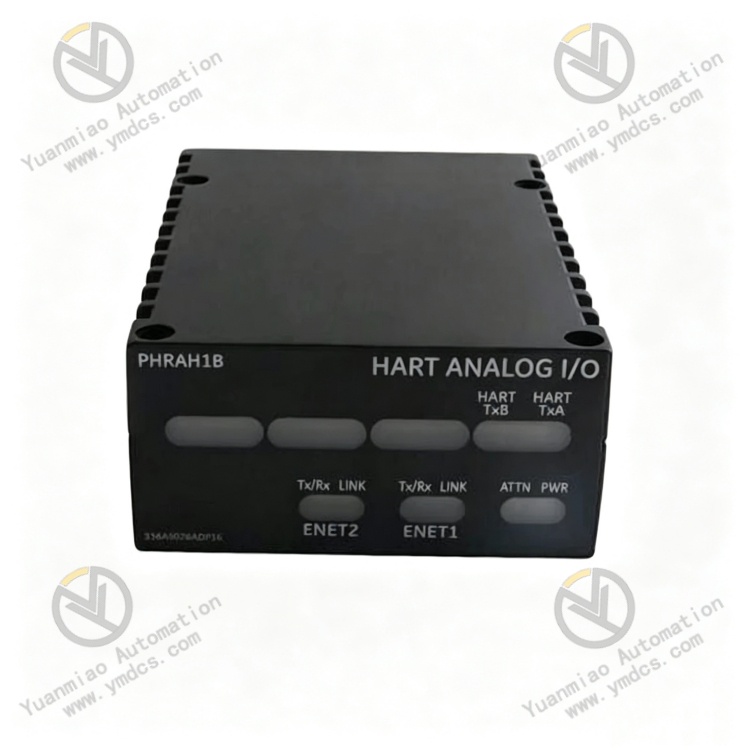
IS220PHRAH1B is a high‑precision HART‑protocol analog input/output module dedicated to gas turbines and steam turbines under the Mark VIe / Speedtronic series of General Electric (GE), USA. As the core I/O processing unit of power‑station power‑control systems, it is designed for process‑signal acquisition, closed‑loop analog regulation, data interaction with smart instruments and safety interlock‑control scenarios of gas‑turbine, steam‑turbine and combined‑cycle generator‑sets. As a standard supporting module for GE power‑station automation‑control systems, this device integrates multi‑channel analog‑signal acquisition, isolation conversion, HART smart‑protocol communication, analog‑output driving, hardware fault diagnosis and safety‑redundancy control into one unit. It is compatible with industrial‑standard voltage, current and smart‑transmitter signals, and constitutes critical hardware for precision measurement & control, intelligent equipment linkage and compliant operation of safety systems for large‑scale power‑generation units.
Built on GE’s mature power‑equipment control‑technology platform, the IS220PHRAH1B module adopts military‑grade industrial hardware architecture, full‑channel electrical‑isolation design, high‑precision AD/DA conversion chips and dedicated HART signal‑processing circuits. It delivers core advantages including high measurement‑and‑control accuracy, excellent signal linearity, strong communication compatibility, drift‑free long‑term operation and high safety level. Natively supporting the HART smart‑instrument protocol, the module enables transmitter parameter reading, remote calibration, equipment‑condition diagnosis and fault tracing. Different from ordinary analog modules, it possesses intelligent measurement‑and‑control capabilities. Complying strictly with SIL2 / SIL3 functional‑safety standards, the equipment adapts to harsh power‑station operating conditions featuring strong electromagnetic interference, wide‑temperature fluctuation, dust and humidity, and supports 7×24‑hour uninterrupted stable operation. It is widely deployed in engineering projects such as complete new‑built control‑system packages for thermal‑power and gas‑turbine plants, combined‑cycle power stations, combined‑heat‑and‑power units and large‑scale industrial self‑owned power plants, replacement of I/O modules for legacy units, intelligent upgrade of power stations and reconstruction of safety‑control systems.
2. Core Functions
Multi‑channel High‑precision Analog Acquisition and Output: Integrated multiple industrial‑standard analog‑input and analog‑output channels support common analog signals such as 4‑20 mA current and ‑10~+10 V voltage. It covers acquisition of key process parameters of units including temperature, pressure, flow, vibration, liquid level and load, and outputs standard analog regulation signals to drive on‑site actuators, regulating valves and smart speed‑control equipment, so as to realize closed‑loop precision regulation of unit process parameters.
Native HART Smart‑protocol Communication: A dedicated built‑in HART‑protocol parsing unit enables direct connection with industrial HART smart transmitters, smart valve positioners and smart instruments. Besides reading conventional analog measurement values, it collects extended data including equipment model, range parameters, fault status, temperature drift and equipment‑diagnosis information. Remote parameter configuration, instrument calibration and online condition monitoring are supported to realize intelligent management of field instruments.
Full‑channel Electrical Isolation and Powerful Anti‑interference Performance: All I/O channels are equipped with independent electrical‑isolation, surge‑suppression, electrostatic‑protection and multi‑stage filtering circuits. Channels are mutually isolated without crosstalk. It effectively isolates high‑frequency electromagnetic radiation, variable‑frequency‑equipment crosstalk, line pulse interference and ground‑loop disturbance at power stations, thoroughly eliminating problems such as signal attenuation, waveform distortion, data jump and sampling bit‑error during long‑distance transmission, and ensuring stable and reliable measurement‑and‑control signals under complex operating conditions.
High‑level Functional‑safety and Redundancy Adaptation: Compliant with the IEC 61508 functional‑safety specification, it supports SIL2 / SIL3 safety‑level applications for high‑safety‑requirement scenarios such as critical‑process safety interlock, shutdown protection and fault interlock at power stations. Multiple operating modes including independent single‑module operation and dual‑module hot‑standby redundancy are available with bumpless and delay‑free redundancy switching, greatly improving fault‑tolerance capability and operational safety of power‑control systems.
High‑speed Signal Conditioning and Precision Calibration: Equipped with high‑precision signal‑processing chips, it carries out noise reduction, waveform shaping, linear correction, temperature‑drift compensation and error calibration for raw on‑site signals, automatically correcting measurement‑and‑control errors caused by line loss, ambient‑temperature variation and component deviation. Accurate collected data and stable output commands are guaranteed to meet high‑precision requirements for precise process control of gas turbines and steam turbines.
Full‑time Hardware Self‑diagnosis and Fault Tracing: Upon power‑on, the module automatically completes hardware self‑inspection, channel verification, communication‑link handshake and protocol‑adaptation detection. During operation, it monitors faults in real‑time such as channel disconnection, over‑range, signal anomaly, circuit failure, communication interruption and instrument offline. Abnormal points are located precisely while fault codes and operation logs are uploaded synchronously, supporting rapid fault investigation and tracing and reducing power‑station‑maintenance difficulty.
- Standardized Modular Non‑destructive Replacement and Upgrade: Built in accordance with the standardized modular structure of GE IS‑series products, its dimensions, pin‑out definitions, electrical parameters and communication timing fully satisfy Mark VIe system standards with outstanding compatibility. It can directly replace legacy I/O modules of the same type. No modifications to system programs, reconstruction of control logic or renovation of on‑site wiring are required during retrofitting. Plug‑and‑play operation enables non‑destructive intelligent upgrade of legacy power‑station control systems.
3. Technical Specifications
| Parameter Item | Technical Specification |
|---|---|
| Product Model | IS220PHRAH1B |
| Product Brand | GE (General Electric) |
| Product Series | Mark VIe / Speedtronic power‑station power‑control I/O module series |
| Product Type | HART‑protocol smart analog input/output module, safety‑grade I/O measurement‑and‑control unit for power stations |
| Core Functions | Analog‑signal acquisition, analog regulation output, HART smart‑instrument communication, signal‑isolation conditioning, safety‑redundancy control, hardware self‑diagnosis, data interaction |
| Compatible System | Complete GE Mark VIe, Speedtronic gas‑turbine / steam‑turbine / generator‑set control system |
| Signal Specifications | Analog input: 4‑20 mA, ‑10~+10 VDC; Analog output: 4‑20 mA, ‑10~+10 VDC |
| Smart Protocol | Natively supports HART communication protocol, compatible with mainstream industrial smart transmitters and smart valve positioners |
| Safety Level | Compliant with IEC 61508 standard, supports SIL2 / SIL3 functional‑safety applications |
| Redundancy Mode | Supports simplex independent operation and duplex hot‑standby redundancy with bumpless switching |
| Power‑supply Specification | 24 VDC industrial‑standard DC power supply, wide‑voltage adaptation to power‑station voltage fluctuation |
| Measurement‑and‑control Accuracy | High‑precision AD/DA conversion, high linearity, low error, drift‑free long‑term data operation |
| Communication Bus | Compatible with high‑speed internal bus of Mark VIe system, supports RS‑485 and Modbus data interaction |
| Hardware Protection | Full‑channel electrical isolation, surge suppression, electrostatic protection, over‑voltage & over‑current protection, short‑circuit protection, electromagnetic anti‑interference protection |
| Operating Temperature | ‑40 ℃ ~ +85 ℃, ultra‑wide‑temperature range adapted to power‑station environments |
| Storage Temperature | ‑45 ℃ ~ +90 ℃ |
| Ambient Humidity | 5%‑95%RH, non‑condensing, suitable for humid enclosed control cabinets in power stations |
| Hardware Construction | Industrial precision PCB, military‑grade wide‑temperature chips, vibration‑reinforced structure, dust‑proof, corrosion‑resistant and moisture‑proof coating |
| Operating Characteristics | Accurate measurement & control, rapid response, stable communication, strong fault tolerance, no frequent calibration required, 7×24‑hour long‑term stable operation |
| Compatible Equipment | Gas turbines, steam turbines, combined‑cycle generator‑sets, smart instruments and actuators for power stations |
| Key Advantages | HART‑based intelligent measurement & control, high SIL safety level, full‑channel isolation & anti‑interference, redundant fault‑tolerant operation, high‑precision signal processing, non‑destructive replacement of legacy modules, wide‑condition adaptation, intelligent instrument operation & maintenance, suitable for safety‑grade control scenarios of power stations |
4. Working Principle
The IS220PHRAH1B module implements a fully‑closed‑loop intelligent measurement‑and‑control workflow: Power Initialization → Hardware Self‑inspection & Handshake → Intelligent‑signal Acquisition & Conditioning → HART‑protocol Parsing → Precision‑output Driving → Bus‑based Data Interaction → Real‑time Fault Monitoring → Safety‑redundancy Protection. After being energized with 24 VDC power supply, the module completes full‑board hardware self‑inspection, channel initialization, communication‑bus handshake, HART‑protocol adaptation and system‑clock synchronization. Once the self‑check passes, it enters a normal high‑speed measurement‑and‑control standby state.
During the acquisition phase, multiple analog‑input channels synchronously receive raw process analog signals such as on‑site pressure, temperature, flow and vibration, while establishing two‑way communication with field smart instruments via the HART protocol. Conventional analog signals pass through electrical‑isolation, hardware‑filtering and waveform‑shaping circuits before being converted into digital signals by high‑precision AD chips. Built‑in calibration algorithms perform temperature‑drift compensation and linear correction to eliminate errors induced by environmental interference and line loss and generate accurate standardized digital data. Meanwhile, extended data including equipment parameters, diagnostic status and fault information of smart instruments are read through the HART bus, realizing integrated acquisition of process data and equipment status.
In the control‑output phase, the module receives regulation commands issued by the main‑control system. After DA conversion, signal amplification and precision calibration, standard analog‑control signals are output to drive on‑site regulating valves, actuators and speed‑control devices to complete closed‑loop regulation of process parameters and stabilize unit operating conditions. The full‑channel isolation architecture blocks on‑site interference from invading the main‑control system throughout the whole process and prevents control deviation and system mis‑operation caused by signal crosstalk.
Equipped with full‑time safety‑monitoring and redundancy‑fault‑tolerance logic, the module continuously monitors channel‑signal status, communication links, hardware conditions and online status of HART instruments. Faults such as disconnection, over‑range, communication interruption, instrument failure and circuit anomaly can be identified precisely, triggering immediate fault‑alarm transmission, data locking and channel‑blocking protection. Under redundant‑configuration mode, seamless hot‑standby switching between dual modules is realized: the faulty module exits automatically and the standby module takes over control bumplessly to guarantee uninterrupted operation of critical processes. After fault removal, the module resets and reconnects automatically without manual intervention, achieving unattended stable measurement and control.
5. Application Scenarios
Designed to solve common drawbacks of conventional power‑station I/O modules, such as low measurement‑and‑control precision, lack of smart‑instrument interaction, insufficient safety level, weak fault‑tolerance capability, high maintenance difficulty and drift‑prone long‑term operation, IS220PHRAH1B leverages its core strengths of HART two‑way intelligent communication, high SIL safety level, full‑channel isolated high‑precision measurement & control, bumpless redundant operation, wide‑condition adaptation and non‑destructive upgrade & reconstruction for precision‑measurement‑and‑control and safety‑control applications of large‑scale power‑generation units.
It is widely deployed in power‑industry fields including large‑scale gas‑steam combined‑cycle power plants, thermal‑power plants, gas‑turbine power stations, combined‑heat‑and‑power stations and large self‑owned power stations at industrial‑and‑mining enterprises. It undertakes core tasks such as high‑precision acquisition of key process parameters for gas turbines, steam turbines and generator‑sets, smart‑instrument condition monitoring, closed‑loop process regulation, safety‑interlock‑signal transmission and equipment‑fault diagnosis & tracing. It is applicable to engineering projects such as high‑safety‑level control loops at power stations, precision‑process regulation, condition monitoring of critical equipment and intelligent upgrade of legacy systems. Problems such as inaccurate unit measurement‑and‑control data, signal‑fluctuation interference, cumbersome instrument maintenance, poor safety‑fault‑tolerance performance and delayed operating‑condition regulation are effectively mitigated. The module comprehensively enhances control accuracy, operational stability, safety compliance and intelligent‑O&M performance of large‑scale power‑generation units, and guarantees long‑term safe, stable, efficient and continuous operation of power‑station control systems.