I. Basic Information
Full Model:8200-1509 (Peak200 Standard Turbine Controller)
Brand & Origin:Woodward, USA Original
Product Positioning
As a compact digital speed governor dedicated to Peak200 series small and medium-sized steam turbines, it serves as the core main control unit for speed regulation, load adjustment and protection of steam turbines and waste heat turbines. Specially designed for chemical waste heat power generation, combined heat and power generation, industrial self-provided power stations and small and medium-sized thermal power steam turbines, it replaces traditional mechanical governors and analog control modules. It undertakes core tasks such as precise closed-loop speed regulation, grid-connected load control, extraction pressure regulation, start-stop logic control, overspeed protection, fault interlock and working condition parameter monitoring. As an integrated standardized turbine control device integrating speed regulation, pressure regulation, protection and communication networking functions, it adapts to digital transformation of standardized automatic control of small and medium-sized steam turbines, upgrading of old mechanical speed regulation systems and optimization of unit control accuracy, and acts as a core original supporting and replacement spare part for industrial turbine electro-hydraulic control systems.
Hardware Architecture
It adopts an industrial turbine-grade reinforced integrated panel-mounted architecture, equipped with a dedicated high-speed turbine control operation core, independent speed regulation logic processing unit, hardware overspeed protection loop, multi-channel isolated I/O acquisition circuit and industrial communication module. Highly integrated in design, it builds in MPU magnetic pulse speed measurement conditioning circuit, analog acquisition module, digital input and output loop and relay protection output unit, which can independently complete full-range speed regulation and protection control of steam turbines without external expansion modules. The body adopts a metal reinforced shell, full-domain electromagnetic shielding structure and PCB three-proof coating technology, with partitioned isolation wiring of strong and weak current circuits, specially adapted to harsh power station working conditions such as high temperature, high vibration, strong electromagnetic interference, dust and humidity. Built-in hardware-level overspeed voting, signal filtering, fault self-inspection and surge suppression mechanisms, it features fast operation response, high speed regulation accuracy, reliable protection action, strong anti-interference performance, no long-term operation drift and extremely low failure rate, perfectly meeting the continuous and stable operation control requirements of small and medium-sized steam turbines.
Mounting Specification
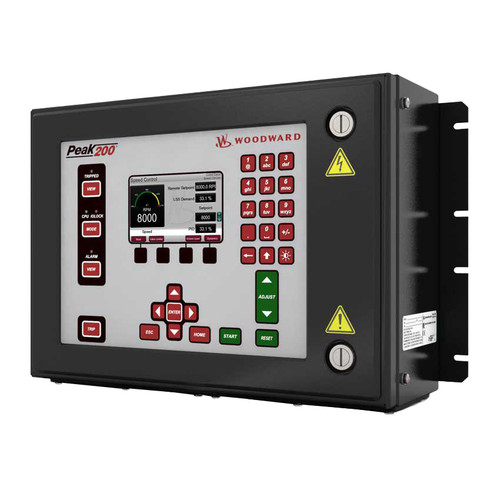
It adopts industrial standard bulkhead through-wall panel mounting, adapting to embedded fixed installation of control cabinet panel openings, featuring convenient disassembly and assembly, stable structure and excellent anti-vibration and anti-loosening performance, adapting to long-term high-frequency vibration working conditions of turbine equipment. The front panel is integrated with a high-definition display screen, physical operation keys and working condition indicators, which can intuitively display core parameters such as unit speed, load, valve position, pressure and fault codes in real time, supporting on-site local parameter setting, working condition debugging, fault query and logic calibration. Featuring a compact integrated structure and dust-proof and moisture-proof closed design, it adapts to the all-weather closed operation environment of power station control cabinets, supporting online parameter configuration and fault troubleshooting without shutdown, fully complying with Woodward original installation and operation specifications for turbine control systems.
Compatible Systems
It is exclusively adapted to the electro-hydraulic speed regulation control system of small and medium-sized steam turbines, compatible with mainstream electro-hydraulic converters, servo actuators, MPU magnetoelectric speed measuring probes, pressure transmitters, temperature sensors and other front-end equipment. Natively supporting Modbus RTU (RS485) serial port communication and Ethernet communication protocols, it can be seamlessly connected with upper SCADA monitoring systems, DCS distributed control systems, power plant energy management EMS and remote operation and maintenance platforms, realizing remote uploading of unit data, remote parameter modification, real-time monitoring of operating status and remote fault diagnosis. It adapts to the transformation of old steam turbine mechanical speed regulation to electronic control, analog control to digital control and digital upgrading of unit automatic control systems, compatible with mainstream industrial turbine control peripherals and upper-level networking architectures.
Product Characteristics
It is an original industrial-grade dedicated digital controller for steam turbines. Before delivery, it has completed full-load speed regulation aging, high and low temperature cycle impact, electromagnetic compatibility test, seismic compression resistance and full verification of protection logic with stable hardware performance and industry-leading speed regulation accuracy. The integrated design integrates speed regulation, pressure regulation, grid connection, protection and communication functions, simplifying the system hardware architecture and wiring costs. The independent hardware overspeed protection loop does not rely on software logic, eliminating protection failure caused by software faults. It supports seamless switching of multiple control modes, adapting to the full working conditions of unit start-stop, no-load, grid-connected and load-bearing operation. It supports 24/7 uninterrupted high-load operation. Old traditional turbine control modules with faults, attenuated accuracy and single functions can be replaced in situ without major transformation of equipment structure and control logic, greatly reducing unit technical transformation and operation and maintenance costs.
II. Technical Specifications
1. Core Control Performance Parameters
Control Modes: Natively support multi-mode adaptation including speed closed-loop control, load closed-loop control, extraction pressure control, valve position limit control and grid-connected synchronous auxiliary control, which can automatically switch regulation logic according to unit working conditions, adapting to the full-scenario operation of steam turbines under no-load, grid-connected, variable load and variable working conditions. Speed Regulation Accuracy: The steady-state speed control accuracy is ≤±0.05%, with fast dynamic response, no overshoot or oscillation during unit load fluctuation and steam parameter change, ensuring stable unit speed, accurate grid connection and smooth load regulation. Protection Logic: Adopting dual redundant protection of independent hardware overspeed protection loop and software, it supports full set of turbine safety protection functions such as overspeed tripping, low-speed protection, valve position fault, signal abnormality, power supply fault and interlock shutdown, with extremely fast protection action response and accurate judgment, eliminating major safety risks of unit overspeed runaway.
2. Signal & I/O Resource Parameters
Speed Measurement Input: Support multi-channel MPU magnetoelectric pulse speed signal acquisition, adapted to industrial turbine dedicated magnetoelectric speed measuring probes, with accurate hardware pulse analysis and strong anti-interference ability, which can accurately capture small unit speed fluctuations. Analog AI Input: Multi-channel isolated analog acquisition channels support 4~20mA/0~10V standard industrial signals, adapting to the acquisition of working condition parameters such as steam pressure, temperature, unit load and valve position feedback. Analog AO Output: Multi-channel adjustable analog output adapts to the drive of electro-hydraulic converters and servo actuators, accurately outputting regulation instructions to realize continuous and precise regulation of steam valve opening. Digital DI/DO: Multi-channel optoelectronic isolated digital input and relay output channels are used for unit start-stop instruction, interlock signal acquisition, fault alarm, shutdown protection and status indication output, with sufficient contact capacity and reliable action.
3. Communication & Networking Parameters
Communication Interface: Standard dual communication architecture of RS485 serial port (Modbus RTU) + Ethernet, taking into account on-site short-distance configuration and debugging and remote networked monitoring. Protocol Adaptation: Standard Modbus RTU industrial protocol with strong universal compatibility, which can be quickly connected with various PLC, SCADA and DCS systems without dedicated protocol conversion modules. Data Transmission: Support continuous uploading of real-time working condition data, fault codes, parameter status and alarm information, and support remote parameter reading and writing and control instruction issuing, with stable communication link, low delay and no data loss, adapting to the needs of remote centralized monitoring and digital operation and maintenance of power stations.
4. Electrical & Power Parameters
Power Supply Specification: Adopting industrial wide-range DC power supply design with input voltage of 18~32VDC (typical working voltage 24VDC), adapting to power station UPS DC stabilized power supply and battery backup power supply working conditions. Featuring low power consumption design, full-load power consumption ≤15W and low heat generation, no power attenuation or hardware overheating faults occur after long-term high-load operation. The power supply loop integrates multi-stage electrical protections including reverse connection protection, overvoltage protection, overcurrent protection, surge suppression and electrostatic protection, which can effectively resist on-site wiring misoperation, instantaneous power grid fluctuation and equipment start-stop surge interference, eliminating module burnout and control logic disorder faults with strong power supply stability and fault tolerance.
5. Environmental Operating Parameters
Operating Temperature:-20℃~+60℃
Storage Temperature:-40℃~+85℃
Operating Humidity:5%~95% RH, non-condensing
The whole machine has passed NEMA 4/4X industrial protection certification, power-level EMC electromagnetic compatibility and seismic impact authoritative testing. The metal reinforced shell is coated with three-proof protective coating, featuring excellent dust-proof, waterproof, moisture-proof, anti-corrosion, aging-resistant, vibration-resistant and strong electromagnetic interference-resistant performance. It can long-term withstand harsh working conditions such as high temperature, high vibration, dust accumulation, water vapor humidity and high-frequency converter interference in turbine workshops, supporting 24/7 uninterrupted continuous equipment operation.
III. Key Features
1. High-Precision Multi-Mode Regulation for Full-Condition Unit Operation
Integrated with multi-dimensional closed-loop control algorithms of speed, load, pressure and valve position, a single controller covers all working condition regulation requirements of small and medium-sized steam turbines. The steady-state speed control accuracy is as high as ±0.05% with no overshoot or oscillation in dynamic regulation, which can accurately adapt to unit no-load speed stabilization, grid-connected precise frequency matching, load-bearing smooth regulation and variable working condition adaptive regulation scenarios. Intelligent seamless switching of multiple control modes eliminates frequent manual parameter adjustments and automatically adapts to steam parameter fluctuations, external network load changes and equipment start-stop working conditions, greatly improving the operation stability and power generation energy efficiency of steam turbines, solving the industrial pain points of low accuracy, large lag and poor working condition adaptability of traditional mechanical speed regulation.
2. Dual Redundant Hardware & Software Protection to Eliminate Unit Overspeed Risks
Different from ordinary pure software speed regulation controllers, 8200-1509 adopts a dual redundant architecture of independent hardware overspeed protection loop + software logic protection. Overspeed judgment and tripping action do not rely on main control software operation. Even in case of main control program abnormality, crash or communication interruption, the hardware protection loop can independently trigger emergency shutdown instructions, completely eliminating major safety hazards of steam turbine overspeed runaway. Meanwhile, it integrates full set of safety logic such as low-speed protection, valve position abnormality protection, signal disconnection protection, power supply fault protection and interlock shutdown protection, fully covering unit operation fault scenarios and providing the highest level of safety protection for steam turbine safe and stable operation.
3. Integrated All-In-One Design to Simplify System Architecture and Reduce O&M Costs
The highly integrated whole machine integrates full functions of speed measurement conditioning, signal acquisition, logic operation, regulation output, fault protection and communication networking, eliminating the need for additional matching speed regulation modules, protection modules and protocol conversion modules, greatly reducing the number of hardware devices and complex wiring in control cabinets. The front visual operation interface supports on-site local parameter modification, curve viewing, fault tracing and debugging calibration, enabling convenient and efficient on-site operation and maintenance. The integrated standardized design has strong compatibility, which can directly replace old mechanical governors, analog speed regulation boards and old digital controllers, adapting to the technical transformation and upgrading of most small and medium-sized steam turbines without reconstructing control logic or transforming actuators, greatly reducing equipment upgrading and daily operation and maintenance costs.
4. Industrial-Grade Harsh Protection for Turbine Severe Condition Operation
Adopting NEMA 4/4X high-standard industrial protection structure, the metal reinforced shell is seismic and drop resistant, with full-domain electromagnetic shielding design, which can effectively resist harsh environmental interference such as high-frequency vibration, strong electromagnetic radiation, high temperature and dust accumulation and humid water vapor in turbine workshops. The circuit adopts multi-layer isolation protection, and the signal loop is anti-clutter, anti-drift and anti-crosstalk with no parameter deviation or logic disorder after long-term operation. It has strong adaptability to wide temperature and voltage range, can adapt to seasonal temperature difference fluctuation and small-range power grid voltage fluctuation, ensuring stable annual all-weather operation of the unit with extremely low failure rate, meeting the continuous uninterrupted production and operation needs of industrial power stations.
5. Standardized Communication Networking for Digital Intelligent O&M
Equipped with dual communication links of standard Modbus RTU serial port and Ethernet, it supports real-time data uploading, remote parameter configuration, remote fault information push and operation trend tracing. It can be seamlessly connected with power plant DCS, SCADA and energy management systems to realize digital, visualized and remote management of steam turbine operation status, helping factories transform from manual on-site operation and maintenance to intelligent remote operation and maintenance. The complete data recording and fault latching function can retain the full working condition parameters of the unit at the time of fault occurrence, providing accurate data support for fault review, equipment maintenance and process optimization, and improving the intelligent operation and maintenance level of the unit.
IV. Working Principle
Woodward 8200-1509 is an integrated digital speed regulation and protection controller dedicated to Peak200 series small and medium-sized steam turbines. As the core hub of unit speed regulation and safety protection, after panel mounting and fixing, connecting 24VDC working power supply, MPU speed measurement signals, analog working condition signals, switch interlock signals and communication links, it automatically completes hardware self-test, loop initialization, control parameter loading, communication handshake and working condition calibration upon power-on, and enters the real-time unit speed regulation and protection operation state after initialization.
During normal equipment operation, it continuously collects real-time speed pulse signals of steam turbines through front-end MPU magnetoelectric speed measuring probes. After accurate analysis and filtering error correction by the hardware speed measurement loop, it compares the difference with the system set speed and load target value. Meanwhile, it real-timely collects unit steam pressure, valve position feedback, load working condition and other parameters. Through the built-in high-precision closed-loop control algorithm operation, it outputs continuously adjustable analog control instructions to drive the electro-hydraulic actuator to accurately adjust the steam valve opening, realizing unit speed stabilization, load closed-loop regulation and extraction pressure stabilization control, adapting to the adaptive operation of the unit under start-stop, no-load, grid-connected and load-bearing full working conditions.
In the whole process of unit operation, the equipment runs dual loops of software logic protection and independent hardware overspeed protection simultaneously, real-timely monitoring abnormal working conditions such as sudden unit speed change, signal disconnection, valve position abnormality, power supply fault and interlock trigger. When hidden dangers such as unit overspeed, parameter over-limit and equipment fault occur, the software logic prioritizes rapid adjustment and correction, and triggers alarm and shutdown protection immediately if the abnormality cannot be eliminated; under extreme working conditions, the hardware protection loop acts independently to force shutdown instructions, lock the fault state and retain fault codes to avoid fault expansion. At the same time, it uploads unit operation data and fault information in real time through dual communication links, receives remote upper-level regulation instructions to complete unit collaborative management, and continuously ensures accurate regulation and safe and stable operation of steam turbines.
V. Application Scenarios
1. Small and Medium-Sized Steam Turbine Main Control Speed Regulation System: Widely applied in combined heat and power units, waste heat power generation steam turbines and industrial self-provided power station turbomachines, undertaking core tasks of unit speed regulation, load control, pressure stabilization and grid-connected management.
2. Digital Technical Transformation of Old Turbine Control Systems: Replace traditional mechanical governors, analog speed regulation devices and old simple digital controllers, solving the problems of low speed regulation accuracy, unstable working conditions, lack of remote monitoring and missing protection functions of old equipment, realizing digital upgrading of unit automatic control systems.
3. Industrial Waste Heat Power Generation Power System: Adapted to waste heat recovery steam turbines in chemical, metallurgical and building materials industries, accurately matching the fluctuating working conditions of waste heat parameters, ensuring efficient, stable and safe operation of waste heat units and improving energy recycling efficiency.
4. Power Station Steam Turbine Safety Protection System: As an integrated core equipment for unit speed regulation + protection, relying on dual redundant protection architecture, it provides comprehensive safety protection such as overspeed and overload prevention for small and medium-sized steam turbines, avoiding major unit safety accidents.