Description
1. Overview
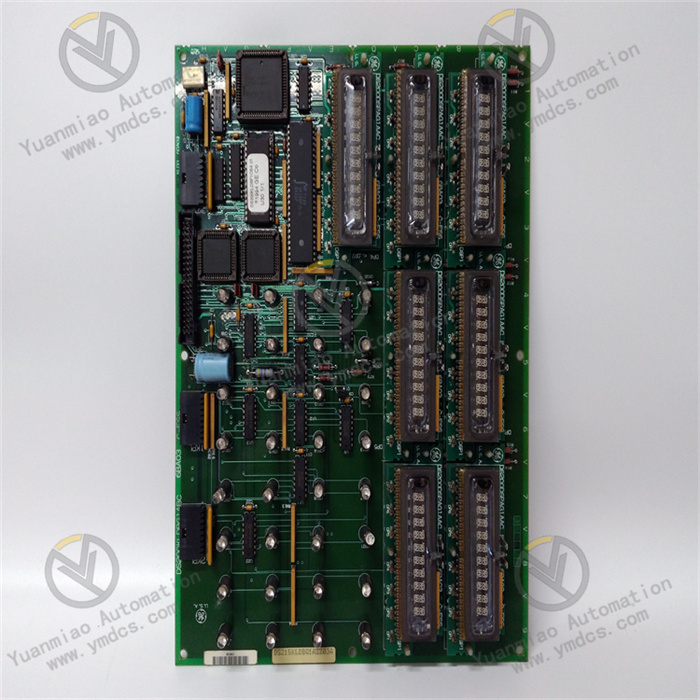
The IS200SSCAH2A is a dedicated terminal communication interface module developed by General Electric (GE) exclusively for the Speedtronic Mark VI turbine control system. Serving as core supporting hardware for system board signal transition, terminal wiring matching and bus data exchange, it is widely compatible with gas turbine, steam turbine and auxiliary power plant automation control systems. As the pivotal hub for internal system signal relay and external field wiring, this module undertakes critical functions including field cable terminal transition, multi-channel signal sorting and distribution, communication link matching, signal isolation preprocessing, system board port expansion and synchronized data transmission. It is an essential foundational module ensuring stable signal docking between the internal and external parts of the Mark VI control system, standardized wiring, organized communication links and closed-loop unit control logic.
Different from general-purpose terminal boards, the IS200SSCAH2A is custom optimized for power plant turbine control scenarios demanding high reliability, high synchronization and long-cycle continuous operation. Adopting an integrated terminal layout, dedicated signal conditioning circuits and anti-interference wiring architecture, it features neat wiring, low signal crosstalk, robust link stability, broad compatibility and excellent fault tolerance. The complete module has passed rigorous power-industry reliability tests covering high & low temperature cycling, damp-heat durability, mechanical vibration shock, Electromagnetic Compatibility (EMC) and long-term energized aging. It can reliably operate under harsh cabinet conditions in power plants, including enclosed high temperature, high humidity with condensation, dust accumulation, intensive electromagnetic radiation, disturbance caused by frequent equipment startup/shutdown, and 24-hour nonstop continuous operation. Identical mechanical dimensions, terminal definitions, interface logic and communication protocols to legacy modules of the same series enable non-destructive in-situ upgrade replacement. It is extensively applied for maintenance of Mark VI control systems in power plants, replacement and upgrade of aging terminal modules, troubleshooting of wiring loops, stability optimization of communication links and hardware renovation of turbine control systems.
2.1 Integrated Terminal Layout Enables Standardized and Neat Wiring
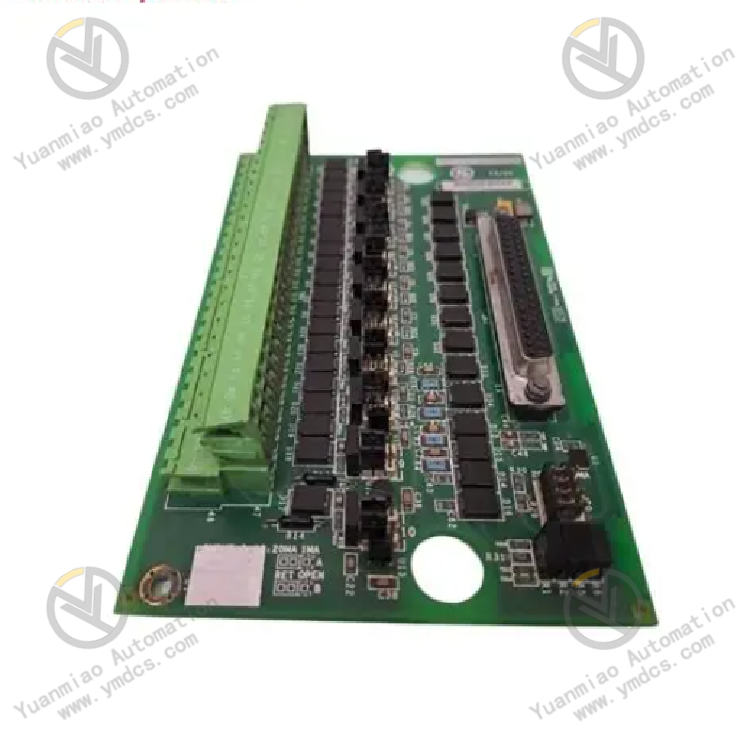
The module is equipped with an integrated terminal block arranged in two rows of 24 terminals each, totaling 48 screw-type wiring terminals, alongside an on-board dedicated 37-pin communication cable interface for standardized transition between field external cables and system main control boards. Terminals are neatly arranged with clear zoning, effectively organizing multi-channel control signals, acquisition signals and communication lines. It eliminates messy field wiring, crossed lines and mixed use of terminals, significantly improving wiring standardization of control systems and efficiency of later maintenance troubleshooting, and meeting networking requirements for centralized access of massive signals in turbine control systems.
2.2 High-Precision Signal Preprocessing Delivers Strong Transmission Stability
Embedded with dedicated signal conditioning, filtering and shaping circuits, the module performs noise reduction filtering, amplitude regularization and impedance matching preprocessing on weak analog signals and digital control signals accessed from the field. It effectively filters out invalid noise such as grid harmonics, power-frequency clutter, electromagnetic crosstalk and line induced interference, resolving issues of signal attenuation, waveform distortion and data jitter during long-line transmission. All incoming signals feature regular waveforms, stable values and unified timing, providing pure and reliable signal support for precise turbine control, logic operation, condition monitoring and fault diagnosis. It eliminates hidden risks of unit control deviation and spurious operation induced by abnormal signals.
2.3 Multi-Signal Compatibility Ensures High System Integration
It supports transition of multiple types of industrial signals including analog signals, digital discrete signals and low-speed bus communication signals, perfectly matching the signal interaction logic and bus protocols of the GE Mark VI turbine control system. The module seamlessly connects system main control boards, various I/O functional modules, field sensors, actuators and upper monitoring systems to realize stable bidirectional transmission of unit control commands, equipment status data and fault alarm information. It accommodates full-process control scenarios including turbine startup/shutdown control, load regulation, condition monitoring and fault protection with superior system integration adaptability.
2.4 Hardware-Level Anti-Interference Design Ensures Excellent Adaptability to Complex Conditions
The whole module adopts an industrial-grade anti-interference architecture. The PCB integrates multi-stage circuits for electrostatic protection, surge suppression, high-frequency filtering and electromagnetic shielding, with optimized isolation for terminal loops and signal links. It effectively counteracts complex interference in power plants and industrial sites such as intensive electromagnetic radiation, pulse disturbance from switch closing/opening, grid harmonic disturbance, line induced voltage and ground circulating current. Hardware-level prevention is achieved against signal jitter, value drift, intermittent communication dropout and erroneous logic judgment, sustaining stable signal transmission under harsh conditions featuring heavy interference, drastic temperature fluctuation and frequent vibration.
2.5 Intelligent Self-Diagnosis and Monitoring Guarantees Controllable Operational Safety
Comprehensive self-inspection and O&M functions are integrated: full hardware self-test upon power-up, continuity monitoring of terminal loops, signal link status identification, line anomaly screening and data transmission verification. Hazards such as loose terminals, poor wire contact, loop short circuit, abnormal signals, open links and communication loss of synchronization can be automatically identified. Operation logs are retained and alarm information uploaded in real time to help maintenance personnel quickly locate fault points and shorten troubleshooting time. Basic fault tolerance protection is also available to prevent full-board signal failure and chaotic system communication triggered by spread of local line anomalies, ensuring stable unit operation.
2.6 Non-Destructive In-Situ Replacement Supports Efficient and Low-Cost O&M Upgrades
Overall dimensions, cabinet installation specifications, slot alignment structure, terminal pin definitions, electrical matching parameters and system communication docking logic are fully compatible with legacy terminal modules of the IS200 series with identical dimensions, enabling direct plug-and-play non-destructive in-situ upgrade replacement. No revision of system control programs, reconfiguration of signal parameters, large-scale renovation of field wiring or re-commissioning of system communication timing is required. The module can resume service after passing power-on self-test and normal link handshake synchronization, drastically cutting unit maintenance downtime, technical renovation commissioning costs and upgrade risks, accommodating hardware upgrade demands of aging Mark VI control systems.
2.7 Industrial-Grade Triple-Protection Construction Enables Long-Term Maintenance-Free Operation
Fabricated with premium original industrial components, thickened flame-retardant PCBs and full-area triple-proof special coatings (moisture-proof, dust-proof, anti-corrosion), the module contains no mechanical moving parts, featuring low power consumption, low heat generation and outstanding resistance to aging, temperature drift, vibration and electromagnetic interference. It withstands long-term cabinet operation under enclosed high temperature, humid condensation, accumulated dust & oil contamination, high-frequency vibration and 24-hour energized continuous operation. No terminal oxidation with poor contact, signal transmission attenuation or performance degradation occurs during long-term service. Regular calibration and commissioning are unnecessary, satisfying years of uninterrupted stable operation requirements of power plant turbine equipment.
3. Specification Parameters
3.1 Basic Parameters
- Model: IS200SSCAH2A
- Manufacturer: GE General Electric
- Device Type: Turbine Control System Terminal Communication Interface Module
- Compatible Systems: GE Speedtronic Mark VI gas/steam turbine control systems, power plant process industrial control systems
- Core Functions: Field cable terminal transition, multi-channel signal sorting & distribution, signal filtering & conditioning, impedance matching, communication link docking, loop status monitoring, fault self-diagnosis, synchronized system signal transmission
- Application Scenarios: Maintenance of Mark VI systems in power plants, replacement & upgrade of legacy terminal interface modules, standardized renovation of field wiring, stability optimization of turbine signal transmission, iteration of industrial control system signal links, unit hardware technical renovation projects
3.2 Electrical and Interface Performance Parameters
- Operating Power Supply: Standard industrial cabinet-compatible power supply with wide voltage adaptability, low power consumption, anti-fluctuation and stable operation fit for nonstop power plant operation
- Terminal Configuration: Two-row layout with a total of 48 screw-fixed wiring terminals (24 terminals on upper and lower rows respectively), delivering firm wiring with vibration resistance and anti-loosening performance
- Communication Interface: On-board dedicated standard 37-pin communication cable connector for docking main control boards and high-speed data exchange
- Supported Signals: Compatible with standard industrial analog signals, digital discrete signals and low-speed bus communication signals for transmission of all types of turbine control signals
- Signal Processing: Embedded multi-stage filtering, noise reduction and shaping circuits to effectively suppress clutter interference and optimize signal transmission quality
- Transmission Performance: Precise timing and high synchronization of signal transmission with near-zero bit error rate, supporting stable parallel transmission of multiple signals
- Protection Capability: Integrated multi-level protection against overvoltage, overcurrent, surge, electrostatic discharge and electromagnetic interference to prevent board and system equipment damage caused by line anomalies
- Operation Mode: Supports 24-hour uninterrupted continuous energized operation, applicable to all working conditions including steady-state unit operation, load fluctuation, startup/shutdown switching and fault transients
3.3 Environmental Operating Parameters
- Operating Temperature: -30℃ ~ +70℃, adaptable to extreme cabinet temperature fluctuation and long-term enclosed high-temperature continuous operation
- Storage Temperature: -40℃ ~ +85℃, meeting environmental requirements for long-distance equipment transportation and long-term equipment shutdown storage
- Operating Humidity: 5% ~ 95%RH (non-condensing); moisture resistant to prevent short-circuit damage and performance degradation caused by dew formation
- Ingress Protection Rating: High-grade industrial protection with dust-proof, moisture-proof, anti-corrosion, mechanical vibration resistance and anti-aging performance
- EMC Compliance: Complies with high-end anti-interference EMC standards for power industries, adapted to complex power plant conditions featuring intensive electromagnetic fields and dense harmonics
3.4 Structural and Maintenance Parameters
- Structure Form: Compact plug-in modular design adopting precision multi-layer SMT PCB technology with neat layout, uniform heat dissipation and strong vibration resistance
- Mounting Method: Slot plug-in installation for standard Mark VI system cabinets with precise alignment, stable contact and convenient installation
- Version Compatibility: Fully compatible with legacy terminal communication modules of the IS200 series with identical dimensions, supporting non-destructive in-situ replacement and upgrade iteration
- Maintenance Features: Automatic hardware self-test upon power-up, real-time loop status monitoring, automatic fault log archiving, visualized link status, no routine parameter calibration required
- Operational Advantages: Stable terminal contact, drift-free signal transmission, dropout-free communication, ultra-low failure rate, long-cycle maintenance-free service
After power-on, the IS200SSCAH2A terminal communication interface module automatically completes hardware initialization, terminal loop self-test, power supply status verification, communication interface inspection and link parameter matching. Upon successful full-dimensional self-inspection and normal communication handshake synchronization with the main control board, the module connects formally to the GE Mark VI turbine control system and enters steady signal transition and data transmission operation.
During runtime, serving as the core transfer hub for signal interaction between the internal and external parts of the system, the module centrally receives raw control and monitoring signals transmitted by field sensors, actuators, temperature/pressure measuring equipment. All incoming signals undergo front-end protection, multi-stage filtering, noise reduction shaping and impedance matching preprocessing on the PCB to eliminate invalid interference such as line clutter, electromagnetic crosstalk and induced disturbance, and correct signal attenuation and waveform distortion induced by long-line transmission, outputting regular, stable and standardized industrial signals. Meanwhile, multi-channel signals are sorted, distributed and categorized via standardized terminal layout to standardize messy field wiring and avoid logic disorder caused by crossed line interference and mixed use of terminal signals.
Preprocessed standardized signals are uploaded to the system main control board at high speed and synchronization via the on-board dedicated 37-pin communication interface for logic operation, data parsing and condition evaluation. In addition, various control commands, parameter configurations, startup/shutdown signals and load regulation instructions issued by the main control system are accurately forwarded, realizing fully automatic closed-loop data interaction and command transmission between the main control system and field equipment. Precise and stable execution of control logic including turbine startup/shutdown control, load regulation, condition monitoring, overtemperature/overpressure protection and fault interlock is guaranteed.
Hardware, terminal loops, communication links and data transmission quality are monitored in real time throughout operation with comprehensive self-diagnosis and anomaly protection capabilities. Once hidden hazards such as loose terminals, poor wire contact, loop short circuit, abnormal signals, open links and communication loss of synchronization are detected, fault locations are pinpointed immediately with operation logs retained and alarm information uploaded to facilitate rapid troubleshooting by maintenance staff. A hardware isolation mechanism restricts spread of local line anomalies to sustain stable signal transmission of remaining normal loops. Risks including unit control failure, blind monitoring zones and chaotic system communication caused by single-point line faults are prevented, comprehensively ensuring safe, stable and reliable signal transmission of the Mark VI turbine control system.
5.1 Signal Transfer Hub of Turbine Control Systems
As the dedicated terminal communication transition core of GE Mark VI gas and steam turbine control systems, it undertakes full tasks of centralized access, sorting, preprocessing and bidirectional transmission of all field control, monitoring and communication signals of units. It builds a signal interaction bridge between main control boards and field equipment, guaranteeing closed-loop signal transmission for core control logic such as unit startup/shutdown, load regulation, condition monitoring and fault protection. It serves as essential supporting hardware for stable operation of turbine control systems.
5.2 Standardization Renovation and Optimization of Field Wiring
Widely deployed for wiring renovation of aging turbine control cabinets in power plants, it organizes messy multi-channel wiring via standardized integrated terminal layout, addressing common drawbacks of outdated equipment including disordered wiring, unzoned terminals, severe crossed line interference and heavy signal crosstalk. Signal preprocessing and anti-interference design comprehensively improve stability and consistency of field signal transmission, reducing latent faults such as unit false alarms, spurious operation and signal drift induced by line interference, and elevating overall operational quality of complete control systems.
5.3 Stable Signal Transmission Adaptation for Complex Operating Conditions
Benefiting from multi-stage electromagnetic protection, signal filtering conditioning and optimized loop isolation architecture, the module is highly adapted to harsh field conditions of power plant turbines: intensive electromagnetic radiation, frequent switching operations, dense grid harmonics, recurring equipment vibration and drastic ambient temperature fluctuation. Various external interference is effectively resisted to guarantee distortion-free, drift-free and dropout-free transmission of control and monitoring signals. Control logic deviation, inaccurate monitoring data and abnormal system communication triggered by interference are avoided, meeting high-reliability operation requirements of units.
![]()