Description
NI GPIB-140A/2
1. Basic Information
The NI GPIB-140A/2 is a high-performance GPIB bus extender. It is positioned as a signal extension and device expansion component for GPIB systems, specially designed for industrial testing, laboratory measurement and other applications. It is used to extend the transmission distance of GPIB bus and increase the number of connectable devices, serving as a key interface device to realize long-distance coordinated operation of multiple devices in complex measurement systems.
It effectively solves the drawbacks of traditional GPIB buses such as short transmission distance and limited accessible devices. Adopting buffer transmission technology, it can extend the maximum transmission distance of GPIB systems up to 2 kilometers without damaging bus integrity or modifying system software. Meanwhile, it expands the maximum number of accessible GPIB devices from 15 to 26. It enables long-distance coordinated measurement of various testing instruments and devices under test, greatly improving the flexibility and coverage of GPIB systems.
2. Technical Specifications
2.1 Core Electrical & Transmission Specifications
- Power Supply: Input 5 VDC, operating current 500 mA. Stable power supply ensures continuous and reliable operation, suitable for standard power supply environments in laboratories and industrial sites.
- Transmission Performance: Two transmission speed modes are supported. The speed reaches 1.1 Mb/s complying with IEEE 488.1 standard and 2.8 Mb/s under HS488 standard. It can be flexibly adjusted according to testing demands to balance transmission speed and stability. Built-in buffer transmission technology guarantees complete data transmission over long distances.
Bus Expansion Capacity: Extends the maximum GPIB bus transmission distance to 2 km to break traditional distance limits; increases accessible GPIB devices from 15 to 26 to meet multi-device connection demands of complex testing systems.
- Interface Standard: Equipped with standard GPIB interfaces fully compliant with IEEE 488 standards. It can be directly connected with GPIB instruments, computers and testing modules without extra adapters. It supports bus buffering and signal amplification to compensate signal attenuation during long-distance transmission.
- Driver & Compatibility: Ready for use without revising system software. It is compatible with NI testing drivers, Windows, Linux and other operating systems, as well as development environments including LabVIEW and Measurement Studio, simplifying system integration.
Environmental Adaptability: Operating temperature: 0℃~55℃; Storage temperature: -20℃~70℃; Operating humidity: 10%~90% (non-condensing). It adapts to conventional laboratory and industrial working environments with excellent long-term operational stability.
2.2 Physical & Structural Specifications
- Installation Mode: Supports desktop and rack mounting, easy to deploy on laboratory workbenches and industrial cabinets. The installation position can be adjusted flexibly according to on-site space for convenient maintenance and later expansion.
- Physical Dimension: Adopts standardized industrial compact enclosure to save installation space, perfectly fitting densely arranged multi-device testing layouts and existing testing system structures.
Weight: Lightweight design with moderate weight, easy for on-site handling and installation without adding extra load to workbenches or cabinets, ideal for mobile testing applications.
- Enclosure & Connection: Industrial housing provides outstanding anti-electromagnetic interference and dustproof performance against common on-site interference and dust. Reasonably arranged GPIB and power interfaces ensure convenient wiring and firm connection with anti-loose design to stabilize signal transmission and power supply.
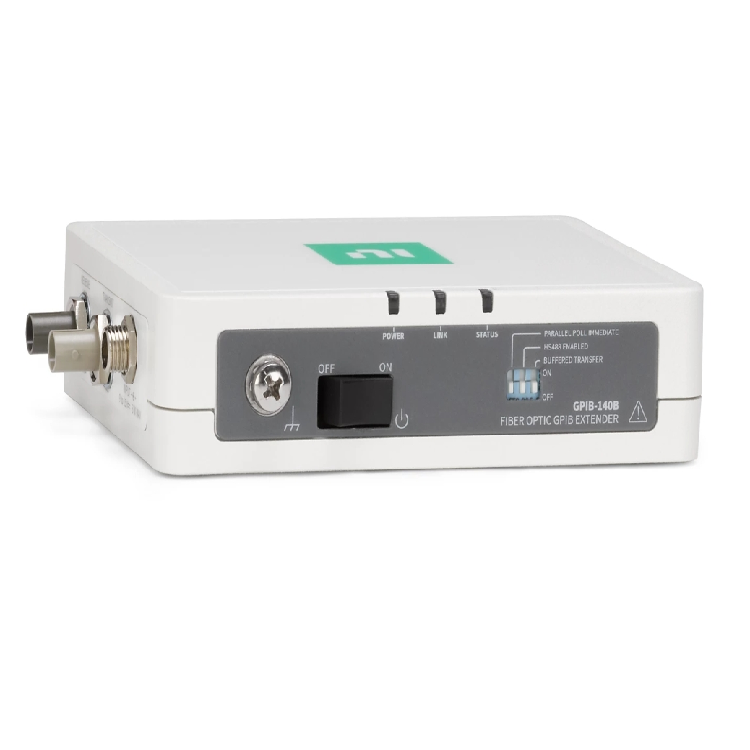
- Product Features: Modular design enables independent operation to realize GPIB bus extension without relying on other NI modules. Complete status indicators directly display power status, bus connection status and data transmission status for quick on-site operation judgment.
2.3 Core Functions & Compatibility Specifications
- Core Functions: Long-distance GPIB bus extension (max. 2 km), GPIB device quantity expansion (max. 26 units), high-speed buffered data transmission, signal amplification and compensation, bus status monitoring. It realizes long-distance multi-device coordinated measurement and ensures complete and stable data transmission.
Integrated Features: Highly integrated design embeds signal buffer unit, signal amplification unit and bus control unit. Complete GPIB bus extension functions can be realized without additional accessories, simplifying system construction and cutting deployment costs. It supports plug-and-play for rapid commissioning without complex configuration.
- Compatibility: Fully compatible with all IEEE 488 standard GPIB devices such as multimeters, oscilloscopes, signal generators and data acquisition modules. It matches full-series NI GPIB testing equipment and drivers for seamless access to existing GPIB testing systems, and supports cross-platform operation under Windows and Linux systems.
- Reliability & Practicability: Reinforced industrial design delivers excellent anti-interference and anti-vibration performance with low long-term failure rate to reduce system maintenance costs. Bus expansion can be realized without software modification to minimize impacts on original testing systems. Intuitive indicator lights facilitate fast on-site troubleshooting and improve maintenance efficiency.
3. Working Principle
- Device Initialization & Connection MatchingAfter power-on, GPIB-140A/2 automatically completes self-check and system initialization to verify the working condition of internal interfaces, signal buffer units and amplification units, and enters ready state after confirmation. Connect one end to the host or existing GPIB system and the other end to remote GPIB devices. It achieves automatic system matching and plug-and-play operation without extra software configuration.
- Bus Signal Buffering & AmplificationWhen GPIB bus signals pass through the extender, the built-in buffer unit caches signals to avoid data loss and distortion during transmission. The signal amplification unit compensates attenuated signals to maintain signal integrity within the maximum 2-kilometer transmission range and guarantee accurate data delivery.
- Data Transmission & Coordinated ControlControl commands issued by the host are buffered and amplified by GPIB-140A/2 and transmitted to remote GPIB devices. Feedback data and measured data from remote devices are processed and sent back to the host to realize two-way data interaction. In addition, the extender supports coordinated operation to achieve synchronous data transmission and control among up to 26 GPIB devices.
- Adaptive Transmission Speed AdjustmentThe device automatically selects proper transmission speed modes according to actual bus load and transmission distance. It switches to IEEE 488.1 (1.1 Mb/s) for stable transmission over long distances or under heavy bus load, and switches to HS488 (2.8 Mb/s) to raise transmission efficiency for short-distance and light-load transmission.
- Status Monitoring & Abnormality HandlingThe extender monitors real-time bus connection status, data transmission status and self-operating status, and feeds back working information via indicator lights. It triggers prompt signals and suspends data transmission once detecting bus disconnection, signal errors, power faults and other anomalies to prevent data loss and device damage and facilitate rapid fault elimination.
4. Application Scenarios
4.1 Laboratory Precision Measurement
4.2 Industrial Automated Testing
4.3 Aerospace Testing
4.4 Multi-device Collaborative Testing
4.5 Long-distance Testing