Description
1. Product Overview
GE IS220PDOAHIA is a high‑performance discrete output module (DO module) dedicated for GE Speedtronic Mark VIe gas / steam turbine control systems. As one of the core I/O components of GE IS series, it serves as the critical execution unit for automation control systems of gas turbines, steam turbines and combined‑cycle units in power plants.
This module converts digital logic control commands issued by the main control system into discrete output signals to drive field‑mounted relays, solenoid valves, trip circuits and actuators, performing key operations including unit start‑stop, interlock protection, valve regulation and emergency trip. Fully compatible with the complete GE Mark VIe industrial control platform, it supports dual‑Ethernet redundant communication, multi‑channel relay‑isolated outputs and real‑time status diagnostic feedback. Compliant with power‑industry SIL safety‑level specifications, it delivers fast control response, high‑precision output, strong anti‑interference performance and outstanding operational stability. It is widely deployed for maintenance replacement, fault substitution and technical retrofit of legacy thermal‑power, gas‑fired and combined‑cycle power‑plant units.
2. Functional Features
2.1 Multi‑channel Isolated Discrete Output for Accurate Logic Execution
The module integrates 12 independent relay‑isolated discrete output channels with galvanic isolation between each channel. Each channel can output discrete control signals independently to drive various on‑site switching actuators for turbine‑generator units. It features precise actuation and fast response, reliably executing logic commands for start‑up / shutdown, switching, interlock and tripping without delay or false actuation. It meets high‑real‑time and high‑safety control requirements of gas and steam turbines and ensures closed‑loop reliable execution of unit control logic.
2.2 Dual‑Ethernet Redundant Communication for Stable Networking
Equipped with dual 10/100Base‑TX industrial Ethernet ports, it supports hot‑standby redundant networking. Two independent I/O Ethernet networks can be connected simultaneously for link redundancy. Upon single‑link failure, disconnection or electromagnetic disturbance, seamless automatic switch‑over to the standby link takes place without interrupting module output or data transmission. It eliminates control failure and unit shutdown risks caused by single‑point communication faults and greatly improves continuous‑operation reliability of the whole turbine‑control system.
2.3 Full‑scope Status Diagnosis and Fault Tracing
Comprehensive hardware self‑diagnosis and loop‑monitoring functions are implemented. It collects real‑time parameters including module power supply status, communication link condition, contact status of each output channel, load conditions and module internal temperature. Local LED indicators provide visual alarm, meanwhile fault data is uploaded to the upper‑level main controller via backplane bus. It accurately identifies hidden troubles such as channel abnormality, overload, communication breakdown, power‑supply anomaly and contact failure, enabling precise fault location and rapid troubleshooting to reduce maintenance workload and downtime.
2.4 High‑safety Design for Unit Protection Loops
Designed in compliance with IEC 61508 functional‑safety standards for SIL2 / SIL3 applications, it is developed for critical safety loops such as unit tripping, interlock protection and emergency shutdown. Output circuits adopt anti‑false‑trigger, anti‑chatter and transient‑suppression measures to avoid mis‑operation induced by electromagnetic interference and signal noise. It guarantees accurate and reliable actuation of vital protection loops and prevents safety accidents and production losses resulting from spurious trip or failure to trip.
2.5 Flexible Redundancy Configuration for Diverse Control Architectures
Multiple operation modes including simplex and duplex hot‑standby are supported. Redundant control structures can be configured flexibly according to process requirements to satisfy power‑plant control systems of different safety and redundancy levels. Compatible with a variety of discrete‑output terminal boards, it adapts to diversified field wiring and equipment types, covering scenarios such as legacy‑unit retrofit, system expansion and loop optimization.
2.6 Industrial‑grade Rugged Design for Long‑term Operation under Harsh Conditions
Adopting ruggedized board‑level technology and wide‑temperature components, the module has passed strict tests for temperature cycling, vibration and electromagnetic interference. It adapts to severe plant‑room conditions such as high temperature, humidity, dust, intensive electromagnetic radiation and mechanical vibration. With stable power consumption, uniform heat dissipation and no mechanical wearing parts, it runs 7×24‑hour non‑stop without performance degradation and achieves extremely low failure rate to sustain stable operation of turbine‑control systems.
3. Technical Specifications
3.1 Basic Specifications
Product Model: IS220PDOAHIA Manufacturer: GE (General Electric, USA) Product Type: Discrete Output (DO) Control Module Product Series: IS Series for Mark VIe Speedtronic Control System Core Application: Discrete‑logic output, field‑device driving, interlock control, emergency tripping and process execution for turbine‑generator units Compatible System: GE Mark VIe control system for gas turbines, steam turbines and combined‑cycle units Product Characteristics: 12 isolated output channels, dual‑network redundancy, SIL safety compliance, comprehensive diagnostics, high anti‑interference capability, maintenance‑free.
3.2 Channel & Output Specifications
Output Channels: 12 independent galvanic‑isolated relay output channels Output Type: Dry‑contact isolated output with galvanic separation among individual loops Response Performance: Fast logic response matching millisecond‑level timing requirements of turbine‑unit control Load Compatibility: Suitable for conventional power‑plant actuators, relays and solenoid valves Isolation Performance: Channel‑by‑channel galvanic isolation to eliminate loop crosstalk and signal coupling interference.
3.3 Communication Specifications
Communication Interfaces: Dual 10/100Base‑TX Ethernet ports Communication Mode: Dual‑network hot‑standby with automatic switch‑over Communication Protocol: Proprietary industrial protocol for GE Mark VIe system Transmission Performance: High‑speed real‑time data exchange with low latency, high synchronization and zero packet loss Networking Capacity: Multi‑module networking supporting distributed I/O architecture for large‑scale power‑generation units.
3.4 Electrical Specifications
Nominal Supply Voltage: 28 V DC, operating range: 18 V DC ~ 32 V DC Circuit Design: On‑board power filtering, surge suppression, galvanic isolation and anti‑false‑trigger circuits Operational Performance: Tolerant of grid fluctuation, electromagnetic interference and voltage transients; stable logic performance during long‑term continuous operation Protection Functions: Multi‑level self‑protection against channel overload, short‑circuit, over‑temperature and communication anomalies.
3.5 Environmental and Mechanical Specifications
Operating Temperature: 0℃ ~ +70℃ Storage Temperature: ‑25℃ ~ +85℃ Mounting Method: Standard slot‑based embedded cabinet installation Construction Technology: Industrial ruggedized PCB, optimized ventilation and anti‑vibration design Environmental Resistance: Dust‑proof, moisture‑proof, anti‑aging, EMC‑hardened, resistant to temperature cycling Applicable Conditions: Non‑stop closed‑cabinet operation in power‑plant control rooms.
4. Hardware Configuration & Structural Advantages
4.1 Multi‑channel Galvanic‑isolated Output for Superior Control Safety
All 12 output channels are fully galvanically isolated. Fault, short‑circuit or wiring abnormality on one channel will not affect other channels or the whole module, avoiding multi‑point control failure caused by single‑point defects. Isolated loops suppress back‑EMF and field‑side noise, protecting module hardware and the main controller, and satisfying high‑safety multi‑loop control requirements of power‑generation units.
4.2 Dual‑Ethernet Redundancy Eliminating Single‑point Communication Failure
Two physically independent Ethernet links run in hot‑standby mode with real‑time data synchronization. Automatic and transparent switch‑over occurs upon single‑network disconnection or disturbance without interrupting control logic or losing operational data. Compared with single‑network modules, it removes single‑point risks of communication links and improves fault‑tolerance and stability of turbine‑control loops.
4.3 Comprehensive On‑board Diagnostics for Efficient Maintenance
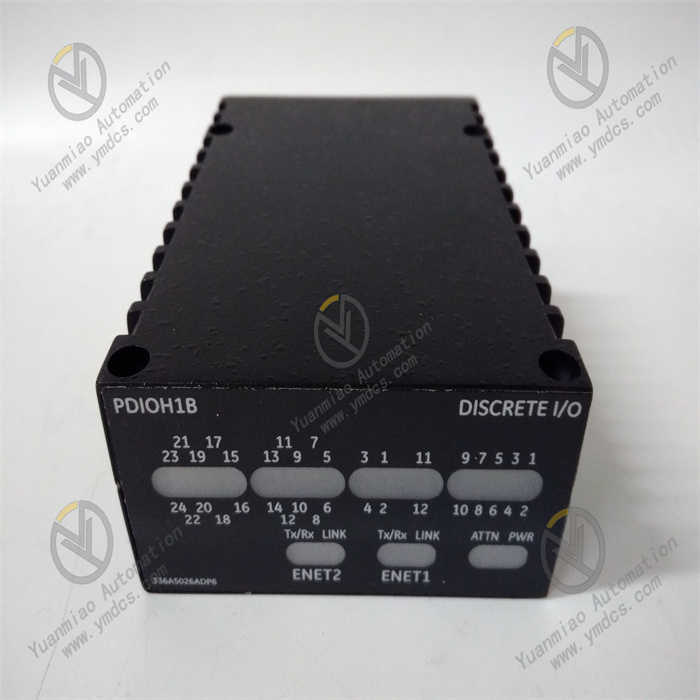
Hardware‑oriented full‑range diagnosis covers power supply, communication, channels, load and temperature status. Local quad‑color LEDs indicate power, alarm, transmit/receive and link status for direct visual monitoring. Combined with GE Proficy diagnostic software, remote supervision, fault early‑warning and predictive maintenance are available. It reduces manual troubleshooting costs and mitigates unit‑shutdown risks induced by latent defects.
4.4 OEM‑standard Design for Direct On‑site Replacement
Board dimension, slot footprint, pin assignment, communication protocol and control logic are fully consistent with original GE Mark VIe systems. Aged, faulty or communication‑failed modules of the same part number can be swapped directly on‑site. No cabinet modification, program rewriting or complex parameter tuning is required. Plug‑and‑play operation restores unit control functions rapidly and cuts maintenance downtime significantly.
4.5 High‑safety Industrial Architecture for Critical Turbine‑unit Service
Developed according to power‑industry functional‑safety standards, it integrates complete anti‑mis‑operation, anti‑refusal‑to‑act and fault‑latching mechanisms for critical safety loops including turbine tripping and interlock protection. Rugged hardware provides excellent resistance to interference, shock and aging for long‑term reliable performance under complex electromagnetic plant‑site conditions and guarantees safety of core unit control loops.
5. Application Scenarios
- Gas‑turbine & Steam‑turbine Control Systems: Deployed in GE Mark VIe main‑control systems to perform discrete‑signal functions for valve control, unit start‑stop logic, mode switching and auxiliary‑equipment driving.
- Unit Safety Interlock & Trip Systems: Executes output duties for emergency shutdown, fuel shut‑off, fan interlock and protection activation to realize fast and safe unit trip under abnormal conditions.
- Combined‑cycle Power‑plant Automation Systems: Fits distributed I/O architectures of combined‑cycle units for driving switching‑type actuators, relays, solenoid valves and indicator lamps.
- Maintenance Replacement for Legacy Power‑plant Control Systems: Replaces aged modules with channel failure, communication error or frequent alarms in existing GE Mark VIe installations to restore full‑system control capability.
- Technical Retrofit and I/O Expansion for Power‑plant Controls: Used for I/O‑loop expansion, redundancy‑architecture optimization and safety‑loop upgrade to improve automation accuracy and safety protection level of unit control systems.