Description
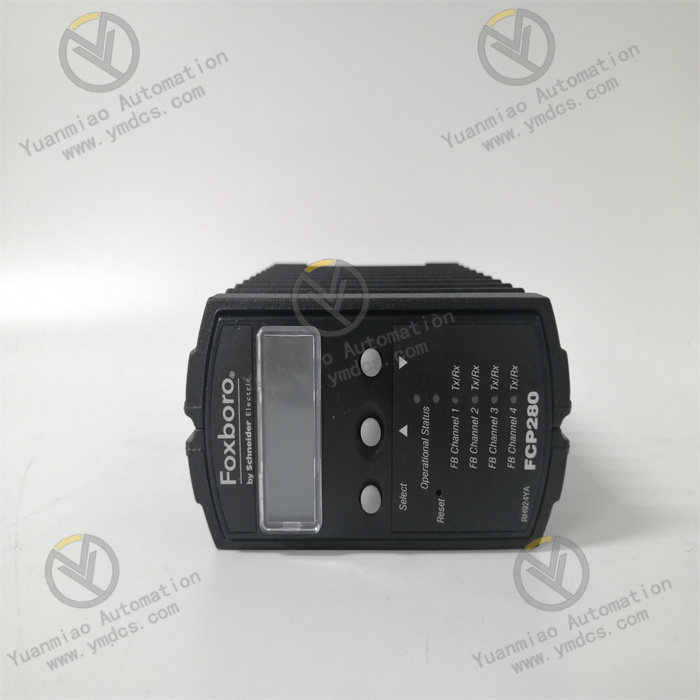
FOXBORO RH924UQ
1. Basic Information
FOXBORO RH924UQ is a high-performance fieldbus control processor module for I/A Series Distributed Control System (DCS). It is commonly used as a core matching unit of FCP280 controller. Specially designed for industrial process control, it serves as a key component to realize fieldbus signal processing, control operation and system communication.
Acting as a connection bridge between fieldbus and DCS control network, it is responsible for analyzing data from Fieldbus Modules (FBM), executing regulation, logic and sequence control algorithms. Meanwhile, it realizes hot standby redundancy switching, protocol conversion and high-speed data interaction, ensuring real-time, accurate and reliable control of industrial processes.
2. Technical Specifications
2.1 Core Electrical & Control Specifications
- Processor: 32-bit industrial-grade RISC processor; execution speed: 0.1μs per Boolean instruction, 0.5μs per floating-point instruction, enabling high-speed operation of complex control algorithms.
- Memory: 8 MB program memory, 4 MB data memory, supporting large-scale control programs and real-time data caching.
- Power Supply: 24 VDC power supply, power consumption 10 W. It supports redundant power supply and reverse polarity protection for stable and reliable power input.
- Bus & Expansion: Matches FCP280 baseboard, supporting up to 256 I/O points; expandable with 32 sets of Series 200 FBM, and up to 128 FBM via FEM100 expansion module.
- Communication Interfaces: Integrated 100 Mbps fiber Ethernet, Ethernet 10/100BaseTX, ControlNet and RS-232 interfaces; supports Modbus TCP/IP, ControlNet, Ethernet/IP and other protocols for seamless connection with Foxboro Evo network and third-party devices.
- Redundancy & Fault Tolerance: Dual-module hot standby redundancy achieves bumpless switchover once the main module fails. Bit-by-bit matching technology verifies data consistency to avoid wrong command output.
- Environmental Adaptability: Operating temperature: 0℃~60℃; Storage temperature: -40℃~85℃; Humidity: 5%~95% (non-condensing); Protection class: IP20. Die-cast aluminum housing features excellent vibration resistance and strong electromagnetic interference resistance.
2.2 Physical & Structural Specifications
- Installation Mode: Standard cabinet mounting or dedicated baseboard mounting, compatible with FCP280 baseboard and supporting dense multi-module arrangement.
- Dimensions: 140 mm × 165 mm × 45 mm (L × W × H), compact structure.
- Weight: Approximately 0.6 kg, lightweight design for easy installation and maintenance.
- Enclosure & Connection: Die-cast aluminum housing with dustproof, moistureproof and anti-interference performance. Power, communication and bus interfaces are arranged in zones with anti-loose wiring design to stabilize signal transmission and power supply.
- Status Indication: Built-in LED indicators intuitively display power, operation, communication and fault status for rapid troubleshooting.
2.3 Core Functions & Compatibility Specifications
- Core Functions: Process regulation, logic/timing/sequence control; fieldbus data acquisition and processing; alarm detection and notification; redundant switching and fault diagnosis; multi-system coordinated control.
- Integrated Features: Highly integrated design realizes control, communication and redundant switching by single module. Built-in data verification simplifies system structure and reduces deployment costs.
- Compatibility: Fully compatible with full-series I/A Series FBM, FEM100 and upper monitoring software such as InTouch; compatible with PLC and DCS products of Siemens, Rockwell Automation and other brands; supports direct connection with smart transmitters and regulating valves.
- Reliability: Industrial rugged design ensures low failure rate in long-term operation; hot standby redundancy guarantees non-stop operation; wide-temperature and anti-interference design adapts to harsh working conditions.
3. Working Principle
Control Operation & Command Output: It processes collected data according to preset logic and algorithms to generate control commands, which are sent to FBM via bus to drive actuators. Meanwhile, it communicates with Evo network and third-party systems to realize coordinated control.
4. Application Scenarios
4.1 Petrochemical Industry
Applied in refining and synthesis plants to collect parameters of reaction kettles and operating status of valves and pumps for precise process control. Its redundant design adapts to flammable and explosive working environments to ensure continuous production.
4.2 Power Energy Industry
Used in thermal power, hydropower and nuclear power plants to control boilers, steam turbines and auxiliary equipment and collect key operating parameters. Redundant communication and power supply design guarantee stable power supply.
4.3 Metallurgical Industry
Suitable for iron and steel smelting and non-ferrous metal processing to regulate furnace temperature, rolling mill pressure and other key parameters. It can work stably in high-dust and strong electromagnetic interference environments to ensure system stability and product quality.
4.4 Municipal Administration & Environmental Protection
Deployed in sewage treatment and central heating systems to control dosing pumps, aeration fans and regulating valves. Modular expansion meets capacity expansion demands and satisfies long-term continuous operation requirements.
4.5 General Industrial Industry