Description
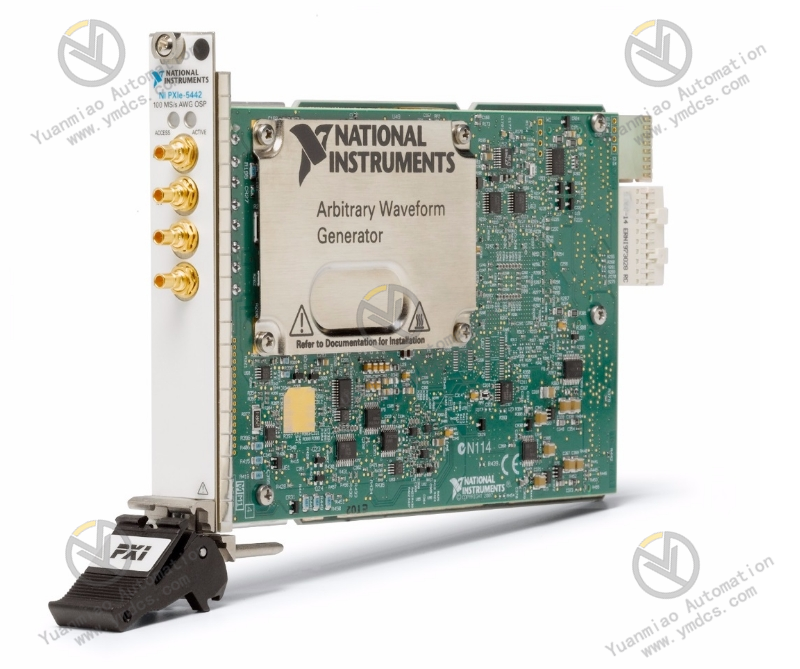
NI PCI-4461 779307-01
I. Basic Information
Model: PCI-4461
Part Number: 779307-01
Brand: National Instruments (NI)
Platform: Standard desktop PCI bus dynamic signal acquisition (DSA) platform, specially designed for high-precision acoustic, vibration and noise measurementProduct Type: Standard PCI form factor dynamic signal analyzer with 2 synchronous analog input channels and 2 synchronous analog output channels. Equipped with 24-bit high-resolution ADC/DAC, maximum sampling rate of 204.8 kS/s, built-in IEPE transducer constant current excitation and TEDS sensor automatic identification, it delivers a high dynamic range of 118 dB, supporting synchronous excitation generation, vibration & acoustic high-precision acquisition, frequency response analysis and modal testing, serving as core high-precision hardware for industrial NVH, acoustic inspection and structural mechanics test applications.
Product Positioning
Hardware Architecture
Mounting & Supporting System
- Mounting: Standard full-height PCI slot installation for desktop industrial PCs, must be fixed with chassis ground screw for shielding performance
- Front Panel Interfaces: 4×BNC analog ports, 1×SMB external reference clock input, hardware status LED indicator
- Driver & Software: NI-DAQmx, NI MAX, LabVIEW, Sound and Vibration Measurement Suite, Python/C#
- Compatible OS: Windows XP/7/10 32/64-bit; supports multi-card synchronous networking via external clock
- Typical Application Industries: Automotive NVH testing, mechanical equipment predictive maintenance, electroacoustic calibration, structural modal test, acoustic & mechanical scientific research.
Product Characteristics
- 24-bit high resolution and 118 dB ultra-wide dynamic range realize lossless acquisition of tiny vibration and acoustic signals without saturation or signal-to-noise ratio degradation.
- Hardware-synchronized AI & AO channels support closed-loop frequency response and modal testing by synchronous excitation output and response signal acquisition.
- Onboard IEPE constant current drive and TEDS automatic identification eliminate external signal conditioners, simplifying test wiring and reducing manual parameter errors.
- Differential input and programmable AC/DC coupling effectively suppress common-mode industrial electromagnetic interference and DC drift, adapting to long-distance field sensor measurement scenarios.
- External reference clock supports multi-card synchronous expansion to build large-scale distributed multi-point vibration test systems with consistent timing.
- Isolated low-noise analog design ensures stable high-precision long-term continuous measurement under desktop industrial electromagnetic interference environments.
II. Technical Specifications
2.1 Analog Input Specifications
- Channels: 2 fully synchronous differential/pseudo-differential input channels
- Resolution: 24-bit Δ-Σ ADC
- Max Sampling Rate: 204.8 kS/s
- Dynamic Range: Typical 118 dB
- Programmable Gain: 30/20/10/0/-10/-20 dB
- Full-Scale Input Range: ±0.316 V ~ ±42.4 V
- Coupling: Software-selectable AC/DC, 3.4 Hz high-pass filter
- IEPE Excitation: 0/4/10 mA switchable constant current, minimum compliance voltage 24 V
- Input Impedance: 1 MΩ || 240 pF; pseudo-differential mode with 50 Ω chassis grounding resistor
- TEDS Compliance: IEEE 1451 standard
- Maximum Safe Input Voltage: ±42.4 V
2.2 Analog Output Specifications
- Channels: 2 synchronous differential/pseudo-differential output channels
- Resolution: 24-bit Δ-Σ DAC
- Max Update Rate: 204.8 kS/s
- Output Voltage Range: ±10 V
- Minimum Rated Load: 600 Ω; recommended load ≥10 kΩ
- Protection: Permanent short-circuit protection between positive and negative terminals
- Differential Output Impedance: Typical 22 Ω; idle high-impedance mode 9 kΩ
2.3 Clock & Trigger Specifications
- External Reference Clock: SMB single-ended input for multi-card clock locking synchronization
- Trigger Types: Software trigger, analog edge/window trigger, digital hardware trigger
2.4 Environmental & Mechanical Specifications
- Operating Temperature: 0℃ ~ +50℃; storage temperature: -20℃ ~ +70℃
- Humidity: 10%~80%RH non-condensing; vibration compliant with IEC 60068-2-6
- Net Weight: 0.28 kg; Form Factor: Standard full-height PCI card with metal shielding bracket
III. Key Features
- High-precision synchronous acquisition captures weak early fault vibration and acoustic features for equipment condition monitoring and NVH data analysis.
- Synchronous waveform excitation enables automatic frequency response, transfer function and modal parameter calculation for structural dynamics testing.
- Native IEPE & TEDS compatibility simplifies sensor system setup and improves batch test accuracy and efficiency.
- Differential anti-interference architecture guarantees stable measurement in industrial sites with long sensor wiring and power frequency interference.
- Multi-card clock synchronization supports large-scale distributed multi-point synchronous vibration testing for vehicle and large structural engineering projects.
- Ultra-low-noise audio-grade I/O performance meets high-precision automated calibration requirements for consumer electroacoustic production lines.
IV. Working Principle
V. Application Scenarios
- Automotive industry: Vehicle NVH noise & vibration testing, component abnormal noise fault localization and road test multi-point vibration acquisition.
- Machinery predictive maintenance: Fan, pump, gearbox vibration monitoring and early mechanical fault diagnosis.
- Electroacoustic industry: Speaker, microphone, headphone acoustic parameter automated calibration and production EOL testing.
- Structural engineering: Aerospace, rail transit, wind turbine modal parameter test and fatigue vibration experiment.
- Scientific research: Acoustic laboratory measurement, material damping characterization and precision sensor calibration experiments.