Description
1. Product Overview
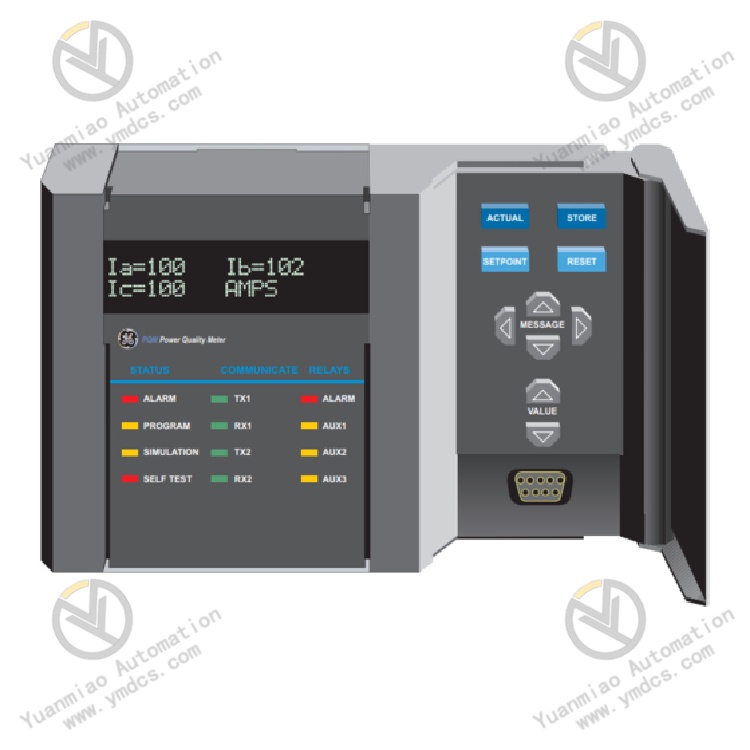
GE PQM‑T20‑C‑A is an industrial‑grade high‑precision power‑quality monitoring meter manufactured by GE (General Electric, now GE Vernova). As a core three‑phase power‑monitoring device of the classic PQM series, it is designed for industrial power‑distribution systems, substations, industrial and mining enterprises, data centres and high‑end building power‑supply scenarios. This unit integrates full‑parameter energy metering, harmonic analysis for power‑quality assessment, waveform recording during electrical anomalies, programmable relay outputs and multi‑serial‑port industrial communication functions. It serves as a key intelligent measurement‑and‑control device for power‑quality diagnosis, refined energy consumption management, electrical‑fault tracing and stable operation & maintenance of distribution systems. Developed in strict compliance with international power‑measurement standards IEEE, IEC and industrial specification C37.90, it is equipped with a dedicated high‑precision DSP power‑processing chip and delivers 0.5S‑class metering accuracy. It can accurately capture subtle power‑quality anomalies including grid harmonics, voltage sags, voltage swells, three‑phase unbalance and frequency drift. Featuring an industrial reinforced structure, fully galvanically‑isolated channels and strong electromagnetic‑interference resistance, the meter adapts to harsh conditions of high temperature, vibration and heavy EMI inside power cabinets and supports 7×24‑hour non‑stop online monitoring. With comprehensive functions, precise measurement, high stability, flexible expandability and broad compatibility, it is widely deployed in new‑build distribution‑system projects, upgrades of legacy monitoring systems, power‑quality improvement programmes and refined industrial energy‑management initiatives, and represents a mainstream core device for power‑quality monitoring and intelligent O&M on industrial power grids.
2. Core Functions
Full‑scope high‑precision electrical‑parameter metering: It supports comprehensive monitoring of three‑phase four‑wire and three‑phase three‑wire systems, and accurately measures three‑phase voltages, three‑phase currents, active power, reactive power, apparent power, power factor, grid frequency, accumulated energy and demand values. Adopting 0.5S‑class high‑precision metering algorithms, it minimises measurement errors common in conventional meters and satisfies refined‑data requirements for high‑accuracy industrial energy‑consumption statistics, production‑capacity accounting, power billing and load analysis.
Professional power‑quality harmonic analysis: A high‑order harmonic‑computation engine enables real‑time monitoring of Total Harmonic Distortion (THD), Total Demand Distortion (TDD) and individual harmonic components, allowing precise identification of harmonic over‑limit conditions and waveform distortion. Time‑series data of harmonic anomalies are fully recorded to provide accurate supporting data for grid‑filter retrofits, reactive‑power‑compensation optimisation and power‑quality governance, thus mitigating industry‑wide problems such as equipment overheating, increased losses, spurious trips and shortened service life induced by harmonics.
Grid anomaly detection and waveform recording: The device automatically captures, logs and time‑stamps electrical events including voltage sags, voltage swells, short‑term power interruptions, three‑phase unbalance, frequency violations and overload conditions. Waveform and operating‑condition data before and after fault occurrence are retained for event trace‑back analysis, enabling maintenance personnel to quickly locate fault points and identify disturbance root‑causes in distribution networks, and greatly accelerating fault‑response efficiency.
Programmable relay outputs and linkage control: It is fitted with 4 user‑configurable output relays and multiple digital‑input channels with freely adjustable threshold settings. Automatic alarms and contact‑based linkage can be triggered by over‑voltage, under‑voltage, over‑current, overload, excessive harmonics, abnormal power‑factor and other conditions. Relay outputs can be interfaced to automatic control workflows such as capacitor switching for reactive‑power compensation, load shedding and fault alarm indication, enabling autonomous intelligent management of distribution systems.
Analogue‑signal acquisition and standardised signal conversion: Dedicated 4‑20 mA analogue I/O terminals convert grid electrical parameters into standard industrial analogue signals for seamless connection to PLCs, DCS platforms, industrial controllers and upper‑level data‑acquisition terminals. Standardised transmission and centralised collection of power data are realised to meet the demands of automated industrial distribution networking and centralised monitoring.
Multi‑serial‑port industrial communication and remote O&M: Multiple independent communication ports are provided, including a front‑mounted RS232 debugging port and two rear‑mounted RS485 networking ports, with native support for the Modbus RTU industrial protocol. Local parameter display, remote data upload, remote device‑parameter configuration, on‑line debugging and real‑time data acquisition are supported. This architecture suits unattended distribution‑rooms and remote central‑control‑centre operation‑and‑maintenance modes and significantly reduces on‑site maintenance costs.
- Long‑term stable operation under harsh industrial conditions: All signal channels are galvanically isolated and protected by surge‑suppression and EMC‑compliant EMI‑filter circuits, offering immunity against strong electromagnetic interference, voltage transients and line‑borne noise in industrial environments. The rugged industrial housing is dust‑proof and vibration‑resistant, and its wide‑temperature operating range accommodates high‑temperature conditions inside enclosed distribution cabinets. No parameter drift or metering degradation occurs during long‑term runtime, delivering excellent maintenance‑free performance suitable for round‑the‑clock industrial monitoring.
3. Technical Specifications
| Parameter Item | Technical Specification |
|---|---|
| Product Model | PQM‑T20‑C‑A |
| Brand | GE / GE Vernova (General Electric, USA) |
| Product Series | PQM Industrial Power‑Quality Monitoring Meter Series |
| Product Type | Three‑phase high‑precision power‑quality analyser & multi‑parameter power monitoring and control unit |
| Metering Accuracy Class | 0.5S high‑precision metering |
| Applicable Systems | Three‑phase three‑wire / three‑phase four‑wire AC distribution systems, 50 Hz / 60 Hz |
| Voltage Input Range | 90‑600 V (line‑to‑line voltage); high‑voltage measurement extendable via PT |
| Current Input Range | 0.1‑20 A high‑precision AC sampling |
| Monitored Parameters | Voltage, current, power, power factor, frequency, energy, demand, THD, TDD, three‑phase unbalance, harmonics, grid anomaly events |
| Hardware Channels | 4 programmable relay outputs, multiple digital inputs, 4‑20 mA analogue input and output |
| Communication Configuration | 1 × RS232 (front‑panel debugging), 2 × RS485 (rear‑side networking); Modbus RTU protocol supported |
| Wave‑recording Function | Automatic capture and time‑stamped storage for voltage sags/swells, power outages, harmonic anomalies and unbalance faults |
| Set‑point Function | User‑definable alarm thresholds and delay parameters; multi‑level alarms and linked outputs supported |
| Operating Temperature | ‑20 ℃ ~ +60 ℃, industrial wide‑temperature operation |
| Ambient Humidity | 5%‑95% RH, non‑condensing |
| Operational Characteristics | 7×24‑hour non‑stop monitoring, drift‑free metering, high interference immunity, built‑in fault self‑diagnosis |
| Key Advantages | High‑precision multi‑parameter metering, professional harmonic analysis, fault‑event waveform recording & traceability, programmable linkage control, multi‑bus networking capability, rugged industrial reliability, convenient maintenance |
4. Working Principle
The GE PQM‑T20‑C‑A power‑quality monitor follows a closed‑loop workflow: isolated signal sampling → high‑precision A‑D conversion → DSP‑based power‑algorithm computation → power‑quality analysis → event judgement & storage → linked‑control output → bus‑based data upload. After power‑on, galvanically‑isolated voltage‑ and current‑sampling circuits continuously acquire raw electrical signals from the three‑phase distribution network. Following noise‑reduction filtering, signal conditioning and high‑precision analogue‑to‑digital conversion, industrial‑site EMI and spurious noise are removed to yield clean, accurate process data. Using its dedicated DSP power‑processing chip, the meter performs real‑time multi‑parameter electrical calculation, harmonic decomposition, three‑phase‑balance evaluation, demand‑value statistics and energy accumulation. Measured values are continuously compared against user‑defined thresholds to detect over‑voltage, under‑voltage, overload, harmonic violations, voltage disturbances, frequency deviations and other fault‑related conditions. Once an anomaly is detected, waveform recording is triggered, the event is time‑stamped and saved, and relay‑output alarm or linkage commands are issued according to pre‑configured logic for early warning and automatic control. Real‑time electrical data, power‑quality metrics and fault records are transmitted via industrial communication ports to upper‑level PLC, DCS or SCADA monitoring systems, enabling comprehensive, high‑precision, automated real‑time monitoring and intelligent operation‑and‑maintenance management of the distribution network.
5. System‑Architecture Compatibility
GE PQM‑T20‑C‑A is a standard universal industrial power‑quality‑monitoring device. Its hardware‑sampling specifications, electrical interfaces and communication protocols are fully compatible with mainstream 0.4 kV‑35 kV three‑phase AC industrial distribution systems. It conforms to standard signal‑access requirements for voltage transformers and current transformers and can be directly connected to high‑/low‑voltage distribution cabinets, switchgears and substation feeder circuits. With native Modbus RTU support, its multiple independent serial ports can connect to different industrial controllers simultaneously and interface seamlessly with PLCs, DCS distributed‑control systems, SCADA power‑monitoring platforms, energy‑management systems and factory automation O&M platforms. No extra protocol‑conversion hardware is required for data interconnection and remote supervision. Its standard panel‑mount footprint matches typical cut‑out dimensions of distribution cabinets and uses universal wiring conventions. The unit can be deployed in new industrial‑distribution projects or directly replace legacy general‑purpose power meters and older power‑quality monitors. Retrofit installations require minimal rewiring or modification to the existing cabinet layout and system architecture, delivering outstanding universality, interchangeability and system expandability.
6. Application Scenarios
Engineered for complex industrial distribution environments, GE PQM‑T20‑C‑A addresses well‑known limitations of conventional power meters: limited‑parameter measurement, low accuracy, lack of harmonic monitoring, no fault waveform‑recording capability and poor interference immunity, leveraging its 0.5S‑class metering precision, professional‑grade power‑quality analysis, comprehensive fault‑traceback recording, programmable linkage functions and wide environmental adaptability. Typical deployment sites include high‑/low‑voltage power‑rooms in industrial plants, municipal public‑supply distribution networks, large‑scale commercial complexes, data‑centres, rail‑transit power‑supply systems, industrial‑mining substations, grid‑connected renewable‑energy stations and hospitals with precision‑critical power loads. Its core tasks include high‑accuracy full‑parameter energy metering, harmonic monitoring and mitigation support, power‑quality diagnostic analysis, electrical‑fault root‑cause tracing, refined energy‑consumption accounting and automated distribution‑system linkage control. The monitor enables precise identification of grid‑disturbance and equipment‑failure triggers, supports optimisation of reactive‑power compensation schemes and load allocation, reduces distribution‑network energy losses and equipment‑failure probabilities, and improves power‑supply quality, operational stability and intelligent‑O&M levels for industrial distribution systems, thereby safeguarding safe, stable and efficient operation of sensitive electrical assets.