Description
1. Overview
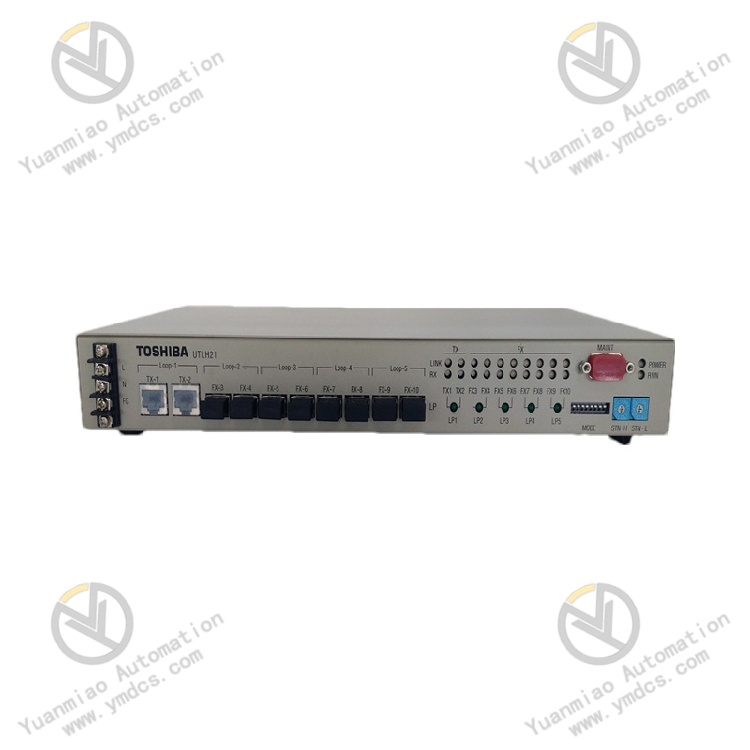
The TOSHIBA UTLH21 is a core industrial automation controller belonging to the Unifi NV series. It is compatible with Toshiba V-series PLCs as well as the TOSMAPS/TOSDIC distributed DCS systems. Serving as an all-in-one high-end industrial control unit integrating main control operation, TC-net ring network communication and multi-channel DI acquisition, it is widely deployed in thermal power auxiliary control, water treatment, chemical process industries, metallurgy, oil & gas, production line automation and other fields. This device incorporates 32-channel isolated digital input acquisition, IEC-standard logic operation, 100Mbps fault-tolerant ring network communication, gigabit Ethernet monitoring, hardware-based program acceleration and full-link fault diagnosis. As the backbone communication hub and local logic control core of distributed control systems, it realizes remote I/O networking of control cabinets, centralized collection of field switching signals, closed-loop linkage control of equipment, and data interaction with upper-level DCS.
2. Technical Features
2.1 100Mbps Self-Healing Fiber Ring of TC-net I/O Ensures High Networking Reliability
2.2 Hardware-Accelerated IEC Operation Balances High-Speed Logic and Continuous Control
2.3 Integrated 32-Channel Isolated DI Enables All-in-One Signal Acquisition
2.4 Dual-Network Separation Architecture: Independent Control Network and Monitoring Network
- Control Layer: TC-net fiber ring exclusively carries real-time I/O and interlock control commands with hard real-time deterministic transmission.
- Management Layer: Dual RJ45 gigabit Ethernet ports connect to DCS, HMI touchscreens and upper-level configuration software for uploading operation curves, fault logs and parameters.
2.5 Full-Range Hardware Fault Tolerance Guarantees Stable Long-Term Industrial Operation
- ECC memory hardware error correction automatically fixes random memory bit errors to avoid program disorder induced by high temperature and electromagnetic interference.
- Wide-voltage power supply adaptation with multi-level surge/electrostatic protection tolerates minor on-site power supply fluctuations.
- Full channel isolation prevents backplane breakdown caused by accidental intrusion of high voltage from field side.
- Hardware watchdog timer and dual-bus self-test are integrated; automatic hardware reset is triggered upon crash to guarantee unattended continuous operation.
2.6 Multi-Interface Hierarchical Operation & Maintenance Simplify Commissioning
3. Specification Parameters
3.1 Basic Parameters
- Model: UTLH21
- Brand: TOSHIBA
- Product Series: Unifi NV series, compatible with Toshiba V-series PLC and TOSMAPS/TOSDIC DCS
- Device Positioning: All-in-one controller integrating ring network communication master and 32-channel isolated DI
- Applicable Scenarios: Thermal power auxiliary control, water treatment, chemical industry, oil & gas, metallurgy, production line automation, large building automation
- Core Functions: TC-net fiber ring networking, 32-channel DC24V digital signal acquisition, IEC logic operation, PID continuous control, gigabit Ethernet upper-level communication, fault self-diagnosis, remote program management
- Programming Standard: Compliant with IEC 61131-3 (Ladder Diagram LD, Function Block Diagram FBD, Structured Text ST, etc.)
- Compatibility Replacement: Directly replaces legacy V-series Toshiba ring modules with no cabinet cutout or wiring modification required
3.2 Communication & Interface Parameters
- Fiber Ring: 2 fiber ports Loop-1, Loop-2; TC-net I/O, 100Mbps transmission rate, self-healing ring topology
- Ethernet: Dual RJ45 gigabit ports for upper monitoring and DCS connection
- Fiber Expansion: Multiple spare FX fiber channels (FX3~FX10) for expanding additional ring branches
- Debug Port: Local maintenance USB port for program flashing and parameter backup
- Terminals: L/N/PG AC auxiliary terminals for equipment protective earthing
- DIP Switches: MODE mode switch, STN-H/STN-L address switch for station number and ring mode configuration
3.3 Digital DI Acquisition Parameters
- Total Channels: 32 channels divided into 4 isolated groups (8 channels per group)
- Rated Input Voltage: DC24V; ON threshold ≥15VDC, OFF threshold ≤5VDC
- Input Current: Typical value 4mA @ 24VDC
- Response Time: ≤5ms with built-in hardware anti-chatter filtering
- Dielectric Withstand Voltage: 500VAC / 1min between channel groups and between channels & backplane ground
- Acceptable Signals: Valve limit contacts, relay contacts, pressure switches, fault dry contacts, start/stop switches
3.4 Electrical Power Parameters
- Standard Power Supply: DC24V with wide voltage tolerance of DC18~30V
- Total Power Consumption: Rated ≤48W
- Electrical Protection: Built-in multi-level protection against overvoltage, reverse polarity, overcurrent, surge and ESD static electricity
- Earthing: FG protective earthing terminal equipped for mandatory equipotential bonding of control cabinets
3.5 Environmental Operating Parameters
- Operating Temperature: -10℃ ~ +60℃
- Storage Temperature: -30℃ ~ +70℃
- Operating Humidity: 5%~95% RH, non-condensing
- EMC Performance: Compliant with high-end industrial EMC standards, resisting radio frequency radiation, electrical fast transient pulses, surges and harmonic interference
- Mechanical Performance: Tolerates regular industrial vibration and shock, suitable for fixed cabinet mounting and onboard installation on genset control cabinets
3.6 Structural & Maintenance Parameters
- Structure: Standard rack plug-in form with industrial metal housing and dense side heat dissipation holes
- Mounting: DIN rail backplane installation on standard control cabinets, compatible with Toshiba UTB-series I/O racks
- Maintenance Features: Full hardware power-on self-test; fault indicator lamps light up upon communication/DI channel errors; programs are permanently retained after power loss; fault logs stored locally
- Operational Advantages: Ring network fault tolerance, stable signal acquisition, high-speed operation, strong anti-interference, low failure rate and long-term maintenance-free performance
4. Working Principle
Signal Acquisition Layer: 32 DI channels collect the status of various field switching contacts in real time. Signals pass through isolation circuits and hardware filtering for noise reduction before being converted into digital signals sent to the main control operation unit.
Logic Operation Layer: The CPU paired with ASIC hardware acceleration cyclically executes IEC control programs to fulfill interlock judgment, PID regulation, sequence logic and fault diagnosis, generating output commands and alarm signals.
Ring Communication Layer: Local I/O data and control commands are bidirectionally transmitted at high speed with remote I/O stations and main controllers via the TC-net dual-fiber ring. If the fiber breaks, the hardware instantly switches to bus topology to guarantee uninterrupted data transmission.
Upper Interaction Layer: Gigabit Ethernet uploads operating parameters, alarms and historical logs to DCS and touchscreens; parameter modification and remote start-stop commands issued by upper systems are received via Ethernet and executed by the main controller.
Protection & Diagnosis Layer: Power supply, ring links, DI channels and memory status are monitored throughout operation. Short circuits, cable breaks, overtemperature and communication abnormalities trigger corresponding fault lamps and fault code recording, with interlock logic configurable to initiate shutdown or alarming. All fault data is stored locally for later traceability and troubleshooting.
Supported by triple safeguards including ring self-healing, electrical isolation and ECC error correction, control failure caused by on-site interference and line faults is effectively avoided, ensuring stable closed-loop operation of the entire distributed control system.
5. Application Scenarios
5.1 Backbone Networking of Auxiliary Control DCS in Power Plants
5.2 Distributed Remote I/O Control for Chemical and Water Treatment Plants
5.3 Hardware Renovation & Upgrade of Legacy Toshiba Automation Systems
5.4 Centralized Multi-Station Control for Metallurgy and Oil & Gas Production Lines