Description
1. Overview
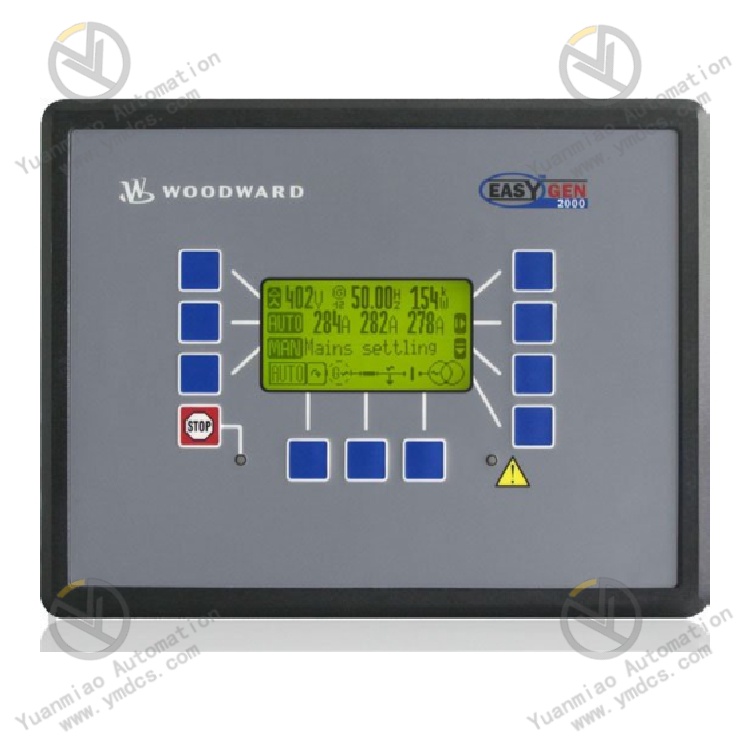
The WOODWARD easYgen-2000 (part number 8440-1955B) is an integrated intelligent genset paralleling control module developed by Woodward. Serving as the core automation control hardware for medium and small diesel/gas generator sets, it is widely applied to industrial standby gensets, power plant auxiliary gensets, distributed energy units, municipal emergency power supplies, and self-contained gensets for oilfields and mines. This device integrates all-in-one functions including engine speed governing control, generator voltage regulation, automatic synchronous paralleling, circuit breaker closing/tripping control, active/reactive load sharing, full-range genset protection, operating data monitoring, fault self-diagnosis, and remote communication management. It acts as the central control hub to realize independent standalone operation of gensets, parallel operation of multiple units, grid paralleling and transfer between gensets and utility mains, as well as fully automatic start-stop unattended operation.
2. Technical Features
2.1 Fully Automatic Genset Control with Strong Adaptability to Unattended Operation
2.2 High-Precision Synchronous Paralleling with Minimal Operating Shock
2.3 Accurate Load Sharing for Excellent Stability of Multi-Unit Paralleling
2.4 Integrated Closed-Loop Speed & Voltage Regulation with Wide Operating Condition Adaptability
2.5 Full-Range Genset Protection for Superior Operational Safety
3. Specification Parameters
3.1 Basic Parameters
- Model: easYgen-2000
- Part Number: 8440-1955B
- Manufacturer: Woodward
- Device Type: Intelligent genset paralleling controller
- Compatible Equipment: Diesel generator sets, gas generator sets, self-contained emergency gensets
- Applicable Scenarios: Industrial standby power supplies, power plant auxiliary systems, distributed energy, self-contained gensets for mines & oilfields, municipal emergency power supply systems
- Core Functions: Automatic genset start-stop control, speed/frequency regulation, voltage excitation stabilization, precise synchronous paralleling, multi-unit load sharing, utility/genset transfer, full-range fault protection, data monitoring and remote communication
- Operating Modes: Stop Mode, Manual Mode, Auto Standby Mode, Load Test Mode
- Paralleling Capacity: Supports parallel operation of up to 16 gensets; supports grid paralleling and transfer between gensets and utility mains
3.2 Control Performance Parameters
- Voltage Regulation Accuracy: Steady-state voltage regulation accuracy ≤ ±0.5%; frequency regulation accuracy ≤ ±0.25%, superior power quality
- Synchronization Mode: Intelligent slip-frequency synchronization with automatic phase matching; supports smooth open/closed transition paralleling
- Load Control: Precise active/reactive power equalization with fast dynamic load response, free of power oscillation and circulating current
- Regulation Algorithm: Digital PID closed-loop speed & voltage regulation with dynamic correction and zero steady-state error, adapting to full-range operating condition fluctuations
- Transfer Mode: Supports load tie-in, soft loading and soft unloading with shock-free transfer throughout paralleling and off-grid processes
- Protection Class: Class A industrial-grade protection with hierarchical action logic: fault alarming with grading, delayed shutdown and emergency tripping
3.3 Interface & Communication Parameters
- Analog Input: Multiple configurable FlexIn adaptive analog channels for collection of voltage, current, temperature, pressure and other signals
- Digital Input/Output: Multiple programmable digital input/output channels for start-stop, interlock, alarm and switch status acquisition
- Analog Output: ±10V standard analog output for drive control of speed governing actuators and excitation regulators
- Bus Interface: CANopen industrial bus supporting multi-unit networking communication and synchronous parameter interaction
- Communication Protocols: Compatible with standard industrial communication protocols for connection with upper computers, DCS and local configuration software
- Service Port: Dedicated service debugging port supporting program flashing, parameter backup and fault log reading
3.4 Electrical Parameters
- Power Supply Voltage: Wide voltage compatibility DC 8V ~ DC 36V, adapting to fluctuating battery power supply of gensets
- Sampling Voltage: Compliant with standard voltage sampling specifications for conventional three-phase AC generator sets
- Frequency Range: Compatible with 50Hz/60Hz power frequency systems; customizable power frequency parameters for different working conditions
- Electrical Protection: Built-in multi-level protection against overvoltage, overcurrent, reverse polarity, surge and static electricity to withstand on-site electrical disturbances
- Operating Power Consumption: Low-power design with low heat generation, suitable for long-term continuous energized operation
3.5 Environmental Operating Parameters
- Operating Temperature: Wide-temperature operation range of -20℃ ~ +70℃, adapting to high-low temperature fluctuation and enclosed high-temperature conditions in equipment rooms
- Storage Temperature: -30℃ ~ +80℃, meeting requirements for long-distance transportation and long-term shutdown storage
- Operating Humidity: 5% ~ 95%RH (non-condensing); moisture-resistant to prevent condensation short-circuit faults, suitable for humid equipment room environments
- Anti-Interference Performance: Compliant with high-end industrial EMC standards, resisting harmonic, radiation and pulse interference
- Mechanical Performance: Tolerant to regular industrial vibration and shock with strong shock resistance, adapting to onboard operation on gensets
3.6 Structural & Maintenance Parameters
- Structure Form: Embedded panel-mounted structure with compact body, neat layout and uniform heat dissipation
- Mounting Method: Embedded installation on standard control cabinets with easy disassembly, firm fixation and compatibility with conventional cabinet cutout sizes
- Compatibility: Fully compatible with hardware and software of the easYgen-2000 series, enabling in-situ non-destructive replacement and upgrade
- Maintenance Features: Power-on full hardware self-test, automatic fault alarming, automatic log retention and power-off parameter retention
- Operational Advantages: High control accuracy, stable paralleling, balanced load sharing, low failure rate and long-term maintenance-free operation
4. Working Principle
After power-on, the WOODWARD easYgen-2000 8440-1955B controller first completes hardware initialization, channel self-inspection, bus link verification, system parameter loading and operating mode initialization. It enters standby mode upon successful self-test, undertaking core tasks of automatic genset control, regulation, paralleling and protection throughout operation.
During operation, multi-channel analog and digital channels collect full-spectrum operating parameters in real time, including genset speed, terminal voltage, output current, system frequency, active/reactive power, power factor, engine coolant temperature, lube oil pressure, utility status and circuit breaker position. The core computing unit compares real operating parameters with preset thresholds via high-precision digital algorithms, dynamically outputs speed and voltage regulation commands, and precisely adjusts fuel actuators of the engine and excitation output of the generator. Stable steady-state frequency & voltage and correction of dynamic disturbances are achieved, guaranteeing parameter stability under genset no-load, loaded and variable-load conditions.
When grid-connected operation is required, the controller automatically activates intelligent synchronization logic, comparing voltage, frequency and phase difference between the genset and utility/busbar in real time. Parameter matching is completed via slip-frequency speed regulation and fine voltage adjustment, and closing commands are precisely output when deviations fall within allowable paralleling ranges to drive smooth closing of the circuit breaker. Under multi-unit parallel conditions, the device exchanges data with paralleled gensets in real time via CAN bus, dynamically equalizes active and reactive loads, corrects output deviation of individual units, and suppresses power oscillation and circulating current to ensure balanced and stable operation of the multi-unit system.
5. Application Scenarios
5.1 Fully Automatic Emergency Power Supply Control for Single Gensets
5.2 Control of Multi-Genset Parallel Grid-Connected Systems
5.3 Bidirectional Grid Paralleling & Transfer Control between Gensets and Utility Mains