Description
GE IS420ESWB3HA
I. Basic Information
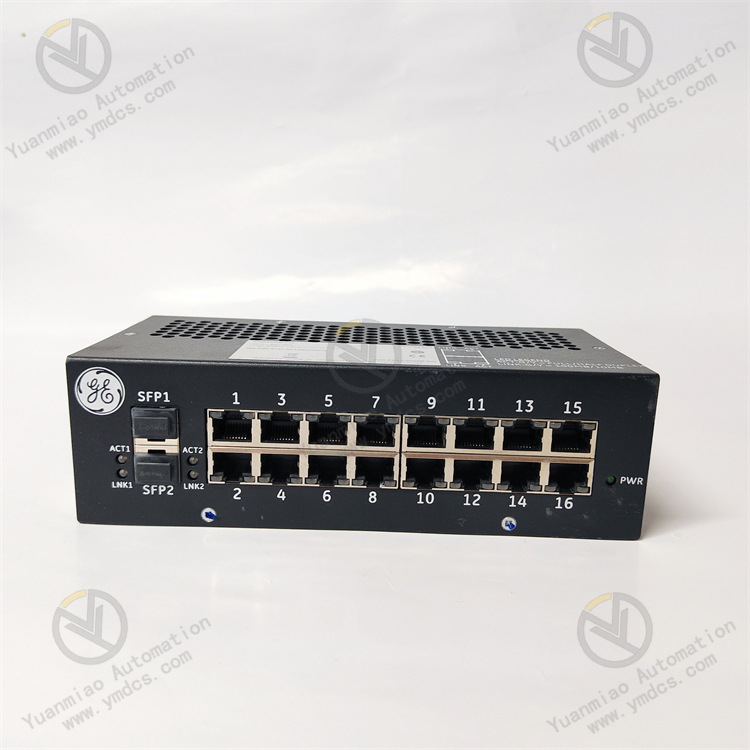
Model: IS420ESWBH3A, abbreviated as ESWB-H3A. It belongs to the Speedtronic Mark VIe/Mark VIeS safety gas turbine control system, functioning as an unmanaged Layer 2 industrial Ethernet switch dedicated to the IONet bus. Serving as the core networking hub connecting gas turbine main CPUs, I/O modules, RTD/TC temperature boards and upper-level monitoring systems, it establishes TMR triple-modular-redundant or dual-redundant control networks for gas and steam turbine generating unit controls. It is a critical replacement spare part for refurbishment of legacy GE Mark VIe systems in power plants and supports 24/7 continuous in-cabinet operation.
Product Positioning: Part of the ESWB base switch series (differentiated from compact ESWA models), this 16-port all-copper variant without optical fiber ports is purpose-built for GE IONet industrial real-time bus. It aggregates data from local I/O substations, facilitates master controller interactions and forwards real-time EGD data, acting as an essential core component of unit control networks.
II. Technical Specifications
(1) Basic Hardware Parameters
- Brand: GE General Electric (GE Vernova) | Origin: USA
- Product Type: Mark VIe IONet Industrial Switch (ESWB-H3A, 16 copper ports, no fiber ports)
- Compatible Systems: Standard Mark VIe control system, SIL3-certified Mark VIeS safety system, EX2100e excitation control system
- Mounting: Dual installation options – DIN35 rail mounting plus cabinet wall fixing via screws
- Overall Dimensions: 188mm(W) × 86mm(D) × 56mm(H), Net Weight: approx. 1.0kg
- Protection Class: IP30 (cabinet-mounted installation only)
- Thermal Design: Fanless natural convection cooling to eliminate downtime risks caused by fan failures
Front Panel: Per-port LED indicators (Link/Speed/Duplex) plus dual-channel power supply status LEDs
(2) Rated Electrical Parameters
- Power Supply: Redundant dual DC24/28V wide-range input (18~32VDC) via separate terminal blocks; seamless automatic switchover upon loss of one power feed, total power consumption ≤15W
- Port Configuration: 16×RJ45 10/100BASE-TX copper ports, no SFP fiber slots (distinct feature of H3A version); all ports support Auto-MDI/MDIX for compatibility with straight-through and crossover Ethernet cables
Switch Fabric: Store-and-forward Layer 2 switching architecture, 256KB onboard data buffer, 4K MAC address table capacity
(3) Communication Protocol Specifications
- Proprietary Protocols: Natively supports GE IONet and EGD (Ethernet Global Data) to fulfill millisecond-level real-time control data exchange for gas turbine applications
- Standard Protocols: IEEE802.3/802.3u/802.3x with auto-negotiation for full/half duplex; compatible with Modbus TCP for upper monitoring communication and IEEE1588 precision time synchronization
Operation Mode: Plug-and-play unmanaged design requiring no IP configuration; automatically discovers IONet network topology after power-up
(4) Environmental Specifications
- Operating Temperature: -40℃~+70℃ for long-term cabinet operation
- Storage Temperature: -40℃~+85℃ for transportation and warehousing
- Operating Humidity: 5%~95% RH (non-condensing). Resists electromagnetic interference from cabinet dust, oil mist, variable frequency drives and excitation equipment; complies with IEC61000 industrial EMC standards
III. Key Features
Redundant Dual Power Input Ensures High Power Supply Reliability
Two independent isolated power supply terminals. Breakage or short-circuit on one supply loop does not interrupt overall switch communication, adapting to fluctuating on-site plant power and maintaining uninterrupted control network connectivity.
16-Port All-Copper Design Enables Large-Scale Networking & Reduced Cabling Cost
As an all-copper-port option within the full ESWB series, it centrally connects multiple on-site RTD/STTC/DI/DO I/O terminal boards, ideal for cabinets with dense measuring points and eliminates fiber splicing expenses.
Native IONet Real-Time Bus Optimization for Gas Turbine Dedicated Use
Hardware-level optimization prioritizes forwarding of EGD real-time messages including governor control, excitation regulation and overtemperature interlock commands with millisecond-level latency. It satisfies synchronization requirements of TMR triple-redundant systems and conforms to supporting specifications for Mark VIeS SIL3 safety architecture.
Fanless Enclosed Construction Delivers Long Service Life with Maintenance-Free Operation
Passive natural cooling eliminates vulnerable fan components, delivering stable performance in dusty harsh plant cabinet environments and reducing routine maintenance workload.
Modular Drop-In Replacement within Series for Wiring-Free Retrofit
All ESWB variants (H1A/H2A/H4A/H5A) share identical mounting dimensions with differences only in fiber port quantity. Faulty legacy switches can be directly swapped on DIN rails without modifying existing RJ45 field cabling.
IV. Working Principle
- Power-On Self-Test: After dual-power energization, the unit runs diagnostics on power circuits and port hardware; all ports enter standby ready status once self-check passes.
- Local I/O Data Aggregation: Field SRTD/STTC temperature acquisition boards and discrete DI/DO I/O modules connect via RJ45 ports to upload real-time temperature and switch status data.
- Classified Message Forwarding: Differentiates high-priority EGD interlock packets from conventional background Modbus traffic and prioritizes delivery of unit control commands to Mark VIe main controllers.
- Cross-Segment Data Interaction: Governing and voltage adjustment instructions issued by master controllers are distributed via the switch to field I/O modules; aggregated field data is uploaded to upper DCS systems.
- 24/7 cyclic packet forwarding; single-port link failure only isolates the affected channel while all remaining ports continue normal network operation.
V. Application Scenarios
(1) Heavy-Duty GE Gas Turbines (9F/6FA/5E Units)
Local I/O networking inside Mark VIe main control cabinets for gas turbines, aggregating exhaust temperature, bearing RTD and valve position discrete signals as core data exchange hub between main controllers and field remote I/O cabinets.
(2) Thermal & Cogeneration Steam Turbine Generating Units
Field measuring point networking for steam turbine bodies, matched with EX2100e excitation systems and backend DCS communication of generating units.
(3) Waste Heat Generating Units at Captive Power Plants of Chemical & Steel Industries
Control cabinet networking for combined gas turbine and waste heat boiler systems, maintaining stable communication under harsh on-site conditions with intensive variable-frequency loads and severe harmonic distortion.
(4) Spare Part Retrofit for Obsolete GE Control Systems
Capacity expansion replacement for older small-port ESWA switches and fault replacement of end-of-life ESWB switches; in-situ cabinet installation without secondary wiring modification.