Description
1. Product Overview
Bently Nevada 1900/65A‑00‑01‑01‑00‑01 is a general‑purpose integrated machinery condition monitor of the 1900 series by Baker Hughes‑Bently Nevada. It is a compact on‑line monitoring and protection unit designed for medium‑and‑small‑sized rotating and reciprocating industrial equipment. This variant is a custom‑configured version equipped with standard Modbus communication. No rack‑based system is required. The unit highly integrates functions of signal acquisition, intelligent alarming, relay interlock, analog transmission, data storage and remote communication. With an industrial‑grade 24‑bit high‑precision ADC sampling chip, it features high‑accuracy measurement, flexible parameter configuration and excellent environmental adaptability, enabling real‑time monitoring of key operating parameters such as vibration, temperature and rotating speed. Compared with conventional large‑scale rack‑mounted monitoring systems, it has the advantages of simple deployment, cost‑effectiveness, easy maintenance and wide compatibility. It provides early‑stage fault warning and over‑limit interlock protection for equipment. Widely applied in power, petrochemical, water‑treatment, metallurgy, general manufacturing and other industrial sectors, it acts as a core intelligent device for lightweight on‑line condition monitoring and safety protection of medium‑and‑small‑sized machinery.
2. Core Functions
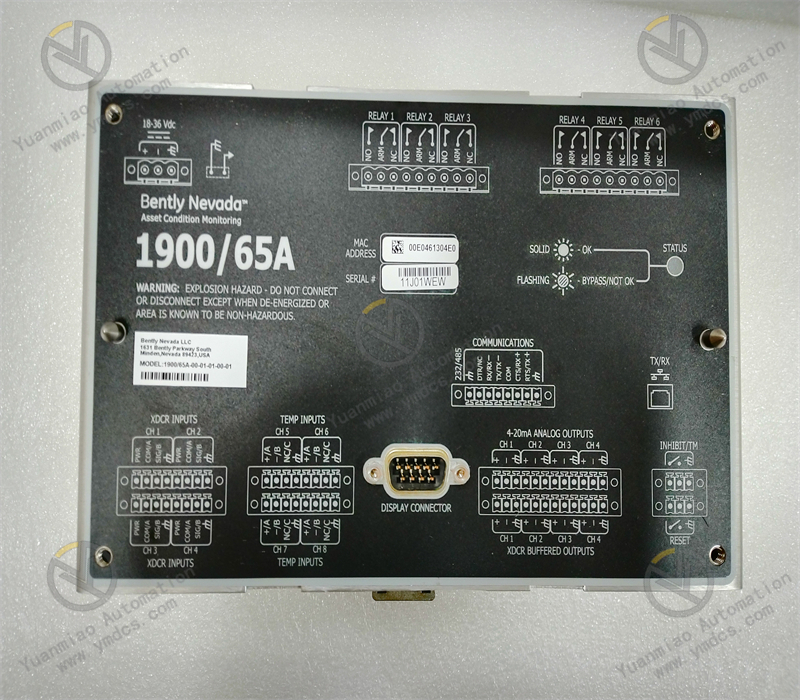
Multi‑type‑sensor Compatible Acquisition: It is furnished with 4 universal sensor input channels plus 4 independent temperature input channels. Universal channels are compatible with various vibration transducers including 2‑wire / 3‑wire eddy‑current probes, velocity sensors and accelerometers. Temperature channels support K‑, J‑, E‑, T‑type thermocouples as well as 2‑wire / 3‑wire RTD resistance temperature detectors, fully meeting multi‑dimensional acquisition requirements for vibration, temperature and rotating‑speed parameters.
Three‑level Intelligent Alarm & Programmable Interlock: Built‑in standardized condition‑judgment logic distinguishes three operating states: OK, Alert and Danger. Six programmable relay outputs are available. Custom trigger logics can be defined for single‑channel activation or multi‑channel linkage, which realizes accurate over‑limit alarm and fault interlock shutdown, effectively avoiding equipment damage and unplanned shutdown accidents caused by overtemperature, excessive vibration and abnormal load.
Standard Analog Transmitting Output: Four independent 4‑20 mA industrial standard analog output channels convert core parameters including vibration amplitude, temperature and rotating‑speed from each monitoring channel into standardized analog signals. Seamless connection with DCS, PLC and upper‑level configuration platforms enables centralized equipment‑condition monitoring and remote data upload.
High‑precision Sampling & Complete‑data Traceability: 24‑bit high‑speed high‑precision ADC sampling technology delivers high acquisition resolution, minimal measurement error and strong data stability. Complete event‑log storage can record equipment operating status, alarm history, fault timestamps and parameter trends for a long time, providing full data support for fault tracing, trend analysis and predictive maintenance.
Modbus Remote Communication & Intelligent Configuration: This model comes with built‑in Modbus communication for remote data exchange, equipment‑status upload and remote parameter reading. Supported by dedicated 1900 configuration software, it allows visual parameter setting, custom alarm thresholds, relay‑logic programming and free output‑variable matching. Customized monitoring‑protection strategies can be formulated for different equipment working conditions
- Long‑term Industrial‑grade Operation with High Protection: Its fiberglass housing meets NEMA 4X / IP66 high‑protection requirements, featuring dust‑proof, water‑proof, corrosion‑resistant, impact‑resistant and anti‑aging performance. Adapted to harsh industrial‑site environments such as outdoor locations, humid and dusty areas with heavy electromagnetic interference, it supports 7×24‑hour non‑stop on‑line monitoring with excellent long‑term stability free of signal drift.
3. Technical Specifications
| Parameter Item | Technical Specification |
|---|---|
| Product Model | 1900/65A‑00‑01‑01‑00‑01 |
| Product Brand | Bently Nevada (Baker Hughes) |
| Product Type | General‑purpose Machinery Condition Monitor |
| Hardware Architecture | Compact integrated unit, 24‑bit high‑precision ADC sampling |
| Input Channel Configuration | 4 universal sensor inputs + 4 temperature inputs |
| Output Configuration | 6 programmable relay outputs, 4‑channel 4‑20 mA transmission outputs, dedicated buffer output |
| Compatible Sensors | Eddy‑current probes, velocity sensors, accelerometers, multiple thermocouple types, RTDs |
| Communication Configuration | Standard Modbus communication (remote data exchange) |
| Power‑supply Specification | AC 110‑220 V (50/60 Hz) industrial alternating‑current power supply |
| Protection Class | NEMA 4X / IP66 Dust‑proof, water‑proof, corrosion‑resistant and impact‑resistant |
| Operating Temperature | -40 ℃ ~ +70 ℃ |
| Core Features | Modbus remote communication, multi‑signal compatibility, high‑precision sampling, programmable configuration, high‑protection grade, rack‑free deployment |
4. Working Principle
The Bently Nevada 1900/65A‑00‑01‑01‑00‑01 monitor adopts a closed‑loop intelligent monitoring mechanism: multi‑channel synchronous acquisition → high‑precision computation → logical judgment → linkage output → remote transmission. After power‑on, multiple input channels synchronously collect dynamic process signals transmitted from field sensors, including vibration velocity, acceleration, shaft displacement, equipment temperature and rotating speed. The 24‑bit ADC chip completes high‑speed analog‑to‑digital conversion and digital filtering to eliminate abnormal data induced by on‑site electromagnetic interference and instantaneous signal fluctuation, ensuring authenticity and reliability of acquired data.
The built‑in core program judges equipment operating status in real‑time according to preset thresholds and customized interlock logics, and accurately classifies conditions into three grades: normal, alert and danger. When monitored parameters approach the warning threshold, audible‑visual alarms will be triggered automatically. Once parameters exceed limits and potential equipment faults are detected, relays will be actuated immediately to output interlock‑protection signals and drive downstream equipment to execute protective actions such as load reduction or emergency shutdown. Meanwhile, operating data, alarm events and fault information are recorded continuously and uploaded to upper‑level systems synchronously via both 4‑20 mA analog channels and the Modbus communication port. It realizes unattended round‑the‑clock monitoring, early‑fault prediction and safety interlock protection for machinery, and guarantees long‑term stable and continuous equipment operation.
5. System Architecture Compatibility
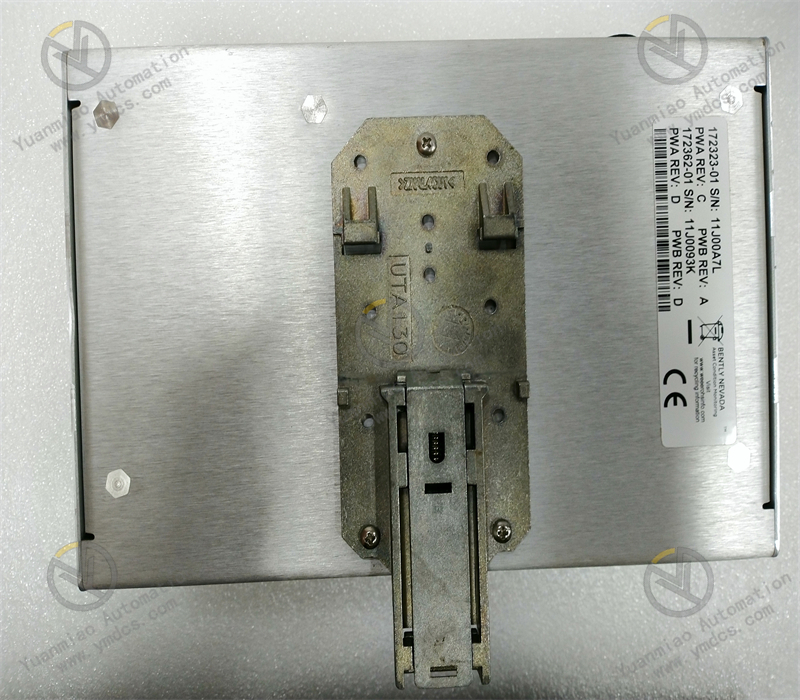
As an independent integrated wall‑mounted monitoring terminal, this unit requires no conventional rack‑based monitoring system and delivers flexible deployment and outstanding adaptability. It is plug‑and‑play with the full range of Bently Nevada vibration and temperature sensors without complicated calibration, enabling fast construction of dedicated on‑line monitoring systems for medium‑and‑small‑sized equipment and satisfying renovation and expansion requirements for new and legacy assets.
Supported by the Modbus industrial‑bus protocol, it can seamlessly connect with various DCS distributed control systems, PLCs and upper‑level SCADA platforms for remote data transmission, centralized aggregation and trend analysis of equipment‑condition data. Its analog outputs are fully compatible with industrial‑standard acquisition frameworks without compatibility barriers. With a universal wall‑mount structure, it can be installed inside standard industrial cabinets or on‑site equipment walls. No modification to the original power‑supply and control framework is required, so it can be quickly incorporated into almost all kinds of industrial automation control systems and is well‑suited for most monitoring‑renovation projects of general rotating machinery.
6. Application Scenarios
This product is widely deployed for on‑line monitoring and safety protection of medium‑and‑small‑sized rotating and reciprocating industrial equipment across multiple industries, adapting to strict unattended continuous‑operation conditions. In the power industry, it performs real‑time vibration and temperature monitoring for plant cooling fans, auxiliary pumps, small‑size motors and standby generator units. Within petrochemical plants, it provides condition monitoring and fault interlock protection for process fans, booster pumps, small reciprocating compressors and auxiliary air‑separation equipment.
It is also extensively used in water‑treatment, metallurgy, building‑material, general‑machinery‑manufacturing and other industries. Capable of detecting incipient minor equipment faults accurately, it delivers over‑limit warning, fault interlock and archived operation‑data traceability, which effectively cuts down equipment failure shutdown rate and losses from unplanned outages. Thanks to its lightweight design, cost‑effectiveness and remote‑communication capability, it is the preferred core device for intelligent on‑line monitoring and predictive‑maintenance renovation of general‑purpose industrial machinery.