Description
1. Overview
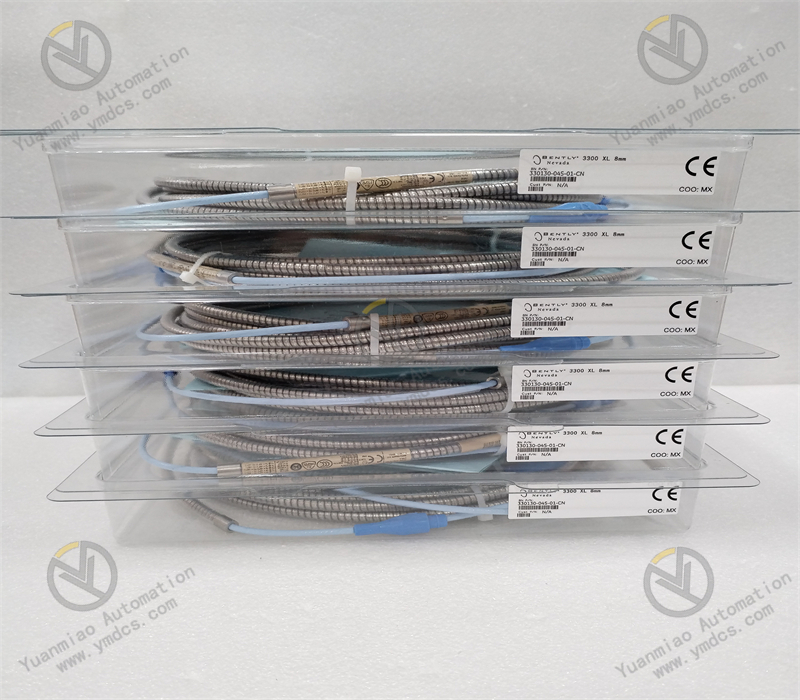
Bently Nevada 330130‑045‑01‑CN is an original 3300 XL 8 mm eddy‑current sensor extension cable from Baker Hughes Bently Nevada. It serves as a core accessory for unit vibration, displacement and speed monitoring systems, and is widely applied in the condition‑monitoring architecture for industrial rotating machinery. Designed for use with 3300 XL series 8 mm probes and proximitors, this extension cable acts as a dedicated signal‑transmission link for sensors, stably transmitting analog eddy‑current induction signals. It is a critical transmission component for vibration, shaft displacement and key‑phase monitoring systems of large rotating equipment such as steam turbines, fans, compressors, pumps and generator sets.
This extension cable adopts the original tri‑axial shielded cable structure with FEP high‑temperature‑resistant insulation material and standardized waterproof & oil‑proof connector technology. It features constant impedance, low signal attenuation, strong anti‑interference capability, low temperature drift and excellent long‑term operational stability. Suitable for harsh on‑site conditions including high temperature, high humidity, oil contamination, heavy vibration and strong electromagnetic interference, it enables long‑distance high‑precision signal transmission between sensor probes and proximitors. It guarantees authenticity, continuity and high accuracy of unit condition‑monitoring data, and fully meets the requirements of 7×24‑hour uninterrupted online monitoring and fault early‑warning for industrial equipment. The suffix CN denotes the domestic standard‑compliant version, whose wiring specifications and mounting dimensions fully conform to Chinese industrial monitoring‑system installation standards.
2. Functions and Features
2.1 Core Functions
Loss‑free transmission of high‑precision monitoring signals: Custom‑made for the 3300 XL 8 mm eddy‑current sensor system. It stably transmits analog induction signals for shaft vibration, shaft displacement, key‑phase and rotating‑speed. Constant cable impedance ensures minimal signal attenuation without waveform distortion or signal drift, keeping measurement accuracy in line with original‑manufacturer specifications.
System‑matched sensor accessory: Perfectly compatible with Bently Nevada 3300 XL series 8 mm probes and corresponding proximitors. As an extended signal link for the system, it flexibly adapts to on‑site installation‑space constraints, resolves wiring challenges caused by long distances between probes and monitoring cabinets, and fully preserves the original measurement performance of the sensor system.
Stable signal output under harsh operating conditions: Optimized for industrial rotating‑machinery environments featuring high temperature, oil contamination, humidity, vibration and strong electromagnetic interference. It effectively isolates signal anomalies induced by external noise, temperature fluctuation and mechanical jitter to ensure long‑term reliable monitoring data.
Guarantee integrity of unit condition monitoring: Provides accurate and continuous signal support for online monitoring, fault diagnosis, trend analysis and interlock protection of large rotating equipment. It acts as a vital transmission medium for fault early‑warning and shutdown protection against excessive vibration, over‑limit shaft displacement and abnormal rotating speed.
Standardized expandable wiring adaptation: Fixed standard cable length with original‑equipment dedicated mating connectors. It supports standardized on‑site wiring, cable‑tray routing and neat cabinet cabling, complying with construction requirements for industrial automatic monitoring systems, DCS and online condition‑monitoring systems.
Long‑duration condition adaptation and fault‑tolerant transmission: Excellent temperature‑drift suppression with negligible impedance shift over a wide temperature range. It accommodates full operating‑condition scenarios including equipment start‑stop, variable load and high‑temperature steady‑state operation, and prevents monitoring‑data jump and distortion triggered by working‑condition changes.
2.2 Product Characteristics
Precise original‑manufacturer parameter matching: Strictly complies with Bently Nevada 3300 XL system impedance specifications. The 75 Ω tri‑axial shielded cable delivers consistent impedance along its full length. No secondary calibration is required; direct replacement preserves original‑system calibration parameters.
High‑temperature‑resistant and anti‑aging material: FEP fluoroplastic high‑temperature‑resistant insulation layer offers broad temperature tolerance, oil resistance, corrosion resistance and anti‑aging performance. It withstands long‑term exposure to high‑temperature cabinet‑chamber conditions, lubricating‑oil immersion and industrial corrosive gases, with service life matching that of unit monitoring systems.
Superior electromagnetic‑interference resistance: Multi‑layer shielding structure effectively rejects electromagnetic interference from high‑power motors, frequency converters and power cables. It eliminates signal noise, data fluctuation and measurement deviation for complex industrial high‑EMI environments.
High‑strength mechanical‑protection design: Good flexibility, tensile strength, bending resistance and wear resistance. Precision injection‑molded sealed connectors are waterproof, oil‑proof and dust‑proof. It resists sustained vibration‑induced tension and on‑site construction bending, and minimizes risks of wire breakage, sheath damage and poor contact.
Low temperature drift and high stability: Proprietary cable formulation and structural design yield a very low temperature coefficient. Parameters and signals remain stable under alternating high‑low‑temperature conditions, ensuring consistent monitoring accuracy across seasons without seasonal recalibration.
Standardized general compatibility: The CN domestic‑compliant version features connector specifications, pin‑out definitions and cable length complying with construction standards for domestic power, chemical, petroleum and metallurgical industries. It is highly interchangeable across the full 3300 XL 8 mm monitoring‑system product range.
Calibration‑free and easy‑maintenance design: Factory‑set standard impedance parameters with high consistency. No sensor‑system recalibration is needed after field installation; only routine circuit inspection is required, greatly reducing commissioning and maintenance workload.
Suitable for explosion‑hazardous areas: Meets installation requirements for industrial explosive zones with no electrical‑spark hazards. It can be deployed in oil, chemical and coal‑chemical hazardous sites and satisfies safety standards for high‑risk operating conditions.
3. Technical Specifications
| Item | Specification |
|---|---|
| Model | 330130‑045‑01‑CN |
| Brand / Manufacturer | Bently Nevada (Baker Hughes) |
| Device Type | 3300 XL 8 mm Eddy‑Current Sensor Extension Cable |
| Supported System | Bently Nevada 3300 XL 8 mm full‑range eddy‑current monitoring system |
| Compatible Probes | Full range of 8 mm eddy‑current probes including 330104, 330105, 330106 |
| Cable Impedance | 75 Ω tri‑axial coaxial shielded structure, constant impedance throughout |
| Cable Length | 4.5 m (fixed OEM length) |
| Insulation Material | FEP fluoroplastic high‑temperature‑resistant insulation, oil‑resistant, corrosion‑resistant, anti‑aging |
| Connector Type | OEM precision aviation‑grade mating connector, waterproof & oil‑proof, twist‑lock latching structure |
| Measured Signals | Analog induction signals for shaft vibration, shaft displacement, key‑phase and rotating speed |
| Signal Performance | Low attenuation, no distortion, ultra‑low temperature drift, high anti‑interference capability |
| Probe Operating Temperature | ‑35 ℃ ~ +260 ℃ |
| Proximitor Ambient Temperature | 0 ℃ ~ +45 ℃ |
| Ambient Humidity | 5 % ~ 95 %RH, non‑condensing |
| Ingress Protection | Industrial IP65, water‑proof, dust‑proof, oil‑proof, corrosion‑resistant |
| EMC Performance | Industrial‑grade electromagnetic compatibility, resistant to strong EMI and continuous equipment vibration |
| Typical Applications | Condition monitoring for large rotating machinery in power plants, chemical, petroleum, metallurgy and mining industries |
| Version Attribute | CN domestic‑compliant version, compatible with Chinese industrial installation standards |
4. Working Principle
The Bently Nevada 330130‑045‑01‑CN extension cable operates based on constant‑impedance signal transmission, shielded anti‑interference performance and low‑temperature‑drift parameter stability. As the core signal‑transmission link of the 3300 XL 8 mm eddy‑current monitoring system, it connects front‑end sensor probes to back‑end proximitors and completes full‑path transmission of unit condition signals.
During operation, the eddy‑current probe generates an alternating high‑frequency magnetic field to detect clearance, vibration and displacement variations on the rotating‑shaft surface, converting mechanical deformation into continuous analog electrical signals. These weak induction signals travel through this extension cable to the proximitor. Thanks to its 75 Ω constant‑impedance structure, uniform signal‑transmission characteristics are maintained along the entire cable length to prevent measurement errors caused by impedance fluctuation and signal attenuation. The multi‑layer shielding structure suppresses electromagnetic interference from on‑site power equipment, frequency converters and line noise, filtering spurious noise and ensuring clean, accurate transmitted signals.
Benefiting from FEP high‑temperature‑resistant insulation and stable cable construction, impedance and transmission performance remain drift‑free under alternating high‑low‑temperature conditions, oil immersion and sustained vibration. Shaft‑vibration, shaft‑displacement and key‑phase signals captured by probes are delivered completely, in real time and synchronously to the proximitor. The proximitor amplifies, shapes and converts incoming analog signals and outputs standard monitoring signals to host monitoring systems, DCS and PLC. Real‑time unit‑condition monitoring, data analysis, fault alarming and interlock protection are realized, providing precise data support for safe and stable operation of large rotating machinery.
5. Application Scenarios
Thermal‑power / cogeneration main‑unit monitoring: Used for steam‑turbine generator sets, boiler‑feed‑water steam turbines, induced‑draft fans, forced‑draft fans, booster fans and other major auxiliary machinery for online monitoring of shaft vibration, shaft displacement, key‑phase and rotating speed. It is a key supporting cable for unit condition monitoring and interlock protection in power plants.
Heavy‑duty equipment monitoring in petrochemical industry: Deployed for centrifugal compressors, screw compressors, process pumps, flue‑gas turbines and other critical rotating equipment in chemical plants. It adapts to high‑temperature, oil‑contaminated, corrosive and explosion‑prone conditions and guarantees reliable condition monitoring for continuous chemical production facilities.
Metallurgical and mining power equipment: Applied to blast‑furnace fans, sintering fans, large‑scale mine air compressors and hoist power units. It suits harsh mine‑site environments with heavy dust and intense vibration and enables early equipment‑fault warning.
Oil‑gas production and offshore platforms: Suitable for generator sets and compressor units on offshore oil‑gas platforms. It withstands high salt‑fog, high‑humidity and heavily corrosive marine environments and satisfies long‑term unattended online‑monitoring requirements for offshore installations.
Retrofit of industrial automatic monitoring systems: Used for upgrading legacy Bently Nevada monitoring systems, replacing aged cables and expanding monitoring points. Probes and proximitors can remain unchanged; direct cable replacement restores system measurement accuracy for convenient and highly‑compatible retrofits.
Equipment fault diagnosis and performance analysis: Delivers accurate and continuous signal‑transmission support for unit vibration‑spectrum analysis, orbit‑of‑shaft‑center analysis, fault tracing and performance‑trend evaluation, supporting refined‑maintenance and predictive‑repair practices.
6. Common Faults and Troubleshooting
6.1 Monitoring data jumps, fluctuates or shows unstable readings
Causes: Damaged extension‑cable shielding layer or poor grounding introducing electromagnetic interference; excessive bending leading to intermittent internal‑conductor connections; loose or oxidized connectors causing poor contact; parameter shift from long‑term oil contamination; parallel routing alongside power cables inducing interference.
Remedy: Fully inspect cable appearance for sheath damage, aging, corrosion and bending damage. Re‑seat and securely lock both‑end connectors, clean oxidized contacts and restore sealing. Standardize cable routing; keep clear of high‑power power cables and frequency‑conversion equipment and implement dedicated shielded routing. Verify proper system grounding to eliminate noise interference. Replace with original‑manufacturer extension cable if data keeps fluctuating despite intact physical appearance.
6.2 No monitoring data, signal loss, system reports probe fault
Causes: Open‑circuit / broken internal conductors in extension cable; deformed, dislodged or poorly‑performing connector pins; cable breakage from tension or construction‑site damage; short‑circuit caused by water / oil ingress through failed connector sealing.
Remedy: Power off the system and inspect full‑length cable integrity for breaks and damage. Disassemble and clean mating connectors, inspect pin integrity and straighten deformed pins. Measure cable continuity and impedance to judge cable health. Remove water and oil contamination from connectors and re‑establish sealing. Replace extension cable when open‑circuit or abnormal parameters are confirmed, then re‑connect and commission the system.
6.3 Large measurement deviation, zero‑point drift, unsatisfactory accuracy
Causes: Impedance shift due to long‑term high‑temperature aging of extension cable; internal‑structure damage from cable compression; connector moisture‑ingress‑induced corrosion from sealing failure; system‑parameter mismatch caused by use of non‑compatible cables.
Remedy: Verify model compliance and confirm usage of 330130‑045‑01‑CN OEM‑matched cable. Measure cable impedance and compare against OEM reference values to identify parameter drift. Replace aged, deformed or parameter‑shifted extension cables. Re‑calibrate system zero‑point and measurement accuracy after replacement to ensure valid monitoring data.
6.4 Water / oil ingress into connectors, corrosion‑oxidation, sealing failure
Causes: Aged or damaged connector O‑rings; water‑vapor and oil intrusion into connectors; accelerated seal aging under sustained high‑temperature conditions; insufficient connector‑locking torque during installation resulting in sealing gaps.
Remedy: Disassemble connectors and clear internal water, oil and oxidation residues. Fit new O‑rings and apply insulating protective grease. Torque connectors fully per OEM requirements for tight sealing without gaps. Revise routing so connectors are not continuously immersed in oil or water. Replace complete extension cable for severe aging.
6.5 Cable hardening, cracking and aging failure
Causes: Insulation‑layer aging induced by prolonged high‑temperature exposure and oil immersion; material fatigue from repeated bending and mechanical tension; accelerated aging in outdoor and highly‑corrosive environments.
Remedy: Thoroughly inspect insulation for cracking, hardening and peeling; replace aged cables promptly. Optimize routing to avoid high‑temperature heat sources, equipment‑friction zones and oil‑accumulation areas. Secure cables to prevent persistent tension and bending. Periodically inspect cable aging status and perform proactive replacement to prevent signal‑related faults.