GE F650NFLF2G5HIP6E - Feeder Protection & Bay Controller

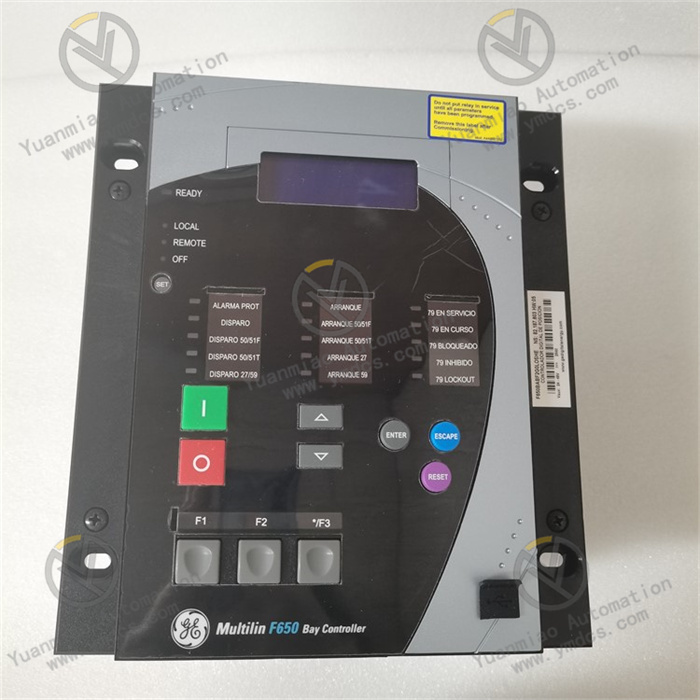
GE F650NFLF2G5HIP6E - Feeder Protection & Bay Controller

Brand: GE Multilin

Product ID: F650NFLF2G5HIP6E

Condition: New / used

Terms of payment: Paypal、T/T 、Western Union

Category:

Description

GE F650NFLF2G5HIP6E

The GE F650NFLF2G5HIP6E is a variable frequency drive (VFD) of the F650 series. As the core executive device for motor speed regulation and control, it mainly undertakes key tasks such as speed adjustment, torque control, energy optimization, and operation protection of AC motors.


Its core function is to convert industrial frequency AC power into AC power with precisely adjustable frequency and voltage through AC-DC-AC power electronic conversion technology, realizing smooth speed regulation of asynchronous motors or permanent magnet synchronous motors. At the same time, it integrates functions such as motor control algorithms, fault diagnosis, and communication interaction, which can dynamically adjust output parameters according to load requirements, balancing speed regulation accuracy and energy-saving effects.


With high power density, a wide speed regulation range, strong environmental adaptability, and a comprehensive protection mechanism, this drive is widely used in the driving scenarios of industrial equipment such as fans, pumps, conveyor machinery, compressors, and machine tools. It adapts to the speed regulation and control needs of multiple industries including metallurgy, chemical engineering, building materials, water treatment, and warehousing logistics, and is a core device for improving the automation level of production processes and energy utilization efficiency.


1. Technical Parameters

1.1 Basic Power Parameters

  • Rated power: 2.5kW; applicable motor power range: 0.75kW~3kW.
  • Rated input voltage: 380V~480V three-phase AC; allowable input voltage fluctuation range: ±15%.
  • Rated input frequency: 50Hz/60Hz, compatible with global power grid frequencies.
  • Rated output current: 6.5A; maximum output current: 19.5A (overload capacity: 150% rated current for 60s continuously, 200% rated current for 2s continuously).
  • Output frequency range: 0.1Hz~400Hz, supporting wide-range speed regulation needs.


1.2 Speed Regulation and Control Parameters

  • Adopts vector control technology (three optional modes: V/F control, sensorless vector control, sensor-based vector control).
  • Speed control accuracy: ±0.5% rated speed in sensorless vector mode, ±0.1% rated speed in sensor-based vector mode.
  • Torque control accuracy: ±5% rated torque (sensorless), ±3% rated torque (sensor-based).
  • Dynamic response speed: speed step response time ≤100ms, torque step response time ≤50ms, meeting the needs of scenarios with rapid load changes.


1.3 Electrical and Energy Efficiency Parameters

  • Input power factor: ≥0.95 (under rated load); total harmonic distortion (THD): ≤5% (with input filter).
  • Conversion efficiency: ≥97% (under rated load), ≥95% under light load conditions (25% load).
  • DC bus voltage: approximately 540V~670V at rated input, supporting adaptive DC bus voltage fluctuation.
  • Built-in braking unit (external braking resistor optional); maximum braking torque up to 150% rated torque, adapting to rapid stop needs.


1.4 Communication and Environmental Parameters

  • Integrates 1 RS-485 serial interface (supports Modbus-RTU, GE-specific communication protocols) and 1 Ethernet interface (supports Modbus/TCP, EtherNet/IP protocols), enabling seamless communication with PLCs, SCADA systems, and HMIs.
  • Equipped with 4 digital inputs, 2 digital outputs, 2 analog inputs (0~10V/4~20mA), and 1 analog output (0~10V/4~20mA), supporting custom I/O functions.
  • Operating temperature: -10℃~50℃ (no derating), 50℃~60℃ (10% derating).
  • Storage temperature: -40℃~85℃.
  • Relative humidity: 5%~95% (no condensation).
  • Vibration resistance rating: IEC 60068-2-6 (10Hz~500Hz, acceleration 2g).
  • Protection rating: IP20 (panel mounting)/IP54 (protective enclosure optional).
  • Dimensions: 200mm×150mm×100mm; supports wall-mounted or DIN rail mounting.


2. Functional Features

2.1 Multi-Dimensional Vector Control, Balancing Accuracy and Dynamics

It adopts the third-generation vector control algorithm, which can automatically match the control mode according to the motor type (asynchronous/permanent magnet synchronous). In sensorless vector mode, it achieves high-precision speed control through motor parameter identification, meeting the needs of general loads such as fans and pumps. In sensor-based vector mode, it realizes rapid torque response through encoder feedback, adapting to high-precision load scenarios such as machine tool spindles and servo conveyors. It supports switching between three control modes: speed closed-loop, torque closed-loop, and position closed-loop, and can quickly adapt to different load characteristics through parameter settings.


2.2 Intelligent Energy-Saving Optimization, Reducing Operating Costs

It has a built-in dedicated energy-saving algorithm for fans and pumps, which can dynamically adjust the output frequency according to load flow/pressure requirements, saving 20%~50% energy compared with traditional industrial frequency operation (depending on load characteristics). It is equipped with automatic energy-saving mode (AEM), which real-time detects the load rate and optimizes the matching relationship between output voltage and frequency, significantly reducing reactive power loss under light load conditions. It supports sleep-wake function: when the load is below the set threshold for a long time, it automatically enters sleep mode; when the load recovers, it wakes up quickly, further reducing standby energy consumption.


2.3 Comprehensive Protection Mechanism, Ensuring Reliable Operation

It integrates more than 20 protection functions, including overcurrent, overload, overvoltage, undervoltage, overtemperature, phase loss, motor lock-up, ground fault, and phase-to-phase short circuit. It has a motor thermal protection function: the rated motor temperature and heat dissipation coefficient can be set through parameters, and the equivalent motor temperature is real-time monitored to avoid motor damage due to overheating. It supports fault self-recovery function: the number of automatic retries and interval time can be set according to fault types; temporary faults (such as instantaneous undervoltage) can resume operation without manual intervention, improving system availability. It uses industrial-grade IGBT power modules and an optimized heat dissipation structure to ensure stable operation under high-load conditions.


2.4 Flexible Communication Interaction and Convenient Operation & Maintenance

Multi-protocol communication interfaces support seamless connection with various industrial control systems, enabling remote setting of drive parameters, real-time monitoring of operating status, and upload of fault information, adapting to factory automation integration needs. Through the GE Proficy Drive Tools software, operation and maintenance operations such as drive parameter configuration, firmware upgrade, fault diagnosis, and waveform recording can be realized, supporting offline simulation and online debugging. The panel is equipped with an LED display and buttons, which can intuitively display information such as operating frequency, current, voltage, and fault codes. Button operations support quick parameter modification and mode switching, enabling basic debugging without connecting to a computer. It has a built-in motor parameter self-learning function, which automatically identifies motor parameters such as resistance and inductance after power-on, optimizing control accuracy and lowering the debugging threshold.


3. Working Principle

3.1 Power Conversion Link

On the input side, the three-phase rectifier bridge converts industrial frequency AC power into DC power, which is filtered by the DC bus capacitor to obtain a stable DC voltage. On the inverter side, IGBT power modules form a three-phase bridge inverter circuit. Driven by the control unit, the DC power is converted into three-phase AC power with adjustable frequency and voltage through pulse width modulation (PWM) technology, which is output to the motor stator winding to drive the motor to rotate.


3.2 Control and Regulation Link

The control unit receives external control signals (such as analog given signals, communication commands, and digital signals), and calculates the target output frequency and voltage combined with the preset control mode (V/F/vector) and parameters. It real-time collects input/output electrical parameters through current sensors and voltage sensors, and obtains torque components and flux components after decoupling via the vector control algorithm. The duty cycle of PWM pulses is dynamically adjusted to achieve precise control of output parameters. In the sensor-based control mode, the motor speed signal is collected through the encoder to form speed closed-loop feedback, further improving control accuracy.


3.3 Protection and Monitoring Link

The monitoring unit real-time collects key parameters such as DC bus voltage, output current, module temperature, and motor speed, and compares them with preset thresholds. When an abnormal parameter is detected (such as current exceeding the rated value), the protection mechanism is triggered immediately: the IGBT module is quickly turned off, the output is cut off, and the fault code is recorded and fed back through the panel indicator light and communication interface. After the fault is eliminated, normal operation is resumed through a reset operation. For recoverable faults, automatic retries are performed according to the preset strategy, reducing manual intervention.


3.4 Communication and Interaction Link

The communication module establishes a communication link with upper-level systems (such as PLCs and HMIs) according to the configured protocol, periodically uploads operating parameters (frequency, current, torque, temperature, etc.) and fault information, and receives control commands issued by the upper-level system (such as start/stop, frequency given, and parameter modification). Local human-machine interaction is realized through panel buttons and the display, supporting operations such as parameter query, modification, and mode switching to meet on-site debugging and operation & maintenance needs.


4. Common Faults and Solutions

4.1 Fault 1: Drive Fails to Start, Panel Displays "Undervoltage Fault" (Code Uv1)

Possible Causes

  • Input power voltage is too low.
  • Power line is loosely connected or broken.
  • Input-side air switch trips.
  • DC bus capacitor is damaged.
  • Voltage detection circuit is faulty.


Solutions

  1. Use a multimeter to detect the input power voltage, and confirm it is within the range of 380V~480V±15%. If the voltage is too low, check the power grid or equip a voltage stabilizer.
  2. Check the power line terminals, re-tighten the connections, and eliminate loose or broken connections.
  3. Check the input-side air switch and fuse; if tripped or fused, replace them and investigate the cause of the short circuit.
  4. After disconnecting the power, use a multimeter to detect the DC bus capacitor voltage. If the voltage drops rapidly, the capacitor is damaged and needs to be replaced.
  5. Test with a spare drive; if the fault still occurs, the voltage detection circuit of the original drive is faulty and needs to be returned to the factory for repair.


4.2 Fault 2: Motor Speed Is Unstable with Large Fluctuations

Possible Causes

  • Incorrect selection of control mode.
  • Motor parameter self-learning is not completed.
  • Given signal is interfered.
  • Load fluctuation is too large.
  • Encoder is faulty (in sensor-based mode).


Solutions

  1. Confirm that the control mode matches the motor type: sensorless vector mode is preferred for asynchronous motors, and the corresponding vector mode should be selected for permanent magnet synchronous motors.
  2. Execute the motor parameter self-learning function to ensure the drive obtains accurate motor parameters such as resistance and inductance.
  3. Check the given signal cable: use shielded cables and route them separately, away from high-voltage cables, to reduce electromagnetic interference.
  4. Analyze the load characteristics; if the load fluctuates frequently, increase the speed loop proportional gain or enable the speed smoothing function.
  5. In sensor-based mode, check the encoder wiring and signal; use an oscilloscope to detect the encoder output waveform, and replace the encoder if abnormal.


4.3 Fault 3: Communication with PLC Is Interrupted, Remote Control Is Unavailable

Possible Causes

  • Communication cable is loose or damaged.
  • Communication parameter configuration is incorrect.
  • Communication interface is faulty.
  • PLC communication module is faulty.


Solutions

  1. Re-plug the communication cable, use a multimeter to detect the cable continuity, and replace the shielded communication cable if damaged.
  2. Verify the communication parameters (protocol type, IP address, port number, slave address, baud rate, parity check) of the drive and PLC to ensure they are completely consistent.
  3. Check the drive communication status through the panel; if "communication timeout" is displayed, try replacing the drive communication interface or restarting the device.
  4. Connect a spare drive to the PLC communication link; if the interruption still occurs, the PLC communication module is faulty and needs to be repaired or replaced.


4.4 Fault 4: "Overload Fault" (Code Oc2) Is Displayed During Operation

Possible Causes

  • Motor load exceeds the rated value.
  • Motor is locked or jammed.
  • Motor winding is short-circuited.
  • The drive overload threshold is set too low.
  • Poor heat dissipation.


Solutions

  1. Detect the motor load to confirm whether there is an overload condition; if it is a process requirement, replace the drive with a higher power rating.
  2. Check the mechanical transmission part of the motor to eliminate mechanical faults such as lock-up and jamming.
  3. Use a megohmmeter to detect the insulation resistance of the motor winding; if the insulation is poor or there is a short circuit, repair the motor.
  4. Verify the drive overload threshold setting to ensure it matches the rated motor current (generally set to 1.1~1.2 times the rated motor current).
  5. Check the drive's cooling fan and heat sink, clean dust or debris to ensure smooth heat dissipation; install additional heat dissipation devices if the ambient temperature is too high.

contact us