Description
1. Product Overview
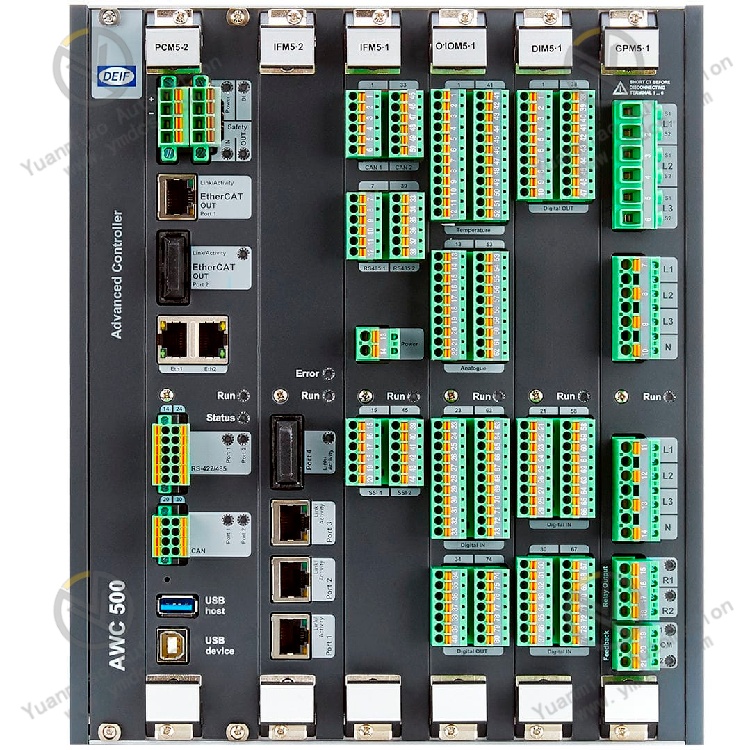
The DEIF AWC500 is a new‑generation advanced programmable turbine controller (PAC) for wind turbines, manufactured by DEIF, Denmark. As a high‑end core control unit for the main control and pitch‑control systems of wind turbines, it is engineered to withstand harsh field operating conditions of large‑capacity wind generators and fully applicable to main control, pitch regulation, grid protection and coordinated energy‑management scenarios for on‑shore and offshore 6‑8 MW large‑scale wind turbines.
Integrating complete logic operation, precise pitch control, grid‑parameter measurement, fault interlock protection, multi‑protocol field‑bus communication and fault‑tolerant operation, this controller serves as the central “brain” that enables smooth grid‑connection, accurate speed regulation, constant‑power output, safety protection and intelligent operation & maintenance of wind‑turbine units. Equipped with an industrial‑grade dual‑core ARM Cortex‑A7 high‑speed processor, PREEMPT‑RT fault‑tolerant real‑time Linux operating system and standard CODESYS programming environment, the unit has passed stringent HALT (Highly Accelerated Life Testing) and features a design service life of more than 20 years.
It delivers outstanding industrial‑grade performance including ultra‑wide operating temperature range, high vibration and shock resistance, strong electromagnetic interference immunity and high‑altitude adaptability. Continuous stable operation is guaranteed within ‑40 ℃ ~ +70 ℃, making it suitable for complex harsh outdoor environments with sand, snow, extreme cold, high temperature, high altitude and heavy electromagnetic disturbance. Natively compatible with mainstream wind‑turbine architectures and industrial bus protocols, it features flexible programming, strong expandability and extremely low failure rate, and is widely deployed in new large‑capacity wind‑turbine projects, upgrade of legacy main‑control systems, pitch‑control retrofits and grid‑connection‑protection optimization works.
2. Core Functions
Turbine main‑control and precise power regulation
Capable of operating independently as the main controller of a wind turbine, it executes start‑stop logic, closed‑loop wind‑speed‑to‑rotor‑speed regulation, constant‑power output control, yaw‑to‑wind alignment management and hydraulic/mechanical brake control. It dynamically adapts to variable wind‑driven loads, effectively suppresses power oscillation and speed deviation caused by wind‑speed fluctuation, ensures smooth turbine operation and high‑efficiency power generation, improves overall generation performance and operational stability, and meets refined control requirements for multi‑megawatt wind turbines.
Individual pitch control and dynamic load optimization
Natively dedicated to pitch‑system control, it independently performs synchronous three‑axis pitch regulation, precise blade‑angle calibration, dynamic wind‑load compensation and balanced rotor‑load control. Based on real‑time wind sampling and algorithm calculation, blade angles are dynamically adjusted to reduce mechanical fatigue loads on blades, gearboxes and main shafts, extend unit service life, and significantly improve turbine stability and gust‑resistance capability under turbulent wind conditions.
Full‑range grid monitoring and grid‑connection protection
Built‑in high‑precision three‑phase 690 V voltage and current acquisition channels enable real‑time monitoring of active/reactive power, frequency, phase angle and power quality. Pre‑configured protection logics comply with international grid‑connection standards such as G59/3. It accurately detects faults including over‑voltage, under‑voltage, over‑frequency, under‑frequency, overload, earth‑leakage, islanding and harmonic anomalies, and executes multi‑level protection actions. It satisfies strict grid‑connection specifications, guarantees safe and stable grid‑tie operation, triggers rapid disconnection during grid abnormalities and prevents turbine damage and grid‑related accidents.
High‑speed multi‑bus communication and coordinated system networking
Comprehensive industrial communication interfaces are provided, supporting EtherCAT, CAN/CANopen, SSI, TCP/IP, RS‑422/485, Modbus TCP/RTU, DNP3 and other mainstream protocols. It seamlessly interfaces with pitch systems, converter units, yaw systems, SCADA supervisory platforms, energy‑storage systems and grid‑dispatching stations, enabling high‑speed data exchange, multi‑subsystem coordination and remote data uploading. Cluster‑based centralized management for multiple turbines is supported, delivering excellent system expandability and compatibility.
Fault‑tolerant redundant operation and high‑reliability safety protection
Powered by the PREEMPT‑RT real‑time fault‑resilient Linux operating system with fault‑tolerant file system, the controller supports automatic program error recovery, power‑failure data retention and continuous runtime self‑diagnosis. The hardware incorporates multi‑stage surge suppression, EMI electromagnetic shielding and galvanic isolation circuits to resist field electromagnetic interference, voltage transients and lightning surges. Abnormalities within a single module or loop will not interrupt core control logic, maximizing uptime and minimizing unplanned shutdowns.
Long‑term operation with superior weather‑resistance and mechanical‑shock immunity
Having passed top‑tier environmental qualification tests, the controller withstands high‑level vibration, shock, condensing humidity and low‑pressure high‑altitude conditions. Stable long‑run performance is maintained at 55 ℃ and 97 % RH condensing environment. The unit adopts reinforced three‑proof industrial design with no vulnerable components. Boasting a 20‑year design life, it supports 7×24‑hour unattended continuous operation with low maintenance requirements, perfectly fitting remote, unmanned wind‑farm sites.
3. Technical Specifications
| Parameter Item | Technical Specification |
|---|---|
| Model | AWC500 |
| Brand | DEIF |
| Product Series | AWC Advanced Wind Controller Series |
| Product Type | Integrated PAC programmable controller for wind‑turbine main control & pitch control |
| Main Processor | 1 GHz Dual‑core ARM Cortex‑A7 Industrial High‑speed Processor |
| Operating System | PREEMPT‑RT Real‑time Fault‑tolerant Linux, fault‑tolerant file system |
| Programming Environment | CODESYS V3, compliant with IEC 61131‑3 standard programming languages |
| Applicable Turbines | On‑shore / Off‑shore 6‑8 MW high‑capacity wind turbines |
| Measurement Accuracy | Class‑0.5 high‑precision power measurement, direct three‑phase 690 V voltage & 1/5 A current measurement |
| Communication Protocols | EtherCAT, CAN/CANopen, SSI, TCP/IP, RS‑422/485, Modbus TCP/RTU, DNP3 |
| Operating Temperature | ‑40 ℃ ~ +70 ℃ ultra‑wide industrial temperature range |
| Storage Temperature | ‑40 ℃ ~ +85 ℃ |
| Altitude Rating | Stable full‑capacity operation up to 4000 m above sea level |
| Humidity Condition | Long‑term operation permitted at 55 ℃, 97 % RH condensing humidity |
| Vibration Resistance | 2.1 g (3.2‑50 Hz), 1.0 g (13.2‑100 Hz) |
| Shock Resistance | 50 g, 11 ms half‑sine shock; 25 g, 6 ms half‑sine bump |
| Protection Features | Full‑range EMC compliance, surge immunity, galvanic isolation, anti‑ageing three‑proof coating |
| Design Service Life | 20‑year industrial‑grade lifespan, HALT accelerated ageing test passed |
| Key Features | Combined main‑control & pitch‑control, extreme weather resistance, high vibration/shock immunity, fault‑tolerant redundancy, multi‑protocol networking, high‑precision grid‑connection protection, long‑life low‑maintenance |
4. Working Principle
The DEIF AWC500 wind‑turbine controller implements a closed‑loop workflow: multi‑source data acquisition → real‑time algorithm computation → closed‑loop condition regulation → grid‑connection logic management → fault‑tolerant protected operation → network‑based data upload.
During operation, the high‑precision acquisition unit synchronously collects full‑range operating parameters, including wind speed, rotor speed, blade pitch angle, nacelle attitude, three‑phase grid voltage/current, power, frequency, equipment temperature and vibration signals. After galvanic isolation, noise filtering and signal conditioning, accurate raw measurement data is generated.
Leveraging its dual‑core high‑speed processor and real‑time Linux system, the controller executes wind‑turbine‑specific control algorithms and grid‑protection logics to complete refined calculations such as wind‑speed prediction, closed‑loop speed regulation, optimized pitch‑angle matching, power‑output optimization and yaw‑alignment correction. Operating modes are dynamically switched according to real‑time wind and grid conditions, achieving fully‑automated control over the complete turbine cycle: startup, grid‑tie, full‑power generation, power curtailment, shutdown and fault disconnection.
Potential hazards such as grid anomalies, mechanical overload and communication failures are continuously monitored to trigger multi‑level alarms and interlock protection. The fault‑tolerant file system and redundant‑operation mechanism prevent single‑point faults from escalating and causing unit shutdown. Finally, operational data, fault codes and generation parameters are transmitted to the SCADA monitoring platform through multi‑bus interfaces to realize intelligent turbine maintenance, precise regulation and safe, stable grid‑connected power generation.
5. System‑Architecture Compatibility
The DEIF AWC500 is a universal high‑end integrated main‑control and pitch controller for the wind‑power industry. Its hardware architecture, bus protocols, electrical logics and programming environment are fully compatible with mainstream multi‑megawatt wind‑turbine system architectures. Three flexible deployment modes are supported: turbine main controller, standalone pitch controller and grid‑connection protection unit, meeting diverse control schemes and retrofit requirements.
Natively supporting EtherCAT high‑speed fieldbus, CANopen wind‑turbine bus, serial‑port and Ethernet communication systems, it seamlessly interfaces with pitch drives, frequency‑conversion transmission units, yaw‑control systems, brake assemblies, meteorological sensors and upper‑level SCADA monitoring platforms.
It is suitable for new‑turbine system integration, domestic‑replacement upgrade of legacy main‑control cabinets, pitch‑system reconstruction, grid‑protection optimization and intelligent wind‑farm cluster upgrades. Its standardized industrial architecture requires minimal modification of existing wiring and mechanical structures. The CODESYS‑based programming environment conforms to mainstream industrial automation development standards and supports legacy wind‑turbine program configurations. With low retrofit difficulty, wide adaptability and high system stability, it serves as a premium core control component for wind‑turbine maintenance, renovation and new‑project deployment.
6. Application Scenarios
Engineered for harsh outdoor wind‑farm environments including remote on‑land sites, salt‑laden offshore locations, high‑altitude mountainous zones and extreme‑cold regions, the DEIF AWC500 delivers extreme weather resistance, superior mechanical reliability, combined main‑control‑pitch functionality, accurate grid‑protection performance and long service life, addressing common pain‑points of conventional wind‑turbine controllers such as poor climate tolerance, interference susceptibility, high failure rates, short service life and insufficient regulation precision.
It is widely deployed for 6‑8 MW on‑shore wind turbines, salt‑resistant offshore wind generators, high‑altitude mountain wind farms and extreme‑cold wind‑power sites, performing core tasks such as full‑turbine automatic control, three‑axis individual pitch regulation, grid‑connection safety protection, turbine‑load optimization and wind‑farm data‑network operation & maintenance.
Typical projects include new‑turbine OEM integration, legacy control‑system modernization, wind‑farm stability improvement, grid‑compliance rectification, failed‑controller replacement and intelligent‑O&M upgrades. Deployment of the AWC500 comprehensively improves power‑generation efficiency, operational stability, grid‑safety performance and equipment lifetime of wind turbines, ensuring long‑term, unattended, high‑efficiency, low‑fault and high‑revenue stable operation of wind‑farms.