Description
1. Product Overview
Full Model: IS220UCSAH1AGE
Manufacturer: GE General Electric
Product Series: Mark VIe Turbine Control System Core Processor Series
Product Name: UCSA Main Control Processor, System Master Computing Module
Product Positioning
IS220UCSAH1AGE is the core main control processor module for GE Mark VIe gas turbine and steam turbine control systems, acting as the computing hub and logic scheduling core of the entire turbine control system. Equipped with an industrial high-performance embedded processor and preloaded with an industrial real-time operating system, this module undertakes core tasks including complex control algorithm computation, logic scheduling, centralized data processing, system bus management and cross-subsystem coordinated control. It serves as the central controller for control systems of thermal power combined cycle power plants, gas turbine power units and industrial turbine installations. Adopting GE standardized industrial control architecture, the module features outstanding environmental adaptability, computing stability and bus compatibility. It is widely applied in new unit system matching, main control module replacement for aging power plants, control system upgrading and expansion, and industrial control system technical retrofits. It ranks among the most reliable and widely deployed core main control units within the Mark VIe platform.
Core Functions
As the main control core of the entire Mark VIe control system, this module performs five primary responsibilities: system logic operation, centralized unit-wide data processing, bus communication scheduling, multi-subsystem coordinated control, fault logic evaluation and protection command output. It handles complex industrial control tasks including unit speed control, temperature regulation, closed-loop load regulation, startup/shutdown sequence logic, interlock protection logic and fault self-diagnosis calculation. It uniformly manages data interaction and command distribution among system I/O boards, communication modules and acquisition units. It aggregates full-dimensional operating data such as unit temperature, pressure, rotational speed, vibration, load and grid parameters. High-precision real-time algorithms are adopted to implement steady-state regulation, dynamic condition adaptation and abnormal condition judgment, and accurate control commands are delivered. It ensures smooth startup and shutdown of gas and steam turbines, precise load regulation and reliable protection logic. It prevents major risks including unit runaway, parameter over-limit, false interlock activation and system collapse, supporting long-term safe, stable and efficient grid-connected operation of generating units.
Compatible Systems
Fully compatible with the complete architecture of GE Mark VIe turbine control systems, it seamlessly matches the main control framework of gas-steam combined cycle units, pure condensing steam turbine units, simple-cycle gas turbine units and industrial drive turbine units. It cooperates seamlessly with various system I/O acquisition boards, high-speed speed measurement boards, analog boards, digital boards, communication expansion modules and power supply modules. Natively supporting GE proprietary bus protocols including UDH and IONet, it complies with system backplane bus specifications, cabinet installation standards and underlying control logic. It supports downward-compatible replacement between new and legacy systems without extensive modification of system programs and wiring layouts. Applicable engineering scenarios cover commissioning of new units, main control module replacement for aged power plants, system performance upgrading, industrial control system technical transformation and unit capacity expansion.
Application Scenarios
It is deployed in large thermal power plants, cogeneration power stations, gas combined cycle power plants, oil & gas chemical power workshops and heavy industrial turbine drive installations, responsible for main control computation and system management of gas turbines, steam turbines and large compressor units. Capable of continuous operation under harsh industrial conditions in power plant control rooms featuring high temperature, dust, vibration and strong electromagnetic interference, it executes core tasks including full-process unit startup/shutdown control, intelligent load regulation, equipment condition monitoring, fault interlock protection and system data networking transmission. It is an indispensable core computing unit for industrial control systems of large power equipment.
2. Technical Features
High-Performance Industrial Computing Core with Powerful Complex Algorithm Processing Capacity
The module integrates a high-clock industrial embedded processor and dedicated industrial real-time operating system. It reliably executes real-time computing tasks such as multi-loop PID regulation for turbines, complex sequence logic, multi-layer interlock protection and massive operating data processing. It delivers excellent parallel multi-task processing, ultra-low computing latency and high timing precision. It accurately adapts to complicated conditions including dynamic load fluctuation, rapid condition switching and transient control during startup and shutdown, avoiding computing stagnation, logic disorder and command delay to guarantee unit control accuracy and response speed.
Multi-Bus High-Speed Communication Architecture for Efficient and Stable Network Interaction
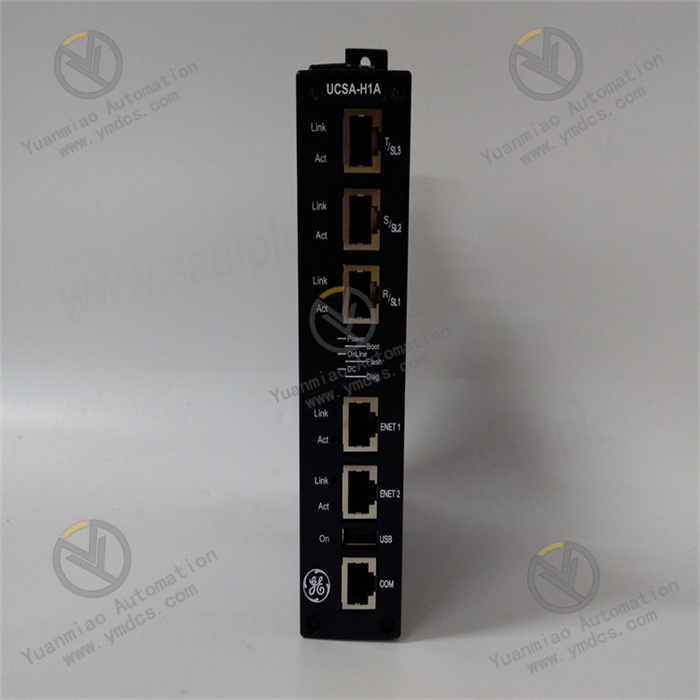
Multiple 10/100M high-speed Ethernet ports are integrated to connect to UDH unit high-speed data bus and IONet system control bus respectively, supporting parallel multi-link data exchange and link redundancy. It simultaneously interfaces with system I/O boards, local monitoring terminals, remote SCADA platforms and grid dispatching systems, enabling millisecond-level uploading of unit operating data, real-time distribution of control commands and online interaction of system parameters. With strong bus compatibility, large data throughput and extremely low packet loss rate, it ensures stable networking and efficient coordination of the whole control system.
Industrial Wide-Temperature Stable Operation with Superior Environmental Adaptability
Designed with power-plant-grade ruggedized hardware and full-range wide-temperature industrial components, the module adopts fanless passive natural cooling. It operates reliably within cabinet temperature range of 0℃~65℃. It offers excellent dustproof, moisture-proof, anti-aging and vibration-resistant performance. It withstands long-term nonstop operation, equipment vibration and temperature & humidity fluctuations in power plants without parameter drift, system crash or logic disorder, meeting requirements of unattended round-the-clock operation.
Comprehensive Hardware and System Self-Diagnosis for Accurate Fault Prediction
Built-in full-range hardware self-test, program self-inspection, bus link monitoring and data verification mechanisms continuously monitor processor operation status, memory conditions, supply voltage, bus link integrity and program execution. It actively and accurately identifies hidden risks such as module hardware failure, program abnormality, bus disconnection, data check error and storage fault. Fault codes and event logs are uploaded in real time to assist maintenance staff in rapid fault localization, eliminating potential hazards and preventing unit shutdown, runaway and false protection triggered by main control anomalies.
Multi-Layer Data Protection and Redundancy Mechanisms for High Operational Reliability
Functions including ECC memory verification, redundant program storage, continuous operation logging and non-volatile storage of critical parameters effectively prevent data corruption, parameter loss and unexpected program jumps. It provides strong anti-interference and fault tolerance against transient unit condition swings, grid disturbances and momentary voltage fluctuations. It automatically corrects computing deviations and locks valid control logic to maintain stable system control and reliable protection logic under extreme operating conditions.
Standardized Modular Design for Convenient Maintenance and Replacement
Adopting unified standardized modular structure of Mark VIe series with regular dimensions and consistent interfaces, the rack-mount pluggable module achieves high interchangeability and easy assembly. It supports power-on comprehensive self-test, online status monitoring and non-stop parameter viewing & fault diagnosis. Failed legacy modules can be replaced in-situ without program modification, logic reconfiguration or wiring changes. It greatly shortens unit outage duration and reduces power plant maintenance costs and generation losses.
Robust Electromagnetic Compatibility Design for Complex Power Plant Environments
The unit is equipped with electromagnetic shielding, electrical isolation, surge suppression and electrical fast transient pulse protection circuits, together with dedicated filtering and voltage stabilization circuits. It effectively resists complex electromagnetic disturbances including variable frequency drive interference, high-voltage radiation, line surge, electrostatic discharge and grid fluctuations. Long-term operation is free from intermittent bus disconnection, data distortion, logic misjudgment and system crash, fully securing stable operation of the entire turbine control system.
3. Specification Parameters
| Item | Parameter |
|---|---|
| Model | IS220UCSAH1AGE |
| Manufacturer | GE General Electric |
| Product Series | Mark VIe Turbine Control System Core Processor Module |
| Equipment Type | UCSA Main Control Processor, System Core Computing Module |
| Applicable Equipment | Gas Turbine, Steam Turbine, Large Industrial Compressor, Turbine Power Machinery |
| Applicable System | Complete GE Mark VIe Turbine Control System, Power Plant SCADA Monitoring System |
| Core Functions | Unit-wide logic operation, multi-loop load regulation, bus communication scheduling, centralized I/O data processing, interlock protection logic execution, fault self-diagnosis, data uploading and tracing |
| Processor | Industrial high-performance embedded processor, 667MHz |
| Firmware | QNX Industrial Real-Time Multi-Task Operating System |
| Memory & Storage | 256MB SDRAM, 1GB CompactFlash for program storage |
| Power Supply | DC 18~36V wide-range input, rated power consumption: 12W |
| Communication Interfaces | 6 × 10/100BaseTX Ethernet ports, 1 × USB debug port |
| Bus Protocols | UDH Unit Data Bus, IONet System Control Bus, compatible with full series of GE native protocols |
| Cooling Method | Passive natural cooling, fanless, maintenance-free |
| Operating Temperature | 0℃~+65℃ |
| Storage Temperature | -40℃~+85℃ |
| Ambient Humidity | 5%~95%RH, non-condensing, suitable for power plant cabinet environment |
| Electrical Features | Electrical isolation, electromagnetic shielding, surge protection, ECC data verification, high electromagnetic interference immunity |
| Mechanical Features | Standard rack pluggable modular design, unified interfaces, compact structure, high interchangeability |
| O&M Features | Power-on comprehensive self-test, precise fault code reporting, online parameter tuning, in-situ replacement, no complex reconfiguration required |
| Product Characteristics | Powerful computing capacity, high real-time performance, stable bus communication, wide temperature tolerance, complete self-diagnosis, strong anti-interference, stable operation, easy maintenance |
4. Working Principle
4.1 Power-On Initialization and System-Wide Self-Diagnosis
After receiving DC 18~36V industrial wide-range power supply, the module automatically completes hardware initialization, real-time OS loading, driver activation, bus protocol matching and memory & storage verification. It sequentially executes full inspection on processor core, storage unit, Ethernet ports, power circuits, bus links and self-test logic to detect hardware damage, missing programs, bus anomalies, supply fluctuations and storage failures. Upon successful self-test, it synchronizes configuration parameters, control logic and interlock programs of the whole Mark VIe system, enters real-time main control operation mode, and takes full charge of unit condition calculation and system scheduling.
4.2 Centralized Acquisition and Verification of Unit-Wide Data
During unit operation, the module collects massive full-dimensional real-time data transmitted by all I/O boards, acquisition modules, speed measurement modules and communication modules via high-speed IONet and UDH bus. Data covers unit rotational speed, exhaust temperature, casing temperature, steam pressure, flow rate, unit load, grid parameters, vibration, variable frequency operating status and equipment status. All raw data undergoes filtering, error correction, ECC verification and logical screening to eliminate distorted interference signals and invalid readings. An accurate and complete unit operating database is established to provide reliable data support for subsequent control computation, condition evaluation and fault protection.
4.3 Real-Time Logic Operation and Precise Unit Control
Based on high-performance real-time computing core and built-in turbine-specific control algorithms, the module executes parallel complex tasks: multi-loop PID load regulation, unit startup/shutdown sequence logic, temperature & pressure closed-loop control, steady-state speed regulation, adaptive load adjustment and power factor optimization. It dynamically modifies control parameters according to real-time thermal energy, grid load and equipment conditions, and outputs accurate regulation commands to each actuator subsystem. It realizes full-process precise control covering unit cranking, speed raising, grid synchronization, load operation, steady-state operation and shutdown. It effectively suppresses condition fluctuation, parameter overshoot and load instability, improving power quality and operational efficiency.
4.4 Multi-Bus Coordinated Scheduling and System Linked Control
As the system bus scheduling core, the module uniformly manages data exchange timing and transmission logic of dual UDH and IONet buses, and coordinates operation of all subsystems. On one hand, it distributes main control regulation commands, parameter configuration orders and interlock control instructions to each I/O unit and actuator. On the other hand, it collects operating status of all subsystems, dynamically adapts to different operation modes, and automatically switches startup/shutdown logic, grid synchronization logic, load limiting logic and fault standby logic. Seamless coordination is achieved among main control system, acquisition system, execution system and monitoring system to guarantee stable collaborative operation under all working conditions.
4.5 Fault Self-Diagnosis and Interlock Protection Execution
The module maintains four-layer continuous self-diagnosis covering hardware, program, data and bus to monitor unit operating conditions and its own running status. When detecting unit parameter violation, equipment abnormality, signal failure, bus disconnection, internal hardware fault or program computing error, it immediately identifies fault type and scope, triggers local alarms and uploads fault codes and operation logs. In accordance with preset interlock logic, protection commands are issued to execute load reduction, unit shutdown, grid disconnection and fault blocking. It effectively contains fault propagation and prevents severe safety risks including unit runaway, equipment damage and grid impact.
4.6 Data Logging for Traceability and Support for Remote Operation & Maintenance
The module continuously records unit operating parameters, condition change sequences, fault events, operation records and bus interaction logs. Critical parameters are retained after power loss to support long-term data traceability and condition analysis. It connects to local terminals and remote SCADA platforms via Ethernet, supporting remote parameter tuning, status monitoring, fault inquiry and program upgrade. It meets requirements of unattended digital operation in power plants, and provides complete data foundation for unit performance optimization, troubleshooting and system technical transformation.
5. Common Faults and Troubleshooting
5.1 Symptom: Module fails to start, unrecognized by system, main control offline, no control logic available
Possible Causes
① Abnormal module supply voltage beyond DC 18~36V range, poor backplane contact, oxidized and loose slots;
② Corrupted module program, missing system firmware or abnormal boot files;
③ Memory or storage failure leading to self-test failure and boot abort;
④ Cabinet backplane bus fault and link anomaly resulting in failed system handshake; ⑤ Aging and damaged core hardware of the module, invalid boot logic.
Solutions
Fully power off and discharge the unit. Extract the module, clean oxidation and dust on gold fingers and cabinet slots, then reinsert firmly. Measure module supply voltage and troubleshoot power circuit faults to ensure voltage within rated range. Check module indicator status to locate abnormal stages during startup self-test. Rewrite matching original firmware and restore system boot configuration. Inspect cabinet backplane bus communication and eliminate bus faults. If startup still fails after power supply, wiring, bus and program verification, hardware damage is confirmed. Replace with original IS220UCSAH1AGE module.
5.2 Symptom: Disordered unit control, severe load fluctuation, abnormal regulation logic and parameter drift
Possible Causes
① Degraded module computing performance, abnormal multi-task processing and algorithm deviation;
② Lost or inconsistent system configuration parameters, mismatched program versions;
③ Abnormal bus data exchange, packet loss and distortion leading to incorrect condition judgment;
④ Insufficient module heat dissipation and unstable operation under high temperature;
⑤ External electromagnetic interference causing data verification error and logic misjudgment.
Solutions
Restore original system configuration parameters, unify program firmware versions and re-synchronize system logic. Inspect all bus cables and ports, eliminate loose wiring, interference and cable damage, and optimize shielding & grounding. Clean heat dissipation channels of modules and cabinets to improve ventilation and lower operating temperature. Check system logs for data verification errors and computing alarms. Reboot the module to refresh operation logic and reinitialize the system. If unit control remains unstable after rectification, module performance fault is confirmed and spare part replacement is required.
5.3 Symptom: Frequent bus communication interruption, offline I/O modules, interrupted data uploading
Possible Causes
① Loose Ethernet ports, aged cables, oxidized contacts and poor connection;
② Incorrect UDH/IONet bus configuration, mismatched baud rate and device address;
③ Strong on-site electromagnetic interference leading to bus packet loss and intermittent disconnection;
④ Aging module communication chips and degraded port performance;
⑤ Excessive bus load, link conflict and abnormal background system.
Solutions
Comprehensively inspect Ethernet ports and bus lines, replace aged cables, clean port contacts and fasten connections. Verify bus protocols, device addresses and communication parameters, correct configuration errors and re-establish bus links. Optimize cabinet shielding and grounding, route away from high-voltage and variable frequency equipment to mitigate electromagnetic impact. Check bus load and background system status to rule out peripheral faults, and adjust bus timing configuration. If communication keeps dropping and I/O modules remain offline after rectification, module communication circuit failure is confirmed; replace with original module.
5.4 Symptom: Module overtemperature alarm, operation lag, frequent self-test and restart
Possible Causes
① Excessive dust in control cabinet, blocked air duct, poor natural ventilation and excessive cabinet temperature;
② Long-term high-load computing, full multi-task operation resulting in component heating;
③ Ambient temperature & humidity exceeding rated operating range;
④ Aging internal circuit of module, abnormal power consumption and deteriorated thermal stability;
⑤ Abnormal system program and infinite loop causing excessive load.
Solutions
Periodically shut down equipment to clean cabinet filters, air ducts and dust on module surfaces, unblock cooling channels and ensure natural heat dissipation. Control room temperature to maintain module operation within 0~65℃ rated range. Optimize system task allocation to reduce unnecessary high-load computation. Reboot the module to refresh program logic and resolve program anomalies. Replace aging IS220UCSAH1AGE modules with persistent overtemperature alarms and frequent restarts promptly to guarantee stable main control system operation.
5.5 Symptom: Frequent false unit protection, unintended logic action and abnormal interlock
Possible Causes
① Module data verification anomaly and computing deviation leading to false condition judgment;
② Improper setting of system protection parameters, incorrect anti-chatter delay and threshold values;
③ Transient bus data anomaly and interference signals triggering logic jump;
④ Corrupted internal logic program and abnormal firmware;
⑤ Momentary supply fluctuation causing unstable module operation.
Solutions
Fully verify critical parameters including unit protection thresholds, anti-chatter delay and interlock sequence, and perform optimized tuning according to field conditions. Eliminate peripheral risks such as bus interference, signal distortion and power fluctuation, and install voltage stabilization and anti-interference measures. Reboot the module, refresh system logic and upgrade to stable matching firmware. Trace trigger sources via fault logs. If false protection and unintended logic action persist after eliminating peripheral condition, parameter and wiring issues, main control computing fault exists and spare part replacement is required。