Description
1. Overview
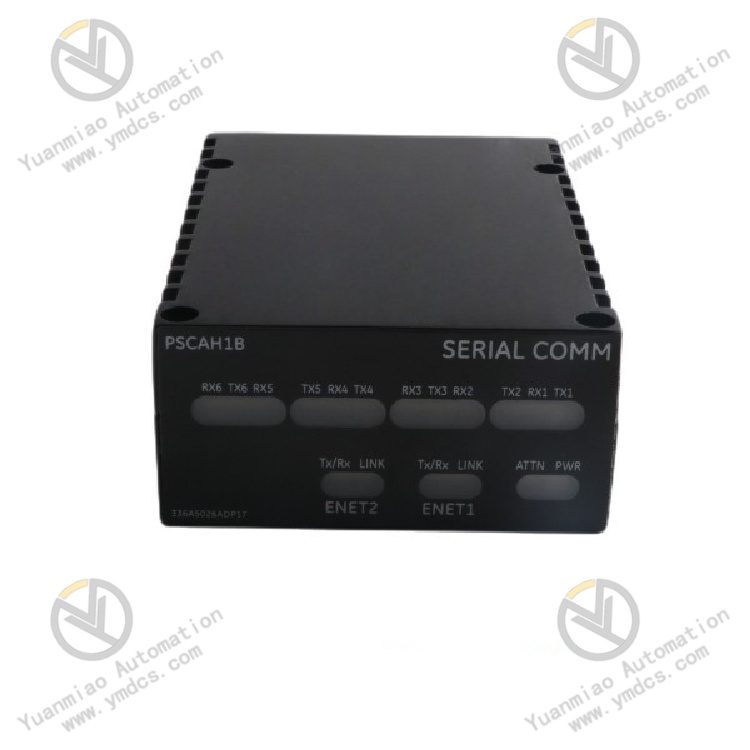
GE IS220PSCAH1B is a dedicated high-speed serial communication I/O module for the GE Speedtronic Mark VIe / Mark VIeS turbine control system. It acts as the core interface unit of the unit distributed I/O network architecture, widely compatible with the main control systems and redundant control systems of gas turbines, steam turbines and combined-cycle generating units. The module is mainly responsible for serial data interaction, network link networking, signal transparent transmission and status forwarding between on-site remote I/O substations, intelligent sensing equipment, auxiliary control units and the system main controller. It sorts and uploads various on-site collected signals and equipment status information to the main control CPU via high-speed serial buses, and issues main control regulation commands and interlock logic commands downward. It serves as the critical hardware carrier for distributed networking, remote signal transmission and cross-unit data interaction of turbine control systems.
Distinct from ordinary general communication modules, the IS220PSCAH1B is customized for power plant redundant control and high-reliability data transmission scenarios. It supports multiple system topologies including simplex, duplex dual redundancy and Triple Modular Redundant (TMR), and boasts industrial-grade features such as high-speed serial transmission, link self-healing fault tolerance, real-time network monitoring, data verification & error correction and seamless redundant switching. The module has passed reliability tests including high & low temperature cycling, vibration shock, electromagnetic compatibility and long-term energized aging for the power industry. It can continuously operate stably under harsh cabinet operating conditions in power plants, including high temperature & humidity, dust accumulation, strong electromagnetic interference, frequency converter harmonic disturbance and 24/7 nonstop operation. Natively compatible with the full lineup of GE Mark VIe control systems, it enables non-destructive in-situ replacement of legacy communication modules of the same model. It is widely deployed for maintenance of turbine I/O communication systems, optimization of distributed network architecture, stability upgrading of communication links and hardware iteration renovation of outdated communication equipment.
2.1 Multi-Topology Redundant Networking Compatible with Full Redundant Control Architecture
The module natively supports multiple network topologies: single-channel, dual-channel duplex redundancy and three-channel TMR triple redundancy, perfectly matching conventional control and safety-grade SIS redundant control systems of the Mark VIe series. The networking mode can be flexibly configured according to the unit control architecture. Redundant links support bumpless switching upon faults; when a single communication link suffers abnormality, wire breakage or interference-induced failure, the system switches to the backup link without disturbance. It eliminates major risks such as control failure, parameter disconnection and spurious interlock action caused by communication interruption, comprehensively guaranteeing the integrity and reliability of the network architecture of the unit control system.
2.2 High-Speed Serial Transmission with Excellent Data Real-Time Performance and Consistency
Equipped with industrial high-speed serial communication processing chips and adopting exclusive optimized transmission protocols, the module realizes high-speed bidirectional interaction of remote I/O data, equipment status and control commands. A precise timing synchronization mechanism ensures high data synchronism and ultra-low transmission latency for multi-module networking. It satisfies real-time requirements for unit variable-load regulation, transient fault response and high-speed interlock protection, thoroughly resolving defects of legacy communication modules such as transmission lag, data misalignment, uneven refresh and command delay, and ensuring accurate closed-loop timing of unit control logic.
2.3 Intelligent Link Fault Tolerance & Data Error Correction with Strong Anti-Interference Capability
Built-in hardware-level mechanisms including data verification, error retransmission, signal correction and link status judgment enable automatic identification of abnormal conditions such as transmission bit errors, packet loss, link fluctuation and signal attenuation. Intelligent correction and fault tolerance are implemented for communication anomalies triggered by strong electromagnetic interference, line induced disturbance and power supply noise in power plants. Invalid error data are effectively filtered to guarantee accuracy, integrity and stability of transmitted data, adapting to complex industrial environments with intensive electromagnetic fields in power stations.
2.4 Comprehensive Self-Diagnosis Monitoring for Accurate Fault Tracing
Integrated functions cover full hardware self-test upon power-up, real-time link monitoring during operation, network status diagnosis, data abnormality alarm and hardware fault identification. The module automatically locates hidden risks including module hardware failure, bus wire breakage, network congestion, abnormal data transmission and mismatched networking configuration. Fault codes and network logs are uploaded to the upper monitoring system in real time, allowing maintenance staff to rapidly troubleshoot communication faults, shorten abnormal handling time and ensure stable round-the-clock operation of the unit I/O communication network.
2.5 Non-Destructive In-Situ Replacement with Superior Operation & Maintenance Compatibility
Fully consistent with legacy communication modules of the same model for GE Mark VIe systems in physical dimensions, slot pin definitions, electrical interfaces, bus communication protocols and networking logic, it supports direct non-destructive in-situ replacement. No system hardware configuration revision, network topology reconfiguration or field communication wiring renovation is required. The module can be commissioned for networking after passing power-on self-test and network synchronization. It drastically cuts unit communication system maintenance downtime and renovation costs, accommodating hardware upgrade iteration demands of legacy unit communication systems.
2.6 Military-Grade Rugged Construction for Long-Term Maintenance-Free Operation
Constructed with military-grade original components, thickened flame-retardant PCBs and triple-proof coatings (moisture-proof, dust-proof, anti-corrosion), the module withstands enclosed high temperature, humid condensation, dust accumulation, high-frequency vibration and long-term energized continuous operation inside cabinets. Free of mechanical moving parts, it delivers outstanding resistance to aging, temperature drift and performance degradation. No communication drift, protocol failure or networking abnormality occurs during long-term operation, eliminating regular calibration and parameter commissioning. It meets the requirements of 24-hour uninterrupted long-cycle network communication and control operation for turbine units.
3. Specification Parameters
3.1 Basic Parameters
- Model: IS220PSCAH1B
- Manufacturer: GE (General Electric)
- Device Type: High-Speed Serial Communication I/O Module for Mark VIe Series
- Compatible Systems: GE Speedtronic Mark VIe / Mark VIeS control systems for gas turbines, steam turbines and combined-cycle units, as well as redundant SIS systems
- Core Functions: Distributed I/O network networking, bidirectional high-speed serial data transmission, fault-tolerant switching of redundant links, communication data verification & error correction, network status self-diagnosis, transparent transmission of remote equipment signals, main control command issuance, system timing synchronization
- Application Scenarios: Maintenance of turbine communication I/O systems, replacement of outdated communication modules, optimization of distributed network architecture, rectification of unit control communication links, stability upgrading of industrial control networks, iterative renovation of redundant control systems
3.2 Electrical & Communication Performance Parameters
- Operating Power Supply: 24VDC industrial wide-range regulated power supply, compliant with standard cabinet power supply specifications of power plants, low power consumption for stable operation
- Communication Mode: High-speed serial bidirectional communication supporting adaptive negotiation of multiple baud rates, low transmission latency and superior real-time performance
- Networking Architecture: Supports multiple topologies including simplex, duplex and TMR triple redundancy, compatible with the full range of redundant control systems
- Fault Tolerance Mechanism: Automatic link fault tolerance, data error verification, lost packet retransmission, seamless switching of redundant links
- Electrical Protection: Multi-level built-in protection against overvoltage, overcurrent, short circuit, surge, electrostatic discharge and high-frequency interference
- Synchronization Feature: Precise system clock synchronization ensuring consistent data timing and conflict-free logic for multi-module networking
- Diagnostic Functions: Real-time network link monitoring, hardware self-test, abnormality alarm, fault code archiving
- Operation Mode: Supports 24-hour uninterrupted continuous networking operation, applicable to all operating conditions including steady state, variable load, start-stop and fault transients of power units
3.3 Environmental Operating Parameters
- Operating Temperature: 0℃ ~ +65℃, suitable for long-term enclosed high-temperature cabinet operation
- Storage Temperature: -40℃ ~ +85℃, meeting environmental requirements for equipment transportation, storage and unit shutdown
- Operating Humidity: 5% ~ 95%RH (non-condensing), moisture resistant to prevent short-circuit damage caused by dew formation
- Environmental Resistance: Dust-proof, moisture-proof, anti-corrosion, vibration-resistant, anti-aging, anti-electromagnetic interference
- EMC Compliance: Complies with high-end EMC anti-interference standards for power industrial control systems, applicable to complex power plant environments with strong electromagnetic interference
3.4 Structural & Maintenance Parameters
- Structure Form: Standard GE plug-in modular structure with multi-layer SMT PCB technology, compatible with original cabinet slots of Mark VIe series
- Mounting Method: Slot plug-in installation allowing flexible horizontal/vertical mounting, featuring precise alignment, stable contact and excellent vibration resistance
- Version Compatibility: Fully compatible with legacy communication modules of Mark VIe series of the same model, supporting non-destructive in-situ upgrade and replacement
- Maintenance Features: Full-link power-on self-test, automatic network negotiation, automatic fault archiving, no routine parameter calibration required
- Operational Advantages: Stable networking, high fault tolerance, drift-free transmission, low failure rate, long-cycle maintenance-free service
After power-on, the GE IS220PSCAH1B automatically completes hardware initialization, communication chip self-test, electrical loop verification, bus handshake matching, network parameter negotiation and timing synchronization. Upon successful self-inspection and networking matching, it connects to the distributed I/O network of the Mark VIe control system and enters steady bidirectional communication networking operation.
As the core communication hub of the unit I/O network, the module builds high-speed data transmission links between the main control unit and field remote I/O, intelligent auxiliary control equipment and sensing acquisition units. In the uplink direction, it receives various field acquisition data, equipment operating status and loop condition information in real time, packages and uploads data to the system main control unit after data verification, error correction filtering and timing sorting. In the downlink direction, it accurately receives load regulation commands, valve position control commands and interlock logic commands issued by the main controller, decodes and sorts the commands before distributing them to corresponding field execution units to realize closed-loop control and status management of the unit.
Under duplex and TMR redundant networking architectures, the module synchronously monitors the operating status and transmission quality of multiple communication links. Under normal conditions, multiple links perform synchronous backup transmission to guarantee multi-layer data fault tolerance. When a single link suffers interference fluctuation, data abnormality or wire breakage fault, the module automatically shields the faulty link, seamlessly switches to healthy redundant links, corrects abnormal data and retransmits lost messages. Communication remains uninterrupted throughout the process without impact on unit control logic, realizing fault-tolerant operation of the communication system.
The module continuously performs real-time self-diagnosis of hardware operating status and network transmission conditions. Once severe hazards such as hardware failure, networking abnormality, link disconnection, massive bit errors and data timeout are detected, it immediately locks fault status, uploads alarm codes and network logs, and cooperates with the main control unit to manage network status. It avoids unit control abnormality, parameter loss, spurious operation or failure of protection caused by communication failure, comprehensively ensuring safe, stable and orderly operation of the unit industrial control network.
5.1 Core Networking of Distributed I/O Networks for Turbine Units
As the primary communication hardware of Mark VIe control systems for GE gas turbines, steam turbines and combined-cycle units, it undertakes core tasks including full-plant distributed I/O substation networking, remote equipment data interaction and cross-unit timing synchronization. It supports stable uploading of process parameters such as unit temperature, pressure, vibration, rotating speed and valve position, as well as precise distribution of main control regulation, interlock protection and start-stop control commands. Serving as the central hub of the unit automatic control network, it guarantees reliable closed-loop control logic under all operating conditions.
5.2 Construction of Communication Links for Redundant Control Systems
Widely deployed in TMR triple-redundant and duplex redundant safety control systems of power plants, it provides highly reliable communication links for unit SIS safety instrumented systems and main control redundant control systems. Multi-layer link fault tolerance and data error correction mechanisms eliminate system degradation, control failure and protection anomalies induced by single communication faults, raising the intrinsic safety level and operational stability of unit control systems.
5.3 Fault Rectification and Stability Optimization of Legacy Communication Systems
It addresses common defects of legacy unit communication modules including transmission delay, data jitter, unstable networking, high bit error rate, failed redundant switching and frequent link disconnection. Replacement of aged faulty hardware comprehensively improves real-time performance, accuracy and fault tolerance of unit industrial control networks, optimizes system data interaction efficiency, and eliminates hidden risks such as unit regulation fluctuation, parameter abnormality and false alarms triggered by communication anomalies.
5.4 Non-Destructive Hardware Iteration & Upgrade of Industrial Control Systems
It enables in-situ non-destructive upgrade for legacy modules of the same model suffering performance degradation, reduced compatibility, insufficient networking fault tolerance and incompatibility with new system configurations. No system architecture modification, networking reconfiguration or field communication wiring alteration is required. It achieves low-cost hardware iteration of unit communication systems, satisfying long-term stable operation and system upgrading demands of power units.
![]()