Description
1. Overview
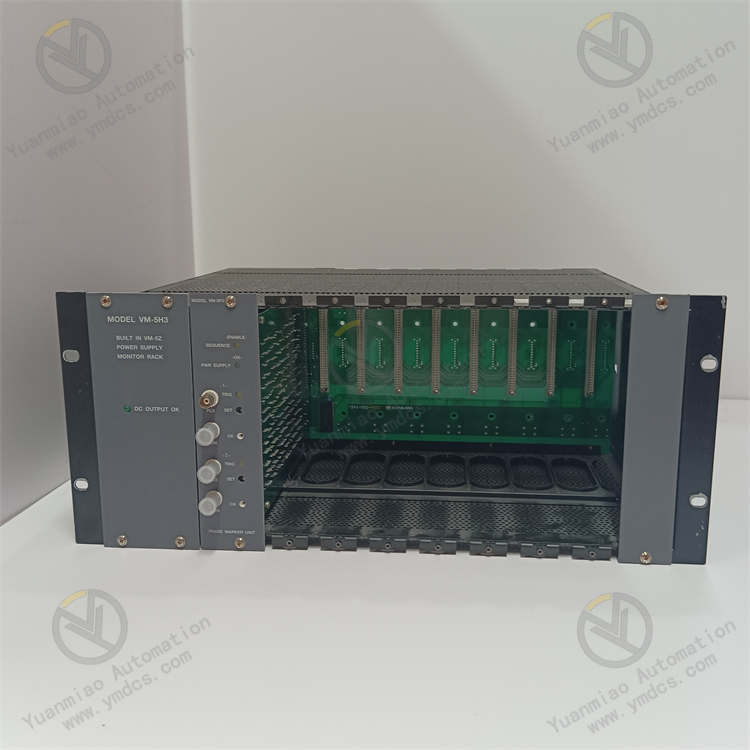
SHINKAWA VM-5Z4 is a dedicated expansion output unit for the VM-5 series TSI (Turbine Supervisory Instrumentation) system manufactured by Shinkawa Electric Japan. It is developed in strict compliance with API 670, the industrial standard for rotating machinery monitoring. As a supporting functional module of the rack-mounted TSI system, it is mainly used for non-standard signal switching, electrical isolation transmission, RMS root-mean-square calculation and signal output adaptation for various peripheral devices. Installed on the backplane of standard cabinets of the VM-5 series, it performs secondary signal processing and multi-channel isolated distribution for front-end monitoring modules measuring vibration, axial displacement, eccentricity, differential expansion, rotational speed and other parameters.
2. Technical Features
Multi-Functional Secondary Signal Processing for Non-Standard Output Scenarios
Built-in dedicated RMS rectifier circuit converts original dynamic vibration signals into effective RMS values. Multi-stage electrical isolation circuits completely separate the TSI input side from external output devices electrically. Custom non-standard signal output is supported to directly connect with paper tape recorders, paperless recorders, portable acquisition equipment and other non-standard industrial peripherals. It makes up for the limitation that basic monitoring modules only provide standard 4–20mA output, and flexibly expands the signal output capability of the system.
Integrated Rack Design with High System Compatibility
Adopting the unified slot-type installation structure of the VM-5 series, it can be directly inserted into the backplane of standard cabinets such as VM-5H4 and VM-5W2 for power supply and communication without separate external power and wiring. It is natively compatible with all main monitoring modules including VM-5Y1, VM-5K, VM-5N and VM-5S. It supports plug-and-play within the same cabinet with no need to modify original system configuration, measuring point logic and alarm parameters, enabling rapid deployment for new system assembly and expansion & retrofitting of legacy units.
Powerful Anti-Interference Isolation to Eliminate Ground Loop and Surge Disturbance
A dual isolation architecture combining optoelectronic and electromagnetic isolation is adopted at input and output terminals to thoroughly cut off circulating interference caused by ground potential difference between front and rear circuits, effectively avoiding signal drift, value fluctuation and false alarms induced by long-distance wiring and common grounding of multiple systems. Surge absorption and overvoltage clamping circuits are integrated inside the module to resist power grid pulse interference generated by inverter startup/shutdown and switching of high-power motors, delivering excellent long-term signal stability under strong electromagnetic environments in power plants and petrochemical plants.
Multiple Specifications for Harsh Onshore and Marine Working Conditions
Three types of versions are available: standard industrial type, tropical enhanced moisture-proof type, and classification society certified marine type (NK Nippon Kaiji Kyokai, KR Korean Register, LR Lloyd’s Register). Marine versions meet anti-corrosion, anti-condensation, anti-vibration and anti-seismic requirements for marine gas turbines and offshore platform compressor units. The hardware contains no vulnerable adjustable components with extremely low failure rate, supporting 24/7 non-stop long-term operation and unattended maintenance.
Comprehensive Loop Self-Inspection and Fault Indication for Easy Operation & Maintenance
3. Specification Parameters
3.1 Basic Model Parameters
- Model No.: VM-5Z4
- Brand & Series: SHINKAWA VM-5 Series TSI System Functional Expansion Module
- Module Type: Isolation Output / RMS Calculation / Non-Standard Signal Transmission Module
- Core Functions: Electrical signal isolation, RMS value conversion, non-standard signal conversion, multi-channel signal distribution, connection with external recorders
- Compatible Cabinets: VM-5H4, VM-5W2, VM-5G series standard cabinet backplanes
- Compatible Preceding Modules: Full range of VM-5 monitoring units including VM-5Y1, VM-5K, VM-5N, VM-5S, VM-5T, VM-5D
- Applicable Equipment: Turbo-generator sets, gas turbines, large centrifugal compressors, fans and marine power rotating units
3.2 Signal Processing Performance Parameters
- Input Mode: Measuring signals acquired from preceding modules via cabinet backplane bus; supports processing of single measuring point signal
- Core Calculation: Built-in RMS rectifier circuit to output effective values of AC vibration signals
- Isolation Method: Complete electrical isolation between input and output with isolation withstand voltage complying with industrial EMC specifications
- Output Types: Standard isolated analog quantity, non-standard voltage/current signals for recorders, passive transmission signals
- Signal Characteristics: Distortion-free signal transmission, ultra-low temperature drift and time drift with no zero offset during long-term operation
3.3 Electrical Parameters
- Power Supply: Unified power feeding from VM-5 cabinet backplane with standard system supply of 24 VDC
- Power Consumption: Low-power circuit design; low power draw per module with no extra cabinet load when multiple modules are installed in one rack
- Built-in Protection: Overvoltage protection, overcurrent protection, self-locking protection against output short circuit, reverse polarity anti-burn protection
- Communication Linkage: Interacts with cabinet system bus to upload module fault information via system SOE event logging
3.4 Environmental Parameters
- Operating Temperature: Standard version -10 ℃ ~ +60 ℃; industrial wide-temperature version -40 ℃ ~ +70 ℃
- Storage Temperature: -55 ℃ ~ +125 ℃
- Operating Humidity: 5% ~ 95% RH (non-condensing); tropical version with enhanced moisture and condensation resistance
- Protection Structure: Sealed modular card structure for rack mounting with dust, moisture and vibration resistance
- Operation Mode: 24-hour non-stop continuous stable monitoring
3.5 Mechanical & Maintenance Parameters
- Mounting Method: Standard embedded rack installation occupying one slot; tool-free pluggable disassembly
- Structural Features: Highly integrated circuit board design with shock & impact resistance and low aging rate
- Status Indication: Front LED indicators for normal power, input fault and output fault respectively
- Configuration Adaptation: No independent programming required; parameters follow the range and alarm settings of preceding monitoring modules
- Maintenance Compatibility: Supports hot-swap replacement without unit shutdown; no power cut needed for legacy system renovation with low construction risk
4. Working Principle
The SHINKAWA VM-5Z4 obtains original measurement signals from preceding vibration and displacement monitoring modules through the VM-5 cabinet backplane bus. Impedance matching is first completed via input buffer circuits, then optoelectronic isolation units cut off the electrical ground loop between input and output sides. If RMS output is required, the built-in RMS rectification calculation circuit converts alternating dynamic signals into stable root-mean-square signals. Signal scaling and non-standard format conversion are executed according to preset ranges, and multi-channel isolated signals are finally output to recorders, third-party acquisition systems and DCS slave devices.
5. Application Scenarios
Signal Expansion for Recorders in Power Plant TSI Systems
Install this module in TSI cabinets of thermal power and combined-cycle units to extract an isolated signal from existing shaft vibration, differential expansion and eccentricity measuring points and connect it to paperless or legacy paper tape recorders. It realizes local archiving of key unit parameters without occupying original DCS acquisition channels, and isolates interference to prevent TSI protection maloperation caused by faults on the recorder side.
Isolation Adaptation for Parallel Data Acquisition by Multiple Systems
When a single TSI measuring point needs to transmit data to unit DCS, remote equipment diagnosis platform and condition monitoring analysis system simultaneously, the VM-5Z4 performs isolated signal distribution with mutually independent multi-channel outputs. It resolves signal jitter and value drift issues resulting from common grounding wiring across multiple systems.
Upgrade and Capacity Expansion of Legacy TSI Systems
Directly plug the module into vacant slots of original VM-5 cabinet without replacing existing monitoring modules and sensor wiring to add new signal output points. It requires minimal construction work with no unit shutdown, suitable for minor system function upgrades during unit overhaul.
Monitoring for Offshore Platform and Marine Power Units
The classification society certified version is adopted to adapt to offshore environments with high salt spray, high humidity and strong vibration. It is used for signal transmission and output of TSI monitoring systems for offshore compressors and marine gas turbines, complying with marine equipment specifications on anti-corrosion and anti-vibration.
Protection System for Rotating Equipment in Petrochemical Plants