Description
1. Overview
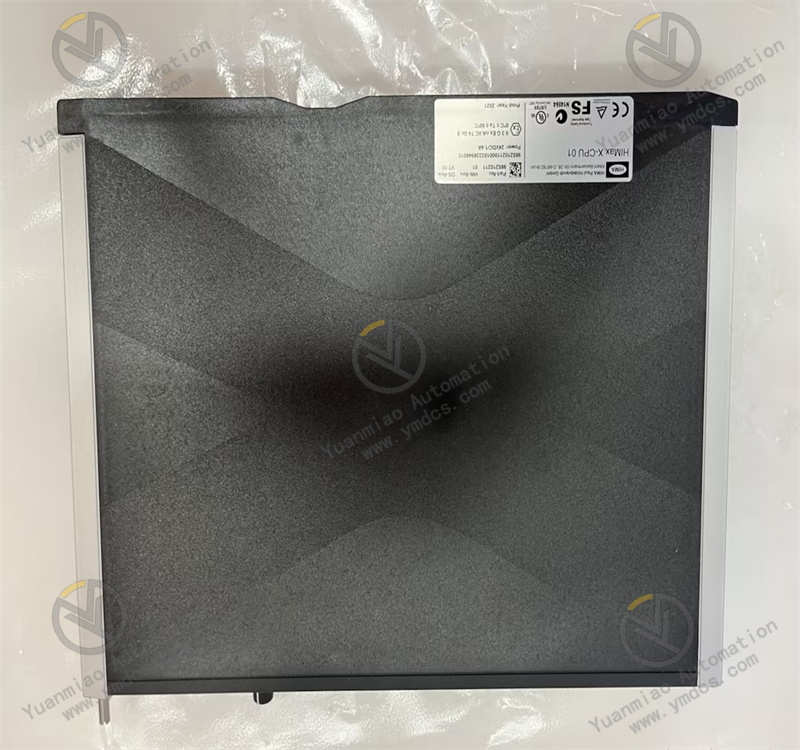
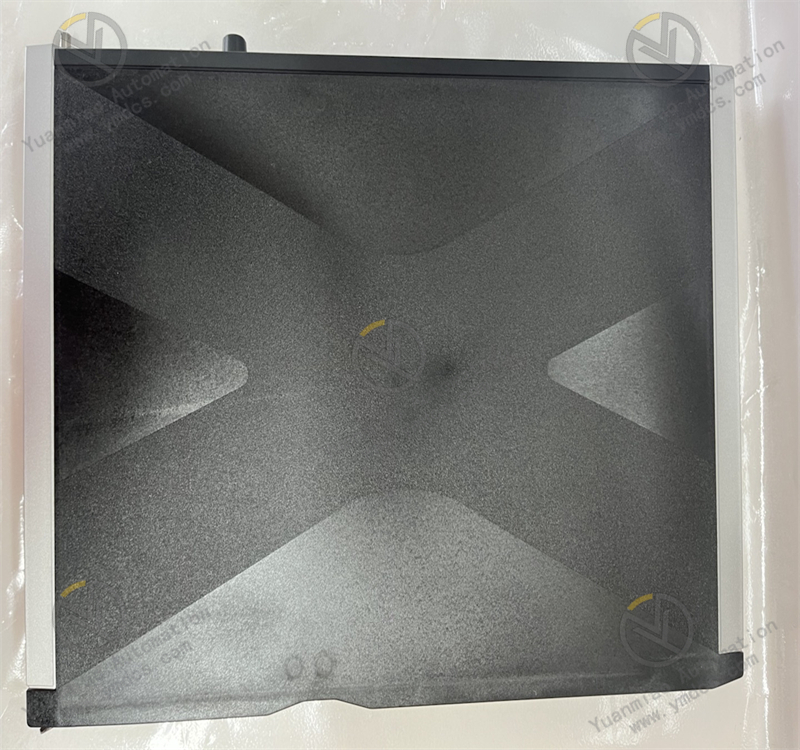
HIMA HIMax X‑CPU 01 is a high-performance SIL 4 safety main control CPU module of Germany HIMA. It serves as the core arithmetic and logic processing unit of the HIMax Safety Instrumented System, specially designed for high-safety-integrity and high-availability safety control applications in high-risk process industries such as petrochemical, oil & gas storage and transportation, and power energy sectors. The module undertakes core tasks of the entire SIS system, including safety logic operation, interlock judgment, program scheduling, data processing, bus communication and fault management. It is the critical hardware guaranteeing reliable operation of ESD emergency shutdown, BMS burner management, process safety interlock and unit protection systems.
Adopting an industrial dual-core safety arithmetic architecture and equipped with dedicated safety processors and large-capacity storage media, X‑CPU 01 supports deterministic safety computation and nanosecond-level system timing synchronization. It natively supports redundant dual-CPU hot standby operation to realize bumpless transfer and non-stop fault-tolerant running. Certified to IEC 61508 SIL 4 and ISO 13849 PL e highest safety integrity levels, it features hardware self-diagnosis, program fault tolerance, data redundancy and fail-safe characteristics. Suitable for 24/7 uninterrupted continuous operation in industrial sites, it is widely applied in complete set delivery of new high-end SIS systems, spare replacement of CPU modules for legacy HIMax systems, performance upgrading of safety control systems and expansion renovation of safety loops for large-scale process units.
2. Technical Features
2.1 Highly Reliable Safety Computing Architecture Compliant with SIL 4 Highest Safety Level
It adopts HIMA proprietary safety redundant computing core with independent safety verification and logic monitoring mechanism. All safety program operations and interlock judgments undergo dual verification to eliminate risks such as computing anomalies, logic misjudgment and data errors. The module fully complies with authoritative safety standards IEC 61508 SIL 4 and ISO 13849 PL e. The full link of hardware circuits, system firmware and program execution follows fail-safe design to achieve fail-to-safe mode upon faults. It fundamentally ensures accurate, reliable interlock actions without spurious trips or failure to act for high-risk process facilities.
2.2 Redundant Hot-Standby Fault-Tolerant Operation for Non-Stop High Availability
It natively supports dual-CPU redundant hot-standby architecture. Real-time program synchronization, data synchronization and timing synchronization are maintained between primary and standby CPUs. When the primary CPU suffers hardware failure or communication interruption, the standby CPU completes bumpless transfer instantly without disrupting system operation, losing process data or affecting safety interlock logic. It thoroughly eliminates risks of system shutdown, interlock failure and unplanned plant outage caused by single-point hardware faults of a single CPU, greatly improving overall availability and production continuity of the SIS system.
2.3 High-Performance Computing Capacity Supporting Large-Scale Complex Safety Logic
Equipped with industrial dedicated PowerPC safety processor, large-capacity program flash memory and high-speed data memory, a single program supports large-scale logic programming. It can execute high-speed computation and processing for complex interlock loops, dense multi-point measuring signals and refined safety control logic of large chemical and power plant units. Featuring short program scan cycle, strong computation determinism and zero logic lag, it can rapidly respond to process parameter deviations, equipment faults and emergency interlock commands, adapting to large-scale, high-complexity and high-real-time industrial safety control scenarios.
2.4 Multi-Bus Compatible Communication for Flexible and Efficient Networking
The module integrates multiple standard industrial communication interfaces. It natively adapts to HIMax X‑SB 01 system redundant safety bus and enables high-speed data exchange with internal I/O modules, communication modules and redundant racks. Meanwhile, it supports general industrial interfaces including Ethernet and RS485 to realize data exchange and protocol interconnection with upper monitoring systems, DCS and third-party devices. The standardized bus protocol architecture delivers streamlined networking and strong expandability, flexibly meeting networking requirements of multi-rack and large-scale distributed SIS systems.
2.5 Global Intelligent Self-Diagnosis for Controllable Safety under Fault Conditions
It adopts multi-layer hardware self-diagnosis covering chip level, board level and loop level, enabling round-the-clock real-time monitoring of CPU core operating status, storage media, bus communication, power supply conditions, I/O links and program running status. It can accurately identify hardware faults, program exceptions, data errors, communication disconnections, timing deviations and other abnormalities. Upon anomalies, it immediately triggers system alarms, fault logging and fail-safe protection. Fault locations and types can be precisely positioned via SILworX configuration software, greatly simplifying troubleshooting and system maintenance procedures.
2.6 Industrial Rugged Design with Strong Adaptability to Harsh Conditions
Adopting industrial ruggedized PCB and conformal coating protection technology with carefully selected high-stability and anti-aging industrial components, the whole module has passed a complete set of industrial reliability tests including high-low temperature cycling, temperature-humidity aging, vibration shock and EMC electromagnetic compatibility. It features dust resistance, moisture resistance, corrosion resistance, vibration resistance, anti-electromagnetic interference and stable operation over wide temperature ranges. It can operate stably for long periods in harsh industrial sites with strong interference, drastic temperature variation and high humidity such as chemical plant areas, power plant control rooms and local explosion-proof cabinets, delivering low failure rate and long service life.
3. Technical Specifications
3.1 Basic Parameters
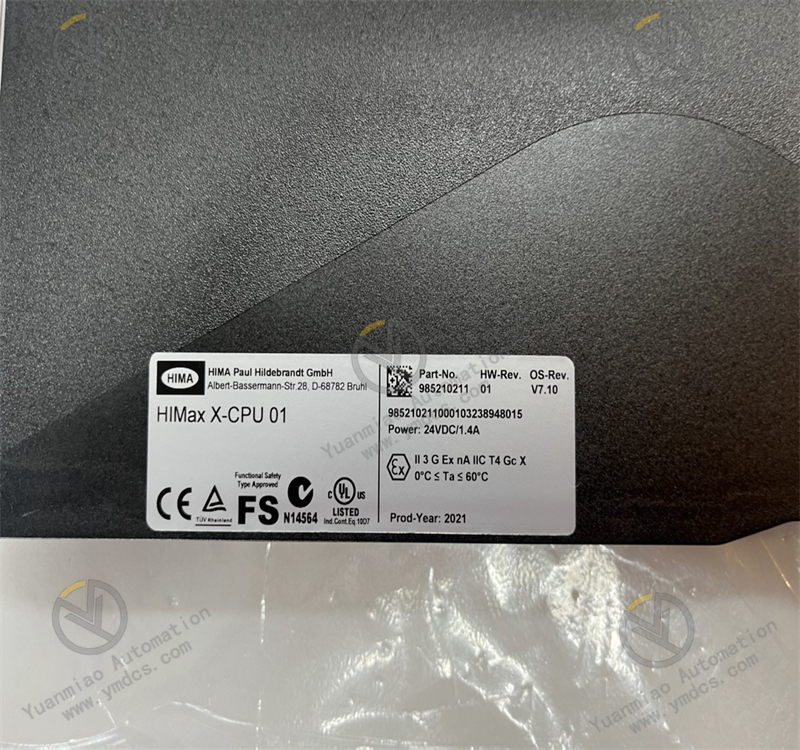
Model: HIMA HIMax X‑CPU 01; Brand: HIMA (Germany); Series: HIMax high-end safety PLC main control module; Type: SIL 4 safety redundant main control CPU module; Compatible Systems: Full range of HIMA HIMax SIS safety instrumented control systems; Core Functions: Safety logic operation, user program execution, system bus scheduling, data storage & processing, redundancy synchronization management, global fault self-diagnosis, interlock logic management; Safety Integrity Level: IEC 61508 SIL 4, ISO 13849 PL e; Application Scenarios: ESD, BMS, process interlock and emergency shutdown safety control systems for facilities in petrochemical, coal chemical, oil & gas storage and transportation, gas power generation and combined-cycle power plants.
3.2 Core Computing and Storage Parameters
Processor Architecture: Industrial dedicated PowerPC safety processor; Program Flash: 128 MB Flash EPROM; High-Speed Memory: 256 MB DDRAM/NVRAM; Single Program Capacity: Max. 1023 kB user program space, 1023 kB variable data space; Computing Characteristics: Deterministic cyclic scanning, low computing latency, precise logic execution, zero data corruption; Fault Tolerance Mechanism: Dual-path computation verification, redundant data storage, fail-safe operation, program exception protection; System Synchronization: Supports nanosecond-level global timing synchronization to realize seamless transfer of redundant systems.
3.3 Electrical and Communication Parameters
Operating Power Supply: 24 VDC industrial safety power supply (wide voltage range 19.2 V~30 V), compliant with SELV/PELV safety specifications; Built-in Protection: 1.4 A built-in fuse, overvoltage & overcurrent protection, reverse polarity protection, surge suppression; System Bus: Compatible with X‑SB 01 dual-star redundant safety bus, gigabit high-speed deterministic communication; Expansion Interfaces: Integrated Ethernet and RS485 standard industrial communication interfaces; Communication Characteristics: Real-time bus data verification, packet loss error correction, timing synchronization, automatic redundant link scheduling.
3.4 Structural and Environmental Parameters
Structure: Standard HIMax rack-mounted rugged CPU board with industrial conformal coating protection; Installation Method: Embedded installation in standard slots of HIMax racks with precise bus docking; Protection Class: IP20; Status Indication: On-board LED indicators to visually display run status, fault status, redundancy synchronization and bus communication status; Operating Temperature: 0℃ ~ +60℃; Storage & Transportation Temperature: -40℃ ~ +85℃; Operating Humidity: 5%~95%RH (Non-Condensing, No Corrosive Gas); Environmental Resistance: Vibration & shock resistance, anti-electromagnetic interference, humidity aging resistance, dust-proof and moisture-proof.
4. Operating Principle
The HIMA HIMax X‑CPU 01 main control module follows standardized safety operation workflow: Program loading & initialization → Hardware self-test & verification → Redundancy synchronization calibration → Global data acquisition → Safety logic computation → Interlock command output → Data storage & upload → Real-time self-diagnosis inspection. After system power-on, X‑CPU 01 first completes firmware self-test, hardware loop verification, user program loading and validity check. Meanwhile, clock synchronization, program synchronization and data synchronization between primary and standby CPUs are accomplished to establish a redundant fault-tolerant operation architecture.
During normal operation, the module periodically scans process parameters, equipment status and interlock contact signals collected by all I/O modules. Relying on the high-performance safety processor, it executes high-speed dual-verified safety logic computation to accurately judge process operating conditions and safety status. According to preconfigured safety programs, it automatically executes safety actions including parameter over-limit alarm, process interlock, equipment shutdown and emergency trip. All operating data, event logs and fault information are stored in real time and uploaded to upper monitoring systems. The module continuously monitors its own hardware, storage, bus, program operation and redundancy synchronization status throughout runtime. Once abnormal faults are detected, the fail-safe mechanism is triggered immediately to implement alarms, fault recording and safety backup protection. Seamless transfer of redundant systems is guaranteed to keep the entire SIS system under safe and controllable operation.
5.1 Core Safety Control for SIS Systems of High-Risk Facilities
As the core main control unit of HIMax SIS systems, it takes full charge of core safety logic computation and command output for ESD emergency shutdown systems, BMS burner management systems, pressure safety protection, process interlock protection and unit safe shutdown of high-risk chemical, oil & gas and power facilities. Supported by SIL 4 highest safety integrity level and fail-safe design, it eliminates risks of safety spurious trips and failure to act, ensures intrinsic safety of high-risk production facilities and complies with national safety production codes and the highest industrial safety management standards.
5.2 Construction of Full-Redundant High-Availability Safety Control Systems
Suitable for building full-redundant SIS architecture with dual-CPU and dual-bus configuration for large industrial facilities. Through real-time synchronization and bumpless fault-tolerant transfer between primary and standby CPUs, it completely eliminates hidden single-point hardware faults of single-CPU architecture. It ensures the system maintains normal operation without outage, offline or failure under hardware faults, temporary maintenance and loop abnormalities, greatly raising annual availability of safety control systems and avoiding production losses and safety accidents caused by unplanned plant shutdown.
5.3 Maintenance Replacement and Performance Upgrade of Legacy HIMax Systems
Fully compatible with all HIMax racks, bus protocols, SILworX configuration platforms and user programs. It can directly replace aging CPU modules suffering from slow computation, synchronization anomalies, frequent faults and performance degradation. No modification to safety programs, interlock logic, wiring loops or system architecture is required, enabling low-cost and zero-risk maintenance and upgrading of main control hardware, and restoring high-performance, highly reliable and safe operation of the system.
5.4 Capacity Expansion and Intelligent Technical Renovation of Large-Scale Safety Control Systems
Applicable to capacity expansion, logic upgrading, measuring point addition and process optimization technical renovation of large-scale SIS systems such as combined-cycle power plants, large coal chemical plants and long-distance oil & gas pipelines. Leveraging powerful computing capability, large-capacity program storage and multi-protocol communication expandability, it supports more complex safety interlock logic and monitoring & control requirements for massive measuring points, improves facility safety protection systems and meets the upgrading demand of intelligent, refined and high-standard safety management in plants.
![]()