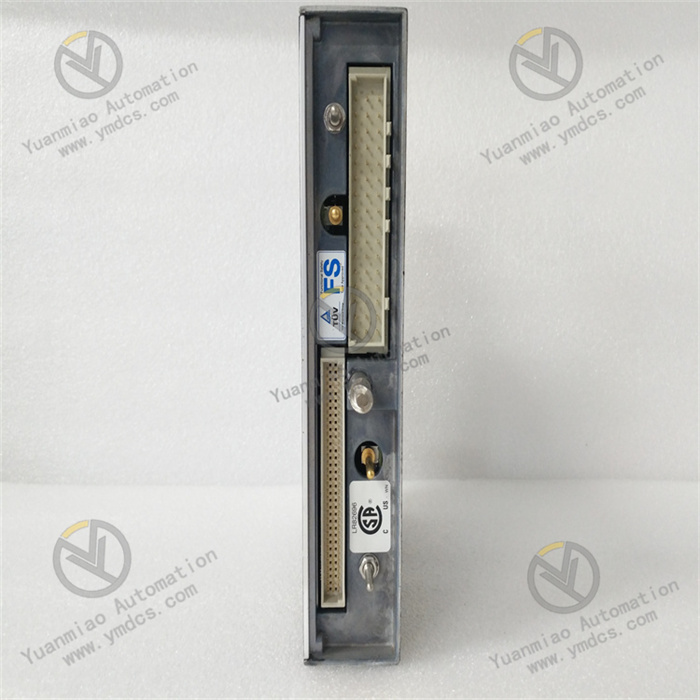
Description
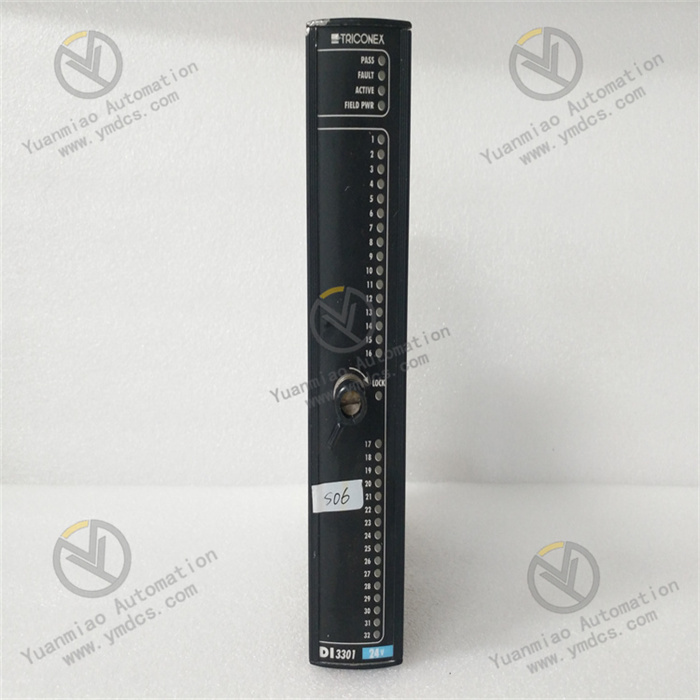
Triconex 3301
Triconex 3301 (commonly designated as DI3301) is a high-reliability Triple Modular Redundancy (TMR) digital input module developed by Schneider Electric (formerly Invensys), specifically designed for Triconex Safety Instrumented Systems (SIS). It is specialized in collecting and processing on-site discrete digital signals (such as switch states, relay outputs, and limit switch signals), converting them into standard digital data for the main controller to execute safety logic operations. Compliant with IEC 61508 SIL 3 and IEC 61511 standards, the module features real-time self-diagnostics, channel-level electrical isolation, hot-swappable capability, and seamless integration with Tricon controllers, making it a core component for safety monitoring and interlock control in harsh industrial environments including oil and gas, petrochemical, power generation, and nuclear energy industries.
I. Product Positioning and Multi-Scenario Adaptability
Core Positioning: TMR Safety-Class Digital Signal Acquisition Hub
As a key I/O component of the Triconex safety control system, the DI3301 undertakes the core task of accurately capturing on-site digital signals (ON/OFF states) from switches, sensors, and other discrete devices, and transmitting them to the main processor for safety logic judgment and interlock execution. It adopts a full TMR redundant architecture with three independent parallel acquisition channels and a 2oo3 voting mechanism, which automatically isolates faulty channels to avoid single-point failures and ensures the integrity and reliability of the safety loop.
The module integrates advanced signal filtering circuits and force-to-value diagnostic (FVD) functions, which can effectively suppress signal interference and detect channel faults in real time, ensuring the accuracy and validity of collected signals even in complex industrial electromagnetic environments.
Full-Scenario System Compatibility
It is fully compatible with Tricon v8/v9/v10 series racks and integrates seamlessly with Triconex main processors (such as MP3008/MP3009) via the proprietary Tricon Sync backplane bus, achieving high-speed data synchronization. The module supports configuration, online monitoring, and diagnostic data retrieval through TriStation 1131 engineering software, and is compatible with Modbus RTU communication protocol, facilitating seamless data exchange with mainstream DCS/SCADA systems and remote device management.
With a plug-and-play modular design, the DI3301 is suitable for both new SIS construction and legacy Triconex system upgrades. It can directly replace older digital input modules without major cabinet rewiring or control logic modifications, supporting hot-swap in redundant configurations to minimize production downtime during maintenance. Additionally, the module is mechanically keyed to prevent improper installation in configured baseplates, ensuring installation accuracy.
Extreme Environment Adaptability
Adopting an industrial-grade reinforced design, the module is equipped with an industrial-grade reinforced PCB, a fully shielded anti-interference enclosure, and high-reliability terminal connectors, passing IEC 61000 EMC certification, UL 508, and CSA C22.2 No.142 standards. It has excellent anti-vibration and anti-shock performance, effectively suppressing common-mode noise, surges, and high-frequency interference from high-power equipment, ensuring stable operation in complex electromagnetic environments.
The operating temperature range covers −40°C to 85°C, and the storage temperature range is −65°C to 90°C, with a relative humidity of 5%–95% (non-condensing). It can withstand harsh conditions such as high temperature, high humidity, strong vibration, salt spray, and dust in industrial sites. The module is designed to be installed in standard NEMA enclosures, with a protection level of IP20, suitable for indoor industrial control cabinets and on-site control panels in harsh environments.
The power interface is protected against overcurrent, overvoltage, and reverse polarity, supporting 24 VDC (15–30 VDC wide-range compatible), with low power consumption, preventing module damage caused by power supply anomalies and further enhancing reliability in harsh environments.
II. Core Functions and Technical Advantages
Core Functions
Multi-Type Digital Input: Configurable for 32 commoned digital input channels, supporting dry contact or active input (DC signals), and compatible with AC/DC and high-speed pulse signals. The input voltage range is 15–30 VDC, with an absolute maximum input voltage of 33 VDC, adapting to various on-site discrete device signal requirements.
TMR Redundancy & Fault Tolerance: Three independent acquisition paths with 2oo3 voting mechanism, each channel independently processes field data and transmits it to the main processor for voting, enabling the system to continue operating normally even if one channel fails, meeting SIL 3 safety requirements.
Comprehensive Real-Time Diagnostics: Equipped with force-to-value diagnostic (FVD) function, with a test speed of less than 2 ms per test, capable of real-time monitoring of channel open/short circuits, signal out-of-range, and module power supply status. When a fault is detected, the fault indicator lights up and activates the system alarm, facilitating quick fault location.
Hot Swap & Easy Maintenance: Supports hot-swap under redundant configuration, no system shutdown required for module replacement; front-panel LED indicators (PWR, OK, CH Fault) provide intuitive status visualization, enabling operation and maintenance personnel to quickly identify module and channel working status.
High Isolation Performance: The minimum isolation voltage between functional earth and protective earth is 500 VDC, and between functional earth and logic ground is 800 VDC, effectively isolating the controller logic circuit from the on-site high-voltage/current environment and preventing transient voltage surges from damaging the safety controller.
Technical Advantages
Fast Response Speed: The input delay is less than 10 ms (on to off or off to on), with a time constant of 6.4 ms and a −3 dB frequency of 25 Hz; the ADC scan time for all 32 channels is less than 1 ms, meeting the rapid response needs of emergency shutdown (ESD) and fire & gas detection (FGDS) systems.
Flexible Configuration & Scalability: The 32 input channels can be configured as single-channel or dual-channel operation according to application needs; multiple modules can be cascaded to expand the number of input points, adapting to varying scales of safety systems. It is compatible with Tricon v8 and later systems, facilitating system upgrade and expansion.
High Reliability & Low Power Consumption: The input impedance is greater than 30 kΩ (without baseplate) or approximately 3 kΩ (with baseplate), with a power consumption of 0.2 W per point at 24 VDC and 0.5 W per point at 33 VDC, achieving energy conservation while ensuring performance. The module is guaranteed to operate properly in the presence of a single fault and may continue to operate with multiple faults.
Easy Installation & Compatibility: Standard Tricon rack mounting, mechanically keyed to prevent improper installation; compatible with model 2301 baseplates and DI external termination baseplates, suitable for typical applications and high-voltage hazardous area applications respectively.
III. Typical Application Scenarios
Oil and Gas Industry
In offshore platforms, wellhead control panels, and long-distance oil/gas pipelines, the DI3301 collects digital signals from explosion-proof switches, limit switches, and relay outputs, transmits data to the Triconex controller for ESD logic execution, and drives emergency shut-off valves and alarms to ensure safety in flammable and explosive environments. It is also used for pipeline monitoring and offshore production process control, ensuring the stability and safety of the production process.
In gas processing plants, it monitors the status signals of gas detection switches and emergency stop buttons, triggering ventilation and shutdown procedures when abnormalities occur to prevent leakage accidents.
Petrochemical & Nuclear Power Industries
In petrochemical hydrocracking, FCC units, and reactor systems, the module collects status signals of on-site discrete devices (such as pump start/stop switches, valve position switches, and fault alarm switches), executes interlock shutdown commands when parameters deviate beyond safe limits, and protects equipment and personnel safety. It is widely used in crude oil processing,炼化, and petrochemical product production process control.
In nuclear power plants, it is applied to the secondary loop cooling system and fuel handling system, collecting status signals from radiation-resistant switches and sensors, supporting the safety protection and emergency response functions of nuclear facilities, and complying with strict nuclear-grade reliability standards.
Power Generation & Other Industries
In coal-fired, gas-fired, and combined-cycle power plants, the DI3301 monitors the status signals of turbine start/stop switches, generator fault switches, and emergency stop buttons, triggering turbine trip commands in case of abnormalities to avoid major equipment damage. It is also used in power plant safety interlock and substation protection systems.
It is also widely used in metallurgical blast furnaces, pharmaceutical bioreactors, and mining industries. In metallurgical blast furnaces, it collects status signals of on-site discrete devices to realize blast furnace safety interlock; in pharmaceutical production processes, it monitors the status of production equipment switches to ensure compliance with industry safety standards; in mining operations, it collects switch signals of mining equipment to ensure production safety.
IV. Technical Specifications
Parameter Name | Parameter Details |
Model | Triconex 3301 (DI3301, TMR Digital Input Module) |
Product Type | Triple Modular Redundancy (TMR) safety-rated digital input module, IEC 61508 SIL 3 certified |
I/O Channels | 32 commoned digital input channels; configurable as single/dual-channel operation |
Input Signal Types | Digital signals (switch states, relay outputs, limit switches), AC/DC signals, high-speed pulse signals |
Voltage Range | Operational: 15–30 VDC; Nominal: 24 VDC; Absolute maximum: 33 VDC; Reverse: −0.6 VDC |
Input Impedance | > 30 kΩ (without baseplate); ≈ 3 kΩ (with baseplate) |
Response & Scan Time | Input delay < 10 ms; ADC scan time < 1 ms for all 32 points |
Isolation Voltage | ≥ 500 VDC (functional earth to protective earth); ≥ 800 VDC (functional to logic ground) |
Redundancy & Configuration | TMR architecture with 2oo3 voting; hot-swappable; TriStation 1131 configurable |
Power Requirements | 24 VDC (15–30 VDC compatible); 0.2 W/pt (@24VDC), 0.5 W/pt (@33VDC); overcurrent/overvoltage/reverse-polarity protection |
Operating Temperature | −40°C to 85°C |
Storage Temperature | −65°C to 90°C |
Relative Humidity | 5%–95% (non-condensing) |
Physical Specifications | Standard Tricon rack mounting; weight approx. 1.42 kg; mechanically keyed for correct installation |
Protection Level | IP20 (installed in NEMA enclosure) |
Supporting Software | TriStation 1131 Engineering Software |
Compatible Systems | Tricon v8/v9/v10 racks, MP3008/MP3009 main processors, all Triconex SIS; compatible with 2301 baseplates |
Special Features | TMR redundancy, FVD diagnostics, hot swap, channel isolation, low power consumption, mechanical keying |