Description
1. Overview
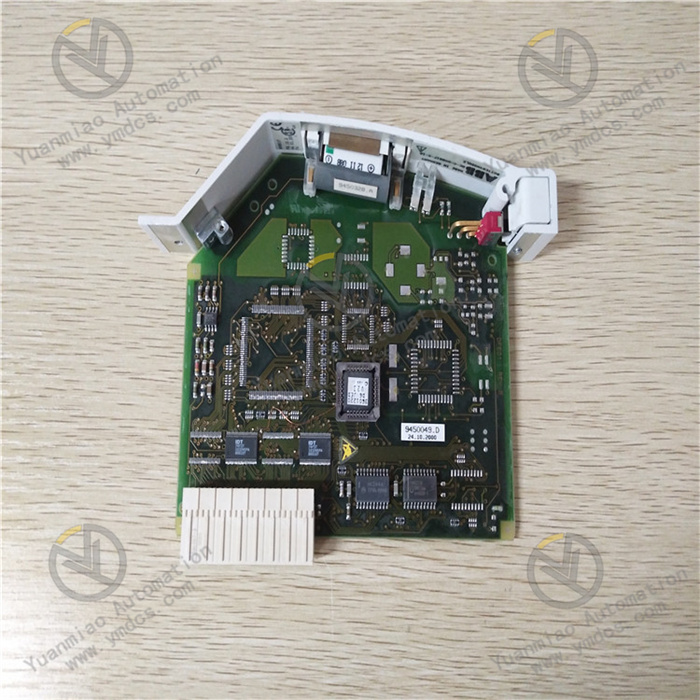
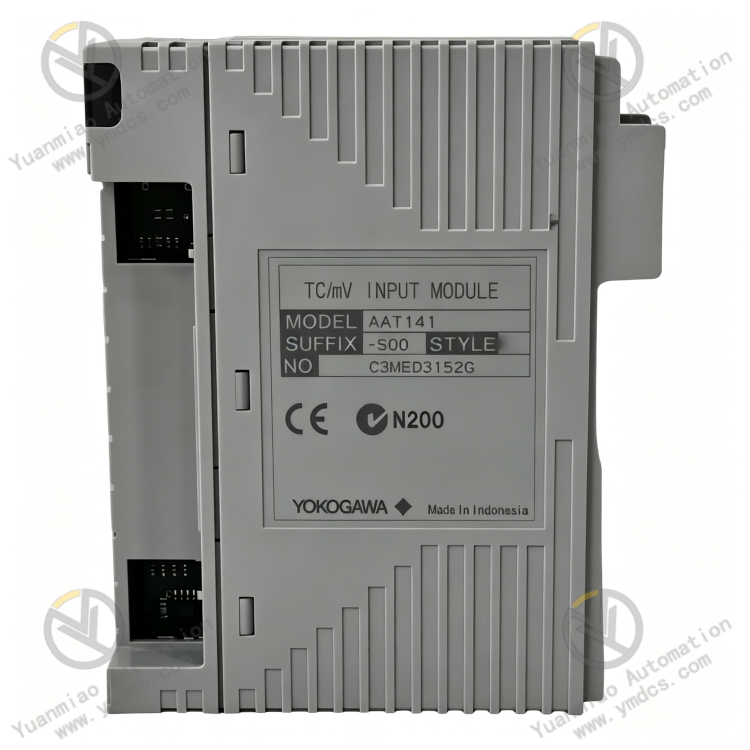
The Yokogawa AAT141‑S00 is an 8‑Channel Multi‑function Isolated Analog Input Module developed by Yokogawa Electric for the CENTUM VP / CS3000 distributed control system. As high‑precision universal acquisition hardware within the FIO series, it is a multi‑purpose AI module for conventional analog, thermocouple, RTD and voltage signals in Yokogawa DCS. It is widely used for high‑precision acquisition of temperature, pressure, liquid‑level and flow measurements in process industries including petrochemical, chemical, power, thermal‑power, metallurgy and pharmaceutical sectors. This is the standard non‑HART version. It supports compatible acquisition of current, voltage, RTD and TC thermocouple signals, solving the challenge of mixed‑type field measurements and offering far greater versatility than conventional single‑signal AI modules.
The AAT141‑S00 provides 8 fully galvanic‑isolated input channels. Each channel can be independently configured for signal type; different field sensors and transmitters can be accommodated without module replacement. Equipped with high‑precision ADC architecture, it delivers 100 Hz high‑speed sampling, ultra‑low temperature drift and full‑range high‑linearity performance for stable operation under wide‑temperature conditions. Certified for high‑grade galvanic isolation, channel faults do not propagate across channels. It natively supports system redundant configuration and online hot‑swap maintenance. With excellent electromagnetic‑interference resistance, it reliably operates under harsh industrial conditions of high temperature, humidity, dust and heavy noise. It is a key spare‑part for DCS mixed‑measurement‑point expansion, legacy heterogeneous I/O‑loop retrofit and general‑purpose acquisition‑channel replacement.
2. Functions and Features
2.1 Core Functions
8‑channel fully‑isolated multi‑purpose signal acquisition: 8 independently galvanic‑isolated input channels. Each channel can be flexibly configured for 4‑20 mA, ±20 mA current; 0‑10 V, ±10 V voltage; PT100, PT1000 RTD and various TC thermocouple signals. It covers most industrial process measurement types. Channels operate independently so faults on one channel will not affect others.
High‑precision signal conversion for multiple operating conditions: Industrial‑grade high‑resolution ADC technology delivers excellent full‑range accuracy. Dedicated calibration algorithms for temperature, current and voltage effectively mitigate temperature drift, signal distortion and data jitter, providing reliable raw data for process regulation, precise temperature control and safety interlocks.
High‑speed continuous sampling and data refresh: 100 Hz high‑sampling rate with millisecond‑level data update. It captures subtle process‑parameter fluctuations and sudden condition changes, suitable for fine‑process scenarios such as precise temperature control, micro‑flow regulation and high‑accuracy pressure monitoring.
Comprehensive hardware self‑diagnosis and alarming: Automatic power‑on hardware self‑test and channel initialization. Runtime continuous monitoring of channel open‑circuit, short‑circuit, over‑range, sensor failure, loop anomaly, bus communication fault and module power‑supply abnormality. Fault channels are accurately located with fault codes uploaded to reduce on‑site troubleshooting effort.
Seamless operation with redundant systems: Natively compatible with Yokogawa CENTUM VP / CS3000 redundant architecture. Dual‑module synchronous acquisition with real‑time data comparison and bumpless automatic switch‑over upon failure. No data loss or parameter jump occurs during switch‑over to guarantee uninterrupted monitoring of critical temperature and pressure interlock loops.
Intelligent signal filtering and anti‑interference: Multi‑stage hardware filtering plus adaptive digital‑filter algorithms. Filter parameters are configurable according to site conditions to suppress industrial high‑frequency harmonics, electromagnetic noise and transient disturbances, stabilizing temperature and flow readings.
Standardized FIO‑bus data exchange: Interfaces with Yokogawa proprietary high‑speed FIO backplane bus. It bi‑directionally uploads multi‑type acquisition data, channel status and fault‑alarm information, while receiving controller‑side range settings, signal‑type definitions, filter coefficients and alarm thresholds to enable remote debugging, parameter modification and centralized management.
2.2 Product Characteristics
Universal compatibility for broad adaptability: One module covers four major industrial analog categories: current, voltage, RTD and thermocouple. Dedicated temperature‑specific or ordinary AI modules are no longer required. A single hardware type satisfies most field analog‑measurement needs and simplifies spare‑part inventory.
Superior accuracy with low drift and high stability: High overall precision and ultra‑low temperature‑drift. Minimal parameter shift across wide temperature ranges; stable long‑term continuous operation without frequent manual calibration, ideal for year‑round non‑stop plant operation.
Per‑channel galvanic‑isolation protection: Complete galvanic separation between channels and system backplane, and among individual channels. It blocks field high‑voltage crosstalk, common‑mode interference and electrostatic disturbance, preventing module breakdown, signal crosstalk and data corruption to safeguard DCS hardware.
Robust environmental adaptability: Designed for wide‑temperature, high‑humidity and dusty environments in refining, thermal‑power and metallurgy. Outstanding vibration and EMI resistance outperforms general‑purpose I/O modules.
Non‑stop hot‑swap maintenance: Supports online hot‑swap replacement. No system shutdown, process bypass or power‑off is required. Module maintenance and fault replacement can be performed during full‑load production to maximize process continuity.
Full native OEM‑system compatibility: Natively compatible with the complete Yokogawa CENTUM VP / CS3000 DCS product line. Backplane bus, configuration logic, redundancy protocols and drivers are fully compliant. Replacement requires no parameter adjustment, reprogramming or wiring changes for plug‑and‑play operation, suitable for legacy‑system upgrade‑and‑retrofit and loop‑expansion projects.
3. Specifications
| Item | Specifications |
|---|---|
| Model | AAT141‑S00 |
| Device Type | 8‑Channel Multi‑function Isolated Analog Input Module (Universal AI Standard Type) |
| Applicable System | Yokogawa CENTUM VP / CS3000 DCS |
| Channel Count | 8 channels, fully galvanically isolated; signal type configurable per channel |
| Input Signals | Current: 4‑20 mA DC, ±20 mA DC; Voltage: 0‑10 V DC, ±10 V DC; RTD, TC thermocouple |
| Sampling Frequency | 100 Hz high‑speed global sampling |
| Accuracy | Typical full‑scale error ≤ ±0.1 % of reading |
| Temperature Drift | Low‑drift coefficient, high stability over wide temperature range |
| Galvanic Isolation | High‑grade isolation between channels and system side, high‑voltage‑crosstalk resistance |
| Communication | Standard version, no HART protocol |
| Redundancy | Supports DCS redundant configuration, bumpless seamless switch‑over |
| Maintenance Features | Online hot‑swap, full‑range hardware self‑diagnosis, precise fault localization |
| Power Supply | 24 VDC standard cabinet DC power |
| Operating Temperature | ‑20 °C ~ +70 °C (industrial wide‑range condition) |
| Storage Temperature | ‑40 °C ~ +85 °C |
| Ambient Humidity | 5 % ~ 95 % RH, non‑condensing |
| Ingress Protection | IP20 (cabinet‑internal installation) |
| Mounting | Slot‑type stacking on standard FIO rack |
| Module Weight | Approx. 0.4 kg |
4. Operating Principle
The Yokogawa AAT141‑S00 multi‑function analog input module implements a closed‑loop workflow: Multi‑type signal reception → Galvanic isolation & filtering → Adaptive signal interpretation → High‑precision ADC conversion → Data packaging & upload → Full‑time self‑monitoring. Upon power‑on, the module completes hardware self‑test, channel initialization, bus protocol matching and system timing synchronization. After downloading controller‑configured parameters including signal type, range, engineering unit, filter coefficient and alarm thresholds, it automatically selects the corresponding acquisition mode per‑channel and enters normal high‑precision acquisition.
Field current, voltage, RTD and thermocouple signals for temperature, pressure, flow and level measurements enter respective channels. Signals first pass through independent galvanic‑isolation circuits for noise rejection. Multi‑stage hardware and adaptive digital filtering remove industrial high‑frequency noise, transient spikes and electromagnetic interference to retain authentic process analog values. Based on per‑channel configuration, the module applies corresponding interpretation algorithms. High‑precision ADC converts diverse analog inputs linearly into standard digital data. Global data refresh runs at 100 Hz; packaged data is transmitted to the DCS controller via the FIO backplane bus. The controller uses received data for graphic display, arithmetic calculation, closed‑loop regulation, trend logging and safety‑interlock decision‑making to achieve precise process‑parameter management.
During operation, the module continuously monitors channel signal status, loop continuity, sensor health, bus communication and hardware condition. It reliably detects channel open‑circuit, short‑circuit, over‑range, sensor damage, communication failure and power‑supply anomaly. Faulty channels are flagged, alarm codes are uploaded and invalid data is suppressed to avoid corrupting system calculations. Under redundant configuration, dual modules perform synchronous acquisition and cross‑checking; automatic bumpless switch‑over preserves data continuity upon primary‑module failure. After fault clearance and system reset, the module resumes multi‑signal high‑precision acquisition and delivers stable, accurate and reliable field process data to the DCS control system.
5. Application Scenarios
Petrochemical & chemical continuous‑process plants: Deployed in DCS for refining, coal‑chemical and fine‑chemical facilities. It centrally acquires temperature, pressure, flow and level from reactors, distillation columns, heat‑exchangers and process pipelines. Support for mixed thermocouple, RTD, current and voltage inputs suits plants with heterogeneous measurement points and ensures stable process regulation and interlock performance.
Thermal‑power & co‑generation automatic‑control systems: Applied to boiler, steam‑turbine, desulfurization‑denitrification and auxiliary‑equipment control in thermal‑power plants. It captures critical parameters such as furnace temperature, process pressure, fluid flow and tank level. High anti‑interference performance and accuracy suit continuous full‑load power‑station operation under heavy EMI.
Metallurgy & building‑materials industrial automation: Used in automatic‑control systems for steel‑making, cement and kiln production lines for kiln‑temperature, furnace‑pressure and material‑flow measurements. Full galvanic isolation and strong noise immunity ensure accurate data acquisition under heavy‑vibration and high‑EMI plant conditions.
Retrofit projects with mixed‑type measurement points: Resolves issues of heterogeneous legacy‑AI hardware, excessive spare‑part varieties and complex maintenance. Its multi‑purpose acquisition capability consolidates multiple dedicated AI types onto one hardware model, simplifying spare‑part management for legacy‑system intensive upgrade and standardized I/O‑loop reconstruction.
High‑precision process‑monitoring and interlock applications: Deployed in fine‑chemical, pharmaceutical and precision‑temperature‑control plants requiring high‑measurement fidelity. Low temperature drift, high linearity and high‑speed sampling support reliable parameter monitoring and interlock actuation, mitigating process‑deviation‑related operational and safety risks.
6. Troubleshooting & Corrective Actions
6.1 Readings jitter, large fluctuation, unstable data
Root Causes: Severe field electromagnetic interference, poor shielding‑earthing, loose/oxidized terminals, improperly‑tuned filter parameters, unstable sensor output, module accuracy drift.
Corrective Actions: Inspect cable shielding and earthing; reroute cables away from variable‑frequency and high‑voltage sources. Retighten terminals and remove oxidation/dust. Optimize channel filter parameters for site conditions. Troubleshoot aged or defective field sensors. If fluctuations persist after field‑side remediation, hardware accuracy degradation is confirmed; replace AAT141‑S00 module.
6.2 Single‑channel / multi‑channel no reading, bad measurement points, no acquisition feedback
Root Causes: Channel not enabled in configuration, mismatched signal‑type setting, incorrect range parameters, damaged field sensor/transmitter, loop open‑circuit / short‑circuit, defective channel acquisition circuitry.
Corrective Actions: Verify DCS configuration for channel enable status, signal‑type definition and range settings; correct mismatched parameters. Test sensor and transmitter integrity; locate wiring break, short‑circuit or loose‑connection faults and repair field‑side equipment. If no readings remain despite valid configuration and field loops, channel hardware damage is confirmed; replace module.
6.3 Large reading deviation, inconsistent with field actual values
Root Causes: Cumulative temperature drift over long runtime, range‑calibration offset, excessive signal‑loop loss, wrong configured signal type, degraded sensor accuracy.
Corrective Actions: Confirm consistency between configured signal‑type/range and field hardware; correct parameter errors. Perform zero‑point and full‑scale calibration for deviant channels. Inspect loop voltage drop and wiring loss; optimize cabling. Replace aged field sensors. If accuracy remains unsatisfactory after calibration, hardware performance decay is confirmed; replace module.
6.4 Module communication fault, system cannot recognize module, no status upload
Root Causes: Dust‑oxidized FIO backplane gold‑fingers, poor contact, fluctuating 24 VDC module power supply, bus‑link failure, corrupted firmware, defective communication unit.
Corrective Actions: Power off, extract module, clean gold‑fingers and rack‑slot contaminants/oxidation, re‑seat firmly. Verify module power‑supply voltage and current to eliminate power‑loss and voltage‑ripple risks. Restart DCS bus service and refresh module firmware and configuration. Replace brand‑new AAT141‑S00 module directly if communication still fails with intact hardware links.
6.5 Frequent module alarms, random alerts, intermittent data dropout
Root Causes: Poor cabinet ventilation leading to module over‑heating and aging, firmware corruption from sustained EMI, intermittent backplane contact, degraded module components.
Corrective Actions: Clear cabinet‑air‑duct dust, improve ventilation and reduce module operating temperature. Fully secure backplane contacts to eliminate intermittent connection faults. Mitigate field electromagnetic interference and re‑save configuration parameters. Replace OEM module if intermittent faults cannot be resolved.
6.6 Abnormal temperature readings, excessive thermal drift, value jumping
Root Causes: Incorrect thermocouple/RTD configuration parameters, abnormal cold‑junction compensation, aged temperature‑sensing element, unstable loop contact resistance, drifted module temperature‑acquisition circuitry.
Corrective Actions: Verify temperature‑channel configuration type, compensation parameters and range; correct erroneous settings. Replace aged field temperature sensors and retighten temperature‑loop wiring. Re‑calibrate cold‑junction compensation and temperature‑measurement accuracy. If anomalies persist with correct parameters and sound field loops, module temperature‑acquisition circuit fault is confirmed; replace AAT141‑S00 module.