Description
1. Product Overview
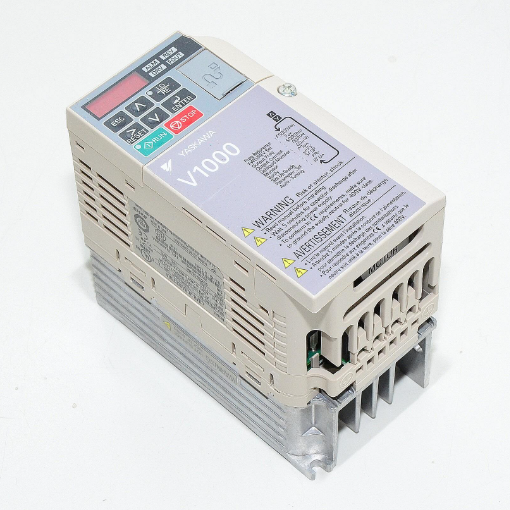
Yaskawa CIMR-P7U4160 is a three-phase AC inverter specially designed for fans and pumps within the VarIspeed P7 series. Rated for 380~480V three-phase input, it matches a 250HP (approximately 185kW) asynchronous motor. Developed for square-torque loads such as fans, water pumps, air compressors and cooling towers, it features energy-efficient operation, wide speed regulation range and comprehensive protection functions for both power grid and motors. Local and remote automatic speed control can be realized via various analog and digital terminals as well as optional extended communication cards. Widely applied in large-scale energy-saving renovation and process speed regulation projects for HVAC, water treatment, metallurgy, petrochemical and power plant auxiliary equipment, this classic heavy-duty industrial model supports abundant process functions including sleep energy saving, automatic fault restart, multi-speed operation and customizable acceleration/deceleration curves, capable of adapting to complex on-site conditions such as power grid voltage fluctuation and short-term power outage.
2. Hardware Structure and Composition
2.1 Main Power Rectifier & Inverter Unit
It adopts a three-phase full-bridge diode rectifier plus IGBT inverter topology, with a rated output current of 304A and rated capacity of 230kVA. Built-in DC bus buffer and absorption circuits effectively suppress grid voltage spikes and harmonic surges from switching devices. Equipped with a forced air cooling module and multiple temperature sensors, it monitors the temperature of power modules and rectifier bridges in real time and automatically derates output under high temperature to prevent thermal damage to power components. Optional DC reactors and input EMC filters are available to restrain grid harmonics and improve immunity to voltage distortion, making it suitable for complex power supply environments with densely installed high-power inverters.
2.2 Control Signal & Terminal Acquisition Unit
A multi-functional I/O terminal block is standardly configured, including multiple digital inputs, relay fault outputs, analog voltage/current input and output terminals. It accepts 4~20mA and 0~10V speed reference signals from transmitters for pressure, temperature, liquid level and other parameters, and feeds back operating status such as output frequency, output current and fault alarm. With built-in digital logic processing circuits, it supports configuration of process logic such as 3-wire start/stop, multi-speed operation, fault reset, external emergency stop and sleep start/stop. Photoelectric isolation for terminal circuits prevents accidental start/stop and parameter disorder caused by strong on-site electromagnetic interference.
2.3 Operation Panel & Parameter Storage Unit
A detachable digital operation panel is provided as standard, which displays real-time operating data including output frequency, output current, DC bus voltage and fault codes, and supports local parameter setting, one-click parameter backup and fault history query. The main control board is equipped with non-volatile memory to permanently store all parameters and fault records without data loss after power failure. Remote panel mounting is supported via extension cables for convenient on-site commissioning and inspection. It can also work with DriveWizard upper computer software to realize parameter upload/download and fault diagnosis analysis on PC terminals.
2.4 Communication Expansion & Peripheral Interface Unit
Expansion slots are reserved on the main control board for installing industrial fieldbus communication cards such as Modbus and Profibus-DP, enabling network-based centralized speed regulation and remote fault upload when connected to DCS and PLC control systems. External terminals for braking units are reserved to connect braking resistors for fast stopping of high-power inertial loads and avoid overvoltage protection triggered by DC bus voltage surge during shutdown. With a protection rating of NEMA1 (IP20) and wall-mounted metal cabinet design featuring dustproof and anti-vibration properties, it is suitable for long-term continuous operation in indoor enclosed control cabinets.
2.5 Heat Dissipation, Mounting & Cabinet Structure Unit
The inverter adopts vertical wall-mounted installation with standard upper and lower air inlet and outlet channels for heat dissipation. The cooling fan is equipped with fault detection to trigger early warnings for fan stall or aging. High-power models adopt modular layered layout with physically separated power and control circuits and electrical isolation between strong and weak current loops to reduce crosstalk. Multiple derivative cabinet types are available for explosion-proof and dustproof upgrading, compatible with standard mounting dimensions of conventional control cabinets to facilitate on-site replacement of old inverters.
3. Technical Specifications
3.1 Electrical Specifications
- Input: 3-phase 380/400/415/440/460/480VAC, 50/60Hz; rated input current: 334A; allowable voltage fluctuation: +10%/-15%; frequency fluctuation: ±5%
- Output: rated capacity 230kVA, rated output current 304A, compatible with 250HP asynchronous motor; maximum output voltage synchronized with input voltage; maximum output frequency: 120Hz
- Overload capacity: 110% rated current for continuous 60 seconds; 150% peak overload protection for transient conditions, applicable to startup impact loads of fans and pumps
- Control mode: constant V/F control; speed regulation range 40:1; steady-state speed accuracy ±2%~±3%; low-frequency starting torque at 3Hz reaches 100% rated torque
- Terminal configuration: multiple isolated digital inputs, 3 relay outputs, 2 analog inputs, 1 analog output; accepts standard 0~10V and 4~20mA speed reference signals
- Communication: local commissioning via operation panel; optional Modbus/Profibus fieldbus expansion cards for remote parameter read-write and status collection by upper computers
- Acceleration/Deceleration: two switchable independent sets of parameters ranging from 0.1 to 6000s; S-curve acceleration/deceleration supported to suppress impact during startup and shutdown
3.2 Environmental Specifications
- Operating temperature: -10℃~+40℃; derating required above 40℃; storage & transport temperature: -20℃~+65℃
- Relative humidity: 5%~95% RH, non-condensing, free of corrosive gas and conductive dust
- Protection class: standard NEMA1 (IP20), only for installation in indoor ventilated control cabinets
- Vibration resistance: amplitude ≤3mm within 10~20Hz; acceleration ≤9.8m/s² within 20~50Hz, complying with industrial anti-seismic installation standards
3.3 Mechanical Specifications
- Mounting: vertical wall-mounted installation for standard industrial control cabinets
- Cooling: forced air cooling with fault early warning for cooling fans
- Compatible loads: square-torque loads such as fans and water pumps; external braking resistors supported for inertial loads
- Optional accessories: DC reactor, input EMC filter, external braking unit, remote operation panel and various industrial communication expansion cards
4. Product Functions and Features
4.1 Special Energy-saving Control Algorithm for Fans and Pumps to Greatly Reduce No-load Power Consumption
Built-in sleep energy-saving function enables the inverter to automatically stop when the system flow and pressure stabilize under low load, and restart once process parameters deviate from preset thresholds. Combined with automatic torque boost and voltage optimization control, it reduces motor iron and copper losses by lowering output voltage under light loads, achieving a 15%~40% energy-saving rate compared with power frequency operation. It also supports alternating operation control for multiple pumps to realize cyclic switching between variable-frequency and power-frequency modes and extend equipment service life.
4.2 Comprehensive Process Protection and Automatic Fault Diagnosis to Ensure Continuous System Operation
It integrates more than 20 hardware and software protection functions including overcurrent, overvoltage, undervoltage, overload, overheating, output short circuit, motor earth fault, input phase loss and output phase loss. Automatic fault retry is available with configurable retry times and intervals to resume operation after transient grid dip or false tripping caused by electromagnetic interference. Specific frequency bands can be blocked to avoid mechanical resonance of fans and pipelines, eliminating abnormal vibration and potential fatigue damage to equipment.
4.3 Diverse Speed Reference Modes and Logic Configuration for Complex Automated Processes
Four switchable speed setting modes are supported: panel potentiometer, multi-speed terminal, analog transmitter remote input and fieldbus communication. Built-in PID closed-loop regulation enables fully automatic constant pressure and constant liquid level speed control by directly connecting pressure, liquid level and temperature sensors without external PLC regulators. Functions including motor preheating, coasting anti-runaway protection and DC injection braking meet safety start-stop requirements for cooling towers, drainage pumps and exhaust fans.
4.4 Complete Motor Adaptation and Commissioning Functions to Reduce On-site Debugging Workload
Static motor parameter auto-tuning is supported to automatically identify stator resistance, inductance and other motor parameters without no-load motor operation, optimizing low-frequency torque output. Multiple built-in V/F curve templates allow selection of the optimal voltage-frequency ratio according to different load characteristics of fans, pumps and air compressors. One-click factory reset and parameter copy/upload/download enable fast batch parameter replication for identical units and greatly shorten on-site commissioning time.
4.5 Powerful Fault Recording and Maintenance Traceability for Efficient Troubleshooting
It stores multiple recent fault codes together with key operating data such as frequency, current and DC bus voltage at fault occurrence. Maintenance personnel can access fault history via the operation panel or upper computer software to quickly locate root causes such as overcurrent, overheating and grid anomalies. Passive relay fault contact output connects to audible and visual alarms and DCS systems for remote fault reporting, facilitating unattended plant equipment operation and maintenance management.
4.6 Industrial-grade Hardware Design for Wide Operating Conditions and Harsh On-site Environments
Photoelectric isolation between strong and weak current circuits and three-proof coating on power boards enable stable operation under severe conditions with dust, humidity and heavy electromagnetic interference. The wide-range grid voltage adaptation design ensures stable operation during short-term under-voltage and over-voltage fluctuations. Equipped with voltage-loss coasting function, it can maintain operation for up to 2 seconds after power dip to avoid system shutdown and production loss caused by transient grid disturbances.
5. Applicable Working Conditions and Application Scenarios
- Energy-saving renovation projects adopting constant-pressure variable-frequency speed regulation for water supply pumps, sewage pumps and circulating pumps in municipal water supply and drainage as well as sewage treatment plants.
- Speed control of boiler induced draft fans, forced draft fans, cooling tower fans and dust removal exhaust fans in power plants, metallurgical and chemical plants.
- Energy-saving variable-frequency control systems for chilled water pumps, cooling water pumps and fresh air fans of central air conditioning systems in commercial buildings and large HVAC projects.
- Soft start and constant process speed regulation for light-start loads such as air compressors, hydraulic pump stations and conveyor belts.
- Energy-saving upgrading of traditional power-frequency motors, replacement of faulty inverters, and centralized automatic monitoring renovation for plant-wide equipment combined with DCS and PLC systems.
![]()