Description
Woodward 8200-1301
I. Basic Information
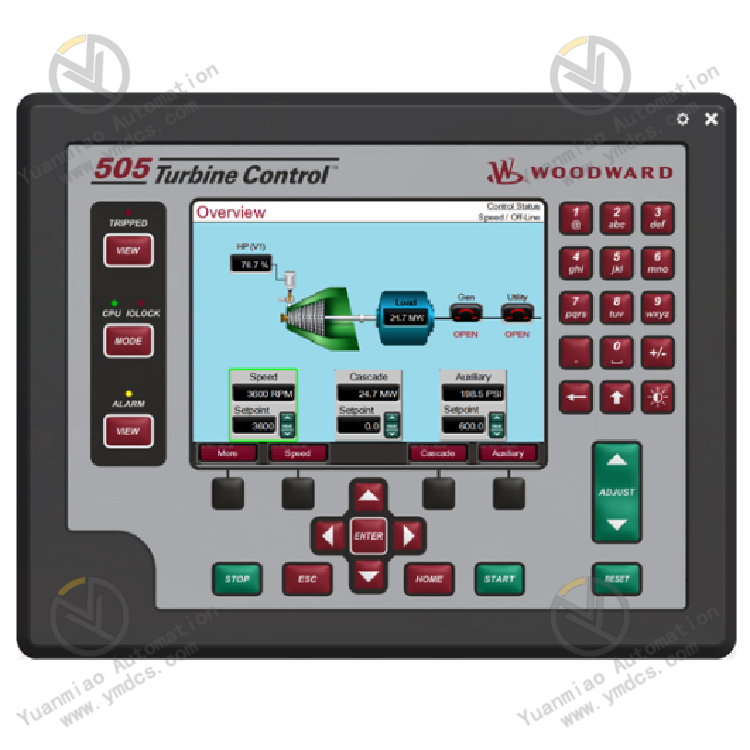
Model:8200-1301Brand:WoodwardProduct Line:505D integrated digital turbine governor with AC/DC universal power supply, integrating graphical HMI, closed-loop speed/load control, multi-channel isolated I/O and multi-protocol communication. It realizes turbine speed regulation, grid connection, extraction pressure control and overspeed safety protection, widely applied in thermal power, petrochemical and waste heat power generation turbomachinery control systems.
Product Positioning
8200-1301 is a general-purpose version of the 505D governor with wide-range AC/DC power input, adopting adaptive PID control algorithm to achieve high-precision speed regulation. It supports single valve, split-range actuator and extraction turbine compound control, built-in overspeed protection, critical speed avoidance and fault safety position logic, equipped with multi-level password authority management and offline simulation function, serving as the core control replacement spare part for upgrading legacy turbine control systems.
Hardware Architecture
Industrial reinforced integrated panel structure with flame-retardant PCB and moisture-proof coating, composed of six independent functional units: high-speed adaptive control unit, graphical HMI human-machine interaction unit, isolated multi-channel I/O unit, multi-protocol communication unit, full-link fault diagnosis unit and wide-voltage power protection unit. Complete electrical isolation between strong and weak current circuits effectively suppresses on-site electromagnetic interference and ensures long-term stable operation.
Mounting Specification
Panel embedded installation with optional DIN rail mounting bracket, front panel IP54, rear terminals IP20. Passed IEC vibration, high and low temperature, EMC reliability tests, compatible with same-series 505D hardware for plug-and-play replacement without large-scale field wiring modification.
Compatible Systems
- Hardware: AC/DC power supply, reluctance/Hall speed sensors, electro-hydraulic actuators, shielded signal cables, ETS trip loop, DCS connection terminals;
- Software: Woodward Control Assistant configuration software, signal calibrator and speed simulator;
- Upper Platforms: Power plant DCS, SCADA, fault recorder and SOE event management system;
- Industries: Captive power plant, petrochemical turbomachinery, waste heat & biomass power generation, industrial steam turbine automatic control projects.
Product Characteristics
- Adaptive PID control realizes ±0.1% high-precision steady-state speed regulation to stabilize unit frequency and power quality under variable load conditions.
- Multi-mode control supports extraction turbine dual-parameter regulation, critical speed avoidance and multi-layer safety interlock protection.
- Local graphical operation plus remote network monitoring realizes convenient parameter configuration, fault diagnosis and intelligent unattended operation and maintenance.
- Fault fail-safe design ensures valves switch to safe position under signal loss, power failure and actuator abnormality to prevent turbine runaway accidents.
- Wide temperature and wide voltage rugged design adapts to harsh industrial environments with strong electromagnetic interference, dust and vibration.
- Compatible with legacy 505 series configuration migration, effectively shortening system commissioning and renovation cycle.
II. Technical Specifications
2.1 Electrical Parameters
- Power Supply: 88~264VAC 47~63Hz / 90~150VDC universal input
- Max Power Consumption: 73W, AC max current 1.6A, DC max current 0.8A
- Protection: Reverse polarity, overvoltage, undervoltage, overcurrent lockout, ±4kV ESD, ±2kV EFT immunity
- Dielectric Withstand Voltage: 1500VAC 1min isolation withstand voltage for all signal and communication ports.
2.2 Control & Speed Parameters
- Control Algorithm: OptiTune adaptive PID, steady-state speed accuracy ±0.1%FS
- Speed Range: 0~10000rpm configurable, supports dual independent speed channels
- Control Modes: Speed, load, extraction pressure, grid synchronization, manual valve position control
- Safety Functions: Overspeed trip, reverse rotation detection, critical speed avoidance, speed signal loss protection
- Actuator Configuration: Single valve, split-range, extraction/admission compound control optional.
2.3 I/O & Communication Parameters
- Analog Input: 8 channels configurable 4~20mA / 0~10VDC isolated input
- Analog Output: 2 channels 4~20mA isolated output for actuator drive and signal transmission
- Discrete Relay Output: Form-C contact rated 8A/240VAC for trip and alarm signals
- Communication: Ethernet TCP/IP, RS485 Modbus RTU, CAN2.0B, USB debugging port
- Data Storage: Local historical alarm, operation event and SOE timestamp record storage and export supported.
2.4 Environmental Specifications
- Operating Temperature: -30℃ ~ +70℃; Storage Temperature: -30℃ ~ +70℃
- Humidity: 5%~95%RH non-condensing, non-corrosive gas environment
- Vibration Standard: IEC 60068-2-6 industrial vibration resistance standard
- Ingress Protection: Front IP54, rear terminal IP20.
2.5 Mechanical Parameters
- Mounting: Cabinet panel embedded installation, optional DIN rail bracket
- Display: 8.5-inch color LCD, 800×600 resolution, multi-language interface
- PCB: V0 flame-retardant industrial board with moisture-proof coating, gold-plated anti-oxidation interface
- Standard Configuration: Emergency stop knob, function keypad, terminal block, debugging communication port.
III. Key Features
3.1 High-Precision Turbine Speed & Load Closed-Loop Control
The adaptive PID algorithm automatically optimizes regulation parameters to realize stable unit startup, grid-connected frequency modulation and load operation, effectively suppressing steam pressure and load disturbance to ensure power grid frequency stability.
3.2 Compound Regulation for Extraction Turbines
Realize coordinated control of power generation load and heating extraction pressure, balance industrial heat demand and power generation efficiency, equipped with valve characteristic correction and anti-reverse flow interlock logic for cogeneration units.
3.3 Multi-Level Safety Interlock & Fault Tolerant Protection
Dual redundant speed monitoring, overspeed trip, actuator fault safety position lock and multiple protection functions prevent turbine runaway and equipment out-of-control accidents under various abnormal working conditions.
3.4 Local Visual Operation & Remote Intelligent O&M
Integrated HMI realizes on-site parameter setting and manual debugging; multi-bus remote access supports online configuration, trend analysis and fault traceability to meet the management requirements of unattended intelligent power plants.
3.5 Offline Simulation Debugging & Hierarchical Permission Security Management
Built-in turbine simulation function supports pre-commissioning debugging without on-site actuator connection; multi-level password authority prevents unauthorized parameter modification and program misoperation, reducing on-site commissioning safety risks.
IV. Working Principle
After power-on self-check of power supply, I/O, communication and display circuits, the controller loads pre-configured control parameters and enters standby mode. During unit startup, it drives the steam valve actuator according to the set acceleration rate, collects real-time speed signals through two independent sensors, and uses PID algorithm to close-loop correct valve output to stabilize turbine speed. After grid connection, it switches to load or extraction pressure control mode to realize multi-parameter coordinated regulation. Once faults such as overspeed and signal loss occur, the controller locks the valve at the safe position, triggers ETS emergency shutdown, latches fault information and uploads alarm data with timestamp for accident analysis.
V. Application Scenarios
- Captive power plants, waste heat and biomass power stations: Turbine speed governing, grid-connected frequency regulation and safety interlock protection.
- Petrochemical industry: Process drive turbine and waste heat recovery turbomachinery automatic control system.
- Cogeneration heating power plants: Back-pressure and extraction turbine heat-power coordinated regulation.
- Waste incineration and cement waste heat power projects: Industrial turbine sequence control and load stable regulation.
- Legacy control system renovation: Upgrade old analog governors to digital 505D intelligent control system.