Description
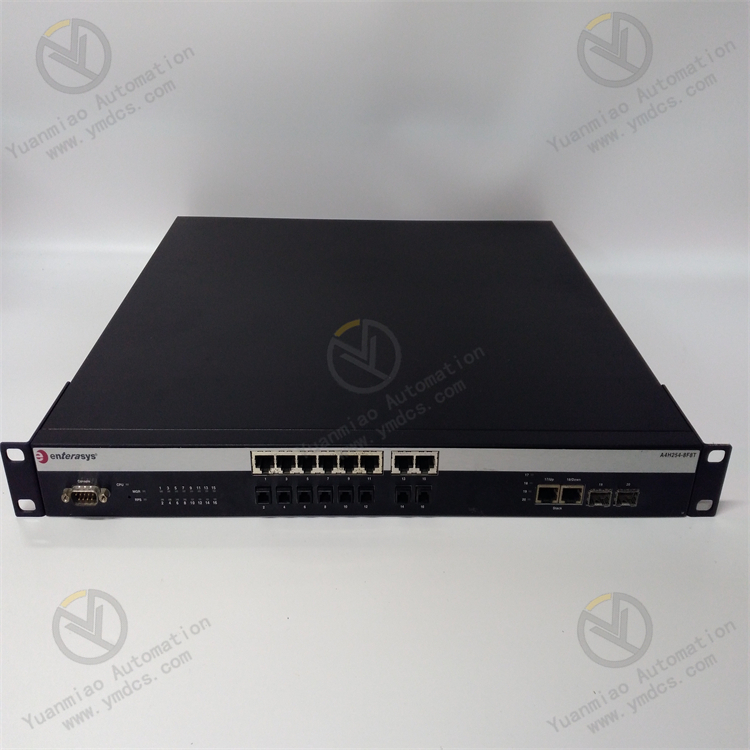
ENTERASYS SSA-T8028-0652
1. Basic Information
ENTERASYS SSA-T8028-0652 is a Layer 2 / Layer 3 Ethernet switch designed for enterprise-grade networks and industrial automation applications. Positioned as a high-density and high-reliability core or aggregation layer network component, it integrates high-speed data forwarding, intelligent network management, security protection and traffic optimization functions. It serves as a key network device for large-scale device interconnection and efficient data transmission in enterprise parks, data centers, industrial automation and other scenarios.
It is mainly used to build a highly flexible distributed switching and routing architecture to connect various network nodes such as enterprise internal terminals, servers and industrial control equipment, realizing high-speed forwarding and efficient management of massive data. Equipped with abundant port configurations, advanced network management functions and redundant design, it improves network reliability, scalability and fault tolerance. Meanwhile, it supports advanced functions such as virtual switch bonding to meet the high-bandwidth and high-stability requirements of complex enterprise networks and industrial automation systems, and flexibly adapt to network expansion and upgrading demands in various scenarios.
2. Technical Specifications
2.1 Core Electrical & Network Specifications
- Power Supply: Supports automatic wide-range input voltage and frequency, compatible with AC power supply (power modules are sold separately). Redundant power deployment is available to effectively prevent network outages caused by power failures and enhance continuous operation reliability.
- Switching Performance: Delivers powerful data processing capability with forwarding rate up to 10Gbps. It processes massive network data efficiently to ensure smooth data transmission during multi-device concurrent communication and satisfy high-bandwidth demands of enterprise networks and data centers.
Port Configuration: Equipped with 48 × 10/100/1000Base-T RJ45 Gigabit Ethernet ports and 4 × 10G Base-X SFP+ 10G uplink ports. The high-density port design meets large-scale device interconnection requirements, while uplink ports realize high-speed data aggregation and forwarding to adapt to multi-layer network architectures.
- Network Management: Supports Layer 2 / Layer 3 switching and abundant network management features. Virtual Switch Bonding technology is available to boost network flexibility and scalability. It also supports VLAN division, QoS traffic optimization and Access Control List (ACL) to realize refined network management and security protection and guarantee transmission performance of core applications.
- Hardware Performance: Built with large-capacity MAC address table to efficiently identify and learn device MAC addresses, achieve accurate packet forwarding and reduce data loss and transmission delay. It supports pluggable optical modules to fit different transmission distances and improve network deployment flexibility.
Environmental Adaptability: Industrial-grade design provides excellent anti-interference and dustproof performance. Front-rear heat dissipation structure adapts to various operating environments such as enterprise computer rooms and industrial sites with stable long-term operation. It complies with relevant industry standards to ensure operational safety and compatibility.
2.2 Physical & Structural Specifications
- Mounting Mode: Supports standard rack mounting in line with installation standards for enterprise and industrial network equipment. It is easy to install and can be quickly installed into existing network cabinets, facilitating later maintenance, expansion and replacement, ideal for densely deployed computer rooms and industrial sites.
- Dimensions: Adopts standardized industrial compact enclosure conforming to unified rack layout and hardware standards of S-series switches, saving cabinet space and facilitating combined deployment with other S-series modules.
Weight: Optimized lightweight industrial design balances structural firmness and easy installation. Its moderate weight brings no extra load to cabinets and meets dense deployment demands of industrial computer rooms.
- Enclosure & Connection: Industrial protective housing features superior dustproof and anti-electromagnetic interference capability against harsh on-site conditions. Ports are arranged in zones for RJ45 and SFP+ interfaces, enabling convenient wiring and stable connection to ensure reliable data transmission. Dedicated power ports and management interfaces including Micro-USB ports are reserved for power module access and equipment debugging.
Product Features: Modular design enables flexible integration into S-series network systems and coordinated operation with peer devices. Ports and functions can be expanded freely as required. Complete system indicators directly display equipment running status, port connection status and fault information for quick on-site troubleshooting. Built-in distributed management and control design allows independent operation of each module to improve overall fault tolerance and reliability.
2.3 Core Functions & Compatibility Specifications
- Core Functions: It supports high-speed data forwarding & switching, Layer 2 / Layer 3 routing, VLAN division, QoS traffic optimization, MAC address learning & filtering, ACL access control and virtual switch bonding. Redundant power supply and distributed architecture ensure non-stop network operation. Comprehensive network management and monitoring functions enable real-time monitoring of network traffic and device status for convenient configuration and troubleshooting.
Integration Features: Highly integrated design embeds data forwarding unit, network management unit, security protection unit and distributed control unit. Complete network interconnection and management can be realized without additional accessories, simplifying network construction and cutting deployment costs. Online configuration and debugging are supported to optimize network parameters on site to fit diverse application demands.
- Compatibility: Fully compatible with Enterasys S-series network systems for seamless linkage with S-series switches, routers and other devices. It connects smoothly with office terminals, industrial control devices and data center servers to realize cross-device intercommunication. Support for mainstream network protocols enables easy access to existing enterprise, data center and industrial automation network architectures for higher integration flexibility. It is compatible with Extreme Networks management software for unified operation and maintenance.
- Reliability & Practicality: Industrial-grade design ensures stable daily operation. Distributed and redundant designs greatly enhance fault tolerance with low long-term failure rate, lowering network maintenance costs. High-density ports and high-speed uplinks meet demands of large-scale device access and high-bandwidth data transmission. Powerful security mechanisms defend against unauthorized access and network attacks to secure network data. Flexible modular expansion allows gradual capacity expansion along with business growth and reduces network upgrading costs.
3. Working Principle
- Equipment Initialization & Parameter ConfigurationAfter power-on, the switch automatically completes self-inspection and system initialization to check the operating status of ports, power interfaces, data forwarding units and management units, and enters ready state after confirming normal conditions. Administrators configure network parameters including VLAN settings, QoS priorities, ACL rules, virtual switch bonding and port speed via Micro-USB ports, network management software or command line interfaces to complete network adaptation.
- Device Access & MAC Address LearningTerminals, servers and industrial control devices are connected to RJ45 or SFP+ ports via network cables or optical modules. The switch automatically identifies accessed devices, learns and records their MAC addresses and updates information into the local MAC address table, providing accurate basis for fast packet forwarding and target device positioning.
- Data Forwarding & Traffic OptimizationUpon receiving data packets, the switch parses destination MAC addresses or IP addresses, matches them with local MAC address tables and routing tables, and forwards packets accurately to target devices or uplink networks. Meanwhile, QoS mechanism classifies network traffic by priority to prioritize audio, video, real-time control data and core service data, ensuring stable transmission of key applications and preventing network congestion.
- Security Protection & Redundancy GuaranteeThe switch divides the entire network into multiple logical subnets via VLAN to realize subnet isolation and improve network security. ACL policies, port security and MAC address filtering block illegal device access and resist network attacks. Redundant power supply enables automatic power switching to avoid network shutdown during main power failure. Distributed module independent operation ensures that single-module faults will not affect overall network operation and greatly improves network fault tolerance.
- Status Monitoring & Fault HandlingThe switch monitors real-time operating status including power supply, ports, data forwarding and module running conditions as well as network connection status, and displays working conditions through built-in indicators. Once port faults, power anomalies, transmission errors and module failures are detected, it will trigger alarms and upload fault information to network management terminals for rapid troubleshooting and stable network operation.
4. Application Scenarios
4.1 Enterprise Campus Network
It acts as core layer or aggregation layer switches in large enterprise parks and office buildings to connect internal terminals, servers and wireless network devices, supporting high-speed transmission of office data, video conferences and file sharing. High-density ports meet large-scale access demands, virtual switch bonding optimizes network flexibility, and QoS ensures smooth operation of core office services.
4.2 Data Center
It is deployed to build high-performance network infrastructure inside data centers to connect servers, storage devices and virtualized equipment, supporting core businesses such as server virtualization and cloud computing. 48 Gigabit ports satisfy dense server access, and 4 10G uplink ports realize efficient data aggregation and forwarding. Distributed and redundant design guarantee uninterrupted data center network operation and avoid data loss and service interruption caused by hardware faults.
4.3 Industrial Automation
It is applied on industrial production sites to connect DCS systems, robots, servo systems and sensors, realizing real-time transmission and interaction of industrial control data and providing stable network support for automated production. Industrial anti-interference performance adapts to harsh field environments, and high reliability ensures stable operation of industrial control networks without affecting production schedules.
4.4 Telecommunication Network
It serves as access layer or aggregation layer equipment for telecommunication networks to provide stable network access and efficient data transmission services between end users and core networks. High-density ports and high forwarding performance meet massive concurrent communication demands, while redundant design ensures stable telecommunication network operation and improves user network experience.
4.5 Government & Education Industry