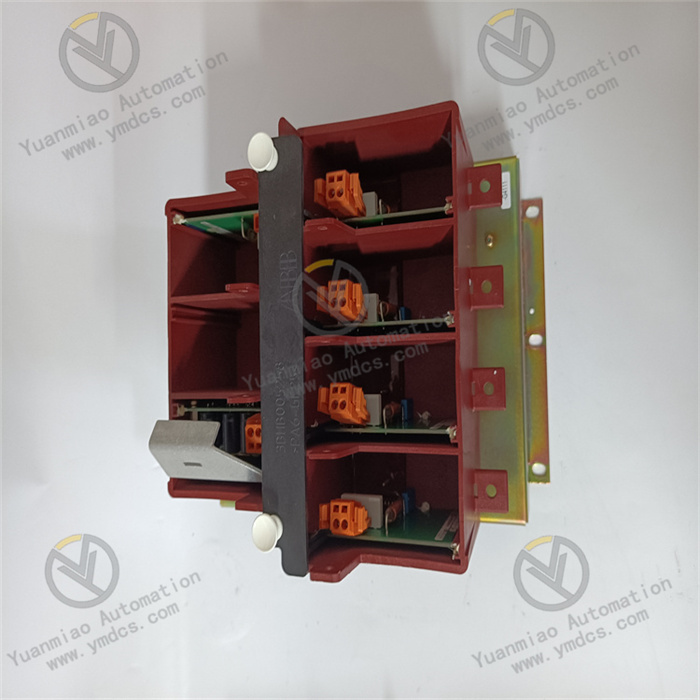
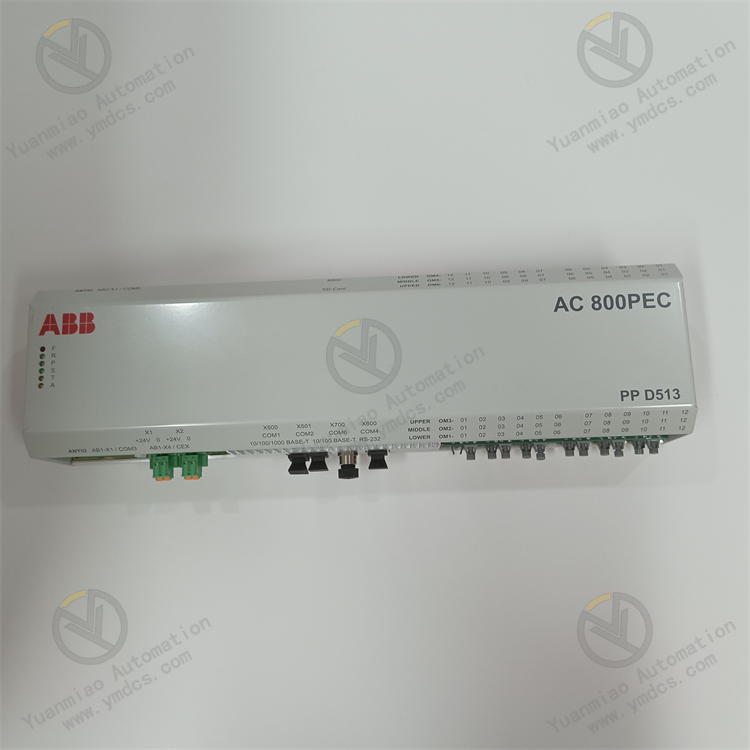
Description
1. Product Overview
Full Model: PPD513AOC-100440
Part Number: 3BHE039724R0C3D
Manufacturer: ABB
Product Name: High-Performance Excitation Main Processor Module & High-Speed Process Control Unit for AC800PEC System
Product Positioning
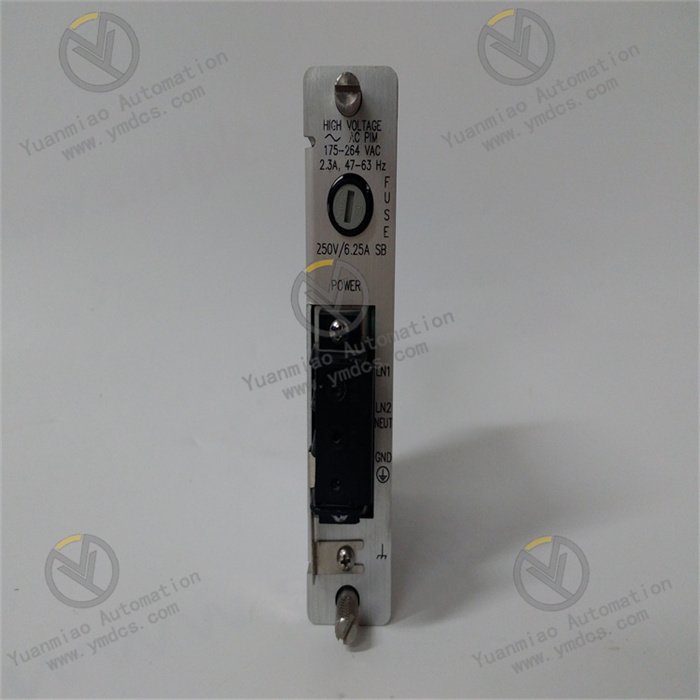
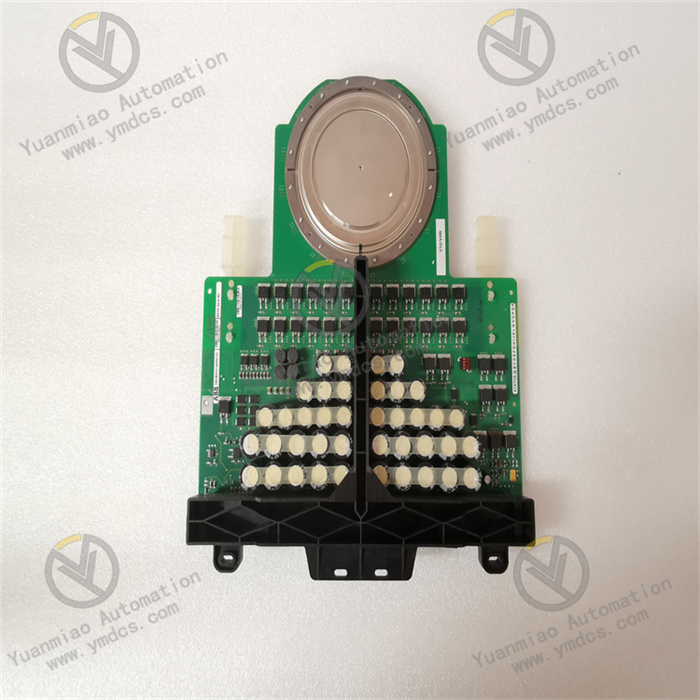
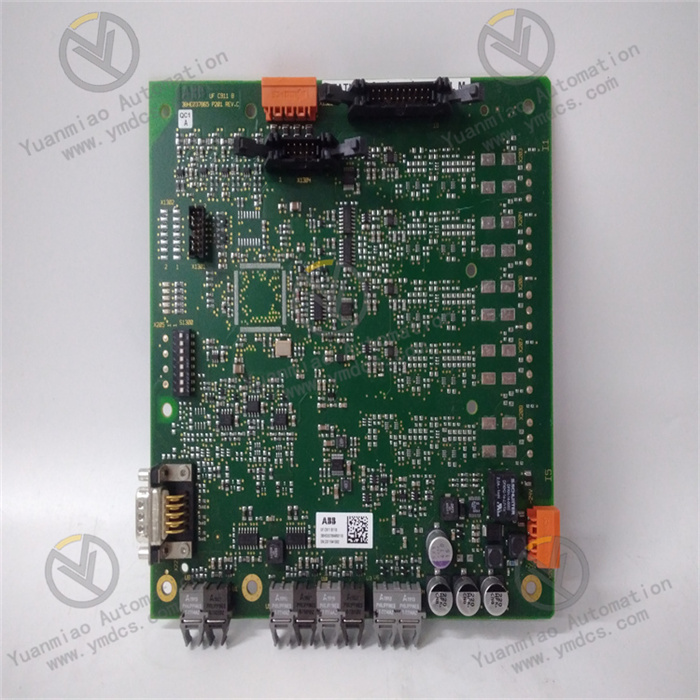
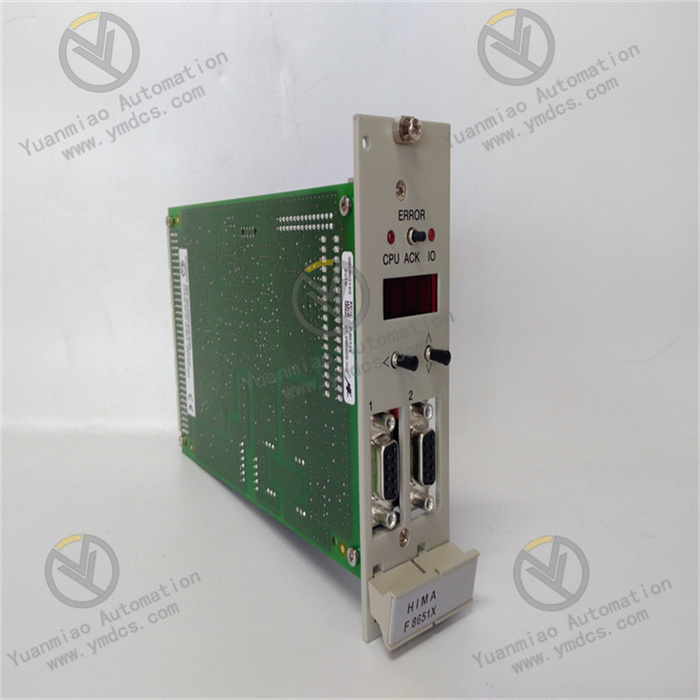
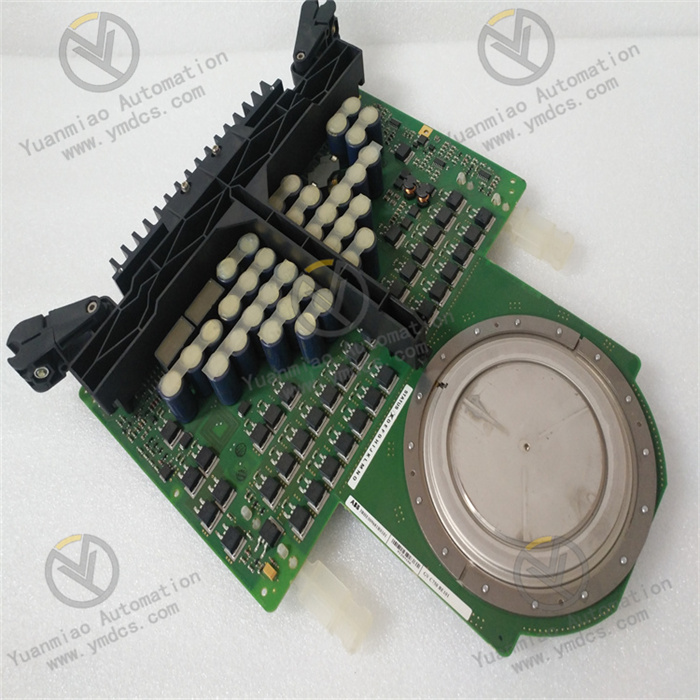
The PPD513AOC-100440 is a high-end core processor module dedicated to the ABB AC800PEC platform. It serves as the core arithmetic and logic processing unit for generator excitation systems, grid power regulation and high-power electric drive control systems. As the computing hub of the complete power control equipment, it undertakes critical tasks including excitation regulation computation, closed-loop control of grid parameters, system logic scheduling, fault protection judgment and high-speed data exchange. It is an original key spare part for power generation, power transmission & distribution and industrial high-power drive sectors, and widely applied in renovation of excitation systems for new and existing generating units, replacement of aging main control modules, and performance upgrading projects of power control systems.
Core Function
Adopting dual-core processor + FPGA hardware acceleration architecture, this module features microsecond-level high-speed computing capability. It can collect full-dimensional electrical parameters in real time, including generator terminal voltage, stator current, rotor current, grid frequency and reactive power. It accurately implements core functions such as closed-loop excitation regulation, reactive power optimization, grid voltage & frequency stabilization, power system damping control and fault interlock protection. It can rapidly respond to grid condition fluctuations and load transients, and effectively suppress unit oscillation, voltage deviation and power imbalance. It guarantees the stability, safety and economy of grid-connected operation for generator sets and high-power drive equipment, and satisfies stringent grid codes for frequency and voltage regulation.
Applicable Systems
It is specially designed for the full series of ABB AC800PEC power-dedicated control systems, and fully compatible with the complete hardware architecture, backplane bus, high-speed communication protocols, I/O module system and cabinet installation specifications of excitation systems. It can seamlessly match signal acquisition modules, power supply modules, communication modules and extended I/O units of the same series, and supports configuration of single-master and dual-redundant master architectures. It is suitable for replacement of obsolete main controllers, system computing capacity upgrading, redundant architecture transformation and spare part replacement for excitation control systems of thermal power, hydropower and wind turbine units, as well as industrial high-power variable frequency drive systems. Hot-swap in-situ replacement requires no modification to system configuration, control logic or field wiring, delivering excellent system compatibility and interchangeability.
Application Scenarios
Widely deployed in thermal power plants, hydropower plants, new energy wind farms, metallurgical high-power drives, large electric drives for oil & gas industry, grid substation regulation and other fields. Main applications include precise excitation regulation of synchronous generators, grid voltage/frequency stabilization control, unit reactive power optimization, logic operation and closed-loop control of electric drive systems, system fault monitoring and interlock protection. It adapts to rigorous operating conditions in the power industry characterized by high voltage, heavy load, frequent working condition fluctuations and complex electromagnetic environment. It is core equipment for long-term stable operation & maintenance of power control systems and ensuring safe grid connection of generating units.
2. Technical Features
Dual-Core + FPGA Acceleration Architecture with Ultra-High Real-Time Computing PerformanceEquipped with industrial-grade dual-core main processor and dedicated FPGA hardware accelerator to realize hardware parallel operation of control algorithms. The minimum control cycle reaches 100 μs, offering much faster response than conventional industrial controllers. It efficiently handles complex tasks including closed-loop excitation regulation, decoupling calculation of grid parameters, multi-loop coordinated control and real-time analysis of massive power data, without computing delay, logic stalling or control drift. It perfectly meets high real-time requirements of generator sets for rapid voltage/frequency regulation and transient load response.
Redundant Fault-Tolerant Design with Power-Grade Ultra-High Operational ReliabilityNatively supports dual-master hot standby architecture, featuring hardware self-diagnosis, program hot backup, real-time synchronization of operating data and bumpless switchover upon fault. During operation, it continuously compares computing data and control commands from two master controllers, and automatically shields potential risks such as single-point hardware failure, data abnormality and communication disturbance. Single-module fault will not trigger system shutdown, excitation runaway or grid fluctuation. It fully meets requirements of uninterrupted operation for power systems and complies with grid safety operation specifications.
Dedicated Excitation Control Algorithms Delivering Top-Grade Regulation PrecisionEmbedded with mature original ABB power-specific control algorithms, integrating dedicated logic including precise PID regulation, power system damping control, reactive power optimization, overexcitation/underexcitation limitation and system oscillation suppression. It can adapt to various operating conditions of units such as no-load, grid connection, on-load and fault disturbance, dynamically optimize excitation parameters, accurately restrain voltage deviation and power oscillation, greatly improve grid-connected stability of units and power quality, and adapt to variable operating characteristics of various generator sets.
Industrial-Grade High Anti-Interference Capability for Complex Power ConditionsThe unit adopts military-grade components and high-density integrated circuits, equipped with multi-layer electrical isolation, electromagnetic shielding, surge suppression and electrostatic protection circuits. It has passed stringent EMC electromagnetic compatibility and high-low temperature reliability certifications for power industry. It features dust resistance, moisture resistance, shock resistance, corrosion resistance, wide temperature tolerance and strong immunity to electromagnetic interference. It can effectively resist adverse conditions at power plants such as intense electromagnetic field disturbance, load impact, sharp temperature & humidity variation, dust and oil contamination, and supports 7×24-hour continuous stable operation under heavy load.
Intelligent Global Self-Diagnosis for Convenient & Efficient MaintenanceBuilt-in on-board intelligent self-diagnosis system monitors CPU status, FPGA operating condition, bus communication, I/O links, supply voltage and program operation status in real time. It accurately identifies hidden risks including hardware faults, program exceptions, data deviation, communication interruption and parameter out-of-limits. Fault codes, fault sequences, operation logs and alarm records are automatically stored, supporting local query, background export and remote fault review. It enables rapid fault localization, significantly shortening troubleshooting and outage maintenance duration of power systems, and reducing maintenance costs and power generation losses.
Multi-Protocol High-Speed Communication with Strong Digital ExpandabilityNatively compatible with the dedicated high-speed backplane bus of AC800PEC, and supports mainstream power communication protocols such as PROFIBUS DP with a maximum communication rate up to 3 Mbps and multi-rate adaptive capability. It can seamlessly connect with excitation background systems of units, power plant DCS systems, centralized control platforms, grid dispatching systems and remote operation & maintenance platforms. It supports real-time data uploading, remote parameter tuning, online program upgrade and online debugging & diagnosis, matching the digitalized, remote and unattended operation & maintenance architecture of smart power plants.
- Standardized Modular Design for Excellent Replacement CompatibilityFully compliant with original ABB AC800PEC hardware specifications. Board dimension, slot specification, pin definition, bus logic and mounting holes are fully consistent with original equipment of the same series. Adopting standard rack slot-mounted modular structure, it supports direct hot-swap replacement of aging main control modules of the same model. No rewiring, control logic modification or system configuration re-commissioning is required. It fits full scenarios including routine maintenance, emergency fault replacement, system computing capacity upgrading and renovation of legacy excitation systems, featuring zero compatibility risk and plug-and-play performance.
3. Specification Parameters
| Item | Parameter |
|---|---|
| Equipment Model | PPD513AOC-100440 |
| Part Number | 3BHE039724R0C3D |
| Manufacturer | ABB (Switzerland) |
| Equipment Type | Dual-Core Main Processor Module Dedicated to Excitation of AC800PEC System, High-Speed Power Process Control Unit |
| Applicable Systems | ABB AC800PEC power-dedicated control system, generator excitation control system, high-power industrial drive control system |
| Application Scope | Excitation regulation of thermal/hydropower/wind turbine units, grid voltage & frequency stabilization control, unit reactive power optimization, electric drive logic control, replacement of obsolete main control modules, system redundancy upgrading & transformation |
| Core Hardware Configuration | Dual-core industrial processor + FPGA hardware accelerator, on-board high-speed storage, independent bus communication processing unit |
| Minimum Control Cycle | 100 μs, high-speed closed-loop computing response |
| Core Functions | Full-dimensional power parameter acquisition, high-speed excitation logic operation, voltage/frequency closed-loop regulation, reactive power optimization, power system damping control, overexcitation/underexcitation limit protection, redundant fault-tolerant operation, fault self-diagnosis & traceability, multi-protocol high-speed communication, remote parameter tuning and program upgrade |
| Communication Protocols | AC800PEC dedicated high-speed bus, PROFIBUS DP (960 kbps / 1.5 Mbps / 3 Mbps adaptive) |
| Node Address Range | 0~255 (configurable for adaptation to all station equipment) |
| Power Supply Specification | Standard industrial DC24V power supply, power consumption <5 W |
| Operation Architecture | Supports single-master and dual-redundant hot standby operation, real-time hot synchronization of data, bumpless switchover upon fault |
| Protection Mechanisms | Hardware fault tolerance, communication abnormality protection, parameter out-of-limit interlock, overload & overheat protection, data abnormality shielding, system self-reset protection, excitation abnormality blocking protection |
| Operating Temperature | 0℃~+65℃ (standard operating temperature range for power industrial control) |
| Storage Temperature | -40℃~+85℃ |
| Ambient Humidity | 5%~95%RH, non-condensing, suitable for indoor cabinet conditions in power plants |
| Protection Capabilities | Electromagnetic shielding, multi-layer electrical isolation, surge & electrostatic protection, shockproof & dustproof, moisture-proof & anti-corrosion, certified against EMC electromagnetic compatibility requirements for power industry |
| Operation Mode | Real-time power parameter acquisition, hardware-accelerated parallel operation, automatic closed-loop excitation regulation, redundant fault-tolerant hot standby operation, full-condition monitoring, automatic fault protection, real-time data uploading and storage |
| Diagnosis Functions | CPU/FPGA status diagnosis, hardware self-test, bus fault identification, operation abnormality recording, fault code storage, full-condition data traceability and review |
| Mounting Method | Standard slot mounting inside AC800PEC cabinet, in-situ modular hot-swap replacement |
| Equipment Characteristics | High-speed computing via dual-core & FPGA, microsecond-level real-time control, bumpless dual-redundant operation, power-grade high safety protection, strong anti-interference, intelligent fault traceability, plug-and-play, suitable for all-weather stable grid-connected operation of generating units |
4. Working Principle
4.1 Power-On Initialization and Global Hardware Self-Diagnosis
After connected to standard DC24V power supply of the AC800PEC cabinet, the module automatically completes power-on initialization, system program loading and self-test of dual-core processor and FPGA unit. It sequentially verifies integrity of computing core, on-board storage, high-speed bus, communication ports, power supply circuits and hardware acceleration units, and simultaneously checks consistency of system configuration parameters, redundancy matching status and communication protocols. It comprehensively identifies hidden risks such as hardware damage, program abnormality, port fault, parameter disorder and bus misalignment. After successful self-test, it enters standby operation state, establishes bus connection with full-station I/O modules, excitation execution units, DCS background and dispatching system, and activates global real-time monitoring and excitation control functions.
4.2 Global Acquisition and High-Speed Computing Analysis of Power Parameters
During normal operation, the equipment collects core power parameters via high-speed backplane bus, including generator terminal voltage, stator current, rotor current, grid frequency, active/reactive power and unit rotating speed. Leveraging dual-core parallel operation and FPGA hardware acceleration, it rapidly performs data filtering, calibration, decoupling calculation and working condition judgment, analyzes unit operating status, grid load fluctuation and variation trend of excitation conditions in real time. It accurately outputs excitation regulation commands, power optimization commands and fault judgment signals, providing core computing support for closed-loop excitation control of generating units and stable grid operation.
4.3 Intelligent Closed-Loop Excitation Control of Generator Sets
According to real-time grid conditions, unit load status and dispatching commands, the module autonomously implements intelligent closed-loop excitation control for generator sets under all operating conditions. It precisely realizes core functions such as generator terminal voltage stabilization, grid frequency correction, smooth reactive power regulation, unit oscillation suppression and overexcitation/underexcitation limit protection. It can adapt to various operating conditions including no-load, grid connection, full load, load transient and grid disturbance, dynamically optimize excitation output parameters, eliminate voltage offset and power fluctuation, ensure stable grid-connected operation of units and qualified power quality, and improve operation efficiency and stability of power generation systems.
4.4 Dual Redundancy Fault Tolerance and Hierarchical Safety Protection
The module supports dual-master hot standby operation. Two modules synchronize programs, parameters and operating data in real time, and continuously compare calculation results and control commands. It can automatically identify single-point hardware failure, data abnormality and communication disturbance to realize millisecond-level bumpless switchover, and avoid excitation runaway, unit shutdown and grid fluctuation caused by single-point faults. Meanwhile, hierarchical power protection logic is embedded: automatic alarm and adaptive parameter correction for minor abnormalities; excitation blocking, unit stabilization control and fault isolation triggered immediately upon severe over-limit or equipment fault to rapidly prevent fault propagation. It comprehensively safeguards operation safety of generator sets and power grids and avoids power safety incidents.
4.5 High-Speed Data Interaction and Intelligent Operation & Maintenance Management
Relying on AC800PEC high-speed bus and PROFIBUS DP communication, it realizes high-speed bidirectional data interaction with field I/O units, excitation power units, power plant DCS centralized control center, grid dispatching platform and remote operation & maintenance system. It uploads excitation parameters of units, grid operating conditions, equipment status, fault alarm codes and operation logs in real time, and receives commands including remote parameter tuning, program upgrade, control mode switching and fault diagnosis to implement intelligent system regulation. The on-board storage continuously retains operation and fault data, supporting fault traceability, working condition review, performance analysis and equipment status evaluation. It provides accurate data support for predictive maintenance, process optimization and troubleshooting of power equipment, and adapts to unattended intelligent power plant operation & maintenance mode.
5. Common Problems and Solutions
5.1 Phenomenon: Module fails to start after power-up, no system response, excitation system cannot initialize
Possible Causes
① Abnormal DC24V power supply of cabinet, power loss, unstable voltage or poor contact in power supply circuit;
② Oxidation of module slots, loose pins or poor contact failure of backplane bus;
③ Hardware damage of dual-core computing core or FPGA acceleration unit;
④ System program crash, program loss or disordered configuration parameters;
⑤ Insulation degradation and partial short circuit of circuit board caused by long-term humidity and dust accumulation.
Solutions
Shut down the unit, cut off power and fully discharge. Inspect DC24V supply voltage and circuit stability of the cabinet, and troubleshoot upstream power supply faults. Clean oxidation and dust on module slots and backplane pins, reinsert and fasten the module to ensure reliable bus contact. Rewrite original matching program and restore standard configuration parameters of excitation system. Perform insulation cleaning, drying and anti-corrosion treatment on damp and dusty modules. If the module still cannot start after confirming normal power supply, slot and program, hardware damage is confirmed and the original PPD513AOC-100440 (3BHE039724R0C3D) main control module shall be replaced.
5.2 Phenomenon: Disordered excitation regulation, frequent voltage fluctuation and unit power oscillation
Possible Causes
① Degraded module computing capacity, unbalanced dual-core operation and abnormal FPGA acceleration;
② Accumulated cache after long-term operation, system process stalling and abnormal control logic;
③ Distorted power parameter sampling and incorrect regulation judgment induced by strong electromagnetic interference at power plants;
④ Drifted excitation control parameters and mismatched system configuration;
⑤ Unstable bus communication, data packet loss & delay and abnormal command synchronization.
Solutions
Restart the control system locally and remotely, clear module operation cache, reset system operation process and excitation control logic. Recheck and calibrate excitation PID parameters, protection thresholds and reactive power optimization parameters, and restore original standard configuration. Optimize cabinet shielding grounding and anti-interference measures to isolate strong electromagnetic interference on site. Inspect bus communication quality and eliminate hidden risks of data packet loss and synchronization abnormality. If disordered excitation and power oscillation persist after rectification, performance aging and failure of the computing unit are confirmed and spare part replacement is required.
5.3 Phenomenon: Abnormal redundancy switchover, failed synchronization between dual main controllers and frequent system alarms
Possible Causes
① Inconsistent program versions and configuration parameters of dual redundant modules;
② Poor contact of redundant bus links, excessive communication delay and interrupted data synchronization;
③ Shifted redundant fault tolerance parameters and disordered switchover thresholds of the module;
④ Unbalanced dual-core operation and failed redundancy matching caused by module hardware aging;
⑤ Incorrect system redundancy configuration.
Solutions
Unify program versions and excitation configuration parameters of dual redundant modules and execute full-station data synchronization calibration. Fully inspect redundant bus links, fasten wiring and clean ports to ensure stable communication synchronization between two modules. Recalibrate redundancy switchover logic and fault tolerance protection thresholds and restore standard redundancy configuration. Monitor operating status of dual-core and FPGA of the module and eliminate hidden risks of hardware imbalance. If redundant functions remain abnormal with frequent alarms, hardware failure of the module is confirmed and original module replacement is required.
5.4 Phenomenon: Frequent communication interruption, no data uploaded to DCS and failed remote debugging
Possible Causes
① Aging module communication ports, dust oxidation and poor contact of bus interfaces;
② Stuck PROFIBUS DP communication program and abnormal protocol parsing;
③ Communication disturbance and packet loss caused by on-site electromagnetic interference and failed shielding grounding;
④ Hardware damage of on-board communication processing unit;
⑤ Disorderly and mismatched communication address, baud rate and protocol configuration parameters.
Solutions
Clean dust and oxidation on communication ports and fasten bus communication wiring. Verify communication baud rate, node address and protocol parameters, and unify communication configuration of the whole station. Restart system communication service, refresh bus links and reset communication processes. Optimize on-site shielding grounding to isolate strong electromagnetic interference. If communication faults recur and cannot be repaired, hardware damage of module communication circuit is confirmed and original PPD513AOC-100440 module shall be replaced.
5.5 Phenomenon: Excessive module temperature rise, sluggish system operation and declining excitation control accuracy
Possible Causes
① Severe dust accumulation inside cabinet, poor ventilation and heat dissipation, leading to long-term high-temperature operation of the module under heavy load;
② Aging module components, rising operating power consumption and intensified heat generation;
③ Long-term full-load grid-connected operation of units results in performance degradation of processor and FPGA under continuous full load;
④ Frequent alternation of temperature and humidity and dust corrosion accelerate hardware aging on site.
Solutions
Regularly shut down equipment to clean dust on cabinets and modules, clear heat dissipation channels and optimize ventilation conditions of cabinets. Monitor operating temperature, power consumption and CPU load of the module in real time and eliminate hidden risks of abnormal heat generation. Optimize system program load to avoid long-term full-load operation of the processor. Replace original spare parts in advance for modules suffering from high-temperature aging, performance attenuation and continuous degradation of excitation control accuracy, so as to prevent sudden faults such as excitation runaway of units and grid fluctuation, and guarantee long-term stable operation of power systems.