Description
1. Product Overview
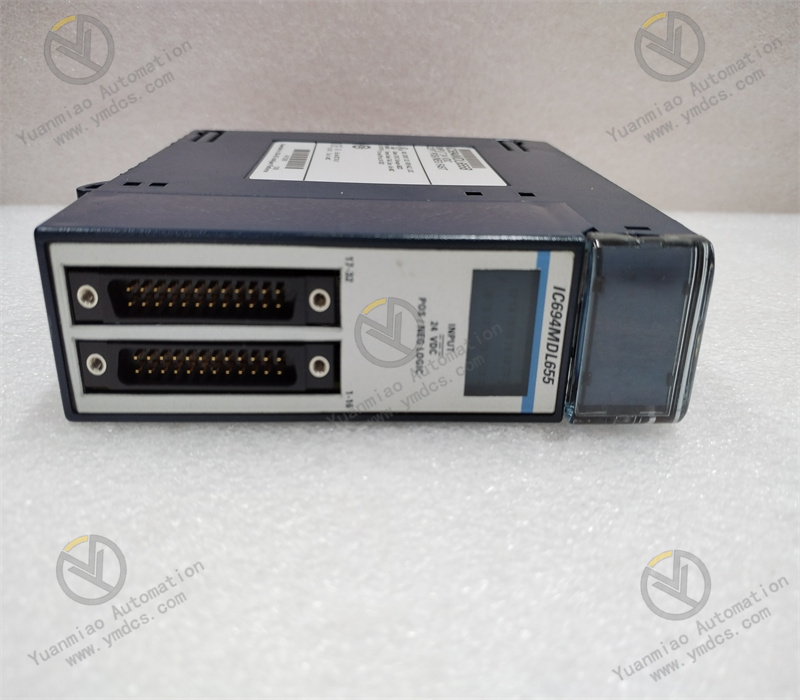
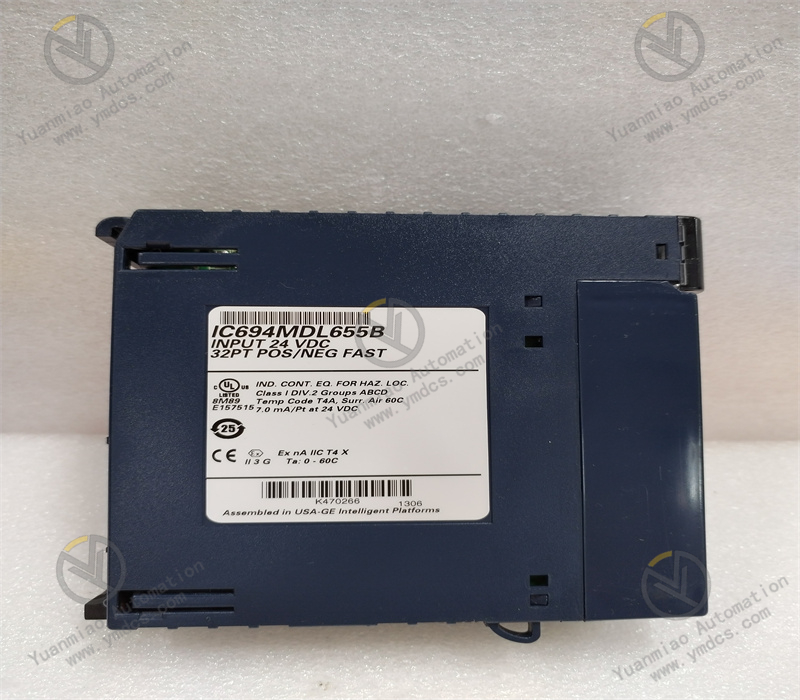
IC694MDL655 is a high‑performance 32‑channel DC digital input module of the Series 90‑30 product family developed by General Electric (GE Fanuc). It serves as a core high‑density discrete‑signal acquisition unit for the 90‑30 PLC control system, designed for centralized collection and monitoring of large‑volume DC switching signals, equipment status points, sensor switching signals, valve limit positions, contactor status and other field signals in industrial environments. The module collects various passive/active DC switching‑state, high‑low‑level and equipment on‑off signals from the field and converts them into digital logic signals recognizable by the PLC. It provides accurate and reliable discrete‑signal data support for equipment‑status monitoring, sequential logic control, equipment interlocking, fault judgment and process start‑stop control in automation systems, and acts as critical I/O hardware for high‑density point acquisition on automated production lines and complete sets of equipment.
As an original industrial‑grade high‑density digital input module manufactured by GE, the IC694MDL655 features 32 highly‑compact input channels. Its single‑module point capacity far exceeds that of ordinary 16‑point input modules, greatly saving rack slots and installation space inside control cabinets. Supporting acquisition of standard industrial 24 VDC signals, the module is built with an opto‑isolated input architecture, hardware surge protection and input filter‑debounce circuits. It effectively resolves common problems of traditional discrete‑input modules, including signal jitter, false triggering, interference‑induced false sampling, channel crosstalk and electrostatic damage. Key advantages include stable input response, powerful anti‑interference performance, excellent channel‑to‑channel consistency and outstanding long‑term operational reliability. Constructed in an industrial‑reinforced modular housing for embedded installation in standard 90‑30 racks, the module can withstand harsh operating conditions such as high cabinet temperature, dust, electromagnetic interference and frequent‑signal switching for 7×24‑hour non‑stop continuous operation. It is widely deployed in engineering projects including new‑system configuration, point‑count expansion for legacy low‑density modules, upgrade of equipment‑monitoring points and optimization of I/O‑slot resources for 90‑30 systems in automated production lines, non‑standard machinery, water‑treatment automation, HVAC systems, light‑industry equipment, auxiliary‑power control and metallurgical‑chemical industries.
2. Core Functions
High‑density discrete‑signal acquisition over 32 channels: Equipped with 32 independent DC digital‑input channels, the module realizes high‑density signal collection from a single unit. Compared with conventional 16‑point modules, it saves 50 % of rack‑slot resources and greatly improves I/O‑point capacity of the PLC rack and space‑utilization efficiency inside control cabinets. It is highly suitable for centralized monitoring of large‑quantity signal points such as equipment limit switches, photoelectric sensors, proximity switches, valve‑switch feedback, fault signals and process‑status indicators on large automated machinery.
Compatibility with standard 24 VDC industrial signals: Natively supports mainstream industrial 24 VDC switching‑input signals and works with most field‑installed switching devices, including PNP/NPN sensors, mechanical limit switches, passive relay contacts and active‑level signals, delivering broad versatility. Its signal‑recognition thresholds conform to industrial standards, enabling accurate differentiation between high‑level and low‑level states and avoiding ambiguous readings or state misjudgment caused by near‑threshold voltage conditions in conventional industrial switching loops.
Electrical‑protection design with optoelectronic isolation: Each input channel uses an independent optocoupler isolation structure that achieves complete galvanic separation between the primary field circuit and the secondary PLC control circuit. It effectively blocks ground‑loop interference, high‑voltage crosstalk and electrostatic surges, prevents damage to the PLC backplane and CPU from reverse‑flowing abnormal high voltage or current originating in the field, and significantly improves the electrical safety and noise immunity of the whole control system.
Hardware‑based filter‑debounce circuit for false‑trigger prevention: Built‑in dedicated input‑filter and signal‑debounce hardware automatically filters transient noise, short‑duration pulse glitches and mechanical‑switch bounce caused by electromagnetic interference on‑site. It stabilizes the input‑logic state and eliminates discrete‑signal flickering, state jumps and instantaneous false sampling triggered by motor startup‑shutdown cycles, variable‑frequency drives and power‑cable coupling interference, ensuring long‑term accuracy of equipment‑status signals.
Real‑time channel‑status LED indicators: Each channel is fitted with an independent LED status lamp that visually displays the on‑off state of the corresponding input channel. Field maintenance personnel can quickly verify signal health, wiring continuity and sensor functionality through visual inspection, greatly simplifying on‑site commissioning, fault troubleshooting and circuit maintenance while reducing downtime.
- Standardized non‑disruptive compatibility and convenient expansion: Fully compliant with GE Series 90‑30 hardware specifications for rack‑slot definitions, bus‑communication protocols, electrical timing signals, backplane interfaces and mounting dimensions, the module supports plug‑and‑play replacement and system expansion. Upgrading legacy low‑capacity modules or adding new I/O points requires no modification of control programs, re‑configuration or alteration of existing field‑wiring logic. Fast deployment eliminates adaptation risks and accelerates I/O‑capacity upgrades and resource optimization.
3. Technical Specifications
| Parameter Item | Technical Specification |
|---|---|
| Model No. | IC694MDL655 |
| Brand | GE (General Electric / GE Fanuc) |
| Product Series | Series 90‑30 PLC Digital I/O Module Series |
| Product Type | 32‑channel high‑density DC digital‑input module, discrete‑signal acquisition module |
| Compatible Systems | Full‑range GE Series 90‑30 PLC control systems |
| Number of Channels | 32 independent digital‑input channels (high‑density layout) |
| Input‑signal Type | 24 VDC industrial DC switching signal |
| Compatible Input Devices | PNP / NPN sensors, mechanical limit switches, passive contacts, active‑level signals |
| Isolation Method | Independent optoelectronic isolation per channel; galvanic separation between system and field circuits |
| Signal Processing | Hardware filtering, switch debouncing, interference‑pulse suppression for jitter‑free stable states |
| Status Indication | Independent LED indicator for each channel, real‑time display of input on‑off status |
| Protection Features | Input surge protection, electrostatic protection, reverse‑voltage protection against transient electrical impulses |
| Anti‑interference Performance | Adaptable to strong electromagnetic environments; suppresses coupling interference from power loops and switching noise |
| Operating Temperature | 0 ℃ ~ +60 ℃, suitable for standard industrial operating conditions |
| Storage Temperature | ‑40 ℃ ~ +85 ℃ |
| Ambient Humidity | 5 %‑95 % RH, non‑condensing, suitable for thermostatically‑controlled industrial cabinets |
| Operational Characteristics | High point density, stable response, freedom from false triggering, excellent channel consistency, strong noise immunity, long‑term reliability |
| Hardware Construction | Industrial‑reinforced plastic housing, high‑quality optocouplers, anti‑interference PCB, wear‑resistant corrosion‑proof terminal blocks |
| Mounting Method | Embedded installation inside standard Series 90‑30 racks |
| Key Advantages | 32‑point high‑density acquisition, rack‑slot saving, safe and reliable opto‑isolation, hardware debounce against false triggering, compatibility with all types of 24 VDC switching devices, visual‑status indication, plug‑and‑play non‑disruptive expansion, substantial improvement of I/O capacity and equipment‑monitoring capability for 90‑30 systems |
4. Working Principle
The IC694MDL655 digital‑input module executes a stable acquisition workflow: field‑switch‑signal reception → hardware filtering and debouncing → optoelectronic galvanic isolation → logic‑level recognition → channel‑state latching → bus data upload. After being inserted into a standard 90‑30 rack and connected to the backplane bus, the module automatically completes power‑on self‑diagnosis, channel initialization and input‑circuit calibration. Once the opto‑isolation units, signal‑processing circuits and communication links are verified operational, it enters continuous high‑speed discrete‑signal sampling mode.
24 VDC on‑off signals generated by field‑mounted sensors, limit switches and relay contacts are fed into the module’s 32 independent input channels. Incoming signals first pass through front‑end hardware filter‑debounce circuits, which remove high‑frequency interference pulses, voltage glitches and mechanical‑switch bounce coupled by variable‑frequency equipment and power cables. Invalid transient noise is discarded while stable valid logic levels are retained, eliminating root‑causes of signal jumps and flickering induced by interference.
Filtered and conditioned switching signals are sent through dedicated per‑channel optocouplers for galvanic‑isolation conversion. This process fully separates field high‑voltage interference, ground‑potential differences and transient‑voltage surges, protecting the PLC backplane, CPU and other precision modules from damage caused by abnormal electrical events on‑site. Isolated standard‑logic signals are delivered to the module’s core processing unit, which accurately identifies the on‑off state corresponding to high‑level or low‑level inputs and latches channel‑state data in real‑time.
Simultaneously, the module drives the corresponding channel‑status LEDs on or off to provide visual feedback for on‑site inspection, commissioning and maintenance. Switch‑state data for all 32 channels are packaged, error‑checked and transmitted at high speed over the backplane bus to the PLC main‑control CPU according to Series 90‑30 bus protocols. Using the reliable discrete‑state data, the main‑control system performs equipment‑status evaluation, process‑logic calculation, equipment start‑stop interlocking, fault alarming and process‑sequence switching, ensuring precise, stable and error‑free logic execution of the whole automation system.
5. System‑Architecture Compatibility
The IC694MDL655 is an original‑equipment factory standard high‑density digital‑input module for the GE Series 90‑30 PLC control system. Its electrical specifications, signal‑acquisition logic, bus‑communication protocols, backplane power‑supply timing, mechanical mounting dimensions and channel‑wiring definitions are fully aligned with the complete 90‑30 hardware ecosystem. It offers native compatibility with all 90‑30‑series CPUs, power‑supply modules, communication modules, analog I/O modules and other digital‑expansion modules, delivering 100 % seamless interoperability as a core expansion unit for high‑density‑point acquisition and large‑scale equipment‑status monitoring on 90‑30 PLC platforms.
Purpose‑built for medium‑and‑small‑scale industrial automation control systems of the Series 90‑30 platform, its 32‑point high‑density layout, 24 VDC signal compatibility, opto‑isolation protection rating and anti‑interference performance fully satisfy large‑volume discrete‑signal‑collection requirements in industrial‑automation environments. Stable bus‑data transmission, high channel‑to‑channel response consistency and drift‑free long‑term sampling make it perfectly suited for multi‑device status monitoring on production lines, multi‑point limit protection and centralized signal acquisition from large‑sensor arrays. Its standard embedded rack‑mount form‑factor fits conventional industrial‑cabinet layouts. The module can be deployed for high‑density I/O configuration on new‑build 90‑30 automation projects, point‑count expansion upgrades replacing legacy 16‑point modules, field‑monitoring‑point additions, cabinet‑slot‑resource optimization and system noise‑immunity enhancement. Retrofit‑upgrade work requires no changes to existing control logic or core field wiring. Plug‑and‑play commissioning eliminates setup overhead and adaptation risks, resolving common defects of older modules such as insufficient point capacity, excessive rack‑slot occupation, high interference susceptibility and unstable signals, and greatly improving the I/O capacity, equipment‑monitoring coverage and logic‑execution stability of 90‑30 automation systems.
6. Application Scenarios
Developed to overcome typical drawbacks of conventional digital‑input modules including low‑point density, high rack‑slot consumption, lack of galvanic isolation, signal jitter, interference‑induced false triggering and difficult on‑site troubleshooting, the IC694MDL655 targets applications requiring centralized collection of large‑scale discrete‑signal points, concentrated equipment‑status monitoring and multi‑process logic control in industrial automation, leveraging its core strengths: 32‑channel high‑density acquisition, opto‑isolated safety protection, hardware‑debounce signal stabilization, universal 24 VDC signal compatibility and visual channel‑status indicators.
The module is widely used in intelligent‑manufacturing automated production lines, non‑standard automation equipment, light‑industry and textile machinery, pharmaceutical automation lines, HVAC automation systems, water‑treatment and environmental‑protection equipment, auxiliary‑power automation, metallurgical‑equipment interlock systems, warehouse‑conveyor automation and other industrial sectors, and is fully compatible with the complete GE Series 90‑30 PLC portfolio. Primary tasks include real‑time acquisition and monitoring of large batches of discrete signals from proximity switches, photoelectric switches, limit switches, travel switches, relay feedback contacts, equipment‑fault signals, valve‑switch states, process‑start‑stop indicators and safety‑protection signals. Typical engineering‑use‑cases include high‑density I/O packages for new automation installations, replacement of low‑capacity legacy modules, system I/O‑point expansion, upgrade of equipment‑monitoring architectures and stability optimization of automation‑logic control systems. It effectively mitigates common on‑site problems such as false triggering, signal flickering, state jumps, interference‑induced false sampling and insufficient I/O points, improving equipment‑monitoring coverage, logic‑control accuracy, operational stability and fault‑response efficiency of automation systems and supporting long‑term orderly, precise, stable and non‑stop operation of automated production workflows.