Description
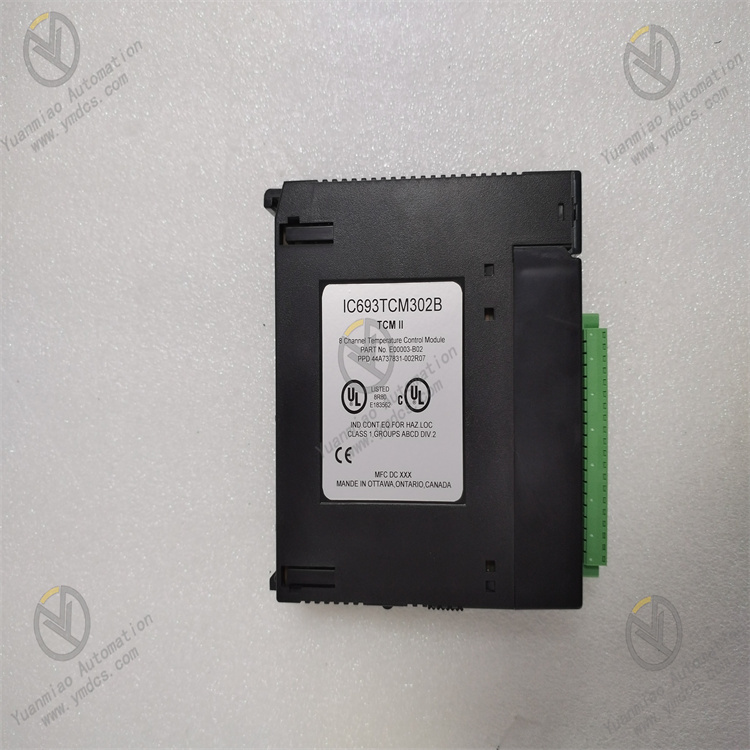
GE IC693CMM302
GE IC693CMM302 is a high-performance communication interface module, which serves as a core communication component of the Series 90-30 Programmable Logic Controller (PLC) system. Its main positioning is a "data interaction bridge" between the PLC, external devices, and upper-level systems. Through standardized communication protocols and flexible interface configurations, this module enables high-speed data transmission between the Series 90-30 PLC and Human-Machine Interfaces (HMIs), Distributed Control Systems (DCSs), remote I/O modules, third-party intelligent devices, and upper-level monitoring software. It supports the needs of centralized monitoring, distributed control, and information integration in industrial control systems.
Relying on GE's technical accumulation in the field of industrial automation, the IC693CMM302 module has core advantages such as multi-protocol compatibility, high transmission rate, strong stability, and easy configuration. It is widely used in industries with strict requirements for communication reliability and real-time performance, including power generation, petrochemicals, intelligent manufacturing, metallurgy, and building materials. It is perfectly compatible with the backplane bus of the Series 90-30 PLC series and can be directly inserted into the PLC rack for rapid integration. Meanwhile, it supports seamless connection with GE's own HMIs (e.g., QuickPanel), third-party DCSs (e.g., Siemens PCS 7), and mainstream monitoring software (e.g., Wonderware Intouch). The module adopts an enhanced electromagnetic compatibility design and industrial-grade protection structure, which can effectively resist complex working conditions such as electromagnetic interference and voltage fluctuations in industrial sites, ensuring the stability and integrity of data transmission. In addition, the module supports online configuration and fault self-diagnosis functions, significantly reducing system integration and operation and maintenance costs. It is a key component for the Series 90-30 PLC system to achieve the integration of informatization and automation.
The module is equipped with 2 independent RS485 interfaces. Each interface can be independently configured with communication protocols (such as Modbus RTU/ASCII, SRTP), communication rates (300bps~115200bps), and master/slave modes, enabling flexible deployment of "one module connecting multiple devices". For example, in an intelligent manufacturing production line, Interface 1 connects 16 intelligent frequency converters (for motor operation control) in Modbus master mode, Interface 2 connects to a GE QuickPanel HMI (for parameter setting and status display) via the SRTP protocol, and at the same time communicates with the upper-level iFIX monitoring software in Modbus slave mode. This realizes the integration of equipment control, data collection, and centralized monitoring. The dual-interface design avoids communication congestion of a single interface and improves the communication efficiency of the system.
Adopting high-performance communication chips and differential signal transmission technology, it can achieve long-distance data transmission of 1200m at a high baud rate of 115200bps, with a data transmission delay ≤ 10μs, meeting the dual needs of "real-time control + data upload" in industrial control. For example, in the control system of a petrochemical reactor, the module can collect sensor data such as reactor pressure and temperature in real time (received via Modbus slave mode) and immediately send PLC control commands to actuators (sent via Modbus master mode). The transmission delay is negligible, ensuring precise control of reaction process parameters. In addition, the module supports data frame verification (CRC verification, LRC verification) functions, which can automatically identify and discard erroneous data frames, ensuring the integrity of data transmission.
In response to the complex electromagnetic environment of industrial sites, the module adopts multiple anti-interference designs: the RS485 interface uses differential signal transmission technology to effectively suppress common-mode interference; the core circuit adopts an optoelectronic isolation design with an isolation voltage ≥ 1500V AC to avoid the impact of external voltage surges on the PLC system; it complies with the IEC 61000-4 series of anti-interference standards and can resist electromagnetic radiation and pulse interference generated by equipment such as frequency converters and motors. In high-interference scenarios such as steel mill rolling workshops, the module can still transmit data stably without packet loss or packet error, ensuring the reliable operation of the control system.
As a native module of the Series 90-30 PLC series, the IC693CMM302 can be directly inserted into the standard PLC rack and achieve plug-and-play with the CPU module through the backplane bus, without the need for additional wiring or adaptation circuits. The module supports direct configuration via GE programming software (Concept and Proficy Machine Edition). Operations such as communication protocol selection, interface parameter configuration, and data mapping can be completed through a graphical interface, without the need to write complex underlying communication code. For example, during configuration, the internal registers of the PLC can be directly mapped to the registers of external devices to realize automatic data reading and writing, which greatly reduces the difficulty and cycle of system integration.
The module has a built-in comprehensive fault diagnosis system that can real-time monitor the power supply status, backplane bus communication status, RS485 interface status (short circuit, open circuit, overcurrent), and data transmission status (timeout, verification error). When a fault is detected, the LED indicators on the module surface will give targeted alarms (e.g., flashing power indicator for undervoltage, steady-on communication indicator for interface short circuit), and at the same time, fault codes will be written into the PLC system diagnostic registers. Operation and maintenance personnel can directly read fault information through programming software or HMI to quickly locate the problem. For example, when a slave device is offline, the module will immediately report the "slave timeout" fault and the corresponding slave address. Operation and maintenance personnel can directly check the power supply and wiring of the device, reducing the fault troubleshooting time from hours to minutes.
The module supports firmware upgrade via GE's dedicated programming software. Without disassembling the module or replacing hardware, it can add support for new communication protocols (e.g., compatibility with the DF1 protocol after upgrade), optimize communication stability, or fix known issues. For example, if an existing system in a chemical plant needs to connect to Rockwell DF1 protocol devices, after firmware upgrade, the IC693CMM302 can directly communicate with such devices without replacing the communication module, significantly reducing system upgrade costs. In addition, the module supports user-defined communication data frame formats (configured via programming software) to adapt to some non-standard Modbus devices, improving the flexibility of scenario adaptation.
Installation Specifications: The module must be installed on the standard rack of the Series 90-30 PLC. Before installation, confirm that the rack power supply is normal and the grounding is good; the module snaps must be fully engaged to avoid poor contact due to vibration; the distance between modules in the rack must be ≥ 10mm to ensure good heat dissipation. Do not stack debris above the module to block heat dissipation.
Wiring Requirements: Use shielded twisted-pair cables for RS485 interface wiring. The shield layer should be grounded at one end (it is recommended to ground at the PLC side, with a grounding resistance ≤ 4Ω) to avoid loop current caused by multi-point grounding; distinguish between terminals A and B during wiring (the module terminals are marked A+ and B-), as reversed positive and negative poles will cause communication failure; tighten the terminal screws after wiring to prevent loose connections due to vibration.
Parameter Configuration: The communication rate, data bits, stop bits, and verification method of all devices in the same RS485 bus must be consistent; otherwise, communication confusion will occur. When configuring the master mode, set the slave address correctly (within the range of 1~247 to avoid address conflicts); it is recommended to configure a "retransmission mechanism" (set via programming software) for important communication data to improve the reliability of data transmission.
Anti-Interference Measures: Install the module away from strong interference sources such as high-voltage cables, frequency converters, and high-power motors, with a distance ≥ 1m; when the length of the RS485 bus exceeds 1000m, install terminal matching resistors (120Ω, matching the characteristic impedance of the bus) at both ends of the bus to suppress communication faults caused by signal reflection; install surge protectors in the control cabinet to prevent module damage caused by lightning strikes or grid voltage surges.
Power Supply Guarantee: Ensure the stable output of the PLC rack bus power supply to avoid module restart or failure caused by voltage fluctuations (e.g., below 4.5V or above 6V); if the on-site power grid is unstable, it is recommended to configure an UPS (Uninterruptible Power Supply) for the PLC system to ensure that the module can normally complete data backup and shutdown procedures in case of power failure.
Maintenance Taboos: Do not plug or unplug the module when the PLC system is running. The rack power supply must be turned off before plugging or unplugging the module; otherwise, the module or PLC CPU may be damaged. Do not touch the golden fingers on the module backplane with metal tools to prevent short circuits and module burnout. Ensure stable power supply during firmware upgrade; do not cut off the power during the upgrade process, otherwise, the module firmware may be damaged.
Environmental Requirements: The module must operate in an environment with a temperature of 0℃~60℃ and no condensation. Do not use it in environments with high temperature, high humidity, excessive dust, or corrosive gases; if the on-site environment is harsh (e.g., excessive dust in metallurgical workshops), configure dust-proof fans or sealed covers for the control cabinet and clean the dust inside the cabinet regularly.
- Fault Handling: When a communication fault occurs, first check whether the parameter configurations of all devices in the bus are consistent, then use a multimeter to measure the voltage between terminals A and B of the RS485 interface (the voltage is approximately 0.2~0.5V during normal communication); if the interface is short-circuited, immediately disconnect the wiring of the faulty device to avoid burnout of the module interface; if the module fails, replace it with a module of the same model. After replacement, re-import the original configuration parameters to ensure consistent communication parameters.
![]()