Description
1. Product Overview
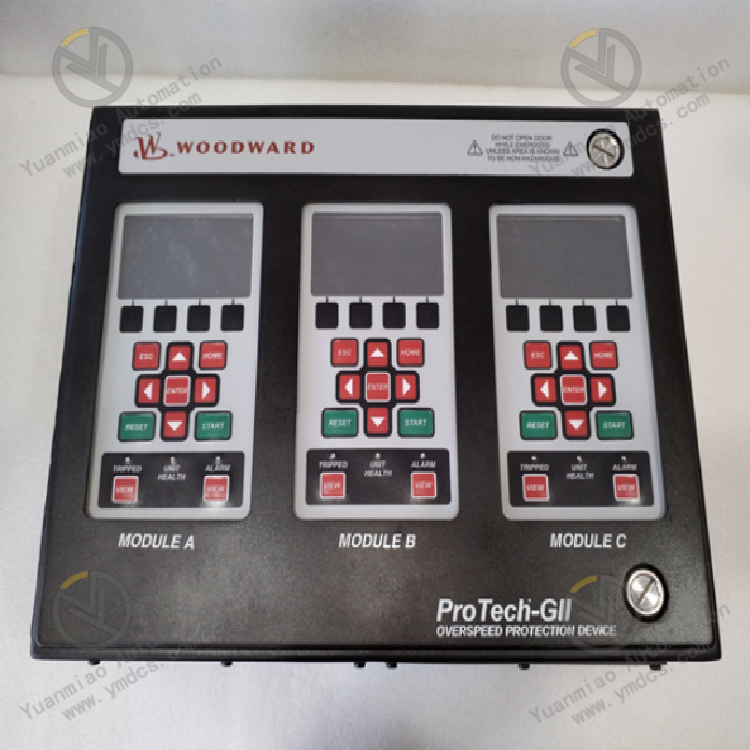
Woodward 8237‑1246 is a triple-redundant programmable overspeed protection system of Woodward ProTech‑GII series. Designed for steam turbines, gas turbines, internal combustion engines and various high-speed rotating power equipment, it serves as a safety-critical hardware device within the safety protection system of power units. Built with bulkhead mounting structure and adopting Triple Modular Redundancy (TMR) architecture alongside 2-out-of-3 voting trip logic, it fundamentally eliminates risks of false tripping and failure to act existing in conventional single-channel overspeed protection devices. Widely applied in thermal power plants, combined-cycle power stations, industrial power stations, oil & gas production power units and other critical scenarios, it is a dedicated high-end industrial control device for overspeed protection, safety interlock and operating condition monitoring of rotating machinery.
This unit integrates three independent speed sampling channels, intelligent fault judgment, voting-based protection output, event recording and communication networking functions. Each channel performs sampling, calculation and logic processing independently without mutual interference. Leveraging high-precision speed acquisition algorithm and mature voting protection mechanism, it can accurately monitor unit speed changes in real time, and rapidly trigger alarms and safety trip actions under conditions such as unit overspeed, abnormal speed, sampling fault and channel anomaly, comprehensively preventing major safety hazards including unit runaway, equipment damage and shutdown accidents. Strictly complying with safety standards for industrial power equipment, the product has passed rigorous tests including electromagnetic compatibility, temperature cycling, vibration shock and long-term energized aging. Featuring high protection grade, strong fault tolerance, excellent operational stability and online maintainability, it is an original core device for replacement of outdated overspeed protection equipment, technical renovation and upgrade of safety systems, as well as preventive maintenance of industrial power units.
2. Functional Characteristics
2.1 Triple-redundant Voting Protection to Eliminate Risks of False Tripping and Failure to Act
The core of the device adopts TMR architecture and 2-out-of-3 voting trip logic, equipped with three fully independent channels for speed acquisition, calculation and control. A fault in a single channel will not cause false tripping or protection failure, greatly lifting the safety fault tolerance level of the unit protection system. Compared with ordinary single-channel and dual-channel overspeed protection equipment, it can effectively avoid protection failures caused by sensor faults, line interference and single-channel hardware anomalies, meeting high-level safety protection specifications of power and energy industries and ensuring long-term safe and stable operation of high-speed rotating units. Meanwhile, three independent non-voting trip relay outputs are configured to satisfy diverse on-site interlock control requirements.
2.2 High-precision Full-time Speed Monitoring Adaptable to Full Operating Conditions
It supports signal access of two types of probes: passive magnetoelectric speed probes and active proximity probes. It collects unit speed parameters at high speed in real time, equipped with a 16-bit high-precision sampling processing unit and a 100kHz ultra-high sampling rate to capture subtle speed fluctuations, transient speed rise and parameter deviation at millisecond level. Customizable overspeed threshold, delay logic and alarm parameters are available, which can precisely match the speed protection demands of different power units such as steam turbines, gas turbines and internal combustion engines, realizing full-cycle speed monitoring and protection covering unit start-stop, no-load, full-load, load variation and fault transition. A standard 4‑20mA analog speed return interface is provided to output speed data to the upper monitoring system in real time.
2.3 Comprehensive Fault Self-diagnosis and Event Traceability
Equipped with full-coverage intelligent self-diagnosis mechanism, it monitors hidden risks round the clock including probe faults, signal disconnection, channel anomalies, power fluctuation, hardware faults and communication abnormalities, and can accurately locate the faulty channel, fault type and fault point. Built-in large-capacity event storage unit completely records time-series data such as speed anomalies, protection actions, switch state changes, equipment alarms and system status, supporting local viewing and remote retrieval. It provides complete data support for unit fault analysis, action tracing, parameter optimization and equipment rectification, thoroughly solving the maintenance pain point of traditional overspeed protection devices lacking records and difficult troubleshooting.
2.4 Flexible Programmable Configuration for Diverse On-site Scenarios
The device supports full-parameter programmable configuration. Users can customize overspeed protection setpoints, alarm logic, trip delay, interlock strategy, output mode and other parameters according to unit rated parameters, process requirements and safety specifications. Multiple debugging modes including conventional test, online verification and offline configuration are available. It can adapt to rotating power equipment of different capacities and types without hardware replacement, featuring strong universality and scenario adaptability to meet personalized safety protection requirements of various industrial power units.
2.5 Stable Multi-protocol Communication for Intelligent Networking Operation and Maintenance
Integrated with standardized serial communication interfaces and supporting mainstream industrial communication protocols, it can seamlessly connect with unit DCS control systems, PLC systems, upper monitoring platforms and power station automation systems. It uploads unit speed data, equipment operating status, fault alarm information and protection action records in real time, and supports remote parameter reading, status query, configuration modification and equipment reset, realizing remote monitoring, digital operation & maintenance and unattended management of the overspeed protection system to fit the intelligent and automatic management & control system of modern power stations.
2.6 Industrial-grade High-reliability Design Supporting Online Maintenance and Long-term Operation
The whole unit adopts industrial reinforced structure and power-specialized EMC design with complete isolation between strong and weak electricity and layered signal shielding, which can effectively resist harsh on-site conditions such as unit vibration, high temperature & humidity, dust corrosion, strong electromagnetic interference and voltage surges. Single-channel hot-swap replacement and maintenance are supported without shutting down the whole unit, greatly reducing the impact of equipment maintenance on unit operation. The circuit board adopts military-grade three-proof coating technology with moisture-proof, dust-proof, anti-corrosion, anti-aging, vibration and shock resistant performance. It supports 7×24-hour uninterrupted continuous operation all year round with ultra-low failure rate and long service life.
3. Technical Parameters
3.1 Core Adaptation Parameters
Product Model: 8237‑1246 Brand: Woodward Series: ProTech‑GII High-precision Overspeed Protection Series Product Type: Triple-redundant Voting-type Unit Overspeed Protection System Applicable Equipment: Steam turbines, gas turbines, internal combustion engines, high-speed rotating power machinery Applicable Systems: Power station DCS control systems, unit safety interlock systems, power equipment monitoring systems, industrial automation control systems Core Functions: TMR speed monitoring, 2-out-of-3 voting overspeed trip, fault self-diagnosis, event recording, 4‑20mA speed transmission, bus communication networking, programmable logic configuration Application Scenarios: Unit protection for thermal / combined-cycle power plants, safety protection of industrial power equipment, technical renovation & replacement of outdated overspeed systems, upgrade of unit safety systems, spare parts reserve for preventive maintenance
3.2 Sampling and Measurement Parameters
Sampling Architecture: Three-channel fully independent redundant sampling, 2-out-of-3 voting logic Compatible Probes: Passive magnetoelectric speed probe, active proximity speed probe Sampling Rate: 100kHz high-speed sampling, millisecond-level response speed Sampling Resolution: 16-bit high-precision sampling, minimal speed measurement error Input Voltage Specification: Multi-range adaptive of ±10V, ±20V, ±50V Input Impedance: 1MΩ high-impedance input for anti-signal attenuation Common-mode Rejection Ratio: >100dB, effectively suppresses on-site common-mode interference Analog Output: Standard 4‑20mA speed signal transmission output for upper-level data acquisition
3.3 Protection and Output Parameters
Protection Logic: 2-out-of-3 voting overspeed trip protection; single-channel fault will not affect system operation Output Configuration: Three independent non-voting trip relay outputs, programmable interlock outputs Protection Characteristics: Instant action on overspeed, configurable delayed protection; no failure to act or false tripping Alarm Mechanism: Speed limit alarm, channel fault alarm, graded alarm for equipment anomalies Function Configuration: Support online verification, setpoint configuration, custom logic, fault reset
3.4 Power Supply and Electrical Parameters
Low-voltage Power Supply: 24VDC industrial standard control power supply High-voltage Output Specification: Multi-specification adaptation for 115VAC / 240VAC / 125VDC Power Withstand Capability: Tolerates transient power fluctuation and surge impact; stable operation without power loss or reboot Electrical Isolation: Full-channel optoelectronic isolation and partition isolation for strong and weak electricity, qualified insulation performance Anti-interference Grade: Compliant with high-grade EMC electromagnetic compatibility standard for industrial use Communication Interface: Standard serial communication interface supporting stable data interaction
3.5 Structural and Environmental Parameters
Installation Method: Standard bulkhead mounting, adaptable to industrial equipment cabinets and unit control cabinets Display Configuration: Equipped with a 4.2-inch high-definition display for local visualization of status and parameters Overall Dimension: 330×486×153mm, compact structure and high integration Total Weight: ≤27 lbs, lightweight reinforced structure Operating Temperature: ‑20℃~+60℃ (‑4℉~+140℉), stable operation under full working conditions Storage Temperature: ‑40℃~+70℃ (‑40℉~+158℉) Operating Humidity: 5%~95%RH (non-condensing) Operation Mode: Support 7×24-hour uninterrupted continuous operation all year round
4. Hardware Configuration & Structural Advantages
4.1 Core Hardware Configuration
Woodward 8237‑1246 adopts safety-grade hardware architecture dedicated to ProTech‑GII series, fitted with three independent high-speed sampling processing chips, dedicated speed operation processor, programmable logic control unit, fault diagnosis processing unit and independent relay output module. The three channels for signal acquisition, calculation and output are completely physically isolated without mutual interference, eliminating channel coupling interference at hardware level and guaranteeing reliable operation of redundant protection logic. Built-in large-capacity solid-state memory can store protection setpoints, operation logs, fault records and action time-series data for a long time, and data is permanently retained after power failure, providing complete support for equipment maintenance and accident analysis. Onboard independent power regulation, filtering and surge protection units effectively resist on-site power fluctuation and electrical interference. Core components adopt industrial and military-grade materials and have passed strict original factory tests including aging, shock and electromagnetic compatibility. The hardware features strong fault tolerance and superior stability far exceeding conventional industrial control protection devices.
4.2 Structural Design Advantages
The device adopts standardized bulkhead reinforced structure with compact layout and high integration, suitable for standardized installation in industrial control cabinets and unit protection cabinets and saving on-site installation space. A 4.2-inch high-definition display and physical operation keys are arranged on the front panel, enabling real-time local viewing of unit speed, equipment status, fault information and protection setpoints. Local configuration, parameter modification, fault reset and function verification are supported for convenient and efficient daily maintenance. It supports hot-swap replacement of single channels without shutting down the whole unit or power-off reconstruction, greatly improving equipment maintenance efficiency and reducing unit outage losses. The fully enclosed three-proof structure effectively resists dust, moisture, corrosion, vibration and temperature variation, adapting to complex operating environments such as power stations and industrial plants. Standardized interfaces and configuration logic deliver strong compatibility, supporting in-situ replacement of old overspeed protection devices of the same series without large-scale reconstruction of on-site wiring and control systems, which substantially cuts technical renovation and maintenance costs.
5. Working Principle
The Woodward 8237‑1246 overspeed protection system implements a full closed-loop redundant protection mechanism: multi-channel speed signal acquisition → independent isolation and filtering → high-precision AD conversion → parallel calculation of three channels → 2-out-of-3 voting logic judgment → protection action output / steady-state data upload → fault self-diagnosis and tracing → system linkage control, realizing full-time safety protection for rotating units.
Through externally connected magnetoelectric or proximity speed probes, the device synchronously collects three independent analog speed signals of the unit. After independent isolation, filtering, shaping and impedance matching conditioning of each channel, the signals are sent to the 16-bit high-precision AD sampling unit for analog-to-digital conversion, converting analog signals into high-speed digital calculation data. The three calculation channels complete speed calculation, parameter comparison and limit judgment independently. Based on the core 2-out-of-3 voting safety logic, when two or more channels detect anomalies such as unit overspeed and parameter overrun, the system immediately judges a unit fault, triggers relay trip output, local audible & visual alarms and upper alarm upload. If only a single channel is abnormal, the system only outputs fault alarms without tripping, balancing equipment safety and unit operation stability.
During the whole operation process, the device continuously refreshes speed data, self-checks hardware channel status and corrects calculation parameters to adapt to complex scenarios such as unit start-stop, load variation and working condition fluctuation. Meanwhile, it uploads unit speed, equipment operating status and fault information to the upper monitoring system in real time via 4‑20mA analog and serial communication ports to realize remote monitoring and intelligent control. It records all operation and fault time-series data throughout the process to complete fault tracing and status storage, comprehensively ensuring safe, stable and compliant operation of high-speed rotating power units.
6. Application Scenarios
6.1 Overspeed Protection for Large Power Units in Power Stations
Widely applied to the core safety protection systems of steam turbines and gas turbines in thermal power units and combined-cycle power stations. As the core safety-critical equipment for unit overspeed protection, it prevents unit runaway, overspeed damage and shutdown accidents, and guarantees safe operation of power station units in full working conditions including grid connection, loading, load variation and start-stop, fully meeting safety protection specifications of power industry units and grid operation standards.
6.2 Safety Protection of Industrial High-speed Power Equipment
Applicable to high-speed rotating equipment in metallurgy, chemical, oil & gas and large manufacturing industries, such as internal combustion engines, high-speed fans, compressor units and industrial turbines. It provides high-precision and high-fault-tolerance overspeed protection and condition monitoring for various power machinery, avoiding production shutdown, equipment damage and safety accidents triggered by equipment overspeed faults and ensuring continuous and stable operation of industrial production lines.
6.3 Supporting Equipment for Unit Intelligent Operation and Maintenance System
With complete data acquisition, event recording and remote communication capabilities, it seamlessly connects with power station DCS, industrial PLC and intelligent monitoring platforms. It realizes visualized unit speed monitoring, digitized protection actions and refined fault troubleshooting, assisting the construction of unattended, digitalized and lean operation & maintenance systems for power equipment.
6.4 Core Safety Spare Parts Reserve for the Industry
As original safety-critical core equipment of Woodward ProTech‑GII series, it is an essential key maintenance spare part for power stations and industrial power enterprises. It can rapidly handle on-site problems such as aging of overspeed protection equipment, channel faults, sampling anomalies, communication failure and false tripping / failure to act of protection, eliminating major hidden dangers of unit operation without protection or operation under faults and ensuring uninterrupted safe and stable operation of power units all year round.