Description
1. Product Overview
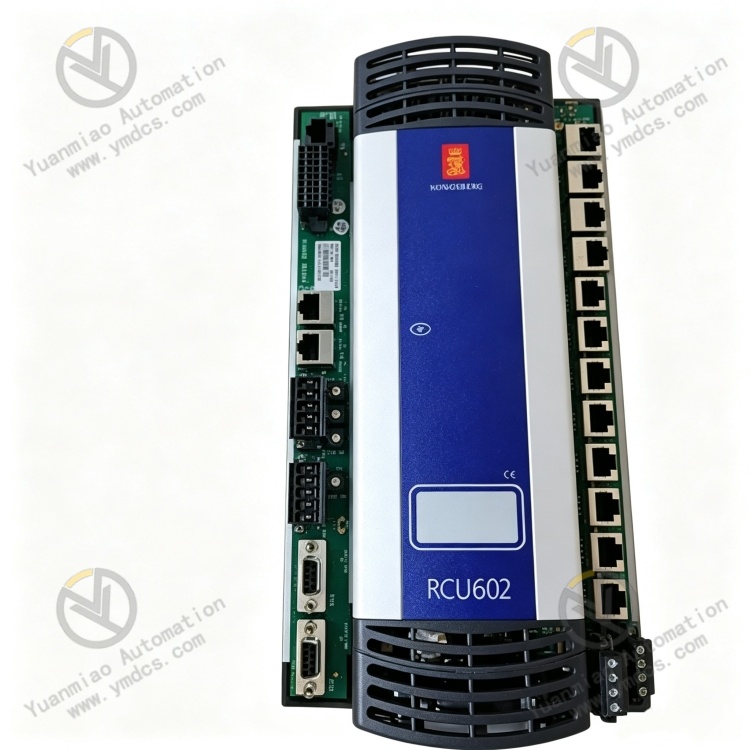
KONGSBERG RCU602 is a high‑performance Remote Controller Unit developed by KONGSBERG for marine and offshore engineering applications. It serves as the core real‑time process control computer for the K‑Chief 700 vessel automation system, K‑Safe safety control system and cJoy manoeuvring control system. Adopting an embedded Power‑PC‑architecture processor, it delivers high‑speed computation, real‑time response and high‑reliability processing capability, acting as the central computing and control hub for complete vessel engine‑room automation, dynamic positioning, condition monitoring, logic control and equipment interlock systems.
The RCU602 supports multi‑redundant topologies including standalone, dual‑unit and triple‑unit configurations, flexibly catering to low‑, medium‑ and high‑level marine safety‑control scenarios and eliminating single‑point‑failure risks in marine industrial‑control systems. Equipped with dual‑Ethernet process networks, dual redundant control networks and dual field‑bus interfaces, it features independent data computation, logical judgement, equipment regulation, fault diagnosis and data‑exchange functions. It centrally acquires operating data from engine‑room power equipment, navigation apparatus, propulsion systems and environmental‑monitoring devices, and executes automation‑control logic, interlock protection, parameter adjustment and system interlocking commands. Designed in compliance with classification‑society marine certification standards, it offers outstanding resistance to vibration, humidity‑heat, salt‑spray and electromagnetic interference. Suitable for harsh offshore conditions such as ocean‑going vessels, offshore platforms and near‑shore engineering units, it is widely deployed for automation outfit on new‑build vessels, K‑Chief system upgrades for existing ships, faulty‑controller replacement and control‑system retrofits for offshore installations. It ranks among the most versatile and reliable core control modules within marine automation.
2. Functional Features
2.1 High‑performance Real‑time Computation for Precise Vessel‑automation Control
Featuring an industrial‑grade embedded dedicated Power‑PC processor with high‑speed floating‑point arithmetic and real‑time task scheduling optimized for marine dynamic‑process control, the RCU602 responds to equipment‑control commands within millisecond intervals. It accurately implements logic computation, parameter tuning, closed‑loop control and interlock protection for engine‑room power systems, propulsion systems and auxiliary systems. It processes massive vessel‑condition data in real‑time to avoid control lag, logic disorder and data stalling, ensuring precise automatic operation of critical assets including main engines, auxiliary engines, pump sets, valves, thrusters and positioning equipment, and providing core computing support for navigation safety and stable equipment performance.
2.2 Multi‑mode Redundant Architecture for Zero‑downtime System Operation
The module natively supports three topological configurations: standalone operation, dual‑unit hot‑standby redundancy and triple‑unit fault‑tolerant redundancy. Redundancy schemes can be selected according to vessel DP (Dynamic Positioning) class and safety‑system requirements. Under dual‑/triple‑unit redundant modes, multiple RCU602 units run in parallel with real‑time data synchronisation and load balancing. If one controller suffers failure, power loss or communication breakdown, the redundant unit takes over all control tasks seamlessly without delay. Control continuity, operational‑data integrity and equipment runtime are fully preserved, satisfying stringent 7×24‑hour non‑stop‑operation requirements for high‑safety‑class ocean‑going vessels and offshore platforms, and eliminating single‑point‑failure vulnerabilities of conventional single‑controller architectures.
2.3 Dual‑redundant Multi‑bus Interfaces for Stable and Reliable Data Transmission
Incorporating multiple sets of industrial‑grade dual‑redundant communication interfaces: dual‑redundant Ethernet LAN process networks, dual dedicated RCU redundant control networks and dual redundant field‑bus interfaces. It simultaneously connects to engine‑room I/O modules, human‑machine operating terminals, supervisory host systems, navigation devices and power‑control units. Parallel multi‑link transmission with mutual backup prevents data disconnection, command loss and system offline status caused by single‑link breakage or interference. It seamlessly interoperates with the full K‑Chief automation portfolio, cJoy manoeuvring‑control systems and vessel DP dynamic‑positioning systems to realise ship‑wide data exchange, equipment interlocking and centralised supervision, delivering excellent networking compatibility and anti‑interference performance.
2.4 Full‑scope Fault Self‑diagnosis and Interlock Protection
Comprehensive hardware‑, software‑ and link‑oriented self‑diagnosis continuously monitors processor status, power‑supply conditions, bus communication, I/O links, program execution and system clock. It accurately identifies module faults, circuit anomalies, communication outages and program exceptions. Upon fault detection, it triggers alarms, latches fault status and uploads fault codes, while executing pre‑configured safety‑interlock logic to mitigate risks of equipment mal‑operation, runaway and over‑range operation. Fault data is stored for traceability to facilitate rapid troubleshooting by on‑board technicians, reducing unplanned downtime and navigation‑safety hazards.
2.5 Light‑weight Modular Design for Convenient Installation and Replacement
Built as a standard marine‑grade modular unit for DIN‑rail mounting inside KONGSBERG‑standard cabinets, it features compact dimensions, tidy wiring and simple assembly‑disassembly. Hot‑swap whole‑unit replacement is supported without rewiring or logic modification, shortening vessel‑repair and lay‑up duration during retrofits and faulty‑unit exchange. On‑board visual LED indicators display operational status, communication health, fault conditions and redundancy‑synchronisation status for quick on‑site assessment and simplified routine inspection and troubleshooting. Secure remote firmware upgrade is available, enabling functional optimisation without module disassembly.
2.6 Marine‑grade Reinforced Protection for Harsh Off‑shore Conditions
Designed to top‑tier offshore‑engineering protection standards and validated by rigorous marine tests covering vibration‑shock, salt‑spray corrosion, damp‑heat ageing, EMC and thermal cycling. It delivers excellent anti‑vibration, anti‑shock, salt‑spray‑resistance, moisture‑corrosion‑resistance and EMI‑immunity. It withstands harsh ocean‑going conditions including high humidity, heavy salt‑spray, persistent hull vibration, wide temperature fluctuation and intense on‑board electromagnetic interference. With low hardware failure rates, it enables long‑term maintenance‑free stable performance and meets year‑round non‑stop operational demands of vessels and offshore platforms.
3. Technical Parameters
3.1 Basic Specifications
Product Model: RCU602;Brand & Manufacturer: KONGSBERG (Norway);Product Series: K‑Chief 700 Vessel Automation Control System / K‑Safe Safety System / cJoy Manoeuvring System;Product Type: Marine high‑performance remote‑control computing unit;Core Positioning: Central control hub for ship automation systems, responsible for ship‑wide equipment logic computation, closed‑loop control, data exchange, interlock protection and redundancy management;Core Features: High‑speed Power‑PC computation, multi‑mode redundant architecture, dual‑bus redundant communication, full‑link self‑diagnosis, marine‑grade protection, easy modular replacement, firmware upgradability, high‑reliability continuous operation.
3.2 Core Computing and Control Parameters
Processor Architecture: Embedded dedicated real‑time Power‑PC processor;Operating Modes: Stand‑alone / Dual‑unit hot‑standby redundancy / Triple‑unit fault‑tolerant redundancy;Control Capabilities: Multi‑task real‑time scheduling, closed‑loop logic control, equipment interlock protection, adaptive parameter regulation;Diagnostic Functions: Hardware self‑test, communication‑link diagnosis, program‑execution monitoring, fault‑code storage and traceability;Upgrade Method: On‑line secure firmware upgrade, function iteration without disassembly;Response Performance: Millisecond‑level command response, free of control lag and logic disorder.
3.3 Communication‑interface Parameters
Process Network: Dual‑redundant Ethernet LAN interfaces;Control Network: Dual dedicated RCU redundant communication interfaces;Field‑bus: Dual‑redundant field‑bus interfaces;Compatible Systems: K‑Chief automation system, DP dynamic‑positioning system, cJoy manoeuvring system, marine DCS supervisory system;Connected Devices: Marine I/O modules, navigation equipment, thrusters, power units, operator terminals, host monitoring platform;Transmission Characteristics: Multi‑link hot‑backup, load balancing, automatic link‑failover, real‑time data synchronisation.
3.4 Environmental and Marine‑condition Parameters
Operating Temperature: 0 ℃ ~ +70 ℃;Storage Temperature: ‑20 ℃ ~ +85 ℃;Operating Humidity: 5%‑95% non‑condensing;Protection Class: Marine‑industrial dust‑proof, moisture‑proof and salt‑spray‑corrosion‑resistant;Vibration Resistance: withstands continuous ship‑borne vibration, hull shock and equipment start‑stop excitation;EMC Rating: Marine Class‑A EMC; immune to strong interference from marine radar, high‑frequency apparatus and power equipment;Operating Mode: Supports 7×24‑hour year‑round non‑stop marine operation;Applicable Conditions: Ocean‑going vessels, near‑shore work‑ships, offshore drilling platforms, marine power installations, automated ship engine rooms.
4. Hardware Configuration & Structural Advantages
4.1 Dedicated Power‑PC Computing Core for Superior Control Accuracy and Real‑time Performance
Equipped with a marine‑customised embedded Power‑PC processor optimised for complex dynamic marine‑control scenarios, it features fast computation, stable task execution and strong interference immunity. It concurrently processes multi‑equipment and multi‑loop control logic to satisfy high‑speed‑control requirements of marine power systems, positioning systems and auxiliary systems. It eliminates control delay, logic errors and data deviation caused by variable on‑board conditions and frequent equipment interlocking, ensuring coordinated and precise operation of ship‑wide automation assets.
4.2 Multi‑level Redundant‑architecture Eliminates Navigation‑control Risks
Three‑tier redundancy topologies satisfy varying vessel safety‑class and DP‑class requirements. Within redundant configurations, RCU602 units mutually monitor status and synchronise data; fault‑triggered switch‑over occurs without control interruption or data loss. This hardware‑level solution removes single‑point‑failure hazards, enhances navigation safety and equipment stability, and complies with high‑grade marine‑safety regulations.
4.3 Dual‑redundant Multi‑bus Networking Delivers High System Compatibility and Stability
Independent redundant communication links perform dedicated functions with mutual backup: the process network handles host‑side data upload, the control network executes equipment‑interlock logic, and the field‑bus acquires I/O data. Real‑time, stable and non‑intermittent data transmission is guaranteed. Native compatibility with the full portfolio of KONGSBERG marine‑automation hardware enables system networking without extra adaptor modules, supporting retrofitting of both new and legacy vessels with outstanding versatility.
4.4 Full‑scope Intelligent Self‑diagnosis for Safe and Controllable Operation & Maintenance
Real‑time multi‑dimensional monitoring of hardware, software, communication links and programs enables early detection of potential faults. Alarms and safety interlocks are activated pro‑actively to prevent equipment runaway and mis‑operation. Fault records are stored for root‑cause analysis, accelerating troubleshooting, minimising ship lay‑up costs and mitigating navigation‑safety risks.
4.5 Standardised Modular Architecture Enables Efficient Retrofit and Replacement
Standard marine‑grade modular hardware is fully compatible with original KONGSBERG cabinets and systems. Hot‑swap non‑destructive replacement is available for system upgrades and faulty‑module exchange without cabinet or cabling modification, reducing work complexity and downtime. Visual status indicators simplify inspection workflows, and on‑line firmware upgrade supports continuous logic optimisation for vessel intelligent‑retrofit projects.
4.6 Marine‑grade Reinforced Hardware for Long‑term Durability under Harsh Off‑shore Conditions
Anti‑corrosion and moisture‑proof reinforced construction is adopted. Circuit boards are treated against salt‑spray corrosion, damp‑heat ageing and static electricity. Flame‑retardant, dust‑proof and impact‑resistant housings have passed stringent classification‑society certification. Stable long‑term operation is achieved within high‑salt‑spray, high‑humidity, high‑vibration and high‑interference offshore environments. No hardware ageing‑induced failure, parameter drift or functional degradation occurs. Long maintenance‑free cycles meet demands of extended ocean‑going voyages.
5. Application Scenarios
5.1 Vessel K‑Chief Engine‑room Automation System
Widely deployed within K‑Chief 700 engine‑room automation systems for merchant vessels, work‑ships and research vessels. Acting as the core control unit, it realises automatic monitoring, logic control and interlock protection for main engines, auxiliary engines, pump sets, valves and engine‑room environments to secure reliable engine‑room equipment performance.
5.2 Vessel Dynamic Positioning (DP) System
Applied in DP systems for offshore supply vessels, drilling vessels and construction work‑ships. High‑reliability redundant‑control logic precisely regulates thrusters, navigation apparatus and positioning parameters to ensure accurate station‑keeping during offshore operations and satisfy marine high‑precision‑positioning requirements.
5.3 cJoy Vessel Manoeuvring‑control System
Serves as the core controller for the cJoy joystick manoeuvring system. It receives manoeuvre commands and coordinates propulsion, steering and navigation apparatus to realise precise manual vessel control, condition switching and equipment interlocking for diverse ship‑handling scenarios.
5.4 Offshore‑platform Automation‑control System
Deployed within monitoring and control systems of offshore drilling platforms, wind‑farm‑service platforms and marine‑engineering platforms. Adapted to harsh high‑salt‑spray and high‑vibration offshore environments, it delivers centralised supervision of platform power assets, safety installations and auxiliary equipment.
6. Product Advantages
Marine‑specific High‑performance Computation with Precise Real‑time Control: Dedicated Power‑PC core delivers millisecond‑level real‑time response and powerful multi‑task parallel processing, eliminating marine‑control lag and logic disorder to guarantee high‑precision automation‑system performance.
Three‑tier Redundant Topology with Zero Single‑point‑failure Risk: Supports standalone / dual‑unit / triple‑unit redundant configurations. Seamless zero‑latency fault switch‑over preserves continuous control tasks and satisfies high‑grade marine‑safety and DP‑classification specifications.
Multi‑bus Redundant Communication for Uninterrupted Transmission: Dual Ethernet, dual control bus and dual field‑bus provide multi‑layer backup with strong interference‑resistance and link‑failure protection, securing reliable ship‑wide data exchange and equipment interlocking.
Full‑link Self‑diagnosis for Efficient and Safe O&M: Multi‑dimensional hardware‑and‑software fault monitoring, accurate alarming and data traceability accelerate troubleshooting and reduce vessel‑maintenance duration and navigation risks.
Marine‑grade Ruggedisation for Long‑term Maintenance‑free Operation: Salt‑spray‑resistant, moisture‑corrosion‑resistant, vibration‑resistant and EMI‑immune. It operates stably 7×24 hours under harsh ocean‑going and offshore‑platform conditions with low hardware‑failure rates and minimum maintenance expenditure.
- High Versatility for Low‑cost Retrofit and Replacement: Fully compatible with KONGSBERG marine‑automation product lines. Standardised modular design enables fast non‑destructive replacement, suitable for new‑build and vessel‑retrofit projects with high cost‑performance and implementation efficiency.