Description
SCHNEIDER 140CPU67060
1. Basic Information
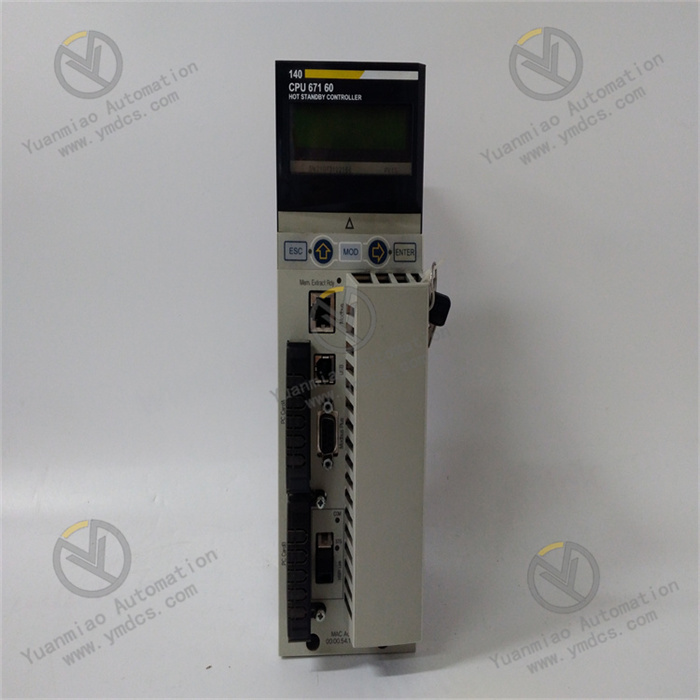
SCHNEIDER 140CPU67060 is a high-performance PLC CPU module designed for industrial automation and process control systems. Serving as the main control unit for complex control tasks, it integrates powerful logic operation, data processing, multi-protocol communication and redundant control functions, and acts as the core control component of Modicon Quantum series PLC systems.
As the core brain of the entire automation system, it receives various signals collected by on-site I/O modules, executes preset control programs, and fulfills tasks including complex logic calculation, process parameter adjustment and equipment linkage control. Meanwhile, it realizes seamless data interaction with host computers, fieldbus devices and remote terminals via abundant communication interfaces. It supports dual-unit hot standby redundancy to ensure continuous and stable system operation, meeting complex control requirements of various medium and large-scale industrial automation scenarios.
2. Technical Specifications
2.1 Core Electrical & Control Specifications
- Processor Performance: Equipped with 32-bit RISC processor with main frequency up to 100MHz (266MHz for partial firmware versions) and built-in math coprocessor, it greatly improves efficiency of arithmetic operation and complex logic processing, capable of efficiently executing large-scale control programs.
Memory Capacity: Built-in RAM: 2972kB; user logic storage: 4MB; internal data storage: 512kB. Storage can be expanded via PCMCIA card, with maximum extended program storage up to 7168kB and file storage up to 8MB, satisfying storage and operation demands of complex control programs.
- I/O Expansion Capacity: Supports expansion of Modicon Quantum series I/O modules including digital and analog modules. The maximum I/O points reach 8000 inputs and 8000 outputs under distributed deployment, and single unit supports up to 512 independent I/O points, adapting to automation systems of different scales.
Communication Parameters: Integrated with rich communication interfaces: 3 local Ethernet ports supporting TCP/IP protocol, 2 remote Ethernet ports expandable via backplane with multi-mode fiber connection up to 4km transmission distance; 1 RS232/485 Modbus/ASCII serial port and 1 USB 2.0 port. It supports fieldbus protocols such as Modbus Plus, Profibus DP and CANopen (partial models). With 3 local communication module slots, it enables flexible communication expansion for multi-device coordination and remote monitoring.
- Redundancy Design: Supports dual-unit hot standby function with paired same-model CPUs. Real-time synchronization is realized for application program memory, system registers, function blocks and other data, and automatic exchange of communication port addresses is available. The switching time is less than 100ms (usually within 30ms) to ensure uninterrupted system operation.
- Programming Environment: Specially developed for Unity Pro software, it complies with IEC 61131-3 standard programming languages including LD, FBD, ST, SFC and IL, facilitating programming, commissioning and maintenance for engineers.
Environmental Adaptability: Operating temperature: -25℃ ~ 70℃; storage temperature: -40℃ ~ 70℃; protection grade: IP20.
2.2 Physical & Structural Specifications
- Mounting Mode: Supports standard DIN rail mounting and Modicon Quantum series cabinet slot mounting in line with industrial installation standards. It is easy to install, can be quickly assembled with same-series modules, and convenient for later maintenance, expansion and replacement.
- Overall Dimensions: Adopts standardized industrial compact packaging, conforming to unified series standards to save cabinet space and facilitate dense layout of multiple modules.
Weight: Lightweight industrial design with moderate weight, balancing sturdiness and easy installation. It causes no extra load on cabinets or brackets and adapts to industrial vibrating working conditions.
- Enclosure & Connection: Industrial metal shell provides excellent dustproof, anti-vibration and anti-electromagnetic interference performance to resist harsh on-site impacts. It is equipped with dedicated bus interfaces, power terminals and communication interfaces with reasonable layout for convenient and firm wiring, ensuring stable and reliable signal transmission.
Product Features: Modular design allows direct insertion into Modicon Quantum backplane bus for communication with other modules without extra wiring. Built-in lithium-ion battery keeps internal memory data intact after power failure. Integrated fault diagnosis indicators enable quick on-site operation status judgment.
2.3 Core Functions & Compatibility Specifications
- Core Functions: It realizes complex logic operation, process control, data acquisition & processing, equipment linkage control, multi-protocol communication, dual hot standby redundancy, fault diagnosis & alarm, program backup & recovery and other functions. It receives real-time on-site I/O signals, runs control programs, adjusts production parameters to achieve closed-loop automatic production control, and supports remote monitoring and maintenance.
Integration Performance: Highly integrated design embeds CPU unit, memory unit, communication unit, redundant control unit and data protection unit. It can be directly used as system core without additional main control components, simplifying system design and wiring and reducing construction and maintenance costs. It supports online program editing, debugging and downloading for on-site logic optimization.
- Compatibility: Fully matched with Modicon Quantum series, it works seamlessly with its I/O modules, communication modules and expansion modules for coordinated system operation. It is compatible with Schneider Unity Pro software, upper computers (SCADA, DCS), fieldbus equipment and remote terminals to realize multi-protocol data interaction, and can cooperate with third-party automation devices to enhance system integration flexibility and scalability.
- Reliability & Practicality: Industrial anti-interference design delivers outstanding EMC and vibration resistance with low long-term failure rate and low maintenance cost. Perfect redundancy and data protection mechanisms avoid data loss and production shutdown caused by equipment faults or power cuts. Abundant communication ports and programming functions fit complex industrial control scenarios and improve system automation and operation efficiency.
3. Working Principle
- System Initialization & Parameter ConfigurationAfter power-on, the CPU automatically completes self-inspection and system initialization, and detects operating status of internal units, backplane bus and connected I/O & communication modules. It enters ready state after confirming normal operation. Engineers download control programs compiled with IEC 61131-3 standard languages into the CPU via Unity Pro, and configure communication parameters, I/O addresses, redundancy modes and protection thresholds to finish system matching.
- Signal Collection & Command ReceptionConnected with I/O modules via backplane bus, the CPU collects real-time analog and digital signals from on-site sensors and actuators such as temperature, pressure, flow rate and equipment status. These signals are filtered and calibrated into recognizable digital data. Meanwhile, it receives control commands including parameter adjustment and equipment start-stop instructions issued by upper computers and remote terminals through communication interfaces.
- Logic Operation & Control OutputAccording to preset control programs, the CPU conducts complex logic calculation, arithmetic operation and process analysis on collected field signals and received commands, generates control signals and sends them to I/O modules via backplane bus to drive on-site actuators such as valves, motors and indicators for precise production and equipment control. Built-in algorithms realize closed-loop adjustment of process parameters to guarantee stable production.
- Redundant Control & Fault HandlingUnder dual hot standby configuration, primary and standby CPUs synchronize programs, data and operating status in real time. Once the primary CPU fails, the standby one will take over system control automatically within 100ms to avoid production interruption. During operation, the CPU monitors its own status, bus communication and I/O module status in real time. It triggers fault alarms, lights corresponding indicators and uploads fault information to upper systems for rapid troubleshooting. The built-in lithium battery preserves memory data to prevent program and data loss after power failure.
- Data Interaction & Remote MaintenanceVia Ethernet, serial ports and fieldbus interfaces, the CPU uploads on-site data, equipment operating status and fault information to upper computers, and receives remote control commands and parameter settings. Engineers can remotely monitor system status, modify parameters and update programs through upper computers to complete debugging and maintenance without on-site presence, greatly improving work efficiency.
4. Application Scenarios
4.1 Petrochemical Industry
It is applied to process control and equipment monitoring systems in crude oil exploitation, refining, transportation and other links. It achieves precise adjustment of temperature, pressure, flow rate and other process parameters, equipment linkage control and fault early warning, adapting to high-temperature, high-pressure and dusty harsh working conditions to ensure safe and stable production.
4.2 Electric Power Industry
It is used in automation systems of power plants and substations to realize control and monitoring of generator sets and power distribution equipment, including power dispatch, load regulation and fault diagnosis. Supported by dual hot standby redundancy, it ensures continuous and reliable power supply and improves the automation and intelligence level of power systems.
4.3 Automobile Manufacturing Industry
It fits automatic production lines for stamping, welding, assembly, painting and other processes. It realizes equipment linkage control, production beat adjustment, product quality detection and data collection, raising production line automation degree and efficiency and stabilizing product quality.
4.4 Water Treatment Industry
It is adopted in running water treatment and sewage treatment process control to precisely regulate water quality, water flow, dosing dosage and other parameters, monitor equipment status and send fault warnings, ensuring qualified treatment effect and improving treatment efficiency and water quality stability.
4.5 General Medium & Large Industrial Automation