Description
1. Overview
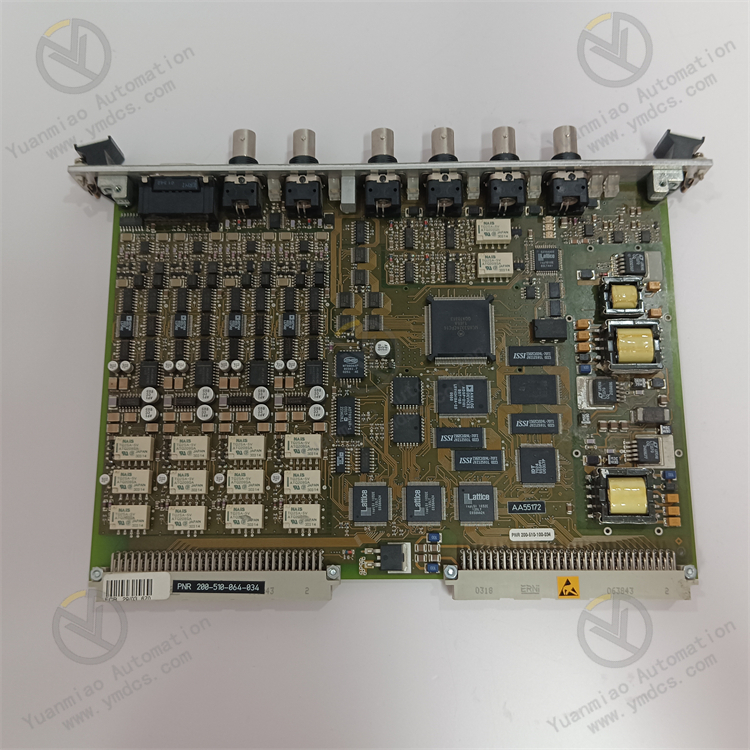
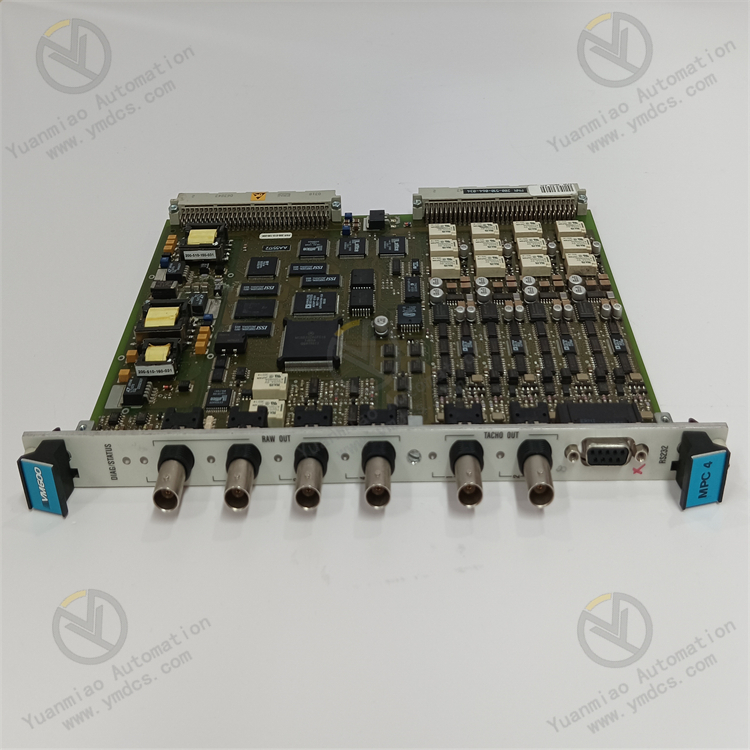
Vibro‑Meter VM600 MPC4 (Part Number: 200‑510‑100‑034) is an industrial high-precision dedicated module for machinery protection and condition monitoring developed by Switzerland-based Vibro‑Meter (now part of MEGGITT Group). As the core monitoring unit of the VM600 Mk2 series, it strictly complies with the international machinery protection standard API 670. Custom-designed for key parameter monitoring and interlock protection of rotating and reciprocating machinery, it is widely deployed on critical rotating assets including steam turbines, compressors, fans and pumps across thermal/hydro/renewable power plants, oil & gas chemical industries, metallurgy and rail transit. It serves as the fundamental hardware for predictive maintenance, fault early warning and safety interlock shutdown in industrial facilities.
2. Technical Features
2.1 Integrated Multi-Channel Monitoring Compatible with All Common Machinery Transducers
2.2 High-Precision DSP Signal Processing Ensures Accurate and Reliable Measurement
2.3 Hierarchical Intelligent Protection Interlock Delivers Superior Operational Safety
2.4 Multi-Mode Signal Output Offers Strong System Expandability
2.5 Comprehensive Self-Diagnosis Provides Exceptional Operational Stability
2.6 Rugged Industrial Construction Accommodates Wide Environmental Envelope
3. Specification Parameters
3.1 Basic Parameters
- Model: VM600 MPC4 200‑510‑100‑034
- Product Series: Vibro‑Meter VM600 Mk2 Machinery Protection Monitoring Module Series
- Manufacturer: Vibro‑Meter (MEGGITT Group, Switzerland)
- Device Type: Multi-channel vibration/displacement/speed monitoring and protection interlock module
- Compliance Standard: API 670 International Machinery Protection Standard
- Compatible Systems: VM600 Mk2 original rack monitoring system, industrial DCS/PLC automation systems, online equipment condition monitoring systems
- Application Scenarios: Condition monitoring, fault early warning, safety interlock protection and legacy system retrofit for critical rotating machinery including steam turbines, compressors, fans and pumps
- Core Functions: Multi-channel dynamic signal acquisition, high-precision DSP signal analysis, intelligent mechanical fault diagnosis, hierarchical threshold alarming, relay interlock output, analog transmission output, bus communication, hardware self-diagnosis alarms
- Operating Modes: 24-hour uninterrupted monitoring, real-time data computation, fault-adaptive tolerance, remote online configuration and supervision
- Compatibility: Fully compatible with VM600 original racks and auxiliary modules; supports in-situ replacement of legacy boards and mainstream industrial control platforms
3.2 Signal Acquisition & Processing Parameters
- Dynamic Input Channels: 4 independent dynamic signal inputs
- Phase Input Channels: 2 phase reference signal inputs
- Frequency Response: 0.1 Hz ~ 10 kHz, covering low-frequency displacement through high-frequency vibration measurement
- Sampling Accuracy: 16-bit ADC, maximum sampling rate 100 kHz
- Dynamic Range: ≥110 dB for excellent signal-to-noise ratio
- Linearity Error: < ±1% for consistent reliable measurements
- Filtering: Onboard programmable wide/narrow band filters with adaptive noise reduction
- Channel Crosstalk Attenuation: Typical 80 dB with negligible inter-channel interference
3.3 Output & Interlock Parameters
- Analog Output: 4 programmable channels configurable for 4~20 mA or 0~10 V
- Relay Output: 4 independent alert/status relays + 1 common system fault relay
- Threshold Configuration: Independent Normal/Alert/Danger programmable thresholds per channel
- Interlock Logic: Configurable single-point alarming, multi-point linkage, fault latching and delayed reset
3.4 Communication Parameters
- Supported Protocols: Modbus RTU + proprietary VM600 system bus protocol
- Communication Functions: Real-time data upload, remote parameter configuration, fault log storage/retrieval, equipment status feedback
- Transmission Performance: Low latency, stable lossless transmission supporting long-term continuous data exchange and fault traceability
3.5 Electrical Power Parameters
- Power Supply: Backplane bus-fed power via VM600 rack system
- Rated Input: Standard industrial DC 24 V
- Operating Current: <100 mA with low heat generation
- Electrical Protection: Multi-stage hardware defense against overvoltage, overcurrent, short circuit, surge and ESD
- Noise Immunity: Integrated power filtering suppresses line ripple and transient voltage spikes
3.6 Environmental Parameters
- Operating Temperature: -30℃ ~ +70℃, tolerating heat buildup inside sealed cabinets and abrupt temperature swings
- Storage Temperature: -40℃ ~ +85℃ for shipping and long-term idle storage
- Operating Humidity: 5%–95% RH (non-condensing), resistant to condensation-induced short circuits
- EMC Compliance: High-level industrial EMC certified against harmonics, RF radiation and power pulse interference
- Mechanical Performance: Tolerates industrial vibration and shock; seismic, dust-proof and anti-aging with no permanent performance degradation
- Ingress Protection: IP20 (indoor cabinet installation only)
3.7 Mechanical & Mounting Parameters
- Construction: High-density multi-layer industrial PCB in standardized rack-mount modular format
- Compatible Racks: VM600 Mk2 ABE04x standard racks and slim ABE056 racks
- Mounting: Embedded DIN rail installation inside cabinet racks with precise locating for easy secure fitting
- Installation Suitability: Supports dense cabinet mounting with no compromise on thermal dissipation, signal integrity or measurement stability
4. Working Principle
After power-on, VM600 MPC4 200‑510‑100‑034 executes comprehensive hardware self-test, channel initialization, power loop verification, pulse port calibration and communication link matching. Once diagnostics pass, continuous 24-hour monitoring commences with the module acting as the primary acquisition and interlock hub of the machinery protection system.
During operation, raw vibration, displacement, speed and phase signals from field transducers are sampled via the 4 dynamic and 2 phase input channels. The onboard high-speed DSP and 16-bit high-speed ADC perform signal filtering, noise reduction, amplification and closed-loop calculation to quantify key metrics including vibration amplitude, frequency, displacement offset and speed fluctuation. Embedded fault diagnosis algorithms continuously compare measured values against user-defined Alert and Danger thresholds to identify abnormal operation and incipient mechanical degradation.
When measurements fall within the normal range, real-time data is steadily transmitted with relays and analog outputs held in steady state. When Alert thresholds are exceeded, warning signals are triggered locally and logged. When Danger thresholds are breached or transducer faults, link failure or module hardware errors are detected, relay interlock is activated immediately to initiate shutdown protection. Fault codes and runtime history are saved and uploaded to upper control systems for rapid identification and resolution.
5. Application Scenarios
5.1 Protection Monitoring for Major Power Plant Equipment
5.2 Condition Management for Oil, Gas & Chemical Process Equipment
5.3 Monitoring of Heavy-Duty Rotating Equipment in Metallurgy & Mining
5.4 Retrofit Replacement for Legacy VM600 Monitoring Systems