Description
1. Product Overview
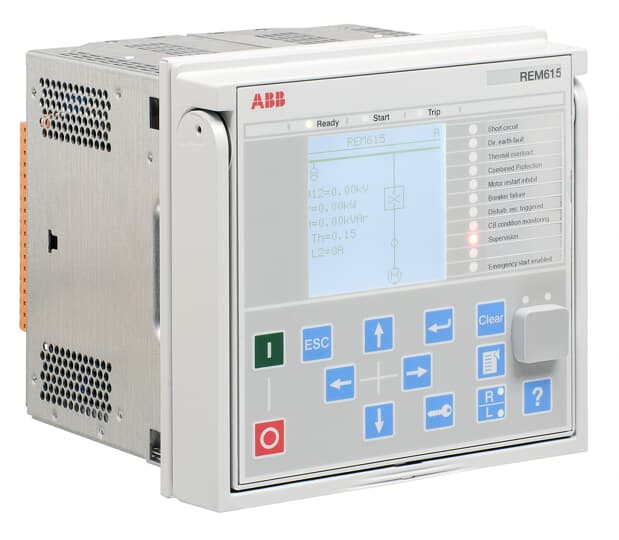
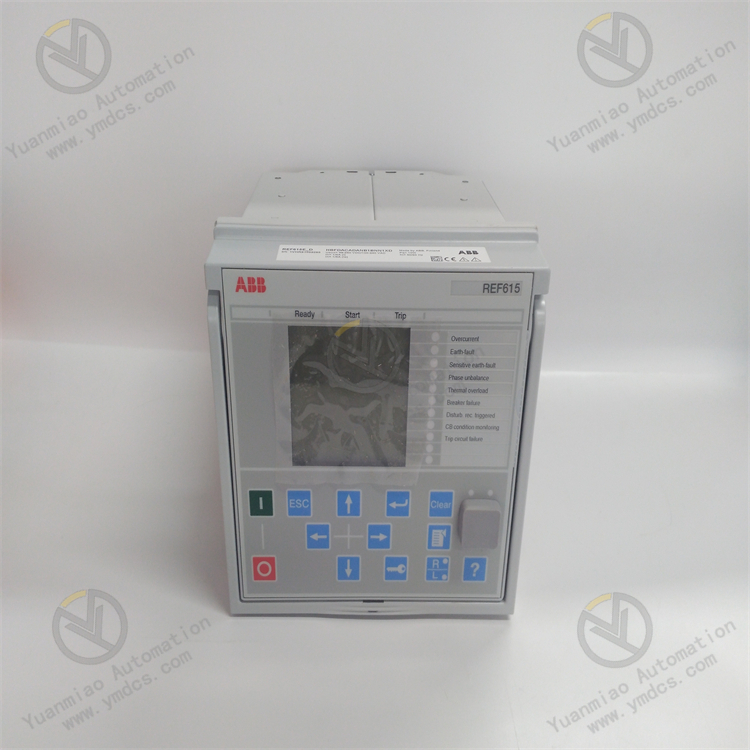
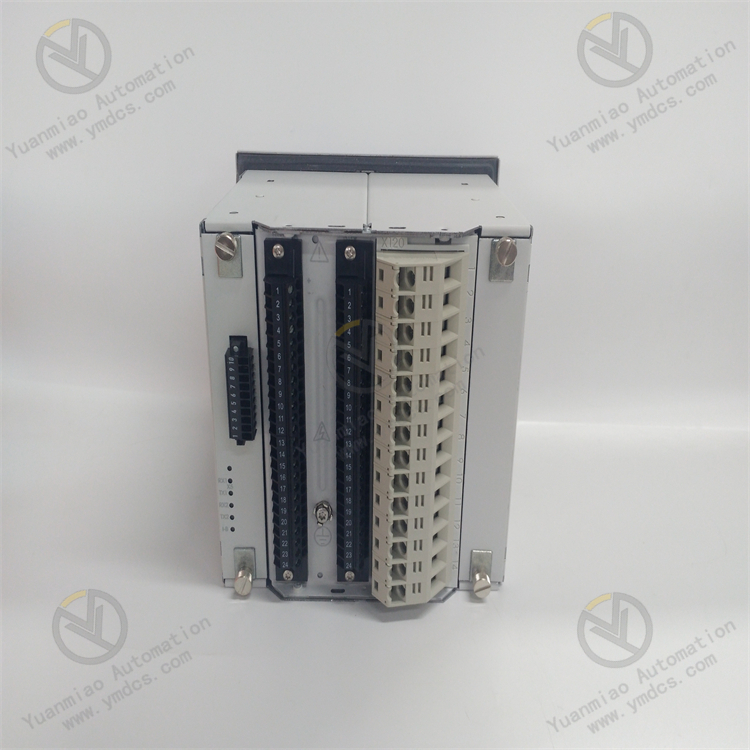
ABB REF615E-D (Order Code: HBFDACADANB1BNN1XD) is a new-generation high-performance intelligent feeder protection and control IED within the ABB Relion® 615 series. It is specially developed for medium and low-voltage feeder systems in industrial plants, municipal power distribution networks and power substations. Serving as an integrated core device for distribution automation, it combines relay protection, electrical measurement, equipment control, condition monitoring, fault recording and communication operation functions.
This unit is a customized configuration version of REF615E-D. Built on ABB’s mature power automation architecture, it adapts to complex distribution operating conditions including radial networks, ring networks, mesh networks and systems connected with distributed photovoltaic power sources. It can fully replace conventional discrete protection, measurement and communication equipment to realize integrated intelligent management of feeder circuits.
The device strictly complies with international IEC power standards as well as technical specifications for distribution equipment issued by State Grid and China Southern Power Grid. It adopts modular pluggable hardware design integrated with high-precision sampling chips, dedicated protection processors and multi-protocol communication units, featuring high calculation accuracy, fast protection operation, strong anti-interference performance and outstanding operational stability.
The dedicated configuration HBFDACADANB1BNN1XD meets mainstream operating conditions of general industrial and municipal power distribution. It covers full-range feeder protection logic, precise electrical parameter measurement, local and remote control as well as fault event recording. Supporting mainstream industrial communication protocols including IEC61850, IEC 60870-5-103 and Modbus, it is widely deployed for protection and control of 10 kV / 35 kV medium-voltage feeders, sectioning switches, tie switches and auxiliary power circuits. It is key equipment for intelligent transformation of distribution networks, new substation construction and upgrade of legacy power distribution systems.
2. Technical Features
2.1 Integrated Comprehensive Functions for Full-Scenario Feeder Management
The device integrates complete core feeder functions, including comprehensive relay protection logic such as overcurrent, overvoltage, undervoltage, zero-sequence, earth fault, overload and negative-sequence protection. It also provides high-precision measurement of three-phase voltage, current, power, energy, frequency and harmonics. It supports local/remote circuit breaker control, circuit condition monitoring, live circuit monitoring and abnormal alarm. Built-in fault recording, Sequence of Events (SOE) and operation trend statistics enable one-stop management covering feeder protection, measurement & control, maintenance and fault tracing. No additional secondary equipment is required, significantly simplifying the secondary circuit architecture.
2.2 High-Precision Protection Calculation with Millisecond-Level Fault Response
Equipped with a dedicated high-speed power processor and optimized protection algorithms, the unit achieves top-tier industry sampling accuracy for current and voltage. Protection operates rapidly with precise time delays to avoid unwanted tripping and failure to trip. It can accurately identify transient faults, permanent faults, intermittent earth faults and load fluctuation disturbances, effectively resolving common issues in distribution networks such as false protection triggering, cascading tripping and undetected faults. Precise setting of time thresholds and magnitude thresholds perfectly satisfies coordination requirements of graded protection in multi-level distribution networks, enabling rapid fault isolation and minimizing affected power supply areas.
2.3 Multi-Protocol Communication Compatibility Adaptable to Intelligent Distribution Architecture
Equipped with multi-channel communication interfaces natively, it fully supports mainstream power communication protocols including IEC61850 Ed2, IEC60870-5-103, Modbus and DNP3, and supports fiber, Ethernet and serial communication modes. It can seamlessly connect to substation integrated automation systems, distribution automation platforms, upper monitoring systems and power dispatching platforms to realize remote parameter setting, remote circuit breaker control, telemetry data uploading, telesignal status collection and real-time fault information push, meeting networking and operation requirements of smart substations and digital distribution networks.
2.4 Modular Pluggable Hardware for Convenient Maintenance and Strong Compatibility
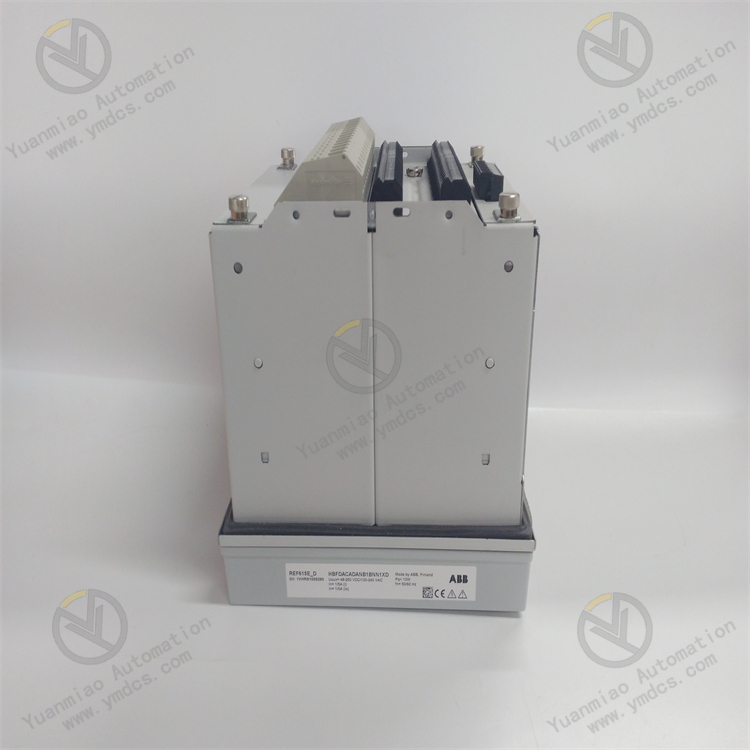
Adopting ABB’s classic modular pluggable structure, power supply modules, sampling modules, I/O modules and communication modules are arranged in independent partitions. Individual modules can be replaced without dismounting the whole unit or modifying secondary wiring. The customized I/O configuration of HBFDACADANB1BNN1XD matches signal point requirements of typical feeder circuits. The hardware boasts excellent universality and interchangeability, compatible with both new and legacy distribution architectures. It supports in-situ replacement of old devices, system expansion and function upgrade, greatly reducing maintenance and technical transformation costs.
2.5 Powerful Self-Diagnosis and Fault Traceability
The device incorporates comprehensive hardware and program self-diagnosis mechanisms to continuously monitor sampling abnormalities, circuit failures, communication interruptions, power supply anomalies, program errors and I/O port faults. It accurately locates fault points and triggers active alarms. Meanwhile, long-term storage of fault recording data, SOE logs, protection operation messages and equipment operating parameters enables full reconstruction of fault processes. It provides complete data support for fault analysis, power grid optimization, hidden danger investigation and compliance tracing, satisfying standardized maintenance requirements of the power industry.
2.6 Industrial-Grade Robust Protection for Harsh Distribution Sites
The unit is designed and manufactured in accordance with top power industry standards. It has passed rigorous EMC tests, temperature cycling aging, vibration shock and humidity cycling tests, delivering strong immunity to electromagnetic interference, voltage fluctuation, temperature variation, humidity, dust and vibration. Free of vulnerable mechanical components, it features low power consumption and low temperature rise with stable performance. It can operate continuously 24/7 in complex environments such as substations, industrial power rooms and outdoor switch stations to meet long-term uninterrupted operation demands of industrial, municipal and power systems.
2.7 Visual Human-Machine Interface for Efficient Commissioning and Maintenance
Fitted with a high-resolution Local Human-Machine Interface (LHMI) LCD, it supports Chinese menu display, local parameter setting, real-time operating status viewing, on-site fault query and circuit commissioning verification. It also supports remote access via Web Human-Machine Interface (WHMI) for online parameter modification, real-time data viewing, waveform file export and protection logic verification. Professional commissioning tools are not mandatory, streamlining equipment commissioning, routine inspection and troubleshooting procedures and improving distribution maintenance efficiency.
3. Technical Specifications
3.1 Basic Specifications
Model: REF615E-D Full Order Code: HBFDACADANB1BNN1XD Brand: ABB Series: Relion® 615 Series Device Type: Medium-Voltage Feeder Intelligent Protection and Control IED Core Functions: Medium-voltage feeder protection, electrical parameter measurement, circuit breaker control, condition monitoring, fault recording, data communication upload, system operation maintenance Applicable Scenarios: 10 kV / 35 kV distribution feeders, sectioning / tie switches, auxiliary power circuits, municipal distribution networks, distribution systems with distributed generation access Hardware Features: Modular pluggable design, highly integrated monolithic structure, industrial anti-interference hardware Core Advantages: Accurate protection, fast response, multi-protocol communication, convenient maintenance, wide adaptability, stable operation
3.2 Protection Function Specifications
Main Protection Functions: Three-stage overcurrent protection (instantaneous, definite-time delayed instantaneous, overcurrent), zero-sequence overcurrent protection, earth fault protection, negative-sequence overcurrent protection Backup Protection: Overvoltage protection, undervoltage protection, overload protection, thermal overload protection, under-frequency load shedding, overfrequency protection Auxiliary Protection: Circuit breaker failure protection, three-phase unbalance protection, line auto-reclosing, fault interlock, soft-start protection Protection Accuracy: Setting error for current and voltage protection ≤ ±1.5%; operation time error ≤ ±20 ms Operating Characteristics: Configurable definite-time and inverse-time characteristics to match multi-level power grid protection coordination Fault Tolerance: Tolerant to load fluctuation, harmonic interference and transient operating disturbances to prevent unwanted tripping and failure to trip
3.3 Measurement Accuracy Specifications
Measured Quantities: Three-phase current, three-phase voltage, active power, reactive power, apparent power, power factor, system frequency, three-phase unbalance factor, accumulated energy, harmonic content Measurement Accuracy: Current & voltage ±1.5%; power & energy ±2.0%; frequency ±0.01 Hz Sampling Characteristics: High-speed synchronous sampling, real-time refresh of electrical parameters, precise measurement under steady-state and dynamic operating conditions Data Statistics: Daily/monthly/annual energy statistics, operating extreme value recording, operating trend analysis
3.4 Communication & Interface Specifications
Communication Protocols: IEC61850 Ed2, IEC60870-5-103, Modbus RTU/TCP, DNP3 Communication Interfaces: Ethernet ports, RS485/RS232 serial ports, extended fiber communication interfaces Networking Modes: Single network, dual redundant network, point-to-point communication, bus networking Data Transmission: Real-time telemetry, telesignal, remote control and remote adjustment transmission; fast upload of fault messages and recorded waveform data Commissioning Interfaces: Local service port, remote web commissioning port supporting online configuration and parameter modification
3.5 Electrical Power Supply Specifications
Operating Power Supply: AC/DC universal supply Operating Voltage Range: 80%~120% of rated voltage, adaptable to grid fluctuation Power Supply Features: Built-in surge, ESD, overvoltage, overcurrent and short-duration power failure protection Power Consumption: Low overall power consumption design, low temperature rise without power drift Supply Stability: Maintains normal operation without restart or data loss under transient grid fluctuations and short power interruptions
3.6 I/O & Control Specifications
Digital Inputs: Multiple passive binary inputs for circuit breaker position, spring charged status, local/remote status and alarm signal collection Digital Outputs: Multiple relay outputs for circuit breaker tripping/closing, fault alarm and interlock output Control Functions: Local manual control, remote control, interlock control, auto-reclosing control I/O Characteristics: Opto-isolated ports with anti-interference and anti-false triggering performance suitable for high-electromagnetic industrial sites Interlock Logic: Customizable multi-channel I/O interlock and blocking logic to satisfy special field process requirements
3.7 Environmental & Certification Specifications
Operating Temperature: -25℃ ~ +70℃ Storage Temperature: -40℃ ~ +85℃ Operating Humidity: 5%~95%RH (non-condensing, no corrosive gas) Electromagnetic Compatibility: Complies with IEC61000 series industrial EMC standards, resistant to heavy electromagnetic interference, high-frequency disturbance and electrostatic discharge Protection Design: High dust resistance and anti-interference structure for indoor cabinet mounting Operation Mode: Unattended 24/7 stable operation all year round Compliance: Conforms to international IEC power standards and domestic technical specifications for distribution equipment
4. Operating Principle
The ABB REF615E-D HBFDACADANB1BNN1XD feeder protection and control IED adopts a high-performance dedicated power main controller as its core. Based on high-precision synchronous sampling technology and standardized power protection algorithms, it realizes integrated protection, measurement & control and communication for distribution feeder circuits. After power-on, the unit automatically completes full hardware self-test, sampling circuit verification, I/O initialization, communication protocol matching and parameter loading to finish initialization and standby, ensuring fault-free startup, valid logic and intact communication links.
During normal operation, the device synchronously collects three-phase current, three-phase voltage, frequency and other electrical parameters via high-precision sampling circuits. Built-in measurement algorithms calculate power, energy, unbalance factor, harmonics and other operating parameters in real time. On one hand, operating data and equipment status are displayed on the local LCD; on the other hand, telemetry and telesignal data are uploaded to upper monitoring systems via communication links to achieve remote visualized monitoring of distribution circuits. Meanwhile, binary signals including circuit breaker position, spring charged status and local/remote selection are continuously monitored, and predefined interlock logic is executed to guarantee compliant operation.
When short-circuit, overload, earth fault, abnormal voltage or three-phase unbalance occurs on the feeder, the corresponding protection logic is triggered instantly. The unit accurately identifies fault type, magnitude and duration. Once thresholds are reached, trip commands are rapidly issued to open the circuit breaker and isolate the faulty circuit, preventing power outages, equipment burnout and system fluctuation caused by fault escalation. Upon fault detection, fault recording, SOE logging and fault message storage are activated automatically to record pre-fault and post-fault waveforms, operation sequence and operating parameters for precise fault tracing.
For daily maintenance, the device supports local manual switching, remote circuit breaker control, online parameter setting and logic commissioning. Equipped with self-diagnosis and fault tolerance capabilities, it continuously detects hardware, communication and circuit abnormalities and generates active alarms to comprehensively guarantee safe, stable, intelligent and efficient operation of medium-voltage feeder distribution systems.
5. Application Scenarios
5.1 Integrated Protection and Control of Medium-Voltage Distribution Feeders
Primarily applicable to 10 kV and 35 kV feeder circuits in municipal and industrial medium-voltage distribution networks. It provides complete protection against line overcurrent, earth fault, overload and voltage anomalies, together with precise electrical measurement, circuit monitoring and intelligent circuit breaker control. Widely used for intelligent management of regular feeders in urban distribution stations, industrial park power rooms and enterprise self-owned substations to secure stable distribution network operation.
5.2 Intelligent Management of Distribution Ring and Tie Circuits
Suitable for ring main units, sectioning switches and tie switch circuits. Leveraging flexible protection logic and interlock control, it realizes ring power flow regulation, fault zone isolation and power restoration for non-fault sections, effectively improving power supply reliability. It adapts to intelligent distribution scenarios such as maintenance without power cut, grid reconfiguration and load transfer.
5.3 Distribution Systems with Distributed Generation Access
For complex circuits connected with distributed power sources such as photovoltaic and wind power, the device accommodates bidirectional power flow conditions. It effectively addresses protection maloperation, voltage fluctuation and harmonic interference triggered by grid connection, and delivers comprehensive grid-tied protection and operating monitoring to meet intelligent operation requirements of new energy distribution systems.
5.4 Intelligent Upgrade of Legacy Distribution Systems
It can replace old discrete protection and measurement devices in-situ. One unit integrates functions previously covered by multiple secondary devices, simplifying secondary wiring and lowering failure rates. No cabinet or main circuit modification is required to upgrade protection accuracy, communication intelligence level and digital maintenance capacity, significantly improving automation of aging substations.
5.5 Protection and Control of Auxiliary Power Systems in Industrial Plants
Widely applied in medium-voltage auxiliary power circuits of metallurgy, chemical, light industry and manufacturing enterprises. Targeting industrial characteristics of heavy load fluctuation, complex operating conditions and high demand for continuous production, it ensures uninterrupted stable power supply and avoids production losses caused by outages with accurate protection logic and high operational stability.
5.6 Power Operation Compliance and Fault Tracing
Supported by complete event logging, fault recording and data storage functions, the unit permanently retains distribution network operating data, fault records and operation logs. It satisfies digital traceability requirements including compliance filing, fault analysis, power grid optimization and hidden risk investigation, matching intelligent and standardized power maintenance systems.