Description
1. Product Overview
Model: PFEA113‑65
Material No.: 3BSE050092R65
Brand: ABB
Product Name: High‑Precision Web Tension Control Module / Tension Amplifier Controller
Product Positioning
It is a core industrial tension measurement & control module of ABB Pressductor series, serving as key hardware for high‑precision tension detection, signal amplification and closed‑loop regulation in web‑processing industry. Designed for continuous production processes of flexible webs such as film, paper, textile, metal foil and adhesive tape. It accurately acquires raw signals from tension sensors and performs signal shaping, amplification, computation and closed‑loop regulation. As a critical control spare part ensuring uniform speed, constant tension, non‑stretching, wrinkle‑free and break‑free operation of web production lines, it is widely compatible with complete automatic winding, unwinding, web‑guide and rewinding control systems.
Core Functions
Working with ABB tension load cells, it collects real‑time web tension data. It performs high‑precision amplification, filter denoising and linear calibration for weak analog signals and outputs standard controllable signals. Built‑in dedicated tension‑control algorithms realize fully‑automatic constant‑tension closed‑loop regulation. It dynamically adapts to line acceleration/deceleration, start‑stop and variable‑load conditions, and automatically compensates tension fluctuation, speed deviation and material‑specific tension difference. It supports multi‑channel signal acquisition, data computation, fault monitoring and remote communication. It effectively avoids process defects including web stretching & deformation, wrinkle & offset, production shutdown due to web break and uneven thickness. It guarantees process stability and finished‑product yield for web production and supports 7×24‑hour non‑stop continuous line operation.
Applicable Systems
ABB Pressductor tension measurement & control system, industrial web automation control system. Fully compatible with full range of ABB tension sensors, web‑guide systems, variable‑frequency drive systems and upper‑level PLC/DCS control systems. It can be seamlessly integrated into various automatic web‑winding control architectures and supports renovation, capacity expansion and spare‑part replacement for new and legacy production lines.
Application Scenarios
Widely deployed in automatic flexible‑web production lines for papermaking, plastic film, textile printing & dyeing, lithium‑ion battery separator, copper & aluminum foil processing, adhesive‑tape coating, printing & packaging and metallurgical web processing. Suitable for installation in equipment control cabinets and field process control boxes. Designed for continuous web‑processing processes requiring high precision, high stability and low failure rate.
2. Technical Features
Ultra‑High‑Precision Signal Acquisition & Amplification with Excellent Measurement‑Control AccuracyEquipped with industrial‑grade high‑precision signal‑processing chip specially optimized for weak millivolt‑level signals from tension sensors. It features high‑gain accurate amplification, multi‑stage digital filtering and linear‑error calibration to effectively eliminate on‑site noise interference and signal drift. It delivers high resolution, good linearity and high repeat accuracy for tension acquisition, and captures tiny tension fluctuations precisely to meet stringent measurement‑control requirements of micron‑level forming processes for high‑end webs.
Dedicated Constant‑Tension Closed‑Loop Algorithm for Adaptive Condition RegulationBuilt‑in ABB‑proprietary tension‑control computation logic. It supports fully‑automatic constant‑tension closed‑loop control, manual fine‑tuning, tension ramping and start‑stop shock‑absorbing functions. It adapts to complex working conditions such as line start‑stop, acceleration/deceleration, load fluctuation and web‑material difference. Output parameters are dynamically revised in real‑time to prevent web stretching, wrinkling and breakage caused by abrupt tension change and maintain stable constant tension throughout operation.
Multi‑Channel Compatible Signal Acquisition with Strong Networking AdaptabilitySupports simultaneous acquisition from single‑channel / dual‑channel tension sensors and is compatible with ABB tension‑detection units of different measuring ranges and specifications. Integrated analog input/output and digital discrete I/O ports connect to speed‑regulating motors, tension cylinders, web‑guide actuators and upper‑level controllers. It realizes integrated control of tension detection, computation, regulation and feedback and simplifies line‑control architecture.
Industrial‑Grade Anti‑Interference Design for Harsh Working ConditionsAdopts military‑grade components and high‑standard circuit design. Built‑in opto‑electric isolation, electromagnetic filtering, surge suppression and ground‑protection circuits effectively resist on‑site interference including variable‑frequency‑drive noise, mechanical vibration, dust‑moisture and heavy electromagnetic radiation. It features temperature‑drift compensation to automatically offset signal drift induced by high/low ambient temperature and maintains stable measurement‑control parameters during long‑term operation.
Integrated Self‑Diagnosis & Protection for Safe and Reliable OperationComplete hardware self‑diagnosis, signal monitoring and fault‑alarm functions. It identifies sensor wire breakage, signal abnormality, overload & over‑range, power‑supply fault and port short‑circuit in real‑time. Fault codes and alarm signals are actively output while abnormal regulating outputs are latched, preventing equipment damage and process accidents caused by fault escalation and greatly improving line‑operation safety.
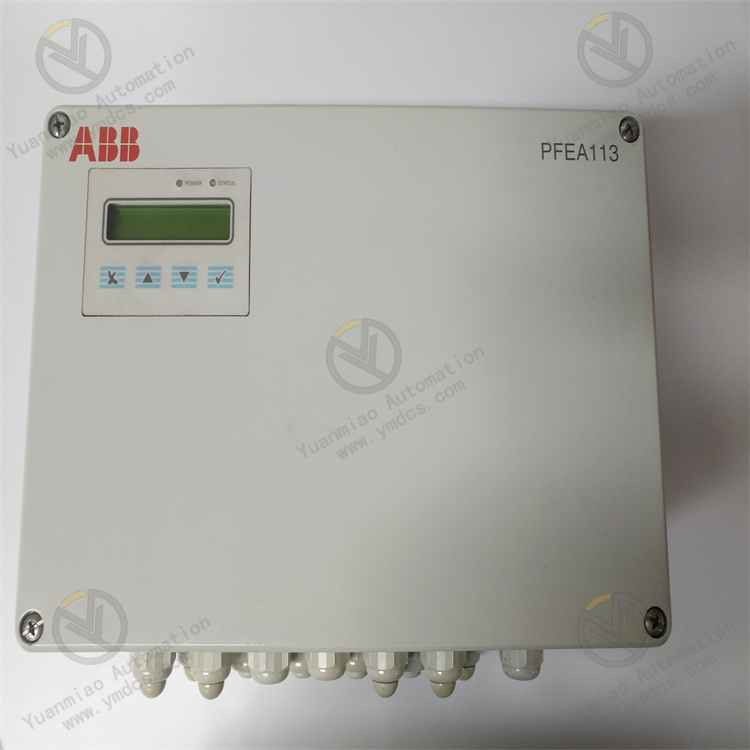
Visual Human‑Machine Interface for Convenient Commissioning & MaintenanceEquipped with visual operation display and interactive multi‑language menu. It guides parameter setting, zero‑point calibration, range calibration and tension‑parameter tuning step‑by‑step for easy operation. On‑board LED indicators intuitively display running, communication, fault and signal status. Local parameter modification and remote configuration debugging are supported to significantly shorten equipment commissioning and fault‑troubleshooting time.
- Standardized Modular Design for Strong Compatibility & VersatilityIndustrial‑standard modular construction with compact footprint, easy assembly‑disassembly and firm fixation, fitting standard industrial‑cabinet mounting dimensions. Natively compatible with full‑range ABB tension‑control accessories without extra adapters. Direct in‑situ replacement of legacy modules is supported for line renovation, equipment upgrade and routine spare‑part replacement.
3. Specification Parameters
| Item | Parameter |
|---|---|
| Device Model | PFEA113‑65 |
| Material Code | 3BSE050092R65 |
| Device Type | High‑precision web tension control module, tension‑signal amplifier controller |
| Applicable Systems | ABB Pressductor tension measurement‑control system, industrial web automation control system, upper‑level PLC/DCS control system |
| Core Functions | Tension‑signal acquisition, high‑precision signal amplification, digital filtering & calibration, constant‑tension closed‑loop regulation, working‑condition adaptive control, fault self‑diagnosis & alarm, data communication transmission, parameter calibration & storage |
| Acquisition Channels | Simultaneous acquisition for single‑channel / dual‑channel tension sensors |
| Signal Type | Millivolt‑level tension‑sensor signal acquisition, standard analog‑signal output |
| Control Modes | Fully‑automatic constant‑tension closed‑loop control, manual fine‑tuning, start‑stop buffer control, ramp tension regulation |
| Communication Protocols | Profibus‑DP fieldbus, standard industrial serial communication |
| Power Supply | DC24 V industrial regulated power (±20 % wide‑voltage tolerance) |
| Operating Temperature | ‑20 ℃~+70 ℃ |
| Storage Temperature | ‑40 ℃~+85 ℃ |
| Ambient Humidity | 5 %~95 %, non‑condensing |
| Protection Class | IP20 (indoor cabinet installation) |
| Protection Features | Opto‑electric isolation, surge suppression, EMC compliance, short‑circuit & over‑current protection, automatic temperature‑drift compensation, signal filtering & noise reduction |
| Display Function | Visual LCD display, multi‑language menu, visual parameter commissioning |
| Mounting Method | Standard cabinet DIN‑rail / card‑mount installation, fixed cabinet mounting |
| Compliance Standards | Industrial IEC measurement‑control standard, EMC certification, CE industrial safety certification |
| Origin | Original imported from Switzerland |
| Product Characteristics | High‑precision measurement‑control, adaptive tension regulation, strong anti‑interference capability, visual commissioning, multi‑channel signal acquisition, fault self‑diagnosis, long‑term drift‑free stability, full‑condition adaptability |
4. Working Principle
Power‑On Initialization and Overall Self‑TestAfter powered by DC24 V regulated supply, the module automatically completes overall initialization, sequentially performing hardware‑circuit self‑test, signal‑port detection, communication‑protocol loading, parameter initialization, sensor‑loop verification and system‑condition calibration. It comprehensively detects hidden risks such as hardware failure, wiring abnormality, parameter disorder and sensor fault. Upon passing self‑test, it enters standby measurement‑control status, establishes signal interconnection with tension sensors, actuators and upper‑level control system and waits for production‑line operation commands.
Tension‑Signal Acquisition and Accurate Pre‑ProcessingDuring line operation, the module collects weak millivolt‑level raw feedback signals from tension sensors in real‑time. Multi‑stage digital filtering, electromagnetic‑noise rejection, temperature‑drift compensation and linear‑calibration algorithms perform noise reduction, waveform shaping, error correction and range conversion for raw signals. Unstable raw analog signals are converted into accurate, stable and linearly‑matched standard tension values. Signal drift induced by industrial interference and equipment temperature difference is thoroughly eliminated to provide reliable data foundation for closed‑loop regulation.
Constant‑Tension Closed‑Loop Computation and Dynamic RegulationWith built‑in proprietary tension‑control algorithms, the module compares real‑time measured tension against system‑set tension threshold and dynamically computes regulation deviation. For conditions including line start‑stop, acceleration/deceleration, load fluctuation and web‑tension variation, accurate regulating signals are automatically output to control inverters, tension cylinders, web‑guide actuators and other executing devices. Operating parameters are revised in real‑time to dynamically balance web tension and maintain constant tension. Process defects caused by abrupt tension change are prevented to realize fully‑automatic stable regulation without manual intervention.
Data Transmission and Real‑Time Working‑Condition SynchronizationVia Profibus‑DP fieldbus, the module uploads real‑time tension values, equipment operating status, process parameters and working‑condition information to upper‑level PLC/DCS control system. Meanwhile it receives tension set‑points, start‑stop commands and parameter‑modification commands from upper level, parses and executes these commands. Bidirectional data exchange, condition synchronization and remote control between field devices and upper‑level system are realized to satisfy centralized‑management requirements of automatic production lines.
- Fault Self‑Diagnosis, Safety Protection and TraceabilityDuring full‑period operation, sensor loops, signal status, power‑supply condition, communication links and hardware status are continuously monitored. Faults such as sensor wire breakage, signal over‑range, circuit short‑circuit, communication interruption and power‑supply abnormality can be accurately identified. Once a fault is triggered, safety‑protection mechanism is activated immediately: abnormal outputs are latched, local alarm signals are generated and fault codes are uploaded. Fault timestamps, operating parameters and abnormal logs are automatically recorded to avoid fault escalation and deliver complete data support for maintenance troubleshooting and rectification.
5. Common Faults and Troubleshooting
Phenomenon: No display after power‑on, equipment fails to start, module unrecognized by systemPossible Causes
① Loss of DC24 V power supply, excessive voltage deviation, reversed polarity or large power‑supply ripple;
② Loose module terminals, poor wiring contact or open circuit;
③ Damaged internal power‑supply circuit or lost/crashed firmware;
④ Circuit‑board short‑circuit caused by humid and dusty installation environment.
Troubleshooting
Power off the system for full discharge. Measure DC24 V voltage, polarity and circuit continuity; inspect circuit breakers and terminal tightness. Clean dust and moisture on module surface and terminals, then retighten wiring. Re‑flash original‑factory firmware and restore factory‑standard parameters. If no response persists with normal power and wiring, hardware failure is confirmed; replace with original spare part.
Phenomenon: Jittering tension readings, zero‑point drift, unstable measurement dataPossible Causes
① Loose tension‑sensor wiring, damaged cable shielding or severe signal interference;
② Zero‑point uncalibrated, incorrect range parameters or long‑term parameter drift;
③ Signal distortion caused by on‑site variable‑frequency‑drive interference and electromagnetic radiation;
④ Degraded signal‑acquisition circuit and reduced precision.
Troubleshooting
Fully inspect sensor wiring and shielding layers, fasten connectors, repair damaged shielding and improve grounding anti‑interference measures. Re‑execute zero‑point calibration and range calibration via module HMI and correct disordered parameters. Optimize field routing and keep cables away from power‑cable interference zones. If faults remain after calibration and interference rectification, module precision degradation is confirmed; replace the module.
Phenomenon: Failed constant‑tension regulation, erratic web tension, web wrinkling / stretching deformationPossible Causes
① Improper tension setting and mismatched closed‑loop PID parameters;
② Aged sensor with reduced sampling precision and distorted feedback signal;
③ Sticking actuators with slow response and mismatched regulation;
④ Disordered module control logic and program exception.
Troubleshooting
Re‑optimize tension set‑point and closed‑loop PID parameters to adapt to line conditions. Inspect and calibrate tension‑sensor precision and replace aged sensors. Rectify sticking and slow‑response issues of actuators to guarantee regulation synchronization. Reboot module to reset program and restore factory control logic. If faults persist, control‑circuit failure is confirmed; replace with original module.
Phenomenon: Upper‑level‑system communication interruption, tension‑data unreadable, remote control disabledPossible Causes
① Damaged Profibus cable, loose connectors or abnormal bus terminating resistor;
② Misconfigured module communication address, baud rate and protocol parameters;
③ Bus networking conflict and duplicate device addresses;
④ Aged communication chip and faulty communication circuit.
Troubleshooting
Inspect communication bus, connectors and terminating resistors; replace damaged cables and fasten connectors. Verify and unify communication address, baud rate and bus parameters; eliminate address conflicts. Reboot bus and module communication program for re‑networking. If communication still fails with correct wiring and parameters, communication‑circuit failure is confirmed; replace spare part.
Phenomenon: Frequent module alarms, large‑amplitude tension fluctuation during start‑stop, unstable operationPossible Causes
① Improper setting of start‑stop buffer and tension‑ramp parameters;
② Abrupt line‑speed change and load fluctuation exceeding module adaptive‑regulation range;
③ Heavy‑duty long‑time operation, internal dust accumulation and poor heat dissipation;
④ Stuck firmware and uncalibrated long‑term parameter drift.
Troubleshooting
Optimize start‑stop buffer and tension‑ramp parameters to improve working‑condition adaptability. Standardize line start‑stop operation and avoid sharp acceleration/deceleration and abrupt‑load change. Clean module dust and improve cabinet ventilation. Calibrate tension parameters periodically and flash stable original‑factory firmware. In case of recurring faults, module performance aging is confirmed; replace spare part in advance to prevent production failure.
Phenomenon: No feedback from sensor, module fails to acquire tension dataPossible Causes
① Damaged sensor, open circuit or reversed wiring polarity;
② Damaged acquisition channel or disabled port parameters;
③ Module signal‑protection latch triggered by circuit short‑circuit;
④ Abnormal signal‑acquisition program.
Troubleshooting
Verify sensor integrity and circuit continuity, correct wiring polarity and replace faulty sensor. Check channel parameters, enable signal‑acquisition function and release fault‑protection latch. Reboot module for program reset and initialization. If no signal is obtained with normal sensor and wiring, acquisition‑circuit failure is confirmed; replace module timely.