Description
1. Product Overview
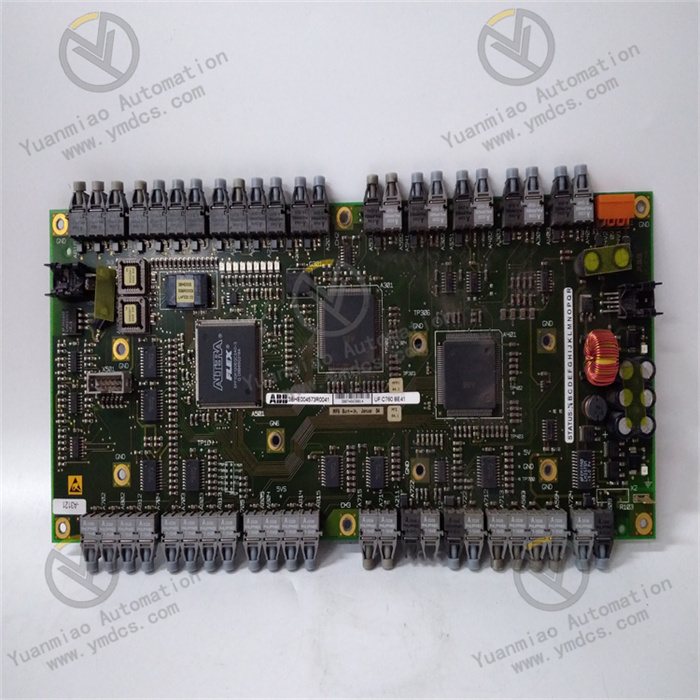
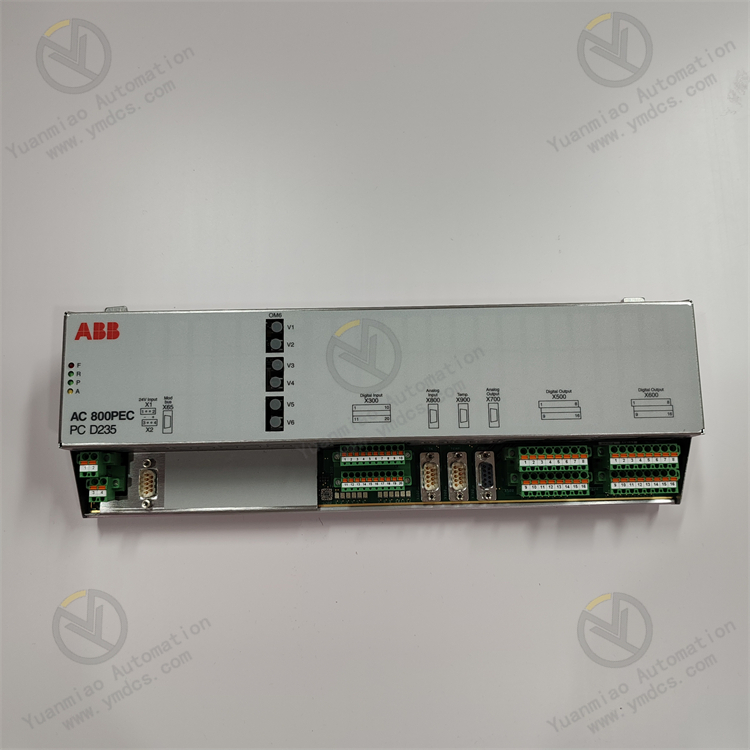
Full Model: PCD235C101
Part Number: 3BHE057901R0101
Manufacturer: ABB
Product Name: Multi-Function Interface Expansion Communication Module for AC800PEC System, Signal Adaptation Adapter for Excitation System
Core Function
Integrated with multiple analog channels, digital channels, temperature sensor interfaces, optical communication links and serial communication ports, this module supports all-in-one collection, adaptation and conversion of on-site multi-dimensional signals including temperature, voltage, current and switch status. It supports high-speed optical link data transmission and RS485 serial communication interaction, realizing signal interconnection, data transparent transmission and protocol adaptation between on-site actuators, sensors and main processor modules. It effectively improves the signal acquisition accuracy and equipment expandability of the excitation system, ensures the integrity and stability of unit excitation regulation, operating condition monitoring and fault protection, and solves the problems of insufficient interfaces, poor signal adaptability and limited expandability of traditional systems.
Applicable Systems
Specially designed for the full series of ABB AC800PEC power-dedicated control systems. It is fully compatible with the hardware architecture of excitation systems, backplane bus, system configuration logic and cabinet installation specifications. It can seamlessly match PPD series main processor modules, various signal acquisition modules and power drive modules. It is applicable to excitation control systems of thermal power, hydropower and wind turbine units, as well as high-power electric drive control systems in metallurgy and oil & gas industries. It supports hot-swap replacement of legacy interface expansion modules of the same model without modifying system programs, control logic and field wiring. Featuring excellent system compatibility and interchangeability, it fits renovation projects of new and existing units and daily maintenance scenarios.
Application Scenarios
Widely used in generator excitation measurement and control systems of thermal power plants, hydropower plants and new energy wind farms. It also applies to high-power drives in metallurgy, large electric drives for oil & gas and industrial high-precision variable frequency control fields. Main applications include unit temperature monitoring, analog operating signal acquisition, digital interlock signal transmission, high-speed optical data interaction, communication adaptation of field peripheral equipment and system I/O interface expansion. It meets the requirements for synchronous acquisition and stable transmission of various signals under complex operating conditions in the power industry, and serves as the core supporting equipment for signal expansion and stable operation of power measurement and control systems.
2. Technical Features
Highly Integrated Multi-Interfaces for All-in-One Signal Expansion and AdaptationThe module is highly integrated with multiple analog input channels, analog output channels, temperature sensor inputs, digital switch interfaces, RS485 serial port and multiple optical communication links. A single module can realize acquisition and output control of all types of industrial signals such as voltage, current, temperature and switch status. It fundamentally solves the limitation of insufficient interface quantity and single signal type of traditional main controllers. No additional expansion boards are required, which greatly simplifies the system hardware architecture, reduces potential fault points and meets the complex working condition requirements of synchronous measurement and control of multiple signals.
Optical-Electrical Hybrid Transmission for High Speed, Stability and Strong Anti-Interference PerformanceNatively supports high-speed data transmission over 3 independent optical links, combined with industrial-grade RS485 serial communication to form a dual optical-electrical data interaction mode. Optical transmission completely isolates electrical interference, ground potential difference and line clutter, eliminating data packet loss, signal drift and distortion caused by conventional wired transmission. It guarantees high-speed, real-time and stable data interaction of the excitation system, perfectly adapting to the complex operating environment with strong electromagnetic interference in power plants.
High-Precision Signal Acquisition Compatible with Various SensorsBuilt-in high-precision signal sampling and conditioning circuits. Analog inputs support dual-mode adaptive acquisition of ±10 V voltage and ±20 mA current. Temperature interfaces are fully compatible with general PT100 and PTC temperature sensors, featuring high sampling precision, favorable linearity and ultra-low temperature drift error. It can accurately capture subtle changes in parameters such as unit operating temperature, operating voltage/current and equipment switch status, providing accurate raw data support for precise excitation regulation, equipment condition monitoring and fault early warning protection.
Industrial-Grade Isolation Protection with Superior Operational ReliabilityAdopting modular isolation design, all signal interfaces and communication ports are equipped with independent electrical isolation, surge suppression and electrostatic protection circuits, and have passed stringent EMC electromagnetic compatibility certifications for the power industry. It is dustproof, moisture-proof, shock-resistant, corrosion-resistant, wide-temperature tolerant and immune to strong electromagnetic interference. It can effectively withstand harsh operating conditions at power plants including sharp temperature & humidity fluctuations, dust, oil contamination, intense electromagnetic field disturbance and load impact, supporting 7×24-hour continuous stable operation under heavy loads.
Powerful Bus Expansion Capacity for Flexible and Efficient NetworkingSupports standard industrial bus networking. Up to 32 devices can be connected on a single bus link to rapidly build large-scale multi-node distributed measurement and control networks. Compliant with AC800PEC system bus protocol, it can seamlessly network with main controller modules, various I/O modules and field peripheral equipment with high data synchronization and low communication delay. It satisfies the networking requirements of multi-equipment coordinated measurement and control for large generator sets and high-power drive systems, delivering outstanding system expandability and networking flexibility.
Intelligent Condition Monitoring for Convenient MaintenanceEquipped with on-board hardware self-test and condition monitoring functions to monitor the operating status of each interface, communication link condition, signal transmission quality and module power supply status in real time. It can accurately identify hidden risks such as interface faults, signal abnormalities, communication interruptions and link disturbances. Combined with the system background, it supports fault alarms and status tracing to quickly locate fault points, significantly shortening troubleshooting and maintenance time, and reducing system maintenance costs and equipment outage losses.
- Standardized Modular Design with Excellent Replacement CompatibilityFully compliant with original ABB AC800PEC hardware specifications. Board dimension, slot specification, pin definition, bus protocol and mounting holes are completely consistent with original equipment of the same series. Adopting standard rack slot-mounted modular structure, it supports direct hot-swap replacement of aging faulty modules without rewiring, system configuration modification or commissioning. Plug-and-play with zero compatibility risk, it covers full scenarios including routine maintenance, emergency fault replacement and system interface expansion renovation.
3. Specification Parameters
| Item | Parameter |
|---|---|
| Equipment Model | PCD235C101 |
| Part Number | 3BHE057901R0101 |
| Manufacturer | ABB (Switzerland) |
| Equipment Type | Multi-Function Interface Expansion Module for AC800PEC System, Optical Communication Adaptation Adapter for Excitation System |
| Applicable Systems | ABB AC800PEC power-dedicated control system, generator excitation control system, high-power industrial variable frequency drive control system |
| Application Scope | Excitation signal expansion for thermal/hydropower/wind turbine units, acquisition of unit temperature and operating parameters, high-speed optical data transmission, communication adaptation of field peripherals, replacement of legacy interface modules, system I/O expansion renovation |
| Analog Input | 3 channels, dual-mode adaptive acquisition: ±10 V voltage / ±20 mA current |
| Analog Output | 3 channels, standard ±10 V voltage output |
| Temperature Acquisition Interfaces | 3 channels, compatible with general industrial PT100 and PTC temperature sensors |
| Communication Interface Configuration | 3 independent optical communication links, 1 standard RS485 serial port, dedicated AC800PEC backplane bus interface |
| Bus Networking Capacity | Maximum 32 stations per bus, suitable for large-scale distributed measurement and control systems |
| Core Functions | Multi-type operating signal acquisition, temperature parameter monitoring, precise analog output, high-speed optical-electrical data interaction, communication adaptation of peripheral equipment, system I/O expansion, signal isolation and conversion, fault status monitoring and alarming |
| Signal Characteristics | High-precision sampling, low temperature drift and low distortion, electrical isolation on all interfaces, anti-interference, stable data transmission without packet loss |
| Power Supply Specification | Standard industrial DC24V power supply, low power consumption |
| Operating Temperature | 0℃~+65℃ (standard operating temperature range for power industrial control) |
| Storage Temperature | -40℃~+85℃ |
| Ambient Humidity | 5%~95%RH, non-condensing, suitable for precise indoor cabinet environment in power plants |
| Protection Capabilities | Electrical isolation on all interfaces, surge & electrostatic protection, electromagnetic shielding, shockproof & dustproof, moisture-proof & anti-corrosion, certified against EMC requirements for power industry |
| Operation Mode | Real-time signal acquisition and conditioning, synchronous optical-electrical data transmission, bidirectional serial communication, real-time interface status monitoring, abnormal signal filtering, data uploading and interaction |
| Diagnosis Functions | Interface self-test, communication link fault identification, abnormal signal monitoring, power supply diagnosis, operation log recording, fault tracing and alarming |
| Mounting Method | Standard slot mounting inside AC800PEC cabinet, in-situ modular hot-swap replacement |
| Equipment Characteristics | Highly integrated multi-interfaces, optical-electrical dual transmission with strong anti-interference, high-precision signal acquisition, powerful networking capability, intelligent self-diagnosis, plug-and-play, suitable for all-weather stable operation of generating units |
4. Working Principle
4.1 Power-On Initialization and Global Interface Self-Diagnosis
After connected to standard DC24V power supply of the cabinet, the module automatically completes power-on initialization, hardware self-test and system bus connection. It sequentially verifies the integrity of analog interfaces, temperature acquisition interfaces, RS485 serial port, optical communication links, backplane bus and power supply circuits, and synchronously matches system configuration parameters and communication protocols. It comprehensively identifies hidden risks such as interface damage, line short circuit, communication abnormality and parameter disorder. After passing self-test, it enters normal operation state, establishes bidirectional data links with main controller modules, field sensors and actuators, and activates signal acquisition and communication transmission functions of all interfaces.
4.2 Multi-Type Signal Acquisition and Precise Conditioning
During operation, the module synchronously collects various on-site operating signals via integrated multi-channels: analog interfaces acquire unit voltage and current parameters; dedicated temperature interfaces collect equipment operating temperature data; meanwhile, field digital interlock status is monitored. All acquired signals are filtered, amplified, calibrated and isolated by built-in high-precision conditioning circuits to eliminate clutter and distortion caused by on-site electromagnetic interference. Raw analog signals and temperature signals are converted into standard digital signals identifiable by the system, ensuring accuracy and stability of collected data.
4.3 High-Speed Data Interaction via Optical-Electrical Dual Links
Conditioned standardized data is transmitted through dual modes: critical excitation measurement and control data is transmitted at high speed via 3 independent optical links. Leveraging the advantage of electrical interference immunity of optical transmission, core data is uploaded to the main processor module rapidly, stably and without distortion. Conventional peripheral communication, equipment debugging and parameter interaction data are transmitted bidirectionally through the RS485 serial port. Meanwhile, the module receives control commands issued by the main controller and outputs standard voltage signals via analog output channels to realize precise regulation of matched field equipment, completing closed-loop measurement and control of the system.
4.4 Bus Networking and Multi-Equipment Coordination Adaptation
The module accesses the system network through the dedicated AC800PEC backplane bus. It can network and operate with main controller modules, other expansion modules and multi-station field equipment inside the cabinet, supporting synchronous communication of up to 32 stations on one bus. During operation, operating data, condition parameters and control commands of each device are synchronized in real time to realize coordinated measurement and control, signal linkage and data sharing among multiple devices. It effectively expands the measurement and control scope and equipment access capacity of the system, meeting the complex measurement and control demands with multiple nodes and signals for large generator sets and high-power drive systems.
4.5 Intelligent Monitoring and Abnormality Protection Operation
The module continuously monitors the operating status of each interface, signal transmission quality, communication link condition and power supply status. Built-in abnormality protection logic is activated: in case of signal over-limit, line short circuit, communication interruption, interface fault and other anomalies, automatic signal isolation, fault alarm and data fault-tolerant protection will be triggered. It prevents abnormal signals from leading to misjudgment of the main control system, disordered excitation regulation and equipment interlock faults. Fault status and operation logs are automatically stored for background traceability and review, ensuring long-term stable and safe operation of the whole measurement and control system.
5. Common Problems and Solutions
5.1 Phenomenon: Module fails to work after power-up, no signals on all interfaces, module unrecognized by the system
Possible Causes
① Loss of DC24V power supply in cabinet, unstable voltage or poor contact in power circuit;
② Oxidation of module slots, loose pins or poor contact of backplane bus;
③ Module hardware failure, damaged main control chip or program loss;
④ Degraded insulation and partial short circuit on circuit board caused by long-term humidity and dust accumulation;
⑤ Unmatched system configuration or disordered module address parameters.
Solutions
Shut down equipment, cut off power and fully discharge. Inspect DC24V supply voltage and circuit stability of the cabinet and troubleshoot upstream power faults. Clean oxidation and dust on module slots and backplane pins, reinsert and fasten the module to ensure reliable bus contact. Verify system configuration parameters and module address, and re-match system protocols. Perform insulation cleaning, drying and anti-corrosion treatment on damp and dusty modules. If the module still cannot operate with normal power supply, slot and configuration, hardware damage is confirmed and original ABB PCD235C101 (3BHE057901R0101) module shall be replaced.
5.2 Phenomenon: Analog signal drift, severe data fluctuation and degraded acquisition precision
Possible Causes
① Oxidation of analog terminals, loose wiring or poor line contact;
② Signal distortion and clutter interference induced by strong on-site electromagnetic interference;
③ Aging signal conditioning circuits and drifted sampling parameters;
④ Failed shielding grounding of signal cables and non-standard cable routing;
⑤ Attenuated sampling precision due to long-term high-temperature operation of the module.
Solutions
Cut off power, clean analog terminals, retighten wiring and standardize signal cable routing and shielding grounding. Optimize cabinet anti-interference and shielding measures to isolate on-site electromagnetic disturbance. Re-calibrate analog sampling parameters in the system background to correct data drift. Clean cabinet heat dissipation channels and improve operating temperature of the module. If signal fluctuation and precision deviation persist after rectification, aging and damage of sampling circuits are confirmed and spare part replacement is required.
5.3 Phenomenon: Abnormal temperature acquisition, inaccurate readings or interrupted temperature signals
Possible Causes
① Damaged PT100/PTC temperature sensors, broken cables or loose connections;
② Oxidation and blockage of temperature acquisition interfaces leading to poor contact;
③ Faulty temperature sampling circuits or incorrect parameter configuration;
④ Signal crosstalk among multiple sensors and failed cable shielding;
⑤ Aging and failure of module interface hardware.
Solutions
Check each temperature sensor and connecting cable channel by channel, replace defective sensors and fasten terminals. Clean temperature acquisition interfaces to eliminate oxidation and poor contact risks. Verify system temperature acquisition parameters and match sensor model and sampling mode. Optimize cable shielding layout to avoid signal crosstalk. If temperature acquisition keeps failing after excluding external circuit and configuration faults, damage to module temperature acquisition interfaces is confirmed and original module replacement is required.
5.4 Phenomenon: Frequent interruption of optical link / RS485 communication, data packet loss and abnormal interaction
Possible Causes
① Contaminated, bent or damaged fiber connectors and excessive optical link attenuation;
② Loose RS485 terminals, aging cables or mismatched baud rate parameters;
③ Communication signal distortion caused by on-site electromagnetic interference;
④ Aging module communication chips and abnormal link parsing;
⑤ Excessive bus stations leading to data conflict and congestion.
Solutions
Clean fiber connectors, inspect fiber integrity, replace damaged optical cables and re-align optical links. Verify RS485 baud rate, device address and communication protocol, and unify communication parameters of the whole station. Retighten communication wiring, optimize shielding grounding and isolate electromagnetic interference. Properly arrange bus stations to avoid data conflict. If communication faults recur and cannot be repaired, hardware damage of module communication unit is confirmed and PCD235C101 module shall be replaced.
5.5 Phenomenon: Single-channel interface failure, no feedback of partial signals and partial functional abnormality of the module
Possible Causes
① Burned interfaces caused by long-term overload and overvoltage on single channels;
② Local circuit faults triggered by corroded terminals, dust accumulation and line short circuit;
③ Aging internal functional circuits and partial performance degradation of the module;
④ Disordered parameter configuration of single channels in the system.
Solutions
Cut off power, inspect terminal status and line conditions of faulty interfaces, clear corrosion and dust, and eliminate short circuit and overvoltage risks. Reset single-channel configuration parameters and restore original standard system configuration. If partial functions remain invalid after excluding external circuit and configuration faults, local hardware damage of the module which cannot be repaired separately is confirmed. The original ABB PCD235C101 (3BHE057901R0101) module shall be replaced as a whole to guarantee stable operation of all module interfaces.