Description
1. Overview
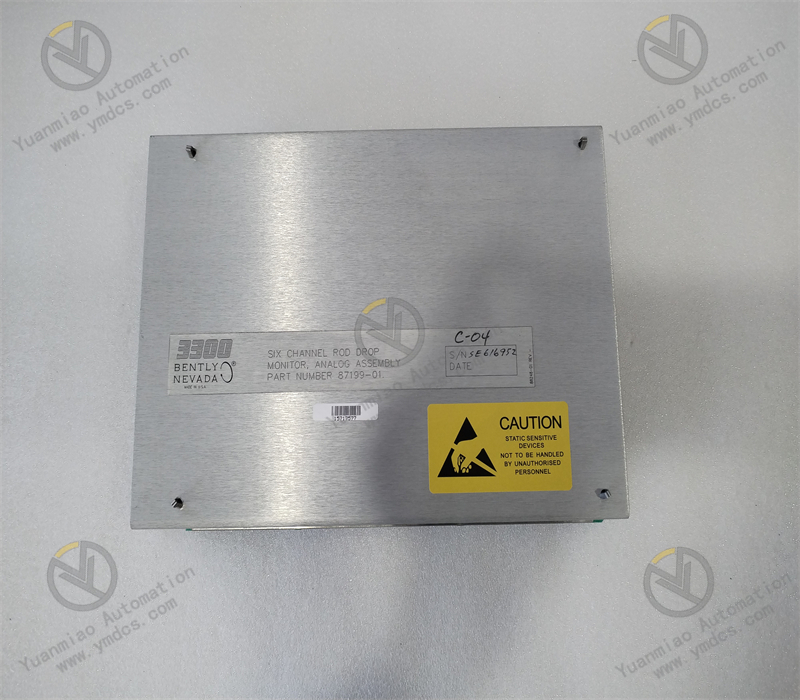
Bently Nevada 87199‑01 is an integrated case‑vibration and temperature composite monitoring sensor manufactured by Baker Hughes Bently Nevada. As a dedicated intelligent sensing device for condition‑monitoring of industrial rotating machinery, it integrates multi‑parameter detection for vibration, velocity and temperature. No external signal‑conditioning module is required. It performs local high‑precision acquisition and signal transmission of equipment housing status. Designed for industrial auxiliary machinery such as fans, pumps, compressors, motors and gearboxes as well as medium‑and‑small‑sized rotating equipment, it serves as a core sensing unit for lightweight online monitoring of distributed assets.
The 87199‑01 features an integrated industrial‑grade stainless‑steel enclosure, incorporating high‑precision piezoelectric sensing chips and temperature‑sensing elements. It delivers wide‑band vibration acquisition, accurate velocity measurement, real‑time temperature detection and low‑noise signal output. Natively supporting standard 4‑20 mA analog transmission output, it can be directly interfaced with DCS, PLC and host monitoring systems. With strong anti‑interference performance, low temperature drift and excellent environmental adaptability, it can be installed locally for long‑term operation in high‑temperature, dusty and electromagnetically‑complex industrial sites. Widely deployed in thermal‑power, chemical, oil‑gas, metallurgical and water‑treatment industries, it applies to legacy measuring‑point retrofits, monitoring‑system expansion for distributed equipment and predictive‑maintenance upgrades.
2. Functions and Features
2.1 Core Functions
Multi‑parameter Integrated Composite Monitoring: A single unit performs triple measurement of housing vibration, vibration velocity and equipment temperature. It synchronously captures mechanical and thermal operating conditions and covers common fault‑monitoring requirements for auxiliary machinery. Separate vibration and temperature measuring points are eliminated, simplifying field cabling and layout.
High‑precision Wide‑band Vibration Acquisition: Based on high‑sensitivity piezoelectric sensing principle, it acquires wide‑band vibration signals and captures subtle vibration anomalies. It enables early identification of latent faults including rotor unbalance, bearing wear, base looseness, mechanical resonance and component eccentricity.
Standard Industrial Signal Transmission Output: Built‑in signal processing and conditioning circuitry linearly converts physical quantities of vibration, velocity and temperature into stable, high‑linearity standard 4‑20 mA analog signals. Direct connection to various industrial control systems enables remote data upload, trend logging and centralized supervision.
24/7 Local Condition Monitoring: Suitable for 7×24‑hour continuous equipment operation. It tracks real‑time condition changes and supplies continuous, high‑quality raw data for fault prediction, hazard investigation, scheduled overhaul and condition‑based maintenance.
Comprehensive Measuring‑point Self‑diagnosis: Detects sensor signal anomalies, loop open‑circuit, short‑circuit and parameter drift. It effectively avoids invalid readings, data jitter, missed and false alarms and ensures reliable monitoring chains.
Lightweight Rack‑free Operation: Independent acquisition, calculation and transmission without Bently Nevada rack‑based monitoring hardware. Well‑suited for industrial sites with distributed equipment layouts and no centralized monitoring cabinets for lightweight monitoring‑retrofit projects.
2.2 Product Characteristics
High‑sensitivity Precision Detection: Factory‑set vibration sensitivity of 100 mV/g paired with wide acquisition bandwidth. Fast dynamic response and high resolution capture minor vibration fluctuations to satisfy precision condition‑monitoring and incipient‑fault‑diagnosis requirements for industrial machinery.
Broad Industrial Temperature Compatibility: Industrial‑grade wide‑temperature construction withstands cyclic temperature variations on‑site. Long‑term local installation is permitted without temperature‑controlled cabinet protection, outperforming conventional commercial sensors.
Robust Anti‑interference Performance: Multi‑stage EMC protection and signal‑filtering circuits suppress electromagnetic crosstalk and noise from variable‑frequency drives, high‑voltage apparatus and power cables, preventing data drift, jitter and signal distortion.
Rugged Integrated Enclosure: One‑piece stainless‑steel housing provides dust resistance, oil resistance, mechanical‑pull resistance and moderate shock resistance. Robust construction suits harsh shop‑floor and process‑unit environments for long service life.
Low‑drift Long‑term Stability: Carefully‑selected industrial components deliver minimal temperature drift. No parameter degradation or performance shift occurs under continuous operation; frequent recalibration is not required and maintenance workload is reduced.
Convenient Installation & Maintenance: Compact form‑factor with universal mounting enables fast field replacement. Fault localisation is straightforward, ideal for large‑scale standardised replacement of legacy measuring points and technical‑retrofit expansion.
3. Specifications
| Item | Specifications |
|---|---|
| Model | 87199‑01 |
| Device Type | Integrated Vibration / Velocity / Temperature Composite Monitoring Sensor |
| Brand & Manufacturer | Bently Nevada (Baker Hughes) |
| Measured Parameters | Equipment housing vibration, vibration velocity, operating temperature |
| Vibration Sensitivity | 100 mV/g |
| Vibration Frequency Range | 1 Hz ~ 10 kHz |
| Output Signal | Standard 4‑20 mA linear analog transmission output |
| Power Supply | 24 VDC industrial regulated power |
| Operating Current | 5 A |
| Operating Temperature | ‑40 ℃ ~ +125 ℃ |
| Storage Temperature | ‑45 ℃ ~ +130 ℃ |
| Unit Weight | Approx. 0.5 kg |
| Housing Material | Industrial stainless steel |
| Ambient Humidity | 5%‑95% RH, non‑condensing |
| Operational Features | Wide‑band acquisition, low temperature drift, low noise, multi‑parameter integration, fault self‑diagnosis |
4. Operating Principle
The Bently Nevada 87199‑01 composite monitoring sensor operates on piezoelectric dynamic acquisition and thermosensing principles. It combines mechanical‑vibration and temperature‑sensing cores to simultaneously capture dynamic operating parameters of rotating‑machine housings and realise integrated multi‑parameter measurement and signal transmission.
During equipment operation, the piezoelectric element converts mechanical housing vibration and velocity variations into weak analog electrical signals. Meanwhile, the built‑in temperature‑sensing element measures surface temperature of the equipment housing. Raw vibration signals go through multi‑stage internal filtering, noise reduction and waveform shaping to remove field electromagnetic clutter, high‑frequency interference and spurious noise for signal purity and authenticity.
On‑board signal‑processing circuitry accurately computes and calibrates vibration amplitude, vibration velocity and temperature readings to compensate measurement errors caused by temperature drift, line loss and environmental disturbance. Calibrated physical quantities are then linearly converted into standard 4‑20 mA analog signals for continuous output. Outputs are transmitted to DCS, PLC and host monitoring systems for real‑time display, trend archiving, condition analysis and over‑limit alarming.
Real‑time self‑diagnosis continuously monitors sensing elements, signal loops and power‑supply status. Signal anomalies, wiring faults and hardware‑performance degradation are actively identified and flagged to prevent erroneous data upload. It guarantees continuity, accuracy and stability of equipment condition monitoring and delivers reliable data support for early‑fault warning, condition‑based overhaul and safe operation.
5. Application Scenarios
Multi‑parameter Condition Monitoring for Industrial Auxiliary Machinery: Widely used for ID fans, forced‑draft fans, circulating‑water pumps, booster pumps, small compressors, gearboxes and large‑size motors in thermal‑power, chemical, oil‑gas, metallurgical and water‑treatment plants. Synchronous monitoring of vibration, velocity and temperature achieves comprehensive equipment health supervision.
Light‑weight Monitoring Retrofit for Distributed Equipment: For sites with geographically‑dispersed machinery and no centralized monitoring cabinets where rack‑system deployment is impractical. Its integrated rack‑free architecture implements multi‑parameter measurement per unit for new measuring‑point addition and legacy‑point upgrade.
Upgrade of Legacy Single‑function Measuring Points: Replaces traditional discrete vibration‑only and temperature‑only sensors. It addresses shortcomings of legacy hardware including limited parameters, low accuracy, poor noise immunity and severe data drift. It improves monitoring completeness and fault‑diagnosis capability for plant intelligent‑transformation projects.
Fault Prediction & Predictive Maintenance: Long‑term trending of vibration and temperature enables early detection of bearing overheating / wear, rotor unbalance, base looseness, mechanical resonance and abnormal loading. It provides data basis for scheduled maintenance, hazard remediation and predictive service.
Monitoring for Harsh Industrial Field Conditions: Wide‑temperature operation, dust‑ and oil‑resistance plus strong electromagnetic‑interference tolerance permit stable long‑term local deployment in high‑temperature, dusty and electrically‑noisy shop‑floor and process‑unit environments.
Monitoring for Medium‑and‑small‑sized Complete Sets: Meets lightweight monitoring demands for medium‑and‑small‑sized units, mobile process equipment and chemical process packages. Complex monitoring infrastructure is avoided; cost‑effective round‑the‑clock supervision of key operating parameters is achieved.
6. Common Faults and Troubleshooting
6.1 Frozen, unchanging measurement readings
Root Causes: Ageing or degraded sensing element; broken / loose sensor cable or terminal; failed sensing component; data locked in upstream acquisition system.
Solutions: Inspect sensor mounting tightness to rule out looseness or detachment. Check cable continuity and connector condition and retighten terminals. Verify host‑system configuration and release data‑locking functions. If readings remain static after wiring and system issues are eliminated, sensor hardware failure is confirmed; replace the 87199‑01 sensor.
6.2 Data jitter, drift and poor stability
Root Causes: Severe on‑site electromagnetic interference with defective shield‑grounding; loose sensor mounting inducing parasitic vibration; unstable 24 VDC power supply with excessive ripple; long‑term sensor performance degradation.
Solutions: Implement single‑end shield grounding for signal cables and route them away from power and variable‑frequency‑drive circuits. Retighten sensor base to eliminate parasitic resonance. Stabilise 24 VDC power supply. Replace sensor if fluctuations persist after field rectification.
6.3 Abnormal 4‑20 mA output; no DCS reading or large reading deviation
Root Causes: Incorrect, open or loose analog‑output wiring; range mismatch between sensor and host system; defective sensor transmission circuit; out‑of‑specification loop load resistance.
Solutions: Power off and verify wiring polarity and continuity, repair faulty cabling. Unify range settings between sensor and DCS. Measure actual loop current and compare against reference values. Replace sensor hardware if output remains faulty despite correct parameter configuration.
6.4 Single‑parameter anomaly (temperature or vibration), other parameters normal
Root Causes: Partial ageing / accuracy decay of the corresponding sensing element; failure of dedicated signal‑conditioning circuit; parameter offset induced by local mounting stress.
Solutions: Calibrate the abnormal parameter and cross‑check against actual equipment operating status. Evaluate influences from mounting stress and field interference. Replace integrated sensor if calibration cannot restore measurement accuracy.
6.5 Intermittent disconnection and sporadic data loss
Root Causes: Loose terminals caused by sustained equipment vibration; poor contact from oxidized, damp or dusty connectors; fatigue‑damaged cables with internal partial breakage.
Solutions: Clean oxidized connectors and remove dust, dry and retighten connections. Optimise cable routing to eliminate sharp bends and mechanical tension. Secure cables and connectors against vibratory stress. Replace sensor and matching cable if intermittent faults recur.
6.6 No response and no output upon power‑on
Root Causes: Abnormal supply voltage or reversed polarity; open power loop or tripped circuit‑breaker; burnt‑out internal circuitry and complete hardware failure.
Solutions: Measure input supply voltage and verify polarity, restore correct power. Troubleshoot upstream power loop. Replace with new 87199‑01 sensor if no output is obtained under valid power conditions.