Description
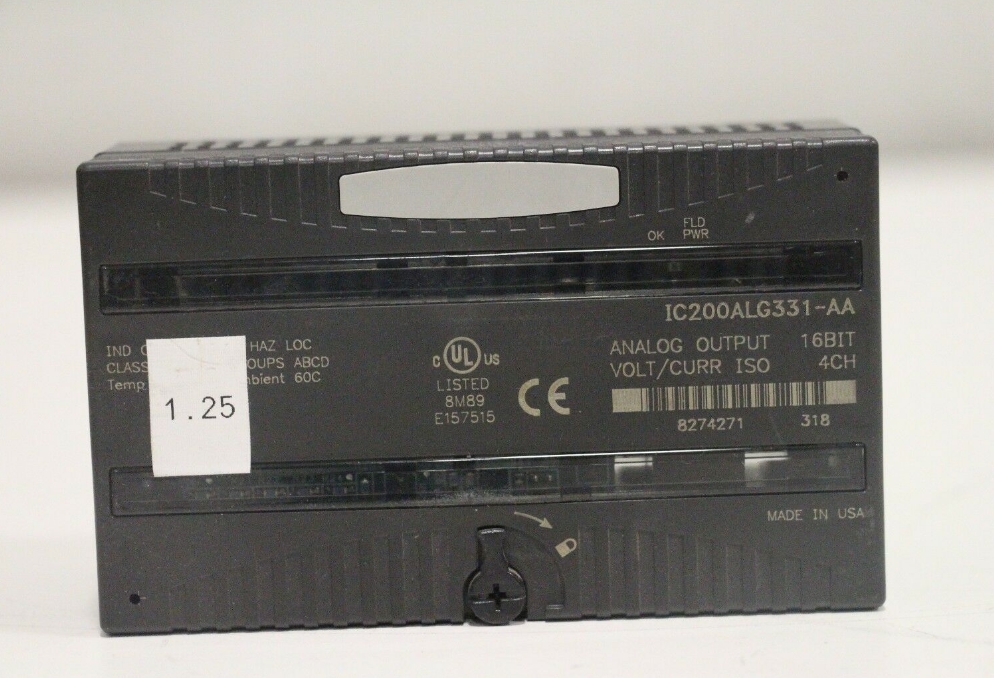
GE IC200ALG331-KD
GE IC200ALG331-KD is an advanced algorithm module positioned as a high-precision multi-channel process control and data processing unit. With core advantages including multi-channel analog processing, a rich library of built-in control algorithms, and high-speed data computing capabilities, this product is specifically designed to provide precise control and real-time data processing functions for complex processes in VersaMax series PLC systems. It is compatible with industrial scenarios requiring strict process control accuracy and data computing efficiency, such as chemical process control, water treatment, intelligent manufacturing, and food and beverage processing. Its core value lies in realizing the coordinated control and data optimization of multiple parameters (e.g., temperature, pressure, flow rate, liquid level) through an integrated algorithm engine and flexible channel configuration. Additionally, it features comprehensive self-diagnostic and status feedback functions, providing key technical support for the stability and efficiency of industrial production processes.
I. Technical Parameters
1. Input/Output Channel Parameters
- Equipped with 8 high-precision analog input channels and 4 analog output channels.
- Input channels support multiple signal types, including standard analog signals (4-20mA DC, 0-10V DC), thermocouple (J, K, T, E types) signals, and RTD (Pt100) temperature signals. Each input signal type can be flexibly configured via software without hardware jumper switching.
- Input accuracy: ±0.1%FS. Thermocouple inputs adopt built-in cold junction compensation technology with a compensation accuracy of ±0.5℃; RTD inputs support 3-wire connection to effectively suppress measurement errors caused by lead resistance.
- Output channels support 4-20mA DC or 0-10V DC signal output, with an output accuracy of ±0.1%FS and a load regulation rate of ≤±0.2%. They can directly drive actuators or interact with other control modules.
- Each input channel is equipped with overvoltage protection, capable of withstanding continuous ±30V DC overvoltage to avoid module damage due to incorrect signal wiring.
2. Algorithm and Computing Parameters
- Built-in rich industrial control algorithm library, including standard PID, auto-tuning PID, fuzzy PID, proportional control (P), proportional-integral control (PI), and custom algorithm programming functions, adaptable to linear and non-linear controlled objects.
- Auto-tuning PID function can complete system identification within 50 seconds and automatically optimize proportional (P), integral (I), and derivative (D) parameters, with a steady-state control accuracy of ≤±0.2%FS.
- Adopts a 32-bit high-performance microprocessor with a core operating frequency of 100MHz. The single-channel algorithm computation cycle is ≤10ms, and the total computation cycle for 8-channel simultaneous operation is ≤50ms, ensuring real-time performance of multi-parameter control.
- Supports algorithm interlock function, enabling logical association control between different channels (e.g., dynamically adjusting flow control targets based on pressure parameters) with an interlock response time of ≤15ms.
3. Communication and Data Interaction Parameters
- Communicates with PLC controllers at high speed via the VersaMax series standard backplane bus, with a data update cycle of ≤20ms, supporting seamless integration with VersaMax series I/O modules and communication modules.
- Features local data storage function, capable of caching 1000 key control parameters and process data. The storage cycle can be software-configured within the range of 100ms-1s, supporting power-off data retention (retention time ≥10 years).
- Supports algorithm parameter configuration, program download, and online monitoring via GE Proficy Machine Edition configuration software. It also supports batch import/export of parameters, simplifying the multi-module deployment process.
4. Structural and Hardware Parameters
- Adopts a single-slot design, compatible with VersaMax series standard backplane installation. Module dimensions: 36mm×100mm×150mm, weight approximately 400g, with a compact structure and easy installation.
- The front panel is equipped with multiple groups of status LED indicators, including a module overall status OK light, 8 input channel status lights, and 4 output channel status lights. The OK light is steadily green for normal operation, flashing green for startup mode or program update status, and flashing yellow for self-diagnostic errors, providing intuitive feedback on the module's overall operating status and channel fault information.
- Input and output terminals adopt spring-loaded terminal blocks, supporting 14-22AWG wire connection, which is firm and vibration-resistant, adapting to complex industrial on-site environments.
5. Environmental and Reliability Parameters
- Complies with industrial-grade wide-temperature operation standards: operating temperature range -20℃~+60℃, storage temperature range -40℃~+85℃, suitable for outdoor cabinets in cold regions and high-temperature workshop environments.
- Relative humidity adaptation range: 5%~95% (non-condensing), meeting the requirements of high-humidity coastal areas, dusty chemical workshops, and other scenarios.
- Certified by multiple international standards including CE, UL, and CSA, supporting Class I, Division 2 hazardous area installation. The Mean Time Between Failures (MTBF) is ≥300,000 hours, ensuring extremely high operational reliability.
- Adopts a fanless natural heat dissipation design. Through an optimized heat dissipation structure, it ensures stable operation in high-temperature environments, adapting to industrial scenarios with high dust concentrations.
6. Diagnosis and Protection Parameters
- Features comprehensive self-diagnostic functions, capable of detecting fault types such as abnormal input signals (e.g., open circuit, short circuit, overrange), output circuit faults (e.g., short circuit, overload), abnormal module power supply, and internal computing errors, with a fault diagnosis coverage rate of ≥95%.
- When a fault is detected, in addition to feedback via LED indicators, fault codes and fault location information can be uploaded to the PLC controller via the backplane bus, facilitating quick problem localization.
- Input channels are equipped with signal filtering functions, and the filter coefficient (1-10 levels) can be configured via software to effectively suppress signal fluctuations caused by electromagnetic interference and improve measurement stability.
II. Key Features
1. Multi-Channel Integration + Flexible Configuration, High Efficiency in Multi-Parameter Management
- Core highlight: Integrated channel design with 8 inputs + 4 outputs, capable of processing 8 process parameters (e.g., temperature, pressure, flow rate) simultaneously and achieving precise control of actuators through 4 outputs. Compared with single-channel algorithm modules, the equipment integration level is increased by 8 times, and the cabinet installation space is reduced by 60%.
- Each input channel can be independently configured with signal type and filter coefficient, and each output channel can be independently associated with a control algorithm. For example:
- Input channels 1-4 monitor reactor temperature and pressure signals;
- Input channels 5-8 monitor feed/discharge flow rate and liquid level signals;
- Output channels 1-2 control heating/cooling actuators;
- Output channels 3-4 control feed/discharge valves.
- Realizes multi-parameter coordinated control, adapting to complex industrial processes.
2. Rich Algorithm Library + Auto-Tuning Function, Dual Advantages of Control Precision and Adaptability
- Built-in multiple mature algorithms such as standard PID, auto-tuning PID, and fuzzy PID:
- Standard PID is suitable for conventional linear processes (e.g., constant pressure water supply);
- Fuzzy PID targets large-lag, non-linear processes such as chemical reactions, dynamically adjusting PID parameters through fuzzy logic to reduce the control fluctuation range to ±0.3%FS;
- Auto-tuning function can automatically identify the thermal inertia, response speed, and other characteristics of the controlled object, completing parameter optimization within 50 seconds. Compared with manual debugging, the debugging efficiency is improved by 90%, and the problem of insufficient control precision caused by insufficient manual experience is avoided.
- Supports custom algorithm programming, allowing the writing of exclusive control logic via Structured Text (ST) to adapt to special process requirements (e.g., segmented temperature control processes in food processing).
3. High-Speed Computing + Real-Time Communication, Efficient and Timely Control Response
- Adopts a 32-bit high-performance microprocessor. The single-channel algorithm computation cycle is ≤10ms, and the total computation cycle for 8-channel simultaneous operation is ≤50ms, which is far superior to traditional 8-bit processor modules. It can quickly respond to changes in process parameters. For example, when the temperature of a chemical reactor rises sharply, the algorithm computation can be completed and control signals output within 10ms, avoiding production accidents caused by parameter exceeding limits.
- Communicates with the controller at high speed via the VersaMax backplane bus, with a data update cycle of ≤20ms, enabling real-time upload of process data and reception of control commands. Combined with the SCADA system, it realizes centralized monitoring and remote regulation of process parameters, with a control command response time of ≤30ms.
4. Comprehensive Diagnosis + Status Visualization, Significantly Improved Operation and Maintenance Efficiency
- Integrates comprehensive diagnostic functions for abnormal input signals, output circuit faults, internal computing errors, etc., capable of accurately locating faulty channels and fault types (e.g., open circuit of the 2nd Pt100 sensor).
- Provides intuitive feedback via front-end LED indicators (corresponding channel status light flashes) and uploads fault information via the backplane bus. Combined with the HMI interface, detailed fault descriptions can be displayed, reducing troubleshooting time to within 5 minutes and improving operation and maintenance efficiency by 70% compared with traditional modules.
- The multi-state display design of the OK light allows quick judgment of the module's overall operating status (startup mode, normal operation, fault status), simplifying daily inspection processes.
5. Data Caching + Easy Configuration, Reduced Integration and Traceability Costs
- Features local caching of 1000 data points, capable of storing key control parameters and process data. Data can be retained for more than 10 years after power-off, meeting the process traceability requirements of industries such as food and beverage and pharmaceuticals without the need for additional data storage modules, reducing data traceability costs by 40%.
- Through GE Proficy Machine Edition configuration software, algorithm parameters, channel types, and filter coefficients can be configured graphically. It supports batch copying, import, and export of parameters, shortening the 8-channel configuration time to within 15 minutes.
- Supports online parameter modification and real-time monitoring of each input/output value, enabling parameter adjustment without shutdown and reducing production downtime.
III. Working Principle and Applications
3.1 Working Principle
GE IC200ALG331-KD realizes precise control of complex processes based on the core logic of "signal acquisition → data preprocessing → algorithm computation → control output → diagnostic feedback". The specific process is as follows:① Signal Acquisition Stage: Sensor signals (e.g., 4-20mA signals from pressure sensors, Pt100 RTD signals) are accessed through 8 independent input channels. Thermocouple inputs are corrected for ambient temperature effects via a cold junction compensation circuit, and RTD inputs are excited by a constant current source to improve measurement accuracy.② Data Preprocessing Stage: Input signals are converted into digital signals by a 16-bit ADC converter. Software-configurable filtering algorithms remove signal fluctuations caused by electromagnetic interference, outputting stable process measurement values (PV). Meanwhile, signal range conversion and linearization processing are performed.③ Algorithm Computation Stage: PV is compared with the preset set value (SV), and the control quantity is calculated according to the selected control algorithm (e.g., auto-tuning PID). It supports interlock computation of multi-channel parameters (e.g., limiting the flow control range based on liquid level parameters).④ Control Output Stage: Based on the algorithm calculation results, control signals (e.g., 4-20mA signals to drive control valves) are output through 4 analog output channels to adjust the state of the controlled object.⑤ Diagnostic Feedback Stage: Real-time monitoring of input signal integrity, output load status, and internal computing status is performed. When an abnormality is detected, an LED indicator alarm is triggered, fault information is uploaded to the controller, and the fault time and related parameters are recorded, forming a complete control-diagnosis closed loop.
3.2 Application Scenarios
Chemical Reactor Process Control
- In the PLC control system of a batch chemical reactor, the IC200ALG331-KD module accesses 4 Pt100 RTDs (monitoring temperatures in different reactor zones), 2 pressure sensors (reactor internal pressure), and 2 flow sensors (feed/discharge flow rates). The 4 outputs control the heating jacket, cooling valve, feed pump, and discharge pump respectively.
- Adopts fuzzy PID algorithm to cope with the large-lag characteristics of the reaction process: temperature control fluctuation ≤±0.5℃, pressure control fluctuation ≤±0.1MPa.
- The auto-tuning function automatically optimizes PID parameters before the start of each reaction batch, adapting to the characteristics of different reaction materials, and improving product qualification rate by 6%.
- When a temperature sensor is open-circuited, the module alarms within 10ms and automatically switches to a backup temperature signal, ensuring uninterrupted reaction processes.
Water Treatment Plant Purification Process Control
- In the water purification system of a waterworks, the IC200ALG331-KD module is configured with 6 inputs (raw water turbidity, pH value, chemical dosage flow rate, sedimentation tank liquid level, filtered water turbidity, effluent pressure) and 4 outputs (chemical dosage pump speed, sedimentation tank sludge discharge valve opening, filter backwash pump, effluent control valve), adopting PID + logic interlock algorithm for process control.
- Dynamically adjusts the chemical dosage pump speed based on raw water turbidity (increasing dosage when turbidity rises) and controls the sedimentation tank sludge discharge valve opening based on liquid level. The filtered water turbidity is stably controlled at ≤0.5NTU, meeting drinking water standards.
- Cached data such as chemical dosage flow rate and turbidity can trace the process within 3 months, facilitating water quality abnormality analysis and reducing the number of operation and maintenance personnel by 30%.
Food and Beverage Sterilization Temperature Control System
- In a dairy product sterilization production line, the IC200ALG331-KD module accesses 8 K-type thermocouples (monitoring temperatures in 8 zones of the sterilizer: preheating zone, sterilization zone, cooling zone, etc.), and 4 outputs control heating tubes and cooling fans, adopting a segmented PID algorithm for multi-stage temperature control.
- Preheating zone temperature: 85℃±0.3℃; sterilization zone temperature: 137℃±0.2℃; cooling zone temperature: 4℃±0.5℃, ensuring sterilization effect while avoiding nutrient loss in dairy products.
- The auto-tuning function can quickly optimize temperature control parameters when changing product specifications, shortening product changeover time to within 15 minutes and increasing production line capacity by 10%.
- The module's fault diagnosis function can quickly locate faulty thermocouples, avoiding batch product scrapping caused by temperature measurement failure.
Intelligent Manufacturing Equipment Process Parameter Control
- In a lithium battery pole piece coating production line, the IC200ALG331-KD module accesses 8 inputs (coating thickness, coating speed, oven temperature, hot air flow rate, pole piece tension, humidity, coating pressure, solid content), and 4 outputs control the coating machine speed, oven heating power, hot air valve opening, and tension regulator, adopting custom algorithms for multi-parameter coordinated control.
- Through interlock control of coating speed and oven temperature, uniform drying of pole pieces is ensured, and the coating thickness deviation is controlled within ±2μm, improving product yield by 8%.
- The module's high-speed computing capability can real-time respond to changes in coating speed, completing parameter optimization of oven temperature and hot air flow rate within 50ms after speed adjustment, avoiding coating defects.
IV. Common Faults and Troubleshooting
1. Fault 1: Abnormal Input Signal Display (Corresponding Channel Status Light Flashes)
- Possible Causes: Incorrect sensor type configuration, loose or damaged sensor wiring, strong electromagnetic interference on signals, input channel fault.
- Troubleshooting Measures:① Log in to the configuration software to verify the sensor type configuration of the corresponding channel (e.g., K-type thermocouple mistakenly configured as J-type) and reconfigure the correct type.② Check the tightness of sensor terminals, replace damaged signal cables, and ensure single-end grounding of the shield (ground resistance ≤4Ω).③ Install the module away from high-interference equipment such as frequency converters, or add a shield to the signal cable to enhance anti-interference capability.④ Connect the sensor of the faulty channel to a normal channel. If it returns to normal, the fault lies in the module's input channel; replace with a spare module.
2. Fault 2: OK Light Flashing Yellow (Self-Diagnostic Error)
- Possible Causes: Incorrect algorithm parameter configuration (e.g., PID parameters exceeding reasonable ranges), program download failure, internal module computing error, abnormal power supply voltage.
- Troubleshooting Measures:① Check the algorithm parameter configuration via the configuration software, restore default parameters or re-optimize parameters before downloading.② Re-download the control program to ensure stable communication during the download process without interruption.③ Disconnect the module power supply for 30 seconds and then re-power it to reset the internal computing unit.④ Measure the module power supply voltage (normal range: 24V DC±10%). If the voltage is abnormal, check the power supply circuit and configure a voltage stabilizer.
3. Fault 3: No Output Action or Abnormal Action
- Possible Causes: Output channel not associated with an algorithm, incorrect output type configuration, actuator fault, module protection triggered by output circuit short circuit.
- Troubleshooting Measures:① Check the association between the output channel and the algorithm in the configuration software to ensure the control quantity is correctly output to the corresponding channel.② Verify the output signal type configuration (e.g., 4-20mA mistakenly configured as 0-10V) and reconfigure before testing.③ Power on the actuator independently to test its operation. Replace the actuator if faulty.④ Disconnect the actuator and measure the module output signal. If it returns to normal, the actuator is short-circuited; repair the short-circuit point before reconnecting.
4. Fault 4: Large Control Precision Deviation (PV-SV Deviation Exceeds Allowable Range)
- Possible Causes: Improper algorithm type selection, unoptimized PID parameters, improper sensor installation position, excessive load changes of the controlled object.
- Troubleshooting Measures:① Switch from standard PID to fuzzy PID algorithm for non-linear, large-lag objects.② Execute the auto-tuning function to re-optimize PID parameters, or manually fine-tune P, I, D values (generally adjust P first, then I, and finally D).③ Adjust the sensor installation position to ensure it is close to the controlled area (e.g., inside the reactor rather than the outer wall).④ Add load buffer devices to reduce load fluctuation amplitude, or adopt feedforward control algorithms to compensate for load changes.
5. Fault 5: Communication Failure with Controller
- Possible Causes: Improper module installation (poor backplane contact), incorrect communication parameter configuration, backplane bus fault, controller fault.
- Troubleshooting Measures:① Reinsert the module to ensure full contact with the backplane and tighten the mounting screws.② Verify the communication parameters (e.g., station number, baud rate) in the configuration software to ensure consistency with the controller parameters.③ Replace the module's installation slot on the backplane to eliminate slot faults.④ Insert a normally communicating module into the current slot. If communication still fails, the controller is faulty; contact technical personnel for maintenance.