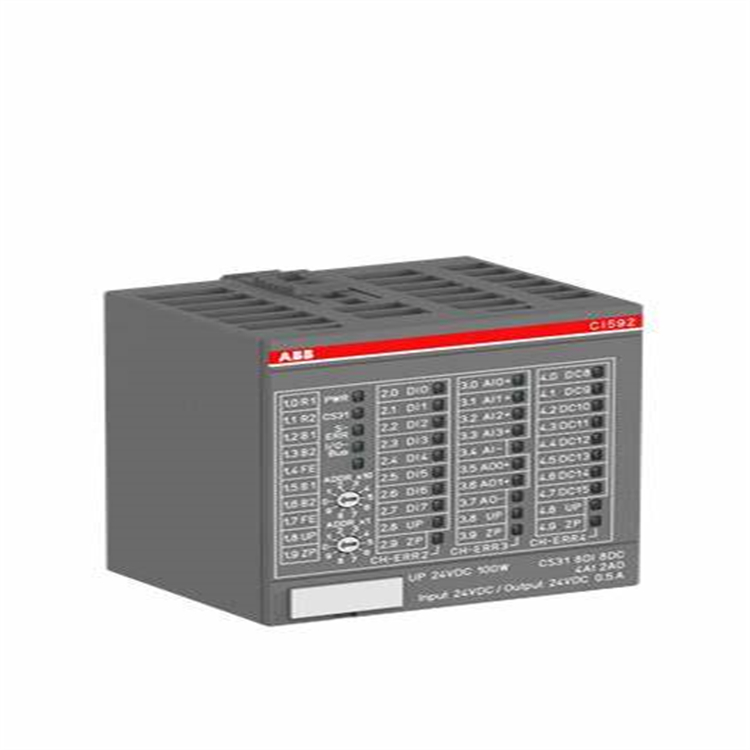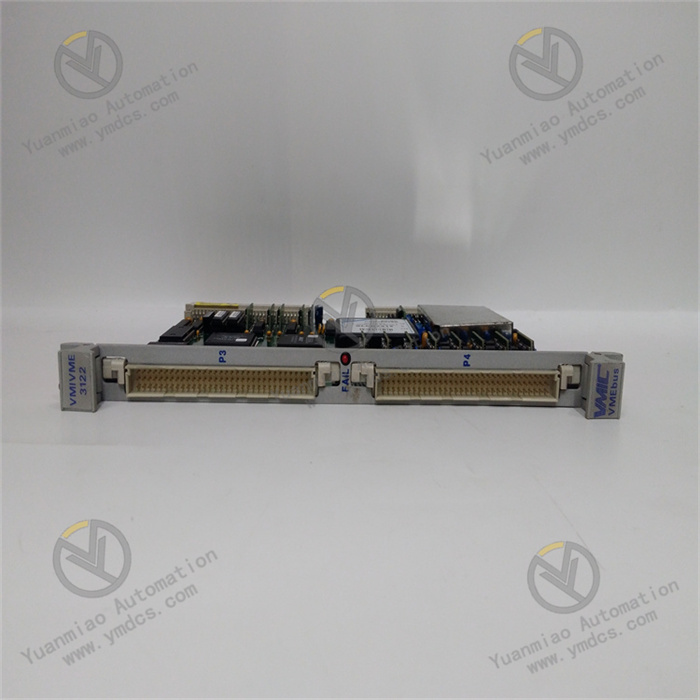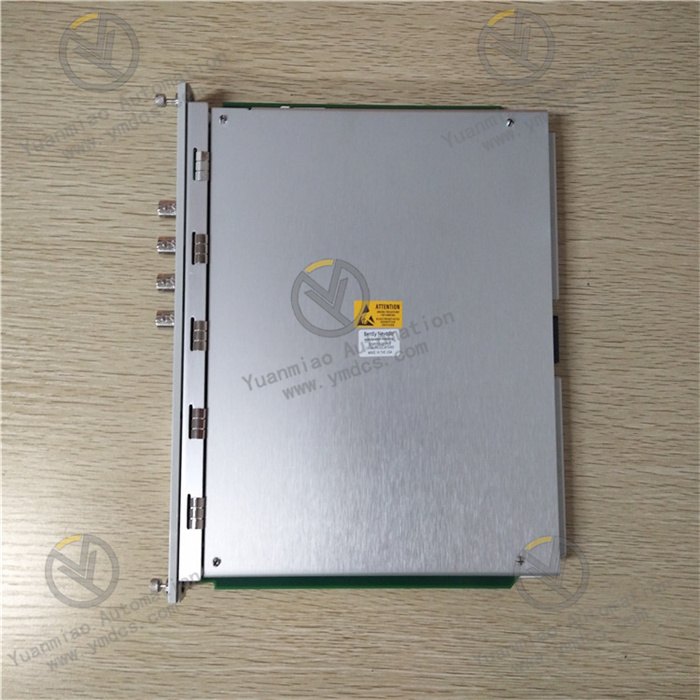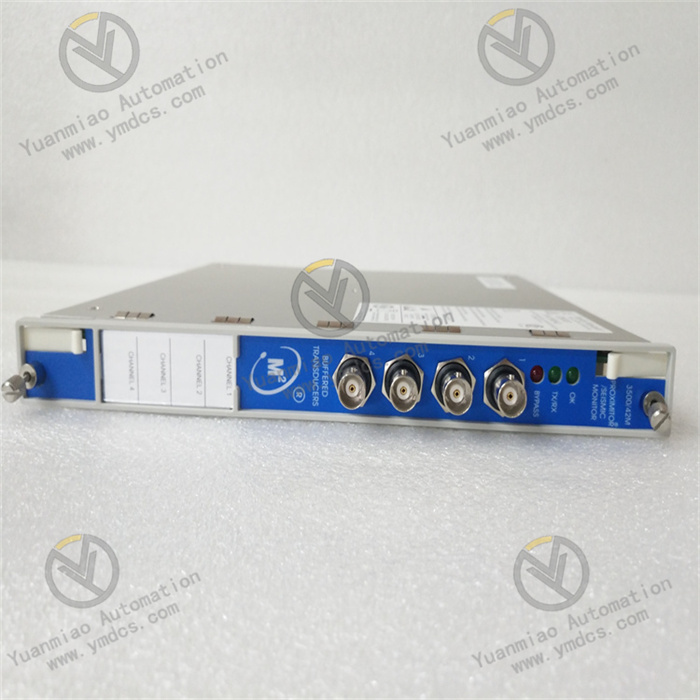
Description
ABB UNS0863A-P,V1 HIEE305082R0001
I. Product Description
- Model: UNS0863A‑P, V1
- Version: V1
- Global Part Number: HIEE305082R0001
- Product Series: ABB Industrial Control Module Series
- Product Category: Industrial Digital I/O Module (32 channels, 16 input + 16 relay output)
- Country of Origin: Switzerland
Core Functions
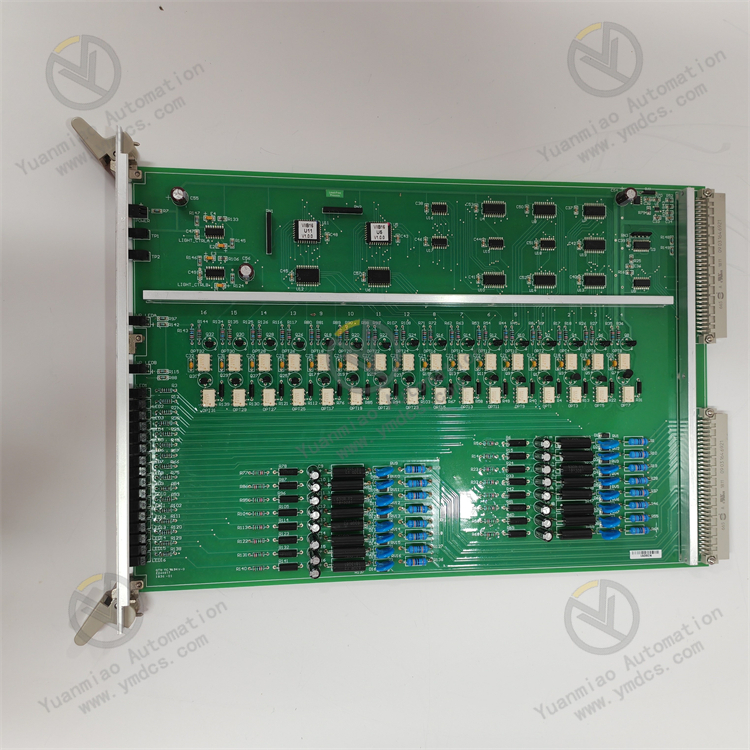
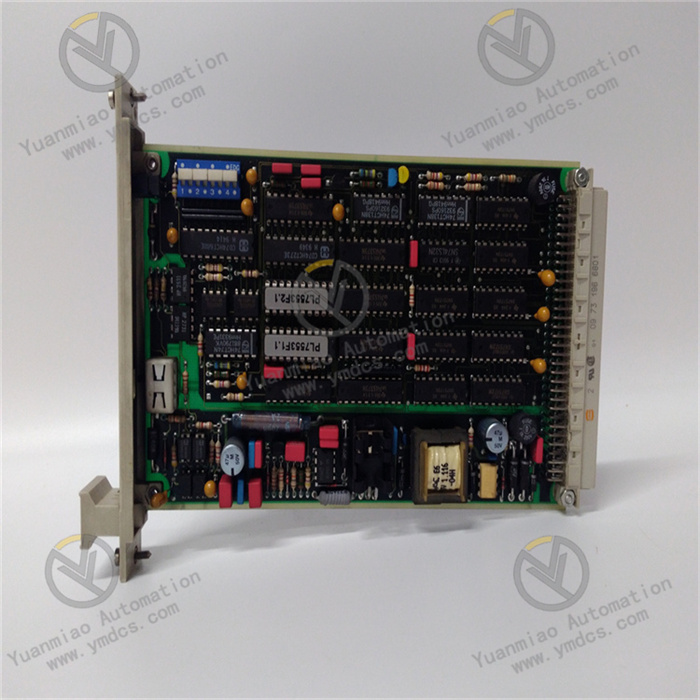
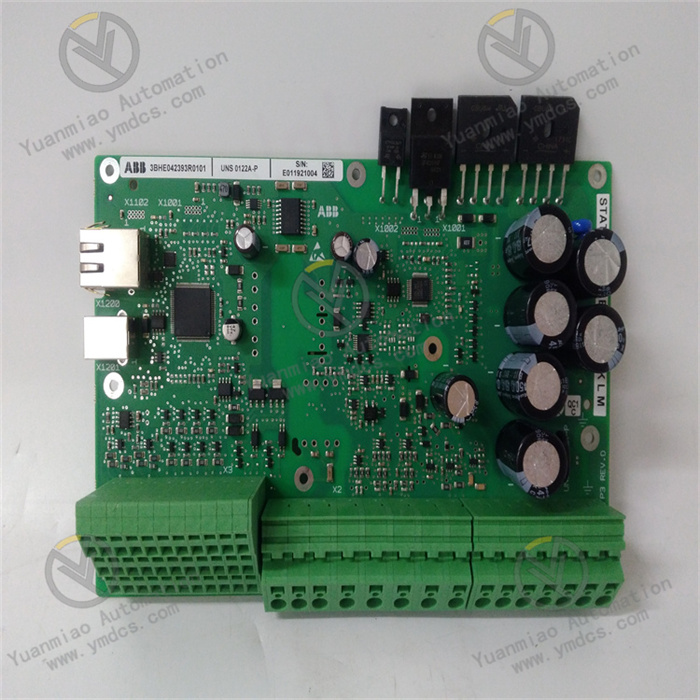
This device is an industrial‑grade digital I/O module manufactured by ABB, model UNS0863A‑P, V1, with global part number HIEE305082R0001. It is a high‑performance digital interface module designed specifically for industrial automation control systems.Its core functions are to achieve accurate acquisition, reliable transmission and efficient control of on‑site digital signals, and to establish a bidirectional communication link between field sensors, actuators and upper‑level control systems.Unlike ordinary I/O modules, its key advantages include high channel density, strong anti‑interference capability and flexible compatibility, enabling it to meet discrete control requirements in various industrial automation scenarios.
Built with industrial‑grade electronic components, the module features advanced galvanic isolation (2500V AC channel‑to‑system) and is fully compatible with ABB industrial controllers such as the AC 800M series.It supports 16 isolated digital inputs (24VDC sinking/sourcing) and 16 SPDT relay outputs (5A @ 250V AC), with configurable debounce filtering (0.1–20ms) to effectively resist interference in electrically noisy environments.It accurately captures digital status signals from field devices and outputs control commands to regulate associated actuators, enabling precise control of industrial production processes.
The module incorporates built‑in safety protection and self‑diagnostic functions, with a front‑mounted diagnostic LED array for real‑time monitoring of operating status and channel signal conditions, enabling fast fault identification and troubleshooting.It supports seamless integration with various ABB controllers, SCADA systems, CI871K01 communication interfaces, PM864AK01 processor units, and more.It supports multiple fieldbus protocols including Profibus DP and Modbus RTU, allowing rapid deployment without additional driver adaptation.Signal response speed is optimized (input ≤ 1ms, output ≤ 10ms).With a dual redundant power supply design, it ensures long‑term stable operation in harsh industrial environments, safeguarding the security, stability and continuity of industrial control networks.Its gold‑plated relay contacts guarantee more than 100,000 mechanical operations under rated load, extending service life.
Application Scenarios
Widely used in power generation (steam turbine control systems), automotive manufacturing (assembly line control), petrochemical, metallurgy, rail transit, water treatment, papermaking, glass manufacturing and other industrial fields requiring high system stability and signal transmission reliability.It is especially suitable for industrial automation production lines and discrete control scenarios, connecting field sensors, actuators, circuit breakers, solenoid valves and other equipment for digital signal acquisition and control.
Typical applications include: auxiliary system control in power plants, discrete control in metallurgical production lines, chemical safety interlock systems, station control in automotive assembly lines, operation monitoring of water treatment facilities, high‑speed discrete I/O processing in material handling systems, etc.It integrates seamlessly with ABB drives, PLCs, SCADA systems and HART‑compatible smart instruments for coordinated data control, and can also be used with the ABB SD822 fail‑safe module to enhance system safety integrity.
Deployable at the field control layer or control station of industrial control networks, it enables centralized acquisition, standardized transmission and precise control of on‑site digital signals.This helps operators monitor system status in real time and respond quickly to faults.With high reliability, high channel density and fast response, it ensures continuous and stable industrial production in 24/7 harsh environments with availability above 99.99%, especially for critical production sections requiring extremely high discrete control accuracy.It also supports automation control in public utilities such as gas supply, water supply and wastewater treatment
II. Technical Specifications
| Parameter Category | Details |
|---|---|
| Software Specifications | Model / Version: UNS0863A‑P, V1 (HIEE305082R0001)Supported Protocols: ABB proprietary protocol, Modbus TCP, Modbus RTU, Profibus DP; compatible with ABB RobotStudio, SCADA systems and industrial Ethernet standards; seamless integration with ABB CI871K01 communication interface and PM864AK01 processor unitCommunication Functions: 32‑channel digital I/O transmission (16 input, 16 output); input response ≤ 1ms, output response ≤ 10ms; configurable debounce filtering (0.1–20ms); 2500V AC signal isolation; real‑time status monitoring, fault alarm and data upload; multi‑module synchronous operation to avoid interference and phase shift; suitable for discrete control, station control and safety interlockingAccess Control: Three‑level permission management (Administrator, Operator, Read‑only) to prevent unauthorized operation and data tampering; configurable via dedicated softwareLogging: Real‑time recording of operation status, signal exceptions, faults and operations; log export and analysis; supports fault location for signal, communication and channel issues; combined with front LED indicators for fast channel fault identificationCompatibility: Seamless with all ABB industrial controllers (including AC 800M series), drives and SCADA systems; compatible with Windows Server (2012 R2 or later recommended); supports ABB SILworX programming tools and dedicated diagnostic software; direct connection to HART instruments and SD822 fail‑safe modules; compatible with multiple industrial automation architectures[3]Dependencies: Microsoft Visual C++ 2010 or later Redistributable; .NET Framework 4.0 or above; properly configured industrial Ethernet and fieldbus communication components and permissionsDiagnostics: Built‑in detection for communication loss, signal abnormality, hardware faults and channel faults with clear error codes; front diagnostic LED array for intuitive channel status display; integrates with ABB diagnostic tools for efficient troubleshooting |
| Hardware Requirements | Recommended Control Station / Server: CPU ≥ Intel Core i3 or equivalent; RAM ≥ 4 GB (8 GB recommended); free disk space ≥ 80 GB (SSD recommended) for smooth signal transmission and control executionInterfaces: At least one Gigabit Ethernet port (100 Mbit/s capable) for controller and monitoring communication; RS485 for Modbus RTU; 32‑channel digital I/O (16 × 24VDC inputs, 16 × SPDT relay outputs); 2500V AC isolation; USB port for local configuration and maintenance; pluggable terminal blocks for easy wiring and maintenance; standard industrial connectorsInstallation: DIN‑rail mounting in industrial cabinets; manual and standardized deployment; supports legacy configuration migration; backup and manual restore; compact size suitable for space‑constrained cabinets; compliant with industrial installation standards |
| Environmental Adaptability | Operating Temperature: -25℃ to +60℃ (wide‑temperature design for harsh environments)Storage Temperature: -40℃ to +85℃Relative Humidity: 5%–95% (non‑condensing)Immunity: Complies with industrial EMC standards and IEC 61131‑2; strong RFI/EMI resistance; supports dual redundant system buses for improved stability; withstands interference from drives and high‑voltage cables; built‑in EMI filtering for enhanced immunityOperational Stability: 24/7 continuous operation; MTBF ≥ 10,000 hours; dual redundant power supply for reliable operation in harsh environments; optional auto‑recovery; optimized reconnection and control logic to reduce outages, data loss and delays; industrial‑grade components and gold‑plated relay contacts; strict quality control and testing; CE and UL certified to international industrial standards |
III. Installation and Maintenance Guide
Pre‑installation Requirements
- Environment: Install in a dust‑free, non‑condensing, well‑ventilated industrial cabinet away from strong interference sources such as drives and high‑voltage cables. Maintain cabinet temperature -25℃~+60℃ and humidity 5%–95% non‑condensing. Ensure stable power supply (24VDC ±10%), typical power consumption 2.1W. A UPS is recommended to prevent equipment damage or configuration loss due to sudden power failure. Deploy separately from programming environments to reduce operational risk, especially in humid and high‑interference industrial environments such as water treatment and chemical plants.
- System Preparation: Use Windows Server 2012 R2 or later. Open firewall ports for RPC (135) and dynamic range 49152–65535. Install Microsoft Visual C++ 2010+ and ensure .NET Framework 4.0+ is functional. Verify network connectivity to ABB controllers and third‑party devices. Configure communication parameters and permissions, granting launch/activation rights to authorized personnel. Optimize filter settings and channel mapping for discrete and station control applications.
- Installation Procedure: Mount the unit on DIN rail in the industrial cabinet with secure wiring. Connect power, communication and I/O cables via pluggable terminal blocks, then power on (24VDC ±10%). Run the configuration software, follow the wizard, accept the license agreement, and use a path without spaces or Chinese characters. The system automatically checks communication and dependencies; install missing components manually. Restart the device and control station and confirm normal startup with proper LED indication. When upgrading from older modules, keep or import existing configurations and restart to activate all functions, with special attention to channel filter and output settings
- Parameter Configuration: Launch the software and set communication parameters (IP, port, protocol), then test connectivity with controllers and monitoring systems. Configure 32‑channel digital I/O mapping (16 input, 16 output), set signal response time, fault alarm thresholds and debounce filter values (0.1–20ms) to suit on‑site discrete control requirements. Set three‑level user permissions with strict control of high‑privilege accounts. Test signal acquisition and control output to ensure no delay or data loss, with LED status matching actual signals. Configure log storage paths and enable diagnostic logging.
Routine Inspection
- Operation Status: Check for error codes, normal front LED diagnostic indication, no abnormal heating or relay chattering. Verify stable communication with controllers and monitoring systems; confirm reconnection function, channel status and compliance of response time (input ≤1ms, output ≤10ms).
- Log Review: Regularly inspect device and system logs to identify signal exceptions, communication errors, permission issues and channel faults. Clean up old logs to save storage. Focus on records related to hardware faults, signal anomalies and short/open circuits; use LED indicators to quickly locate faulty channels.
- Network and Environment: Ensure secure Ethernet and RS485 connections with stable transmission above 100 Mbit/s. Check cabinet temperature, humidity and UPS status, with special attention to protection in humid environments. Inspect cables and terminals for looseness or damage; verify proper grounding for improved anti‑interference performance and secure pluggable terminal blocks.
- Parameter Verification: Confirm model and version: UNS0863A‑P, V1 (HIEE305082R0001). Check communication settings, permissions, signal mapping and filter parameters for unauthorized changes. Test I/O functions to ensure proper operation for discrete and station control. Verify compatibility of dependencies, effectiveness of safety and isolation measures, and status of dual redundant power supplies.
Periodic Maintenance
- Monthly: Dust the device, cabinet and front LED array; check operation, communication stability, signal reliability and channel status. Back up configurations. Inspect interfaces and terminal blocks for looseness. Verify fault alarm and LED indication functions; test relay operation smoothness.
- Quarterly: Monitor control station hardware utilization (CPU, RAM, disk). Install OS and dependency updates, especially communication and fieldbus‑related patches. Test access control. Review and adjust signal mapping and filter parameters. Verify transmission speed and response time (input ≤1ms, output ≤10ms). Inspect for potential hardware faults and relay contact wear; apply ABB official recommendations.
- Semi‑annually: Perform full backup of configurations and logs; verify integrity and repair anomalies. Check port configuration and optimize communication and filter parameters. Evaluate official patches and apply after testing. Restart the device and control station. Verify compatibility between ABB diagnostic tools, CI871K01 and this module. Conduct comprehensive risk assessment of hardware, communication and channel control; inspect signal isolation performance to ensure stable operation.
IV. Common Faults and Troubleshooting
| Fault Symptom | Possible Causes | Troubleshooting & Solutions |
|---|---|---|
| Device fails to start, initialization error | 1. Missing or outdated VC++ Redistributable or incompatible .NET Framework2. Incompatible device/control station version or abnormal adaptation with ABB CI871K013. Corrupted configuration, especially filter and channel mapping settings4. Configuration software not run as Administrator5. Improperly registered or configured communication/fieldbus components6. Installation/configuration path contains spaces or Chinese characters | 1. Install/update VC++ 2010+ and confirm .NET 4.0+2. Use Windows Server 2012 R2 or later and ensure compatibility with configuration software and CI871K013. Restore backup configuration or reconfigure parameters, focusing on filters and channel mapping4. Launch software with administrative privileges5. Verify registration of communication/fieldbus components and reconfigure parameters6. Reconfigure using a path without spaces or non‑English characters and restart |
| Cannot connect to controller / monitoring system, communication lost | 1. Incorrect IP, port or fieldbus protocol settings2. Loose cables, network failure or abnormal bandwidth3. Firewall blocking ports 135, 49152–65535 or fieldbus ports4. Permission or registration failure of communication/fieldbus components5. Controller, monitoring system or CI871K01 fault or not running6. Reconnection logic not activated | 1. Verify and reconfigure communication/fieldbus parameters and test connectivity2. Check cabling, restart network equipment and ensure ≥100 Mbit/s3. Open required firewall ports for Ethernet and fieldbus4. Correct permissions and registration of communication components5. Inspect controller, monitoring system and CI871K01 status and protocol matching6. Check reconnection settings and restart the device |
| Abnormal digital I/O or channel unresponsiveness | 1. Incompatible client and device versions2. Insufficient client access permissions3. Unstable network causing signal delay4. Device malfunction, incorrect wiring or loose terminal blocks5. Wrong communication, mapping or filter parameters6. Worn relay contacts, channel short/open circuit or LED fault | 1. Use a compatible client version2. Assign proper access permissions on the device3. Improve network stability and reduce interference4. Restart the device, check wiring and re‑seat terminal blocks5. Verify and correct communication, mapping and filter settings (0.1–20ms)6. Inspect relay contacts, replace faulty parts, check LEDs and troubleshoot channel faults |
| Signal delay, loss or unrecognized signals | 1. Network instability or bandwidth < 100 Mbit/s2. Incorrect signal path or channel mapping3. High control station load4. Excessive log storage usage5. Unreasonable filter or response time settings6. Faulty communication/fieldbus components or poor grounding | 1. Upgrade network, ensure stable high‑speed connection, improve grounding and enable EMI filtering2. Correct mapping using dedicated tools to avoid input errors3. Close background processes; upgrade RAM to 8 GB if needed4. Delete old logs and restart the device5. Adjust filters (0.1–20ms) and response times (input ≤1ms, output ≤10ms)6. Check and restart communication services; verify grounding |
| Frequent faults, auto‑restart or abnormal relay output | 1. Insufficient control station hardware resources2. Hardware damage (interface failure, component aging, relay wear, poor terminal contact)3. Invalid configuration including filters, mapping and power settings4. Environmental interference (high temperature, humidity, strong EMI)5. Incompatible dependencies or fieldbus protocol mismatch6. Unstable power (outside 24VDC ±10%), poor grounding or dual redundant power supply fault | 1. Upgrade hardware (8 GB RAM recommended) and optimize resource allocation2. Inspect hardware, replace faulty unit or parts, re‑seat terminals3. Restore valid configuration and recheck filters, mapping and power parameters4. Improve cabinet environment, ventilation and isolation from interference5. Update dependencies and verify fieldbus protocol settings6. Stabilize power supply (24VDC ±10%), check UPS, repair grounding and dual power supply status, then restart |