Description
1. Product Overview
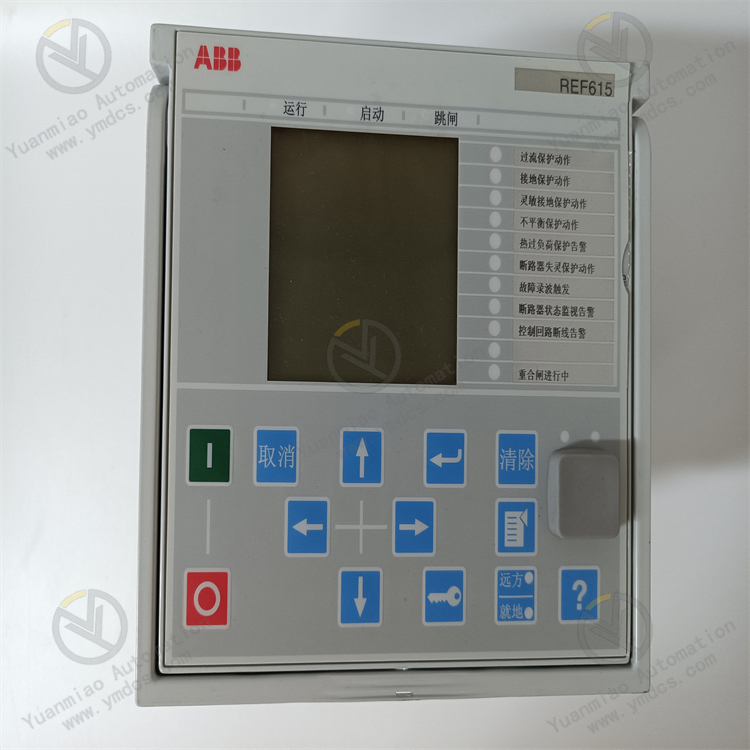
ABB REF615C-D (Full Order Code: HCFFAEAGABC2BAA1XD) is an industrial high-end enhanced intelligent feeder protection and control IED within the ABB Relion® 615 series. It is custom-developed for smart distribution networks with bidirectional power flow integrating distributed PV, energy storage and wind power, complex industrial auxiliary power systems, and urban ring networks equipped with self-healing capability. Integrating high-precision relay protection, full-range electrical measurement, intelligent circuit breaker management, arc fault protection, feeder automation (FA) self-healing, full-process fault recording and tracing, dual redundant Gigabit communication and comprehensive equipment self-supervision, this device serves as the core secondary equipment for digitalization, self-healing upgrade and high-reliability transformation of new-generation 10 kV/35 kV medium-voltage smart distribution networks.
This model is a specially customized variant of REF615C-D. Compared with standard C/E versions, it upgrades six core functions: arc fault protection, high harmonic-resistant sampling, adaptive protection for bidirectional power flow, dual-network redundant communication, millisecond-level FA self-healing interlocking and high-precision power quality analysis. It perfectly adapts to medium-voltage distribution operating conditions featuring high penetration of renewable energy, drastic load fluctuation, complex electromagnetic environment and strict power supply reliability requirements. The hardware I/O allocation, logic program and communication configuration are standardized for domestic power grids, fully complying with technical specifications for intelligent distribution equipment issued by State Grid and China Southern Power Grid. Compatible with radial, ring and meshed network topologies, it supports direct in-situ replacement of legacy protection and control devices. It is widely deployed in smart substations, renewable energy interconnection points, industrial captive power plants, park self-healing distribution networks and critical municipal power supply feeders.
The IED strictly complies with international IEC power standards and holds IEC 61508 SIL3 functional safety certification, full IEC 61850 Ed2 protocol certification and full-grade industrial EMC anti-interference certification. Adopting ABB’s mature pluggable modular industrial hardware architecture, it is equipped with high-speed power-dedicated processors, high-precision synchronous sampling units, independent harmonic analysis chips and dual redundant communication modules. Outstanding advantages include accurate protection operation, ultra-fast fault response, comprehensive power quality monitoring, stable parameters without drift over long-term operation and maintenance-free stable performance, fully meeting all-scenario requirements of unattended operation, self-healing control, precise fault tracing and compliant maintenance for modern smart distribution networks.
2. Technical Features
2.1 Built-in Arc Fault Protection for High-Risk Switchgear Applications
This model is equipped with native arc fault detection and protection logic. It can accurately identify latent severe faults inside medium-voltage switchgear such as insulation breakdown, busbar short-circuit and internal arc flashover, and achieve millisecond-level fast tripping and isolation, effectively preventing catastrophic accidents including switchgear burnout, busbar damage and large-area power outages. It delivers ultra-high sensitivity for latent arc faults caused by internal humidity, equipment aging, dust accumulation and insulation degradation, filling the gap that conventional feeder protection cannot monitor arc hazards inside switchgear. It greatly improves operational safety of complete switchgear assemblies and satisfies high-reliability operation requirements for industrial sites, renewable energy stations and critical municipal power supply circuits.
2.2 Optimized for Renewable Energy, Adaptive Operation under Bidirectional Power Flow
It adopts upgraded dedicated protection algorithms for distributed generation interconnection and embeds highly sensitive anti-islanding protection. It can accurately detect subtle islanding conditions and complete tripping isolation within ≤200 ms, thoroughly eliminating grid safety risks induced by island operation of renewable resources. The optimized adaptive identification mechanism for bidirectional power flow automatically accommodates frequent switching between forward and reverse power flow. It precisely distinguishes anomalies including harmonic disturbance, abrupt load variation, voltage flicker and power flow offset originating from renewable integration, suppresses harmonic interference on protection sampling, and fundamentally prevents protection mal-operation, failure to trip and selective tripping malfunction. It fully meets operational standards for modern distribution networks with high renewable penetration.
2.3 Millisecond-Level FA Self-Healing Control Enables Unattended Grid Operation
Embedded with advanced native FA feeder automation control logic, supported by high-speed peer-to-peer GOOSE communication, it realizes fully automatic unattended handling for distribution circuits: accurate fault location → instantaneous fault isolation → rapid power restoration of non-fault sections. Fault section isolation can be completed within ≤100 ms, and load transfer and power restoration for non-fault areas within ≤300 ms. It minimizes outage scope and duration, supports live maintenance, grid reconfiguration and intelligent load dispatching, and comprehensively satisfies self-healing and unattended operation requirements of smart distribution networks.
2.4 Comprehensive Power Quality Monitoring for Smart Grid Management
Compared with standard versions, it enhances harmonic analysis and power quality statistics. It accurately monitors power quality indicators including harmonic contents of each order, three-phase unbalance factor, voltage deviation, frequency fluctuation and flicker disturbance, and automatically generates power quality trend reports and abnormal alarm records. It enables precise localization of power quality defects triggered by renewable interconnection, variable-frequency loads and impact loads, providing accurate data support for grid power quality governance, setting optimization and hidden risk investigation, and satisfying refined management demands of smart grids.
2.5 Dual Redundant Gigabit Communication Ensures Stable Networking and Strong Compatibility
Equipped with dual redundant Gigabit Ethernet interfaces together with extended RS485/RS232 ports, it fully supports mainstream power protocols including IEC 61850 Ed2, GOOSE, IEC 60870-5-103, Modbus RTU/TCP and DNP3. It supports multiple topologies such as PRP/HSR redundant networking, GOOSE peer-to-peer networking and bus networking. The dual-network hot standby redundant design thoroughly avoids equipment disconnection, data interruption and remote control failure caused by single communication channel breakdown. It seamlessly connects with various substation automation systems, distribution automation platforms and power dispatching backends, ensuring stable and reliable digital operation and coordinated control.
2.6 Pluggable Modular Hardware for Simplified Maintenance and Wide Compatibility
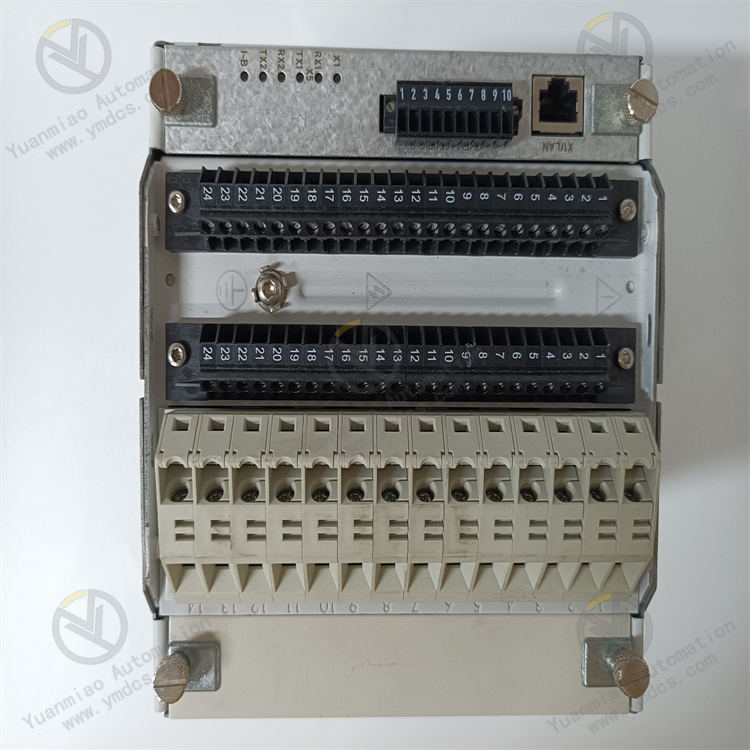
Utilizing ABB’s classic industrial pluggable modular architecture, power supply, sampling, I/O and communication modules are arranged in independent partitions without mutual interference. Individual modules can be replaced without powering off the whole unit, modifying secondary wiring or reconfiguring programs. The customized I/O allocation of HCFFAEAGABC2BAA1XD fully matches wiring specifications of mainstream 10 kV/35 kV switchgears and ring main units in China. High hardware interchangeability enables rapid in-situ replacement of legacy equipment, system expansion and intelligent technical retrofit, significantly cutting operation and retrofit costs.
2.7 Rigorous Industrial-Grade Protection Suitable for Harsh Field Conditions
The unit has passed complete IEC 61000 EMC tests, temperature cycling aging, vibration shock and humidity cycling tests. Front panel protection class reaches IP54 and terminal block protection class IP20, delivering excellent dustproof, moisture-proof, seismic and anti-electromagnetic interference performance. Free of mechanically wearable components, it features low power consumption and low temperature rise, supporting continuous unattended 7×24-hour operation. It can operate steadily in outdoor switch stations, industrial workshops with strong electromagnetic interference, renewable interconnection stations and humid power distribution rooms and other complex harsh environments.
2.8 Dual HMI + Comprehensive Self-Supervision for Compliant Traceability and Efficient O&M
It integrates a high-resolution local Chinese LCD Human-Machine Interface (LHMI) and remote web-based HMI (WHMI). Local parameter setting, fault inquiry, real-time data monitoring and circuit commissioning are supported, alongside remote online configuration, oscillography export, protection logic verification and remote parameter modification. Built-in integrated hardware and software self-supervision continuously monitors operating status of power supply, sampling circuits, I/O ports and communication links around the clock. It accurately locates fault points and triggers both local and remote active alarms. Fault records, SOE event logs, operation records and power quality data are persistently stored, fully meeting power industry requirements for fault tracing, compliant filing and acceptance inspection.
3. Technical Specifications
3.1 Basic Specifications
Model: REF615C-D Full Order Code: HCFFAEAGABC2BAA1XD Brand: ABB Series: High-End Enhanced Version of Relion® 615 Series Device Type: Medium-Voltage Intelligent Feeder Protection and Control IED (Integrated Arc Fault Protection + Power Quality Analysis) Core Functions: Complete feeder protection, switchgear arc fault protection, renewable interconnection protection, bidirectional power flow control, FA self-healing automation, full electrical quantity measurement, power quality analysis, dual redundant communication, fault tracing and maintenance Application Range: 10 kV/35 kV distribution networks with renewable integration, urban self-healing ring networks, complex industrial auxiliary power systems, smart substations, intelligent upgrade of legacy distribution systems, critical power supply circuits Hardware Characteristics: Pluggable modular structure, high-precision synchronous sampling, independent harmonic analysis chip, dual Gigabit redundant communication, industrial anti-interference hardware Core Advantages: Integrated arc fault protection, strong adaptability to renewable operating conditions, fast FA self-healing, comprehensive power quality monitoring, stable redundant communication, convenient maintenance, zero parameter drift during long-term operation
3.2 Protection Function Specifications
Main Protection Functions: Three-stage overcurrent protection (instantaneous overcurrent, definite time delayed overcurrent, long time overcurrent), residual overcurrent protection, high-sensitivity earth fault protection, negative sequence overcurrent protection, high-performance anti-islanding protection (trip response ≤200 ms), bidirectional power flow anomaly protection, switchgear arc fault protection Backup Protection: Overvoltage protection, undervoltage protection, overload protection, thermal protection, under-frequency load shedding, over-frequency protection, three-phase unbalance protection, voltage/frequency interlock protection Auxiliary Protection: Circuit breaker failure protection, auto-reclosing, fault blocking, soft-start blocking, circuit supervision, harmonic over-limit protection, trip circuit supervision Protection Accuracy: Setting error of current/voltage protection ≤ ±1.5%; operating time error ≤ ±20 ms Operating Characteristics: Supports both definite time and inverse time modes; customizable protection curves for grading coordination of multi-level power networks Self-Healing Performance: FA fault isolation ≤100 ms; power restoration of non-fault sections ≤300 ms Fault Tolerance: Adaptive to renewable harmonic interference, abrupt load changes, bidirectional power flow fluctuations and industrial electromagnetic interference to avoid protection mal-operation and failure to trip
3.3 Measurement and Power Quality Specifications
Measured Quantities: Three-phase currents, three-phase voltages, active power, reactive power, apparent power, power factor, system frequency, three-phase unbalance factor, accumulated energy, real-time bidirectional power flow direction Power Quality Monitoring: Harmonic contents from 2nd to 31st order, voltage fluctuation, frequency deviation, three-phase unbalance rate, power quality extreme value recording, trend analysis Measurement Accuracy: Current and voltage ±1.5%; power and energy ±2.0%; frequency ±0.01 Hz Sampling Characteristics: High-speed synchronous sampling plus adaptive harmonic filtering, suitable for steady-state, dynamic, bidirectional power flow and heavy harmonic disturbance operating conditions Data Statistics: Daily/monthly/yearly energy accumulation, load curve storage, automatic generation of power quality reports, persistent storage of abnormal data
3.4 Communication and Interface Specifications
Communication Protocols: IEC 61850 Ed2, GOOSE, IEC 60870-5-103, Modbus RTU/TCP, DNP3, IEEE 1588 time synchronization protocol Communication Interfaces: Dual redundant Gigabit Ethernet ports (supporting PRP/HSR), RS485/RS232 serial ports Network Topologies: Dual-network hot standby redundancy, GOOSE peer-to-peer networking, point-to-point and bus topology compatible with smart self-healing grid architecture Data Transmission: Real-time uploading of telemetry, telesignalling and power quality data, remote reception of remote control and remote adjustment commands, millisecond-level push of fault messages, oscillography files and alarm information Commissioning Interfaces: Dedicated local service port, remote web commissioning port supporting online configuration, parameter modification, logic verification, oscillography export and data analysis
3.5 Power Supply Specifications
Operating Power: Wide-range universal AC/DC power supply Input Range: 80%~120% of rated voltage, tolerating regular grid fluctuations, transient voltage surges and short-duration power interruptions Power Circuit Features: Built-in surge, ESD, overvoltage and overcurrent protection circuits suitable for complex grid and industrial conditions Power Consumption: Low overall power design with low temperature rise, no power drift and parameter shift over long-term operation Supply Stability: Continuous operation during transient grid fluctuations and short power interruptions without device restart or data loss
3.6 I/O and Control Specifications
Digital Inputs: Multiple passive galvanically isolated DI channels for circuit breaker position, spring charged status, local/remote selector, equipment alarms, interlock status, arc fault signals and grid operating signals Digital Outputs: Multiple relay DO channels for circuit breaker tripping/closing drive, fault trip output, arc fault alarm, system interlocking and FA self-healing control output Control Functions: Local manual control, remote control, user-defined logic interlocks, auto-reclosing, FA coordinated self-healing control, fault lockout, bidirectional power flow blocking, emergency blocking upon arc fault detection I/O Characteristics: Galvanic isolation on all ports for anti-interference and anti-false triggering, adapted to high electromagnetic environments at renewable energy sites Interlock Logic: User-configurable multi-channel I/O blocking and interlock logic for special operating conditions of ring networks, renewable interconnection systems and arc fault protection of switchgear
3.7 Environmental and Certification Specifications
Operating Temperature: -25℃ ~ +55℃ Storage Temperature: -40℃ ~ +85℃ Operating Humidity: 5%~95%RH (non-condensing, no corrosive gas) Electromagnetic Compatibility: Complies with IEC 61000 series industrial EMC standards; resistant to strong electromagnetic fields, high-frequency harmonics and electrostatic discharge Mounting Type: Standard embedded cabinet mounting Device Weight: Approx. 2.5 kg Operation Mode: Unattended continuous 7×24-hour stable operation Compliance: Conforms to international IEC power standards and technical specifications for intelligent distribution equipment of State Grid and China Southern Power Grid
4. Operating Principle
The ABB REF615C-D HCFFAEAGABC2BAA1XD enhanced feeder protection and control IED takes a high-performance power-dedicated main controller as its core. It integrates an independent arc fault detection unit, harmonic analysis unit and dual redundant communication processing unit. Supported by high-precision synchronous sampling technology, adaptive filtering algorithms, dedicated protection logic for bidirectional power flow under renewable interconnection, arc fault identification algorithms and advanced FA self-healing programs, it realizes integrated intelligent functions including medium-voltage feeder protection, arc fault protection, power quality monitoring, intelligent control, self-healing coordination and fault tracing.
Upon power-on, the unit automatically executes comprehensive hardware self-test, sampling circuit verification, initialization of arc detection unit, I/O configuration, matching of dual communication links and loading of system parameters and self-healing logic. It rapidly completes initialization and enters standby status to ensure fault-free startup and coordinated stable operation of all functional modules.
During normal operation, high-speed synchronous sampling circuits continuously collect fundamental electrical quantities including feeder three-phase currents, three-phase voltages and system frequency. After adaptive harmonic filtering processing, core operating parameters such as power, energy, power flow direction, harmonic contents and three-phase unbalance are accurately calculated. The arc detection unit monitors internal arc anomalies of switchgear 24/7 to predict latent cabinet faults. On one hand, the local LCD displays operating data, equipment status, power quality information and alarms for on-site inspection and commissioning. On the other hand, four-remote data and power quality data are uploaded in real time to background systems via dual redundant Gigabit communication links to achieve full-range visualized, digitalized and refined management of distribution circuits. Meanwhile, circuit breaker status, spring charged status and local/remote signals are continuously collected, and preset interlock and blocking logic are strictly executed to adapt to bidirectional power flow and complex grid operating conditions.
When electrical faults occur on the feeder such as short-circuit, overload, earth leakage, abnormal voltage/frequency, three-phase unbalance, islanding operation, excessive harmonics and power flow disorder, or high-risk faults such as arc flashover and insulation breakdown inside switchgear, the IED instantly triggers corresponding dedicated protection logic. It accurately identifies fault type, magnitude and duration and rapidly outputs trip commands to isolate faults. Islanding faults from renewable generation can be cleared within 200 ms, and arc faults are tripped at millisecond speed to prevent catastrophic equipment damage. Upon fault occurrence, the FA self-healing system is activated simultaneously. Via high-speed GOOSE communication and coordination with adjacent IEDs, fault sections are isolated within 100 ms and power supply is restored for non-fault areas within 300 ms to maximize power supply reliability. Fault recording, SOE sequenced event logging, fault message storage and abnormal power quality data saving are automatically activated. Complete waveforms, time sequences and parameter data throughout fault events are retained to support fault review, hidden danger investigation, power quality governance and setting optimization.
For daily operation and maintenance, local manual control, remote circuit breaker control, online parameter setting and logic commissioning are supported. Comprehensive hardware and software self-supervision monitors hardware faults, circuit anomalies and communication interruptions round the clock with active alarms. It fully safeguards safe, stable, self-healing and refined efficient operation of smart distribution networks with high renewable penetration and complex industrial power systems.
5. Application Scenarios
5.1 Smart Distribution Systems for Renewable Energy Interconnection
Suitable for 10 kV/35 kV circuits with multiple PV, wind and energy storage interconnections. Leveraging anti-islanding protection, adaptive bidirectional power flow algorithms, harmonic and power quality monitoring functions, it addresses key challenges including islanding risks, voltage fluctuation, harmonic exceeding limits, power flow disorder and protection mal-operation caused by renewable integration. It ensures safe grid connection and stable consumption of renewable energy and satisfies intelligent operation and power quality control requirements for distribution networks with high renewable penetration.
5.2 Arc Fault Protection for High-Risk Switchgear Applications
Specially matched with indoor switchgears, ring main units and busbar cabinets. With dedicated arc fault protection, it accurately detects latent faults induced by insulation aging, dust and moisture, and insulation breakdown flashover. Millisecond-level tripping minimizes losses and thoroughly prevents catastrophic accidents such as switchgear burnout, busbar short-circuit and large-area power outages. It is widely adopted in critical high-reliability power supply scenarios including municipal key loads, data centers, hospitals and critical industrial loads.
5.3 Self-Healing Management of Urban Smart Distribution Networks
Applicable to ring feeders, tie feeders and sectionalizing feeders in urban smart distribution networks. Supported by ultra-fast FA feeder automation self-healing functions, fully automatic unattended fault location, isolation and power restoration are realized. Intelligent load transfer, live maintenance and grid reconfiguration are supported to significantly improve power supply reliability of urban distribution networks and adapt to unattended intelligent distribution operation modes.
5.4 Industrial Auxiliary Power Systems with Complex Bidirectional Power Flow
Applied to medium-voltage plant service circuits with captive power plants, waste heat power generation and on-site distributed PV in metallurgical, chemical, manufacturing and other industrial facilities. Aiming at characteristics of industrial systems including large load fluctuation, numerous impact loads, severe harmonics, frequent bidirectional power flow switching and complex electromagnetic environment, it secures continuous production and avoids economic losses caused by power outages via accurate stable protection logic and strong anti-interference performance. It also provides data support for on-site power quality governance.