Description
1. Product Overview
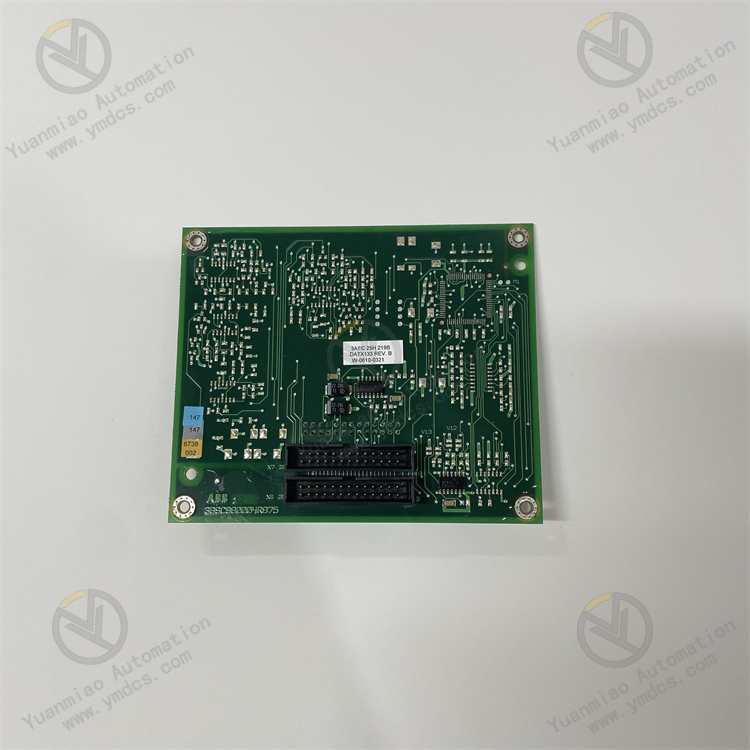
Full Model: DATX133 3ASC25H219B
Manufacturer: ABB
Product Series: DATX Series Distributed Digital I/O Control Module
Product Name: Multi-function Digital Signal Acquisition Module, NAMUR Intrinsically Safe Signal Input Module
Product Positioning
ABB DATX133 3ASC25H219B is a high-performance digital I/O module designed for ABB industrial distributed control systems. It is developed for discrete signal acquisition, sensor signal monitoring in hazardous areas and low-voltage logic signal access. Different from ordinary general I/O modules, this module natively supports dual-mode acquisition: NAMUR intrinsically safe sensor signals and standard DC digital signals. It can be directly connected to hazardous area sensors and low-voltage logic control equipment without additional signal isolation or conversion modules, greatly simplifying the architecture of intrinsically safe control loops. Adopting industrial rugged construction with dust-proof and anti-interference capability, the module meets the demand of 24/7 continuous operation in flammable and explosive high-risk industries such as chemical and oil & gas sectors, as well as general automated production lines. It is widely applied in engineering projects including I/O point expansion for new and legacy automation systems, reconstruction of intrinsically safe detection loops, centralized acquisition of field discrete signals and upgrade of equipment condition monitoring.
Core Functions
The module fulfills four core responsibilities: precise acquisition of industrial digital discrete signals, adaptation and interpretation of NAMUR intrinsically safe sensor signals, real-time identification and upload of field equipment status, and fault monitoring & abnormal protection of I/O loops. It stably collects valve status, equipment start/stop signals, limit switch signals and process monitoring signals within hazardous areas. The physical field signals are converted into standard bus data recognizable by the system and transmitted to DCS/PLC master controllers in real time, providing accurate signal basis for process interlock, equipment linkage, status monitoring and fault alarming. Built-in loop self-check and fault identification mechanisms accurately detect open circuits, short circuits and abnormal signals, preventing false equipment actions and process runaway caused by spurious signals, and ensuring operational safety, stability and reliable linkage for both intrinsically safe zones and conventional industrial control systems.
Compatible Systems
Fully compatible with ABB distributed control systems, process automation control systems and corresponding standard rack backplane bus architecture. It can seamlessly network and cooperate with master control units, analog modules, communication modules and relay output modules. Natively supported by official ABB configuration and commissioning software, enabling signal type configuration, threshold parameter setting, online I/O status monitoring, fault parameter calibration, online program debugging and remote parameter modification. The module features excellent backward compatibility and in-situ replacement capability. It supports non-destructive hot-swap replacement of legacy I/O modules of the same series without cabinet wiring modification or system logic program revision. It suits various industrial retrofits: compatibility upgrade of new and old systems, intrinsically safe loop renovation, I/O point expansion and improvement of signal acquisition accuracy.
Application Scenarios
Primarily deployed in industrial sites equipped with ABB automation systems, including oil & gas chemical industry, fine chemicals, petrochemical refining, thermal power, metallurgy, intelligent manufacturing and hazardous-area plants. Typical applications: acquisition of NAMUR sensor signals in hazardous areas, centralized monitoring of field discrete status, access of low-voltage DC logic signals, collection of equipment start/stop and limit interlock signals, and status monitoring of critical process points. It can withstand harsh on-site conditions including dust, humidity, mechanical vibration, electromagnetic interference and voltage fluctuation over long-term operation. Particularly suitable for safe signal acquisition in flammable and explosive hazardous locations, it delivers a compliant, stable and highly reliable digital signal acquisition solution for industrial intrinsically safe control systems.
2. Technical Features
Dual-Signal Acquisition Support for Wide Application Coverage
Supports both IEC 60947-5-6 standard NAMUR intrinsically safe signals and conventional DC5V/DC24V digital logic signals. It can interface with dedicated NAMUR sensors for hazardous areas as well as standard industrial switches, limit switches and relay status signals. A single module covers signal acquisition requirements for both intrinsically safe and general applications, offering higher versatility than single-function I/O modules. When matched with safety barriers, it can be directly deployed for signal acquisition in explosive hazardous areas without extra signal conversion equipment, simplifying field wiring and equipment layout.
High-Precision Signal Discrimination with Excellent Anti-Interference Performance
Equipped with dedicated signal shaping and threshold discrimination circuits to accurately distinguish valid discrete signals, weak interference noise and loop fault signals. It effectively suppresses signal jitter and false switching caused by electromagnetic interference and induced voltage on site. Dedicated algorithm processing for NAMUR signals enables reliable identification of three states: sensor normal operation, open circuit and short circuit. It eliminates signal misjudgment in hazardous zones and guarantees accuracy and safety of signal acquisition under high-risk operating conditions.
Industrial-Grade Electrical Protection for Stable and Reliable Operation
Independent electrical isolation for each signal loop, together with multi-layer hardware and software protection against overvoltage, overcurrent, short circuit, surge and electrostatic discharge. Fully compliant with industrial EMC standards and specifications for intrinsically safe automation equipment. It effectively resists high-frequency interference from variable frequency drives, electromagnetic radiation during motor startup/shutdown, line surge impact and ground potential difference. No signal disorder, data fluctuation or loop breakdown occurs under complex industrial conditions, making it suitable for non-stop continuous operation.
Hot-Swap Replacement Without System Shutdown for Efficient Maintenance
Supports in-situ hot-swap installation and replacement on the rack. Module replacement or equipment upgrade can be performed without shutting down the system or powering off the whole cabinet, leaving the rest of the system operating normally. It significantly reduces production loss and maintenance risks. Visual status indicators on the front panel clearly display operating status, signal connection, loop faults and bus communication anomalies for fast and accurate fault localization, shortening maintenance response time greatly.
Intelligent Loop Self-Diagnosis with Full Traceability of Faults
Three-level self-diagnosis covering channel level, loop level and module level. It continuously monitors potential risks such as open circuit, short circuit, signal overrange, power supply abnormality, bus disconnection and module overtemperature. Fault codes are automatically generated and operation logs are stored. Supports online parameter calibration, I/O point testing and non-stop debugging. Loop inspection and function verification can be completed without disassembly, lowering on-site maintenance difficulty substantially.
Compact Industrial Rugged Design with Strong Environmental Adaptability
Constructed with high-reliability industrial PCB and wide-temperature anti-aging components, enhanced with moisture-proof, dust-proof, vibration-proof and shock-resistant treatments. Compact size and low power consumption. Stable operation under extended temperature range. Capable of enduring alternating temperature & humidity, dust accumulation and continuous mechanical vibration on industrial sites. No signal drift, parameter loss or circuit aging failure after long-term service, delivering outstanding durability and environmental adaptability.
High-Speed Bus Communication for Real-Time Data Synchronization
Compliant with ABB system backplane high-speed bus protocol. Acquired discrete status, sensor operating conditions and loop fault information can be uploaded to the master control system within milliseconds to refresh upper monitoring data in real time, ensuring real-time and accurate process interlock and equipment linkage. Meanwhile, it rapidly receives configuration commands from the upper system to complete I/O parameter setting and function adaptation, achieving seamless synchronous linkage between field points and the control system.
3. Specification Parameters
| Item | Parameter |
|---|---|
| Model | DATX133 3ASC25H219B |
| Manufacturer | ABB (ABB Group, Switzerland) |
| Product Series | DATX Series Distributed Multi-Function Digital I/O Module |
| Module Type | NAMUR Intrinsically Safe Signal Acquisition Module, Industrial Digital Discrete Input Module |
| Applicable Systems | ABB distributed control systems, full range of process automation control systems |
| Configuration & Commissioning | Official ABB configuration software; supports signal type configuration, threshold setting, online monitoring and remote debugging |
| Core Functions | NAMUR intrinsically safe sensor signal acquisition, DC digital logic signal acquisition, loop fault self-diagnosis, status data upload, interlock signal processing |
| Supported Signal Standards | IEC 60947-5-6 NAMUR intrinsically safe signals, DC5V/DC24V industrial digital signals |
| Channel Configuration | Single channel high-precision signal acquisition |
| Maximum Load Current | 5A |
| System Power Supply | Industrial standard DC24V |
| Power Consumption | Low power design for long-term continuous operation |
| Operating Temperature | -40℃~+70℃ (extended industrial temperature range) |
| Storage Temperature | -45℃~+80℃ |
| Ambient Humidity | 5%~95%RH, non-condensing; suitable for humid and dusty industrial environments |
| Protection Class | IP20 (module body) |
| Mounting Method | Snap-in installation on standard system rack slots, supports hot-swap replacement |
| Isolation & Protection | Independent electrical isolation for signal loops; multi-protection against overvoltage, overcurrent, short circuit, surge and electrostatic discharge |
| O&M Features | Three-level full-range self-diagnosis, fault code traceability, online non-stop debugging, hot-swap replacement, visual status indication |
| Product Characteristics | Compatible with intrinsically safe signals, dual-signal acquisition, strong anti-interference, precise signal discrimination, low power consumption, non-stop maintenance, stable operation |
4. Working Principle
4.1 Power-On Initialization and Comprehensive Self-Test
After powered by standard DC24V, the module automatically completes hardware initialization, firmware loading, bus protocol matching, signal parameter reset and channel calibration. It conducts comprehensive self-test on power supply circuits, signal acquisition channels, signal processing circuits, bus communication units and fault diagnosis modules to detect risks including abnormal power supply, channel short/open circuit, circuit failure, bus interruption and missing parameters. Upon successful self-test, preset signal type parameters, threshold settings and diagnosis logic are loaded automatically. The module enters normal signal acquisition and status monitoring mode.
4.2 Multi-Signal Adaptation and Isolation Preprocessing
When field NAMUR intrinsically safe sensor signals or DC digital logic signals enter module channels, they first go through independent isolation preprocessing units for electrical isolation, surge suppression and multi-stage noise filtering. This thoroughly eliminates signal distortion and jitter induced by electromagnetic interference, ground potential difference and line noise. Dedicated waveform shaping and signal adaptation are applied to NAMUR signals to distinguish normal operating signals from fault signals of intrinsically safe sensors. Various non-standard raw field signals are converted into standard, stable and recognizable digital signals, guaranteeing authenticity and stability of acquired data from the source.
4.3 Precise Signal Discrimination and Status Judgment
Preprocessed standard signals are transmitted to the core processing unit. The module automatically matches the signal type according to preset configuration parameters and executes signal discrimination and status judgment via high-precision threshold algorithms. For conventional digital signals: accurately identify switch on/off, equipment start/stop and limit trigger status. For NAMUR intrinsically safe signals: reliably distinguish three core states: sensor normal operation, line open circuit and line short circuit. It effectively prevents signal misjudgment in hazardous areas and avoids accidental process actions and safety risks under high-risk operating conditions.
4.4 High-Speed Bus Data Interaction and System Linkage
The module aggregates identified equipment status, sensor operating conditions, channel status and loop fault information in real time. Data is uploaded to DCS/PLC master controllers within milliseconds via the system backplane high-speed bus, refreshing upper monitoring interfaces and data image areas. It provides real-time data support for process interlock, equipment linkage, status monitoring, fault alarming and data traceability. At the same time, it accurately receives configuration commands from the upper system to rapidly adjust signal parameters and adapt functions, realizing seamless synchronous linkage between field points and the automation control system.
4.5 Continuous Loop Monitoring and Intelligent Fault Protection
During operation, the module continuously activates three-level self-diagnosis and intelligent protection mechanisms to monitor channel signal status, line continuity, loop current, supply voltage, bus communication quality and module temperature. It precisely detects faults such as short circuit, open circuit, signal overrange, abnormal power supply, intermittent communication interruption and module overtemperature. Protection actions including channel locking, overload protection and communication reset are triggered automatically. Meanwhile, front-panel fault indicators light up, unique fault codes are generated and operation logs are stored to achieve real-time fault alarm, accurate localization and full traceability.
4.6 Dynamic Adaptation for Hot-Swap and Non-Stop Maintenance
The module supports live hot-swap on the rack. Replacement, upgrade and debugging can be carried out without powering off or shutting down the system. After insertion into the rack, it automatically completes bus matching, parameter loading and condition adaptation to restore signal acquisition quickly. The operation has no impact on other channels of the system, greatly improving maintenance flexibility and equipment availability. It fits continuous production scenarios where shutdown is not permitted.
5. Common Faults and Troubleshooting
5.1 Symptom: No response after power-on, indicators off; module undetected by system
Possible Causes
① Missing DC24V power supply, abnormal voltage or loose wiring terminals;
② Poor contact of rack slots, oxidized and dusty backplane contacts;
③ Damaged internal power circuit or blown fuse inside the module;
④ Missing firmware or abnormal initialization program;
⑤ Hardware failure of the core processing unit.
Solutions
Power off and measure module supply voltage, tighten terminals and repair loose or broken wiring to restore standard DC24V power supply. Re-seat and lock the module, clean dust and oxidation on rack backplane contacts to ensure reliable contact. Inspect internal power fuse and circuit, replace blown components and repair power faults. Reload firmware, restore factory settings and reconfigure signal parameters. If no response persists after eliminating all external faults, hardware damage is confirmed. Replace with original ABB DATX133 3ASC25H219B module.
5.2 Symptom: Signal acquisition jitter, frequent status toggling and inaccurate signal identification
Possible Causes
① Severe on-site electromagnetic interference, unshielded signal cables or non-standard grounding;
② Loose sensor wiring or aging cables causing unstable signals;
③ Incorrect signal type configuration or unreasonable threshold parameters;
④ Insufficient channel filtering parameters leading to weak anti-interference capability;
⑤ Spurious signals induced by line induced voltage.
Solutions
Replace with shielded signal cables, implement single-point grounding and route cables away from strong interference sources such as variable frequency drives and high-power motors. Tighten sensor terminals and replace aged cables to avoid poor contact and signal attenuation. Verify signal type in configuration software, select NAMUR / general digital signal mode and optimize threshold and filtering parameters. Enable channel anti-jitter filtering to suppress induced voltage and interference noise. If signal fluctuation remains after parameter optimization, channel circuit aging is confirmed; replace the spare module.
5.3 Symptom: Abnormal NAMUR signal recognition; unable to distinguish sensor faults from normal status
Possible Causes
① NAMUR signal mode not configured; mistakenly set as general digital signal;
② Mismatched intrinsically safe safety barrier model or incorrect wiring;
③ Sensor aging or abnormal operating conditions resulting in signal distortion;
④ Missing or corrupted channel calibration parameters;
⑤ Fault of the module’s NAMUR signal processing circuit.
Solutions
Switch channel signal type to dedicated NAMUR mode in configuration software to match intrinsically safe acquisition conditions. Verify safety barrier model and wiring layout, correct wrong wiring to ensure compliant signal transmission. Inspect operating status of intrinsically safe sensors and replace aged defective units. Restore factory calibration parameters and recalibrate NAMUR signal thresholds. If recognition remains abnormal after rectification, failure of the signal processing unit is confirmed; replace with original module.
5.4 Symptom: Bus communication interruption, failure to upload status data; no point update in system
Possible Causes
① Module not fully locked leading to poor backplane bus contact;
② Mismatched bus address and protocol parameters;
③ Bus link congestion and data cache overflow;
④ Oxidized backplane contacts or bus loop faults;
⑤ Hardware damage of the module communication unit.
Solutions
Power off, re-lock the module and clean rack backplane bus contacts for good conduction. Verify module bus parameters, unify address and communication protocol and re-match system bus links. Restart bus communication and clear data cache to resolve link congestion. Troubleshoot system backplane bus loops and repair wiring defects. If communication remains abnormal after rectification, communication unit failure is confirmed; replace the module.
5.5 Symptom: Frequent alarms, intermittent offline and unstable operation
Possible Causes
① Severe supply voltage fluctuation and unstable power capacity;
② Poor cabinet ventilation triggering overtemperature protection during long-term high-temperature operation;
③ On-site strong electromagnetic interference causing program reset and data abnormality;
④ Intermittent protection triggered by long-term channel overload;
⑤ Hardware performance degradation due to long-term aging.
Solutions
Install power stabilizer and filter to stabilize DC24V supply voltage and eliminate fluctuation interference. Clean cabinet dust and optimize ventilation to lower module temperature and release overtemperature protection. Optimize field wiring and grounding, strengthen electromagnetic shielding to avoid interference-induced reset. Check load conditions of each signal channel and eliminate overload risks. For intermittent faults caused by hardware aging, directly replace a brand-new original module to guarantee long-term stable system operation.