Description
1. Product Overview
Full Model: B5LA
Material Code: HENF327886R0001
Manufacturer: ABB
Product Name: High-Power Industrial Voltage-Stabilized Power Supply Module / Special Power Supply Unit for Power Plant DCS Systems
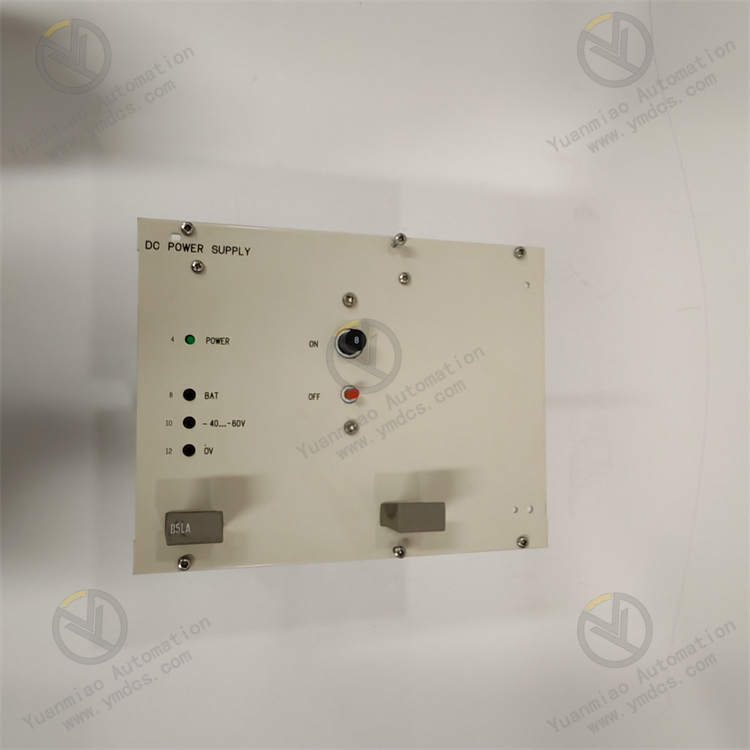
Product Description ABB B5LA (HENF327886R0001) is a high-power industrial isolated switching power supply module designed for ABB Symphony, REG216 power plant automatic control systems, industrial DCS and large-scale automation equipment. Adopting high-efficiency isolated switching power supply architecture, it is developed for harsh industrial conditions in power, chemical and heavy industries. It features wide-range AC input, high voltage regulation accuracy, strong load capacity and excellent anti-interference performance. It mainly supplies stable 24 V DC operating power to rack main control cards, I/O modules, field monitoring loops and communication units.
The module delivers a rated output power of 1440 W and a maximum output current of 60 A, supporting wide-range AC input to adapt to industrial grid voltage fluctuations. It integrates multiple protection mechanisms including overvoltage, overcurrent, overload, overtemperature and short-circuit protection. With full-process voltage stabilization and filtering, it generates ultra-low output ripple, effectively avoiding equipment power failure, card reset and data disorder caused by grid fluctuation and surge impact. Featuring compact and lightweight construction, it enables convenient installation and easy maintenance, supporting 24/7 long-term continuous operation. It serves as the core supporting hardware for stable power supply of power plant automatic control systems and industrial automation control equipment. Only genuine identical models can be used for non-destructive on-site replacement to guarantee power continuity and stable operation of the whole control system.
2. Core Functions
Wide-range AC input voltage stabilization. Supports 85 V ~ 264 V AC universal mains input, adapting to industrial grid conditions including voltage fluctuation, voltage drop and transient disturbance. It maintains constant output voltage under significant input voltage variation to provide stable power for downstream equipment.
High-power stable output. Rated output 24 V DC, maximum output current 60 A, rated power 1440 W with strong load capacity. It meets the demand of simultaneous high-load power supply for multiple cards and multiple loops in the whole system, applicable to large racks with high-density module layout.
Multiple electrical safety protections. Built-in output short-circuit protection, overload protection, overcurrent protection, overvoltage protection and overtemperature protection. It automatically limits current or latches off upon faults to prevent burnout of downstream equipment and breakdown of the power module, improving overall system safety.
High-precision low-ripple output. Equipped with multi-stage filtering, voltage regulation and shaping circuits, it achieves high output voltage accuracy and minimal ripple interference. It effectively eliminates abnormal operation of main control cards, signal drift and intermittent communication failures induced by power noise, ensuring precise operation of the automatic control system.
Industrial-grade anti-interference capability. Excellent electromagnetic compatibility and surge resistance enable tolerance against severe on-site electromagnetic interference, voltage transients and lightning surges, suitable for harsh high-interference environments such as power plants, chemical plants and heavy industry sites.
Intelligent operating condition self-diagnosis and status indication. Real-time monitoring of input voltage, output load, module temperature and running status. Protection is triggered automatically and fault status latched under abnormal conditions. Status LED indicators intuitively display operation and fault information to facilitate rapid on-site troubleshooting and maintenance.
- Long-term stable uninterrupted operation. Low-loss power architecture and high-efficiency thermal design reduce heat generation and power loss. It supports all-day continuous operation with low failure rate and long service life, matching the non-stop production and maintenance mode of industrial facilities.
3. Technical Features
Excellent wide-input voltage adaptability: Covers the global industrial mains range of 85 V–264 V AC without manual voltage adjustment. It automatically adapts to grid fluctuation, voltage drop and transient interference for complex industrial power supply environments.
High-power and heavy-load performance: 1440 W rated power and 60 A high-current output provide sufficient load margin to supply power simultaneously for high-density I/O racks, multi-master redundant systems and multi-loop field equipment without voltage drop or insufficient power.
Comprehensive safety protection architecture: Integrates five types of protection: short-circuit, overload, overcurrent, overvoltage and overtemperature. Automatic fault latching prevents cascading failures and protects hardware of the entire DCS and protection system from the power supply source.
Low-ripple high-precision voltage regulation: Professional multi-stage filtering and voltage regulation circuits deliver superior output linearity and strong ripple suppression, avoiding card misjudgment, signal jitter and intermittent system faults caused by power interference.
Stable architecture with efficient heat dissipation: Modular open heat dissipation structure combined with low-loss circuit design results in low temperature rise during operation and high heat dissipation efficiency. Stable output is maintained under high-temperature conditions without power derating or false protection triggering.
- Compact and maintenance-friendly design: Lightweight compact housing with regular structure for easy mounting and fixing on standard cabinets. Simple non-destructive in-situ replacement significantly shortens equipment downtime and maintenance costs.
4. Specification Parameters
| Item | Parameter |
|---|---|
| Model | B5LA |
| Material Code | HENF327886R0001 |
| Product Series | ABB Industrial DCS / Power Plant Control System Power Supply Series |
| Product Type | High-Power Industrial Switching Voltage-Stabilized Power Supply Module |
| Input Voltage Range | 85 V~264 V AC (Wide-range adaptive) |
| Maximum Input Current | 10 A |
| Output Voltage | 24 V DC (Voltage adjustable) |
| Maximum Output Current | 60 A |
| Rated Output Power | 1440 W |
| Protection Mechanisms | Short-circuit protection, overload protection, overcurrent protection, overvoltage protection, overtemperature protection |
| Cooling Method | Natural convection cooling |
| Operating Temperature | -20℃~+60℃ |
| Storage Temperature | -40℃~+80℃ |
| Ambient Humidity | 5%~95%RH (Non-Condensing) |
| Overall Dimensions | 230 mm × 127 mm × 61 mm |
| Weight | 3.2 kg |
| Core Characteristics | Wide voltage input, high-power high-current output, low-ripple voltage stabilization, multiple safety protections, strong anti-interference, 24/7 continuous operation |
| Compatible Systems | ABB Symphony Plus, REG216 unit protection system, industrial DCS control system, automation equipment racks |
| Typical Applications | Power supply for automatic control systems of thermal/hydraulic/new energy power plants, power supply for DCS racks in chemical and heavy industries, centralized power supply for large industrial automation equipment |
5. Working Principle
After AC mains is connected to the module, the front-end filtering and rectifier circuit first performs AC-DC preprocessing to filter grid noise, surges and high-frequency interference and purify input power quality. High-frequency switching voltage regulation circuits then conduct voltage conversion and precise stabilization, converting widely fluctuated AC voltage into standard stabilized 24 V DC. The rear multi-stage filtering and shaping circuits optimize output waveform and reduce ripple, finally delivering high-quality regulated power to downstream main control cards, I/O modules, communication equipment and field control loops.
During normal operation, the module continuously collects data of input voltage, output current, load power and internal temperature. It dynamically adjusts switching duty cycle to adapt to grid fluctuation and load variation, ensuring constant output voltage and stable power, and preventing voltage drop and fluctuation induced by load switching and grid disturbance.
When faults such as downstream loop short circuit, overload, overcurrent, module overtemperature or output overvoltage occur, the corresponding protection mechanism is activated immediately. The module limits current, reduces voltage or latches off, locks fault status and feeds back fault information via indicators to avoid burnout of the power module and damage to downstream automatic control equipment. After fault elimination, the module can recover normal operation via automatic or manual reset, ensuring safe, stable and continuous power supply for the whole control system.
6. Common Faults and Troubleshooting
1. No module output, complete equipment power loss, indicators off
Causes: Loss of front AC input, loose or disconnected wiring; blown input fuse; damage to primary internal power circuit; permanent protection latch triggered by severe overload.
Solutions: Inspect front mains input and terminals, fasten loose wiring; detect and replace blown input fuse; troubleshoot downstream load short-circuit and overload faults; reset the module after abnormal load conditions are removed; replace the module if hardware circuit damage cannot be repaired.
2. Unstable output voltage, voltage fluctuation, severe load voltage drop
Causes: Excessive grid voltage fluctuation, poor contact of input wiring; overloaded downstream load with concentrated overload of multiple devices; aging voltage regulation circuit and failed filter capacitors; power derating caused by insufficient heat dissipation.
Solutions: Troubleshoot and optimize front power supply wiring to stabilize input mains; verify total downstream load and split overloaded loads; clean dust on the module to ensure ventilation and heat dissipation; replace original module directly if hardware aging leads to failure.
3. Frequent overcurrent/overload protection, repeated equipment restart
Causes: Latent short circuit or leakage in downstream loops; excessive single-channel load and superimposed overload across multiple loops; drift of module protection parameters and excessive sensitivity; false protection triggered by on-site electromagnetic interference.
Solutions: Check downstream power supply loops section by section to eliminate short-circuit and leakage risks; distribute load reasonably to avoid operation above rated power; optimize cabinet grounding and shielding to suppress electromagnetic interference; replace the module if protection function fails abnormally.
4. Module overtemperature alarm, shutdown due to overtemperature protection, severely hot housing
Causes: Poor cabinet ventilation, dust accumulation blocking heat dissipation channels; excessive temperature rise from long-term full-load operation; aging heat dissipation structure with reduced efficiency; ambient temperature exceeding rated operating range.
Solutions: Clean dust on the module and inside cabinet to unblock heat dissipation channels; improve cabinet ventilation and reduce ambient temperature; avoid long-term overload operation; replace the module if heat dissipation fails and overtemperature protection activates repeatedly.
5. High output ripple, downstream card signal drift, intermittent communication
Causes: Aging internal filter circuits and failed capacitors; poor grounding and electromagnetic interference coupled into power supply loops; interference introduced by excessively long and disorderly output wiring.
Solutions: Optimize cabinet grounding and cable routing, keep wiring away from high-power interference equipment; organize output power cables to reduce line interference; replace original module directly if filter circuit aging cannot be repaired.
6. Unable to carry load and abnormal power supply after module replacement
Causes: Mismatched parameters of new module and on-site load; reversed positive/negative terminals or misconnected input/output wiring; latent downstream faults not fully eliminated.
Solutions: Strictly verify input/output wiring definition and correct miswiring; thoroughly troubleshoot downstream load faults and loop hazards; re-energize and commission after confirming operating condition matching. Check model compatibility if abnormalities persist.