Description
1. Product Overview
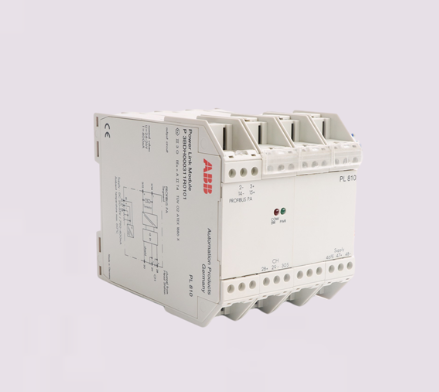
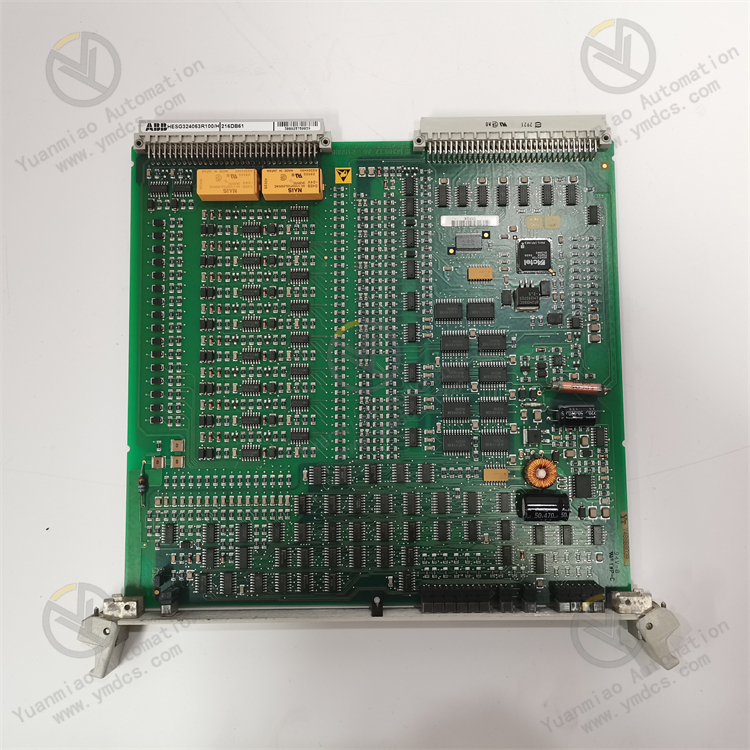
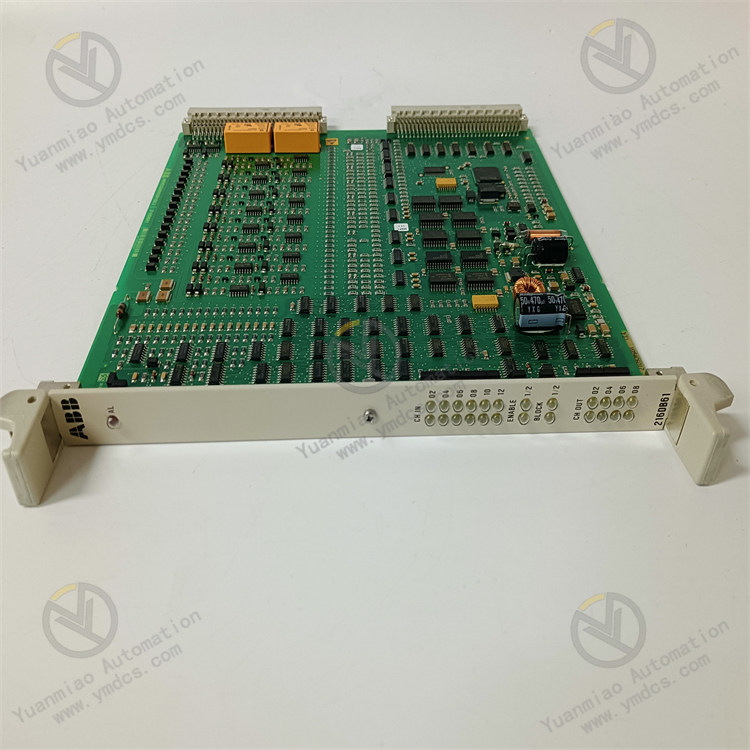
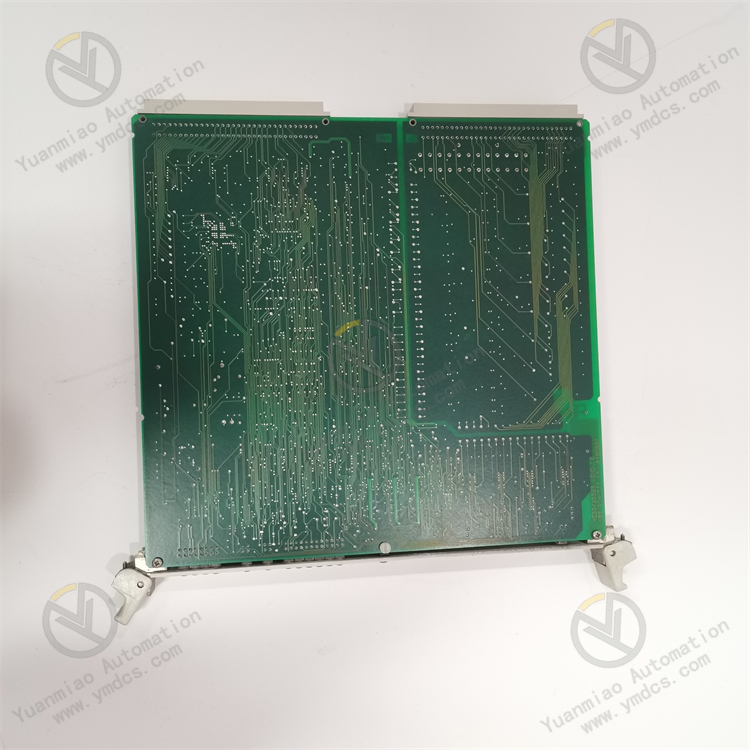
Full Model: 216DB61 Part Number: HESG324063R100/H
Manufacturer: ABB
Product Name: Digital Input/Output Protection Control Module / Unit Interlock IO Card
Product Description ABB 216DB61 (HESG324063R100/H) is a high-reliability digital IO control module dedicated to ABB industrial power control systems. It is applicable to auxiliary equipment protection, unit protection and industrial automation interlock control systems, serving as core hardware for interlock control, signal acquisition and loop driving of critical equipment in power, petrochemical and metallurgical industries. Integrated with multi-channel digital input, relay trip output and industrial communication functions, the module realizes field discrete signal acquisition, logical judgment, interlock action output, equipment status feedback and data interaction with host systems.
Compatible with redundant architecture, the module features excellent environmental adaptability and operational stability for long-term operation under industrial conditions with high temperature and strong electromagnetic interference. Equipped with hardware-level self-diagnosis, overcurrent & overvoltage protection and contact anti-misoperation mechanism, it prevents false interlock or interlock refusal caused by single-point faults. Widely adopted for motor protection, unit start-stop interlock, process discrete signal monitoring, equipment fault alarm and trip protection, it is a standard IO control card with outstanding versatility and reliability for industrial automatic control and power protection systems. Only original identical replacement is allowed; ordinary general IO modules cannot be used as substitutes.
2. Core Functions
Multi-channel discrete signal acquisition to accurately receive passive/active switching signals from field pushbuttons, limit switches, relay status and equipment feedback, enabling real-time monitoring of equipment operating status.
Equipped with 6 independent trip relay outputs adopting series dual-pole contact design, which can directly drive interlock circuits, trip circuits and alarm circuits to execute equipment shutdown, fault protection and process interlock actions.
Embedded industrial-grade logic processing engine. It cooperates with system configuration to realize control functions including start-stop logic, fault interlock, time-delay protection and status interlock, meeting the requirements of complex process interlock control.
Multi-protocol industrial communication capability supporting B448C parallel bus, Modbus TCP, PROFINET and PROFIBUS. It seamlessly connects with PLC, DCS and protection hosts to support remote data upload, parameter configuration and status monitoring.
Full-range hardware self-diagnosis function that continuously monitors circuit short-circuit, open circuit, contact abnormality, power supply failure and communication anomaly, accurately locates fault points and uploads alarms to facilitate maintenance troubleshooting.
Designed for redundant power supply, fitted with 2A fast fuse for overload protection to effectively resist voltage fluctuation and surge impact and ensure safe operation of the module and loop equipment.
- High-speed signal processing with maximum 1kHz switching response frequency to rapidly capture transient fault signals, suitable for unit protection and interlock control scenarios requiring high precision and fast response.
3. Technical Features
High-reliability relay output architecture: 6 independent trip relays with series dual-pole contacts avoid contact adhesion and misoperation. Interlock outputs are highly secure for high-risk power protection applications.
Industrial design with strong anti-interference performance: Built-in electromagnetic filtering, surge suppression and overcurrent/overvoltage protection effectively suppress electromagnetic interference from inverters and high-power equipment, adapting to harsh complex industrial environments.
High-speed signal response: Supports 1kHz high-frequency switching response with extremely low latency for signal acquisition and output actuation, enabling accurate capture of transient fault signals and ensuring timely unit protection actions.
Broad multi-protocol compatibility and expandability: Compatible with mainstream industrial bus protocols, supporting all ABB control systems and third-party mainstream automation equipment for convenient system integration and flexible expansion.
Redundant safety protection mechanism: Redundant power supply plus independent fuse protection prevents module damage and system failures triggered by abnormal power supply and circuit overload, offering high operational fault tolerance.
- Non-destructive replacement with minimal commissioning: Standard hardware configuration and universal pin definition. No modification to interlock logic is required after replacement; commissioning can be completed merely by synchronizing basic parameters, improving maintenance efficiency and cutting downtime costs.
4. Specification Parameters
| Item | Parameter |
|---|---|
| Model No. | 216DB61 |
| Part Number | HESG324063R100/H |
| Product Series | ABB Power Protection & Industrial Automation IO Module Series |
| Product Type | Digital Input/Output Interlock Protection Control Module |
| Relay Output | 6 integrated trip relays, series dual-pole contacts |
| Single Channel Output Rating | 0.5A per channel; maximum total output 8A |
| Switching Response Frequency | Up to 1kHz |
| Power Supply Protection | Redundant power supply design with built-in 2A fast fuse |
| Communication Protocols | B448C Parallel Bus, Modbus TCP, PROFINET, PROFIBUS |
| Operating Temperature | -40℃~+70℃ |
| Ambient Humidity | 5%~95%RH (Non-Condensing) |
| Core Characteristics | High-speed signal acquisition, relay interlock output, full-link self-diagnosis, multiple overload protection, multi-protocol communication |
| Operating Characteristics | Electromagnetic interference resistance, low failure rate, prevention of contact misoperation, 24/7 continuous operation |
| Mounting Method | Standard rack/rail fixed mounting, supports in-situ replacement |
| Typical Applications | Auxiliary equipment protection in power plants, motor interlock control, process discrete signal monitoring, equipment fault trip protection, industrial automation systems |
5. Working Principle
After power-on, the module automatically completes hardware self-test, communication initialization, circuit inspection and parameter loading. It verifies power supply circuits, relay contacts, signal channels and bus communication status, and enters normal operating mode once no abnormality is confirmed.
During operation, the module continuously collects field discrete signals. After filtering, debouncing and signal shaping, standardized digital signals are transmitted to the main control system. Meanwhile, it receives interlock, trip and control commands issued by the system, verifies command validity via embedded logic algorithms, and drives 6 independent relay contacts to perform switching actions for equipment start/stop, fault trip and process interlock protection.
Hardware self-diagnosis and protection mechanisms run continuously on the module to monitor channel status, contact condition, supply voltage and communication links in real time. Once circuit short-circuit, open circuit, contact failure, communication interruption, overload or other anomalies are detected, the faulty channel will be locked immediately, alarms uploaded and exception protection executed to avoid equipment misoperation or operation refusal. Equipment status, fault codes and operation data are transmitted in real time through industrial buses to achieve monitorable system status and traceable faults, guaranteeing stable and reliable operation of the whole automatic control and protection system.
6. Common Faults and Solutions
1. Abnormal discrete signal acquisition, frozen status or signal fluctuation
Causes: Loose field wiring, oxidized terminals; severe interference on signal circuits; abnormal channel filtering parameters; aging input channels with reduced sensitivity.
Solutions: Tighten terminals and remove oxide layers; optimize cable shielding and grounding to mitigate electromagnetic interference; check and adjust channel filtering parameters; replace the module if persistent single-channel faults cannot be repaired.
2. No relay output, interlock failure, invalid trip commands
Causes: Overloaded output circuit and blown fuse; aged, adhered or burnt relay contacts; incorrect output wiring and open circuit; corrupted system interlock configuration parameters.
Solutions: Inspect and replace blown fuses; test continuity of relay contacts and repair or isolate faulty channels; verify output wiring and troubleshoot open circuits; sort out interlock configuration and command parameters, then re-download configuration.
3. Frequent module misoperation and unexpected interlock trip
Causes: False signal triggering caused by field interference; deteriorated contact insulation and micro-short circuit; improperly configured signal debounce and delay parameters; logic misjudgment due to module hardware failure.
Solutions: Strengthen cable shielding and cabinet grounding to suppress field interference; test contact insulation and eliminate micro-short circuit risks; optimize signal debounce and interlock delay parameters; replace original module if hardware logic faults cannot be fixed.
4. Communication interruption, unrecognized module and no data upload
Causes: Damaged communication cables or loose connectors; inconsistent bus address, baud rate and protocol parameters; faulty communication port; abnormal module communication firmware.
Solutions: Inspect and replace communication cables, tighten connectors; verify and unify system communication parameters and device addresses; restart the module to reinitialize communication; replace the module if communication port or underlying firmware failure occurs.
5. Alarm upon power-up, self-test failure and failure to operate normally
Causes: Unstable power supply voltage, overload or undervoltage; dust accumulation and moisture leading to circuit short circuit; aging and damage of internal chips and circuits; abnormal parameters or firmware.
Solutions: Stabilize supply voltage and troubleshoot overload; clean dust and moisture on the module and dry damp circuits; restore factory settings and re-flash compatible firmware; directly replace the module if hardware damage leads to unrecoverable self-test failure.
6. System incompatibility and abnormal functions after module replacement
Causes: Mismatched firmware versions between old and new modules; unsynchronized bus parameters and device addresses; system hardware configuration not updated.
Solutions: Flash firmware version compatible with the system; unify module bus address, communication protocol and configuration parameters; refresh system hardware configuration and restart equipment for initialization before normal commissioning.