

Description
1. Product Overview
HIMA F8652E (Order‑No. 984865264) is the System Processor for the HIMax safety controller series, serving as the core computation and scheduling unit of the HIMax Safety Instrumented System (SIS). Developed by HIMA for safety‑critical interlock applications in process industries including oil‑gas, petrochemical, chemical, nuclear power, thermal power and long‑distance pipeline sectors, the HIMax platform undertakes safety logic execution, I/O data management, redundant communication scheduling, system self‑diagnosis and backplane bus control, acting as the “brain” of the complete HIMax safety system.
Adopting HIMA proprietary quadruplex 2oo4D redundant architecture, the F8652E integrates four independent processor channels within one single module, implementing safety‑function fault tolerance via hardware‑based voting mechanism. Certified for SIL 3 (IEC 61508), it maintains safe operation upon single‑channel or dual‑channel failures. When failures reach the hazardous failure threshold, the system automatically transfers to predefined fail‑safe state to prevent personal injury, severe equipment damage and unplanned plant shutdown. Seamlessly integrated with HIMax rack backplane, power supply units, digital/analogue I/O modules and communication modules (e.g. F8621, F8622, F8623, F8627, F8623X) through the dedicated backplane bus, the F8652E enables large‑scale distributed safety interlock networks.
2. Functional Features
2.1 Quadruplex 2oo4D Redundancy Architecture with SIL 3 Safety Integrity
The F8652E contains four fully independent micro‑processor channels, each equipped with dedicated CPU, memory, clock circuit, power supervision and bus interface. All four channels execute the identical safety application program in parallel. Key intermediate variables and output status are judged by dedicated hardware ASIC following the 2oo4D (2‑out‑of‑4 diagnostic voting) principle: results agreed by at least two channels are adopted as valid system outputs, while random faults in single channels are automatically masked by hardware. TÜV‑certified for SIL 3 compliance with IEC 61508, the architecture achieves both high availability (non‑stop operation) and high safety (fail‑safe), making it a benchmark CPU solution for SIS in large‑scale critical plants.
2.2 Hardware‑based Voting and Fault Tolerance with Bumpless On‑line Switch‑over
Four processor channels perform cyclic cross‑data comparison via high‑speed internal bus. Voting logic is implemented by independent hardware ASIC instead of operating systems or user application software. When self‑diagnosis detects anomalies, data deviation or hardware defects within one channel, the faulty channel is isolated in real‑time, and the remaining three channels continue 2oo4D voting. Upon dual‑channel faults, the system degrades to 2oo3 or 1oo2D mode for continuous safe operation. Once faults threaten safety functions, outputs transfer to predefined fail‑safe state. The whole procedure of fault detection, isolation and degradation is fully transparent to field actuators, without output glitch or system shutdown, ensuring continuous availability of safety functions.
2.3 High‑performance Safety Calculation for Large‑scale SIS Applications
Equipped with high‑performance 32‑bit industrial RISC processors for four‑channel parallel processing, the F8652E supports large‑size safety application programs. It complies with all five IEC 61131‑3 programming languages (LD, FBD, ST, IL, SFC). Built‑in large‑capacity user program memory and process data memory support complex interlock logics including cause‑effect matrix, sequence judgment, analogue comparison, pulse counting, equipment state machine and batch interlock. Configurable millisecond‑level scan cycle fulfils requirements for fast ESD trip, turbine overspeed protection, gas turbine emergency shutdown and rapid F&G linkage.
2.4 Full‑channel On‑line Self‑diagnosis with Precise Channel‑level Fault Localization
Multi‑layer self‑diagnosis covers CPU registers, memory bit‑flip, clock synchronization, supply voltage, backplane bus CRC, voting link parity error and I/O communication error. Power‑on self‑test runs concurrently with cyclic runtime diagnosis. High diagnostic coverage (DC) enables fault localization down to specific channels, function blocks and fault codes. Fault information is presented via front‑panel LEDs, local diagnostic port and HIMatrix engineering workstation, allowing maintenance staff to identify defects without interrupting system operation and effectively reduce Mean Time To Repair (MTTR).
2.5 Native HIMax Backplane Bus for Flexible Multi‑rack Expansion
Designed for HIMax rack backplane bus, the F8652E supports plug‑and‑play interoperability with series power supplies, digital/analogue I/O and communication modules. Single rack follows standard slot configuration; multi‑rack systems built upon redundant expansion bus support large‑scale distributed SIS networks up to tens of thousands of safety I/O points. Supported communication protocols include Modbus TCP, Ethernet/IP, PROFIBUS DP, OPC and IEC 61850 for bidirectional safety‑data exchange and status monitoring with upper‑level DCS, SCADA and engineering stations.
2.6 Hot‑swap Capability for On‑line Maintenance and Spare‑part Replacement
The F8652E supports hot‑swap operation with mechanical anti‑mis‑insertion and locking structures. Faulty processor modules can be extracted and replaced during normal system runtime. After insertion, the new module automatically loads application program, completes four‑channel synchronization and relocks voting logic without disturbing safety interlocks or field control loops. This feature is critical for petrochemical plants, offshore platforms, long‑distance pipelines and nuclear‑related facilities where unplanned shutdown must be avoided, minimizing production impact during maintenance windows.
3. Technical Specifications
3.1 Core Adaptation Parameters
| Item | Specification |
|---|---|
| Model | F8652E |
| Order No. | 984865264 |
| Brand | HIMA (HIMA Paul Hildebrandt GmbH, Germany) |
| Series | HIMax Safety‑related Control System |
| Type | System Processor Module (CPU) |
| Safety Level | IEC 61508 SIL 3 (TÜV Rheinland certified), compliant with IEC 61511 for process‑industry SIS |
| Redundancy Architecture | Quadruplex 2oo4D (Four‑channel redundant with hardware voting) |
| Compatible System | HIMax rack‑mount safety controller; compatible with F86xx‑series I/O, communication and power modules |
| Typical Applications | Refining & chemical SIS/ESD, offshore‑platform safety interlock, long‑distance pipeline ESD, gas‑/steam‑turbine ETS, Fire & Gas (F&G) system, nuclear‑related protection loops |
| Core Functions | Four‑channel parallel safety‑logic execution, hardware 2oo4D voting, I/O data management, backplane‑bus scheduling, on‑line self‑diagnosis, faulty‑channel isolation, redundant communication, SOE event logging |
3.2 Hardware Architecture & Electrical Parameters
- Processor: High‑performance 32‑bit industrial RISC, four fully independent parallel channels
- Memory: Large‑capacity Flash/RAM for IEC 61131‑3 application, non‑volatile data retention upon power loss
- Scan Cycle: Configurable down to millisecond level for fast trip and dynamic interlock
- Power Supply: Powered by redundant HIMax rack backplane (typical 24 V DC), independent voltage supervision for each of four channels
- Voting Link: Dedicated high‑speed serial voting bus, hardware cross‑comparison with microsecond‑range latency
- Backplane Interface: HIMax dedicated backplane connector with gold‑plated contacts for redundant reliable connection
- Front‑panel Indicators: LED indicators for power, run, fault, channel status, voting status, bus status and maintenance mode
- Service Interface: Local diagnostic port for HIMatrix engineering software to read diagnostic words and SOE logs
3.3 Functional‑safety & Reliability Parameters
- Safety Integrity Level: SIL 3 per IEC 61508, applicable for high‑demand / continuous‑demand mode
- Fault Tolerance: Single‑channel arbitrary faults do not impair safety functions; multi‑channel faults trigger graded degradation and fail‑safe transition
- Diagnostic Coverage: High DC covering CPU, memory, clock, power supply, voting links and backplane bus
- Reliability Metrics: High MTBF, low Probability of Dangerous Failure per Hour (PFH), suitable for long‑term plant operation
- Fault Response: Fault detection and channel isolation within micro‑to‑millisecond range; bumpless system degradation without safety‑output glitch
- Programming Standard: IEC 61131‑3 (LD/FBD/ST/IL/SFC), configured via HIMatrix engineering tool
3.4 Environmental & Physical Parameters
- Operating Temperature: Industrial wide temperature range for enclosed cabinet installation
- Storage Temperature: Meets extreme temperature requirements for transportation and warehousing
- Humidity: 5 %‑95 % RH, non‑condensing, tolerates high‑humidity and dusty cabinet environment
- Vibration & Shock: Complies with IEC 60068 industrial vibration and shock standards, anti‑loosening design
- EMC: IEC 61326 industrial EMC certification, robust against heavy on‑site electromagnetic interference
- Mounting: Hot‑pluggable slot‑mount inside HIMax standard rack; mechanical locking and anti‑mis‑insertion feature
- Module Replacement: Supports hot‑swap; replacement does not interrupt safety‑related functions
4. Hardware Configuration & Structural Advantages
4.1 Core Hardware Configuration
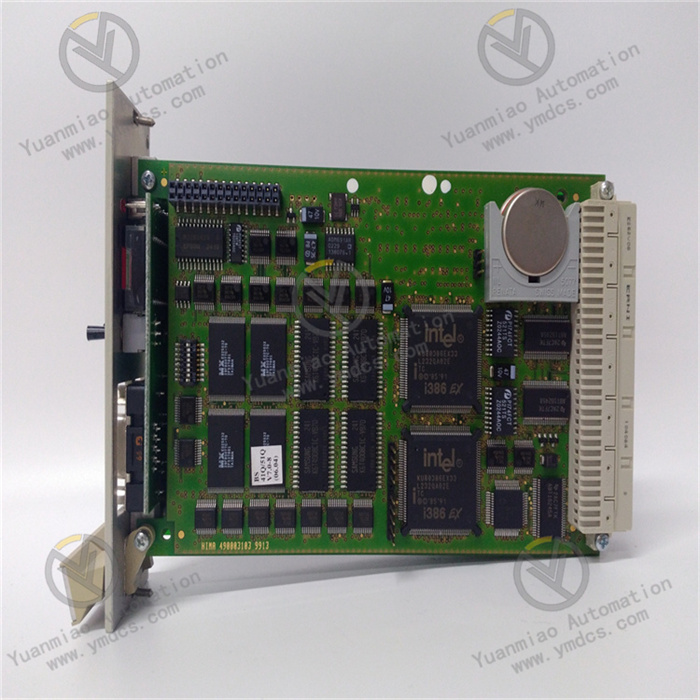
Within one modular unit, the F8652E integrates four fully independent processor subsystems. Each channel consists of dedicated 32‑bit RISC CPU, RAM, Flash memory, clock oscillator, voltage‑monitoring and power‑conditioning circuits and backplane‑bus transceiver. Galvanic isolation and dedicated hardware voting ASIC interconnect four channels with no single‑point shared components. In each scan cycle, the voting ASIC performs bit‑wise comparison for input data, intermediate calculation results and output states; data inconsistent with majority result is automatically suppressed and the faulty channel is flagged and isolated.
Multiple groups of front‑panel LEDs indicate power, run, fault and synchronization status for four individual channels as well as system‑level communication and maintenance mode. The service interface exchanges diagnostic words, SOE sequence‑of‑events logs and channel health information with HIMatrix engineering software. The rear HIMax‑specific rack connector adopts gold‑plated contacts for reliable corrosion‑resistant connection. Equipped with industrial flame‑retardant PCB and metal shielding enclosure, internal circuits are mechanically reinforced to withstand cabinet‑level vibration, thermal cycling and electromagnetic interference.
4.2 Structural and Redundancy Advantages
The 2oo4D quadruplex architecture simultaneously achieves fault tolerance and fail‑safe objectives at hardware layer. Random single‑channel hardware faults are masked by hardware voting while the system continues operation in 2‑out‑of‑4 or degraded mode without any impact on field actuators. When multi‑channel faults endanger safety functions, outputs transfer to predefined fail‑safe state (normally trip / de‑energize). Compared with conventional dual‑redundant PLC solutions relying on software voting, HIMA hardware‑based voting is independent of operating systems and application logic, delivering faster response, more thorough fault detection and higher diagnostic coverage, making it a high‑reliability CPU choice for large‑scale SIL 3 SIS systems.
Uniform mechanical dimensions are shared with other F86xx‑series I/O, communication and power modules of HIMax, simplifying engineering configuration, spare‑parts management and field maintenance. Hot‑swap and on‑line partial application download allow spare‑part replacement and minor logic upgrade while the plant keeps running, which delivers irreplaceable engineering value for petrochemical complexes, offshore platforms, long‑distance pipelines and nuclear‑related sites where unplanned shutdown is prohibited.
5. Working Principle
The F8652E safety processor executes closed‑loop safety control following the workflow: four‑channel parallel data acquisition → 2oo4D hardware voting → parallel safety‑logic computation → output‑side voting → graded isolation of faulty channels + full‑time self‑diagnosis supervision.
During runtime, four independent processors acquire field input signals synchronously from backplane‑connected I/O modules. Each I/O module itself adopts redundant design; signals are voted on I/O side before transmitted over backplane bus to F8652E. Driven by synchronized clock signals, four CPUs execute identical user safety application programs in parallel. All input data, intermediate variables and output commands are cross‑compared cycle‑by‑cycle over dedicated hardware voting bus. If four sets of data agree, voting results are forwarded to output modules as defined by user application. When one channel deviates from others, hardware voting circuitry automatically suppresses its outputs, adopts majority‑agreed valid values and marks the defective channel.
Identical 2oo4D voting is implemented on output side: four CPUs send commands to four separate output drive circuits respectively. Output‑side hardware voting rejects abnormal commands from individual channels; field actuators (solenoid valves, trip relays, ESD loops) operate only upon consistent majority commands. Upon multiple faults that compromise safety capability, outputs transfer to predefined fail‑safe state to execute safety trip.
Meanwhile, self‑diagnostic circuits continuously monitor CPU registers, memory integrity, clock synchronization, supply voltage, voting‑link CRC and backplane‑bus communication errors. Detected faults trigger real‑time channel isolation with LED and upper‑station alarms. Maintenance personnel may hot‑swap the defective processor module under running conditions. The replacement unit automatically synchronizes with remaining channels and restores full 2oo4D voting without disturbing safety interlock functions.
6. Troubleshooting
6.1 Front‑panel Fault LED ON or individual channel fault indicator activated
| Probable Cause | Inspection Method | Solution |
|---|---|---|
| Self‑diagnostic fault of CPU / memory / clock within single channel | Read diagnostic words and fault codes via HIMatrix engineering software to locate defective channel | Faulty channel has been isolated automatically by system. Perform hot‑swap with spare F8652E; wait until four‑channel synchronization completes after replacement. |
| Poor backplane‑connector contact or gold‑finger oxidation | Observe whether fault disappears upon gentle module re‑seating; inspect physical condition of slot and connector | Extract module, clean gold‑fingers and re‑insert with proper locking; test in alternative slot if necessary. |
| Rack power‑supply anomaly causing out‑of‑range voltage in certain channel | Check output voltage and alarm status of redundant rack power‑supply units | Rectify power‑supply defects; replace faulty power module if needed. Module will re‑synchronize after power recovery. |
| Mismatched program CRC / version across four channels after program download | Compare program CRC and version number of four channels via engineering workstation | Redownload application program to enforce four‑channel synchronization; system stays in safe state during download. |
6.2 Multi‑channel desynchronization or voting‑link alarm
| Probable Cause | Inspection Method | Solution |
|---|---|---|
| Newly replaced processor module not finished synchronization yet | Observe Sync LED; normal status turns ON within several seconds | Wait for automatic synchronization. If desynchronization persists, re‑seat module or verify firmware revision. |
| Inconsistent firmware revisions among four channels | Read firmware version of each channel from engineering station | Upgrade all channels to identical firmware version following manufacturer sequential upgrade procedure. |
| Backplane‑bus communication errors (CRC / parity error) | Check backplane‑bus error counters and status of adjacent modules | Inspect rack grounding and shielding; clean backplane connectors; replace rack backplane if required. |
6.3 Engineering workstation or DCS fails to communicate with F8652E
| Probable Cause | Inspection Method | Solution |
|---|---|---|
| Defective communication module (F8621/F8622/F8623/F8627) or loose copper/fiber cables | Check LED status of communication modules and physical link connections | Re‑tighten cables or replace faulty communication module. F8652E keeps running without shutdown. |
| Incorrect or conflicting IP / communication configuration | Scan network from engineering workstation and cross‑check against configuration documents | Rectify configuration parameters, eliminate IP conflict and re‑download communication settings. |
| Single link interruption within redundant communication paths | Check status of primary and standby links; HIMax shall switch automatically to standby channel | System maintains communication. Repair primary‑link copper/fiber during maintenance window. |
6.4 Output circuit fails to act or triggers unwanted action
| Probable Cause | Inspection Method | Solution |
|---|---|---|
| Drift of field input signals causing boundary jitter in 2oo4D voting | Check raw four‑channel values of related AI/DI points via engineering‑station trend view | Calibrate field sensors and loop wiring; adjust filter and delay parameters. |
| Single‑channel defect of corresponding output I/O module | Inspect LED indicators and diagnostic information of output I/O modules; F8652E itself may remain fault‑free | Locate and hot‑swap faulty output I/O module. F8652E continues normal voting operation. |
| Logic configuration error or unauthorized program download | Compare running logic with validated baseline version; review SOE event logs | Restore previous validated safety program version; re‑release application following Management Of Change (MOC) procedures. |